理想汽车

Search documents
中概股走势分化,腾讯音乐领涨超4%
Jin Rong Jie· 2026-02-13 23:32
Group 1 - The Livermore Chinese Concept Stock Index closed down 0.27% at 10,125.69 points on February 14, with mixed performance among constituent stocks [1] - Tencent Music led the gains, rising over 4%, followed by Yum China with an increase of more than 3%. In contrast, New Oriental and Alibaba both fell over 2%, while Li Auto, JD.com, and iQIYI saw declines of more than 1% [1] - The Nasdaq China Golden Dragon Index (HXC) also experienced a slight decline of 0.1% on the same day [1] Group 2 - Notable movements included Pinduoduo with a minor increase of 0.06%, NetEase rising 2.06%, XPeng up 1.38%, and Bilibili gaining 1.02%. Conversely, Baidu fell by 0.99%, Beike dropped 1.07%, and Huazhu Group decreased by 1.48% [1] - The Livermore Chinese Concept Stock Index had previously experienced a significant decline of 2.64% in the prior trading session, closing at 10,152.05 points. The drop on February 14 was less severe, indicating a shift from a broad decline to a more mixed performance among individual stocks [1]
国际金银大涨,现货白银一度涨超5%!热门科技股多数下跌,苹果跌超2%,英伟达市值蒸发超6900亿元
Mei Ri Jing Ji Xin Wen· 2026-02-13 23:25
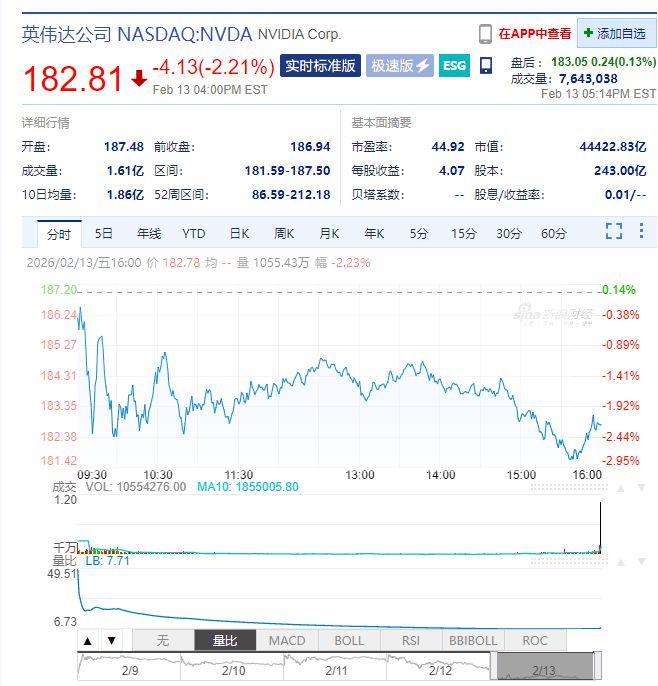
当地时间2月13日,美股三大指数收盘涨跌不一 。道指涨0.1%,纳指跌0.22%,标普500指数涨0.05%。 热门科技股多数下跌,英伟达、苹果跌超2%。英伟达市值一夜蒸发1004亿美元(约合人民币6936亿 元)。 谷歌、Meta、博通跌超1%。板块方面,加密货币概念、贵金属涨幅居前,Coinbase涨超16%,科尔黛伦 矿业涨超7%,泛美白银涨超6%,HUT8涨超5%,皇家黄金、金田涨超4%。博彩、邮轮板块跌幅居前, 挪威邮轮跌超7%,佩恩国民博彩跌超5%,嘉年华邮轮跌超2%。 利弗莫尔中概股龙头指数收跌0.27%,报10125.69点。成分股中,腾讯音乐涨超4%,百胜中国涨超3%; 新东方、阿里巴巴跌超2%,理想汽车、京东、爱奇艺跌超1%。 富时A50期指连续夜盘收涨0.27%,报14722点。 中东局势升温,或受地缘政治紧张局势影响,黄金、白银价格周五2月13日大幅拉升。COMEX黄金期 货收涨2.33%,报5063.8美元/盎司;COMEX白银期货收涨2.1%,报77.27美元/盎司。现货白银一度涨超 5%。 据央视新闻,当地时间2月13日,美国总统特朗普证实,美军将向中东地区派出第二个航空母舰打击 ...


深夜黄金突破5040美元,美股黄金股爆发,芯片股反弹,特朗普证实美军第二艘航母将派往中东
21世纪经济报道· 2026-02-13 23:23
Market Performance - On February 13, the three major U.S. stock indices closed mixed, with the Dow Jones up 0.1%, S&P 500 up 0.05%, and Nasdaq down 0.22% [1] - For the week, the Dow Jones fell 1.23%, S&P 500 dropped 1.39%, and Nasdaq decreased by 2.1% [1] Index and Stock Movements - The Dow Jones Industrial Average closed at 49,500.93, with a gain of 48.95 points [2] - The Nasdaq Composite Index closed at 22,546.67, down 50.48 points [2] - The S&P 500 Index closed at 6,836.17, up 3.41 points [2] - Major tech stocks mostly declined, with Apple and Nvidia down over 2%, while Facebook and Google fell over 1% [2] - Semiconductor stocks saw a majority increase, with the Philadelphia Semiconductor Index rising 0.66% [2] Gold and Precious Metals - Gold stocks performed strongly, with notable increases such as Coeur Mining up over 7% and Harmony Gold up over 6% [2] - Spot gold rose 2.4%, surpassing $5,040 per ounce, while spot silver increased by 2.8%, reaching $77.3 per ounce [3] Commodity Prices - WTI crude oil futures rose 0.08%, closing at $62.89 per barrel, while Brent crude oil futures increased by 0.34%, closing at $67.75 per barrel [4] Cryptocurrency Market - The cryptocurrency market saw a collective rebound, with Bitcoin rising over 4%, nearing $68,847 per coin [5] - Ethereum also increased by 6.93%, reaching $2,055.93 [5] Economic Indicators - The U.S. Consumer Price Index (CPI) for January showed a year-over-year increase of 2.4%, lower than the expected 2.5% [5] - The CPI's month-over-month increase was 0.2%, also below the anticipated 0.3%, indicating a significant cooling of inflation [5] - Following the CPI release, the probability of the Federal Reserve implementing a rate cut in June surged to 83% from 49.9% [5]

Rokid创始人祝铭明: 智能眼镜产业需构建软硬件生态
Zhong Guo Zheng Quan Bao· 2026-02-13 22:25
春节临近,智能眼镜成为当下流行的新年货。全球智能眼镜市场迎来爆发,在这场智能穿戴的产业变革 中,扎根杭州余杭的杭州灵伴科技有限公司(Rokid)成为中国智能眼镜企业中的亮眼代表。 Rokid创始人兼首席执行官祝铭明近日在接受中国证券报记者采访时表示,2025年公司AI+AR智能眼镜 产品乐奇AI眼镜(Rokid Glasses)收获30万台订单,同时公司旗下各类智能眼镜产品在文旅、工业应用 场景不断拓展市场份额。上游供应链产能的突破是智能眼镜产业破局的关键,同时软件生态的构建将决 定智能眼镜的使用体验和未来市场空间。 智能眼镜悄然流行 春节前夕,无论在线下商场还是线上电商平台,智能眼镜成为今年流行的新年货。市场研究机构IDC预 测,2026年中国智能眼镜市场出货量将突破491.5万台,正式迈入规模化增长新阶段。 2025年,一次杭州余杭区政府内部沟通会,让智能眼镜公司Rokid走入大众视野。祝铭明戴着Rokid Glasses样机脱稿演讲的视频广为传播,为企业带来关注度与销量增长。"关注度变高,最直观的变化是 产品销量快速增长,促使生产节奏加快。"祝铭明坐在Rokid位于余杭的展厅内,回忆过去一年企业发展 历 ...
通胀降温难抵AI忧虑,美股三大指数周线齐跌,中概股涨跌不一
Feng Huang Wang· 2026-02-13 22:20
Market Overview - The three major indices showed mixed performance, with the Dow Jones up 0.10% at 49,500.93 points, the S&P 500 up 0.05% at 6,836.17 points, and the Nasdaq down 0.22% at 22,546.67 points [2] - Concerns over AI disruption led to market volatility, affecting various sectors including software, real estate, trucking, and financial services [5] - Notable declines included Charles Schwab down 10.8%, Morgan Stanley down 4.9%, and software company Workday down 11% [5] Inflation Data - The U.S. Bureau of Labor Statistics reported a 2.4% year-over-year increase in January CPI, with a 0.2% month-over-month rise, both below market expectations [2] - Core CPI, excluding volatile food and energy prices, rose 2.5% year-over-year and 0.3% month-over-month, aligning with market expectations [2] Company News - SpaceX is reportedly considering a dual-class share structure for its upcoming IPO, allowing certain shareholders, including Elon Musk, to maintain control despite lower ownership stakes [6] - Anthropic appointed former General Motors executive Chris Liddell to its board as it prepares for a potential IPO in 2026, indicating openness to going public by the end of this year [9] - Following the merger with xAI, Musk's team is exploring financing options to reduce high-interest debt, which has accumulated to nearly $18 billion, in preparation for a potential IPO [10] - Moderna reported fourth-quarter revenue of $678 million, a 30% year-over-year decline, with a loss of $2.11 per share compared to a loss of $2.91 per share in the same period last year [11]
智能眼镜产业需构建软硬件生态
Zhong Guo Zheng Quan Bao· 2026-02-13 20:23
Core Insights - The smart glasses market is experiencing significant growth, with Rokid emerging as a leading player in China, particularly with its Rokid Glasses product expected to receive 300,000 orders by 2025 [1][2] Market Trends - Smart glasses have become a popular item for the upcoming Chinese New Year, with IDC predicting that the shipment volume in China will exceed 4.915 million units by 2026, marking a new phase of scaled growth [1] - The user demographic for smart glasses has expanded beyond tech professionals, now including business people, civil servants, media personnel, teachers, lawyers, and designers, with the proportion of tech workers as users dropping from 50% to about 16% [2] Application Expansion - The application scenarios for smart glasses are diversifying, with significant market share in the cultural tourism sector, where Rokid's AR glasses hold over 90% of the market [3] - Smart glasses are being utilized for various functions such as teleprompting, translation, and information retrieval, as well as in industrial, medical, and educational fields [3] Supply Chain Challenges - Rokid faced production capacity challenges due to a surge in demand, with actual orders for Rokid Glasses reaching 300,000, significantly higher than the anticipated 100,000, leading to delays in fulfilling 30-40% of orders until 2026 [3] - The company is addressing these challenges by collaborating with upstream suppliers to increase production capacity and ensure timely delivery [3] Competitive Landscape - The entry of major companies like Xiaomi, Alibaba, and Li Auto into the smart glasses market is expected to intensify competition, with players categorized into three types: simple audio glasses, non-display smart glasses, and full-featured smart glasses [4] - Rokid positions its products as full-featured smart glasses, emphasizing the importance of system integration, yield rates, production processes, supply chain management, and ecosystem development for future competitiveness [4] Software Ecosystem Development - Rokid is developing a software ecosystem to enhance the functionality of smart glasses, with over 20,000 developers and 4,000 companies already participating in its platform [4] - The company plans to upgrade its products in three phases: solidifying the tool attributes, integrating entertainment and social features, and ultimately expanding to full functionality over the next three to five years [4] Future Outlook - The company believes that smart glasses will not replace smartphones but will transform human-computer interaction, positioning itself as a core platform for interaction in the AI era [5] - With a large base of eyeglass wearers in China and a high acceptance rate for wearing glasses, the market for smart glasses is expected to grow, with Chinese manufacturers projected to account for 45% of global shipments by 2026 [5]
李想之外具体的人事变动始终都是次要矛盾
理想TOP2· 2026-02-13 16:02
Core Viewpoint - The article discusses the strategic shifts within Li Auto, particularly focusing on the leadership changes and the implications for its autonomous driving and AI initiatives. It emphasizes the importance of Li Xiang's judgment on the AI industry's development and the need for effective organization of talent to achieve the company's vision [1][2][5]. Group 1: Leadership Changes and Organizational Structure - Zhan Yifei will take full responsibility for the research and productization of the robotics business, while Lang Xianpeng will be leaving the company [1]. - The restructuring of Li Auto's autonomous driving departments from 3 to 11 is seen as a secondary issue, with the primary challenge being the alignment of production factors and Li Xiang's vision [2]. - The merger of the autonomous driving and smart cockpit departments reflects a shift in Li Xiang's approach, emphasizing integrated design over traditional software and hardware separation [2][3]. Group 2: Strategic Direction and Market Position - Li Auto's strategy is compared to Tesla's VA (Value Added) approach, suggesting that while both strategies have their merits, the VA route may carry less risk due to Tesla's pioneering efforts [3]. - The article notes that regardless of whether Li Auto adopts a VA or VLA (Value Learning Architecture) approach, both have their rationales, and the company may continue to evolve its viewpoints [3][4]. - The potential for Li Auto's autonomous driving technology to enhance user value is considered highly probable, with a clear direction towards improving data utilization and model performance [3]. Group 3: Talent Management and AI Development - The ability to effectively recruit and organize suitable talent is crucial for Li Auto's success, with over 50% of significant technological breakthroughs expected to come from new graduates [9]. - Li Xiang's learning ability and decision-making quality are highlighted as critical factors in determining the company's future success in the AI sector [5][9]. - The article emphasizes that the departure of older team members is less significant than Li Xiang's capability to harness the intellectual resources of new talent [9].

车贷“长跑”开启 汽车金融驶入共赢新赛道
Zheng Quan Ri Bao· 2026-02-13 15:43
Core Viewpoint - The automotive market is experiencing a shift in competitive dynamics as long-term financing options like "0 down payment" and "7-year ultra-low interest" loans become more prevalent, moving away from cash discounts [1][4]. Group 1: Long-term Financing Options - Companies such as Tesla, Xiaomi, and Li Auto have introduced 7-year low-interest car loan products to attract new customers with lower entry barriers [2][4]. - The extended repayment periods allow first-time buyers, particularly young families, to experience electric vehicles sooner, effectively lowering the cost of ownership [1][4]. - The introduction of these financing options is seen as a strategy to stimulate demand and alleviate financial pressure on consumers [4][5]. Group 2: Market Dynamics and Competition - The competition in the automotive market is intensifying, particularly in the electric vehicle sector, with projections indicating that by 2025, new energy vehicles will account for 47.9% of total new car sales in China [4]. - The long-term loan offerings serve as a differentiation strategy for automakers, enabling them to secure long-term customer relationships and create opportunities for additional services [4][5]. Group 3: Banking Sector Involvement - Banks are increasingly viewing high-quality auto loans as a key growth area, responding to government policies aimed at boosting consumer spending [5][6]. - Collaborations between banks and automakers on long-term low-interest products allow banks to access quality customer resources while mitigating risks through interest subsidies from car manufacturers [5][6]. - Financial institutions are encouraged to enhance their risk management capabilities and customer credit assessment systems to adapt to the long-term nature of these loans [5][6]. Group 4: Future Ecosystem Development - There is a potential shift from traditional lending to a comprehensive service model that encompasses the entire lifecycle of vehicle ownership, including financing, insurance, and maintenance [6][7]. - Banks are advised to establish data-sharing mechanisms with automakers to create integrated financial products that cater to various customer needs throughout the vehicle ownership experience [7]. - The goal is to transition from one-time transactions to long-term customer engagement, fostering a win-win ecosystem for banks, automakers, and consumers [7].
新能源汽车迎春运“大考”:力保充电、救援无忧
Zheng Quan Ri Bao· 2026-02-13 15:42
Group 1 - The demand for electric vehicle travel is surging as the Spring Festival approaches, leading to increased pressure on charging services and higher expectations for response speed and service quality [1] - Major electric vehicle brands, including NIO, Zeekr, and Li Auto, have committed to 24-hour roadside assistance during the holiday period [1] - By the end of 2025, 71,500 electric vehicle charging guns will be installed in highway service areas across the country, with 20,000 new installations planned for 2025, significantly enhancing charging service capabilities [1] Group 2 - In response to the peak travel demand during the Spring Festival, electric vehicle companies are accelerating the deployment of charging networks and upgrading service guarantees to alleviate range anxiety for drivers [2] - Li Auto has launched its 4,000th supercharging station, with a network of 22,173 supercharging guns covering 31 provinces and 289 cities, ensuring a supercharging station is available every 130 kilometers [2] - Xiaomi Auto has announced 24-hour free roadside assistance for all drivers from February 10 to March 3, 2026, enhancing customer service during the holiday [2] Group 3 - NIO has achieved 100 million battery swaps, with 8,627 battery swap stations established nationwide, significantly reducing charging time to just 3 minutes [3] - The Ministry of Transport has implemented a series of measures to enhance service capabilities, including creating a list of busy charging service areas and upgrading the "e-road smooth" app for real-time charging station status [3] - Various companies, including China Petroleum and Southern Power Grid, are actively supporting the charging infrastructure to ensure a smooth travel experience during the Spring Festival [3] Group 4 - Yunnan Transportation Investment Group has built "Yun Jiao Chang Chong" driver lounges in 57 key service areas, equipped with amenities to improve driver experience during the Spring Festival [4] - Emergency charging vehicles have been deployed at high-traffic locations to enhance service efficiency and customer experience [4] - A collaborative initiative has been launched to create an integrated charging network map for Yunnan Province, marking a new phase in charging service integration [5]

【重磅深度】2026年主流车企城市NOA试驾报告—2月上海篇
东吴汽车黄细里团队· 2026-02-13 15:40
Investment Highlights - The main contradiction in C-end automotive intelligence has shifted from coverage to experience optimization in 2026. Major intelligent driving manufacturers and solution providers have achieved urban NOA (Navigation on Autopilot) experiences in complex scenarios such as roundabouts and U-turns, and have improved advanced functions like parking and ETC passage. The primary optimization direction moving forward will be the handling capability of Corner Cases to enhance the driving experience for passengers and safety operators [2][7]. Road Testing Overview - This report conducted both large-sample concentrated road tests and small-sample in-depth road tests. It qualitatively and quantitatively evaluated the intelligent driving experiences of six manufacturers/solution providers: Horizon, Li Auto, Qianli Zhijia, Qingzhou Zhihang, WeRide, and Xpeng, based on dimensions such as scenario implementation, takeover frequency, and comfort. Due to subjective scales, actual road conditions, and the trust level of safety operators in intelligent driving, the report does not rank the intelligent capabilities of specific manufacturers/solution providers [3][7]. Performance Improvement - Compared to 2025, all major manufacturers have improved their intelligent driving capabilities in Q1 2026, while third-party suppliers have also demonstrated excellent implementation results. The self-research camp of manufacturers is expected to continue iterating. Li Auto and Xpeng have developed mature self-research solutions that cover full-scene NOA on public roads and some internal roads, showing improvements in static and dynamic lateral perception, scenario understanding, and Corner Case handling. Li Auto's OTA 8.2 iteration has made AD Max smoother, reducing driving jolts and stabilizing responses. Xpeng's XOS 5.8.5 version can achieve three-point U-turns and autonomously learn from parking to parking, with VLA 2.0 expected to launch after the Spring Festival, enhancing reasoning efficiency and response speed [4][7]. Third-Party Supplier Performance - Third-party intelligent driving suppliers have shown impressive results. Their solutions have been launched to cover all external public roads seamlessly, with roundabouts and U-turns executed without interruptions. Horizon's HSD demonstrated smooth performance, achieving a full hour of deep road testing with zero takeovers (with one intervention for acceleration). Qianli Zhijia's G-ASD solution on the Zeekr model significantly reduced takeover rates. Qingzhou Zhihang utilized a single J6M chip (with 128 TOPS computing power) to achieve mass production of urban NOA, which is the lowest computing power among urban NOA models. WeRide's solution won the championship at the China Intelligent Driving Competition in Taizhou, showcasing excellent lane selection logic with no safety takeovers [4][7].