
追觅科技

Search documents
2026年北交所IPO首单花落浙江
Mei Ri Shang Bao· 2026-01-06 22:15
Core Viewpoint - The successful IPO of Zhoushan Chenguang Electric Motor Co., Ltd. marks the beginning of the 2026 IPO season on the Beijing Stock Exchange, with the company aiming to raise 399 million yuan for expansion projects in high-speed motors and R&D [1][2] Company Overview - Chenguang Electric Motor specializes in the research, production, and sales of micro-special motors, recognized as a national high-tech enterprise and a "little giant" in the industry [2] - The company has over 20 years of experience in the micro-special motor sector, with products primarily used in cleaning appliances like vacuum cleaners [1][2] - Chenguang Electric Motor holds 77 patents, including 8 invention patents, covering key technologies such as integrated structures for brushless DC motors and noise control [2] Financial Performance - The company's revenue for 2022, 2023, and 2024 was 495 million yuan, 712 million yuan, and 827 million yuan, respectively, reflecting a compound annual growth rate (CAGR) of 29.23% [3] - In the first half of 2025, the company achieved a revenue of 437 million yuan, a year-on-year increase of 23.47%, with a net profit of 43.24 million yuan, up 52.36% [3] Market Potential - The global micro-special motor market is projected to exceed 60 billion USD, with a forecasted market size of 66.41 billion USD by 2029, growing at a CAGR of 6.14% from 2025 to 2029 [5] - The Chinese micro-special motor market is expected to grow from 20.83 billion USD in 2021 to 34.27 billion USD by 2029, with a CAGR of 6.66% from 2025 to 2029 [6] IPO Fund Utilization - The IPO proceeds will be allocated primarily to two projects: 370 million yuan for high-speed motor and control system expansion, and 28.7 million yuan for R&D center construction [4] - The expansion project in Zhoushan is expected to achieve an annual production capacity of 12 million sets of permanent magnet brushless motors and systems, among other products [4]
人形机器人板块投资机遇凸显
Zhong Guo Zheng Quan Bao· 2026-01-06 20:42
Core Insights - The humanoid robot industry is approaching a pivotal moment, with significant advancements showcased at CES 2026, highlighting its central role in global technological competition and industrial transformation [1] - The humanoid robot concept index has risen by 12.92% since December 17, 2025, indicating a positive market trend [1] - Analysts predict a broad market potential for embodied robots, with continuous technological breakthroughs and successful commercialization efforts [1] Industry Developments - CES 2026, held in Las Vegas from January 6 to 9, 2026, featured humanoid robots as a key focus, with significant participation from leading global companies [1] - NVIDIA's CEO announced that the robotics field has entered its "ChatGPT moment," emphasizing the shift towards "general-specialized" robots that combine broad knowledge with specialized skills [1] - NVIDIA introduced new models aimed at enhancing robots' understanding of physical properties and spatial relationships [1] Application Scenarios - LG showcased the CLOiD household robot capable of performing various domestic tasks, while Boston Dynamics announced the mass production of its Atlas humanoid robot, set to be deployed in Hyundai's factories starting in 2026 [2] - Numerous domestic humanoid robot manufacturers, including Yushu Technology and Zhiyuan Robotics, presented their latest products at CES 2026, indicating a strong domestic presence in the market [2] Industry Chain Collaboration - A-share listed companies are actively positioning themselves across different segments of the humanoid robot industry, leveraging their technological expertise for diversified development [3] - Key components such as precision reducers and servo systems are being tested and developed by companies like Haozhi Electromechanical and Tongda Power, indicating a focus on enhancing core robotic technologies [3] Market Analysis - The Chinese embodied intelligent robot market is experiencing rapid growth, driven by policy, capital, and industry chain support, transitioning from "technological breakthroughs" to "value realization" [4] - Analysts suggest that the humanoid robot sector will see significant investment and development, with Chinese companies leading in hardware and operational control, while AI technology remains a competitive focal point [4] Future Projections - 2025 is anticipated to be the year of mass production for humanoid robots, with 2026 expected to mark a significant advancement in their practical application [5] - The commercial progress of humanoid robots is accelerating, with potential applications in inspection and navigation expected to expand significantly [5] - The manufacturing and logistics sectors are projected to be the first to adopt humanoid robots at scale, with substantial demand anticipated in automotive and 3C manufacturing by 2028 [6]


两大牛股,停牌核查
Sou Hu Cai Jing· 2026-01-06 14:00
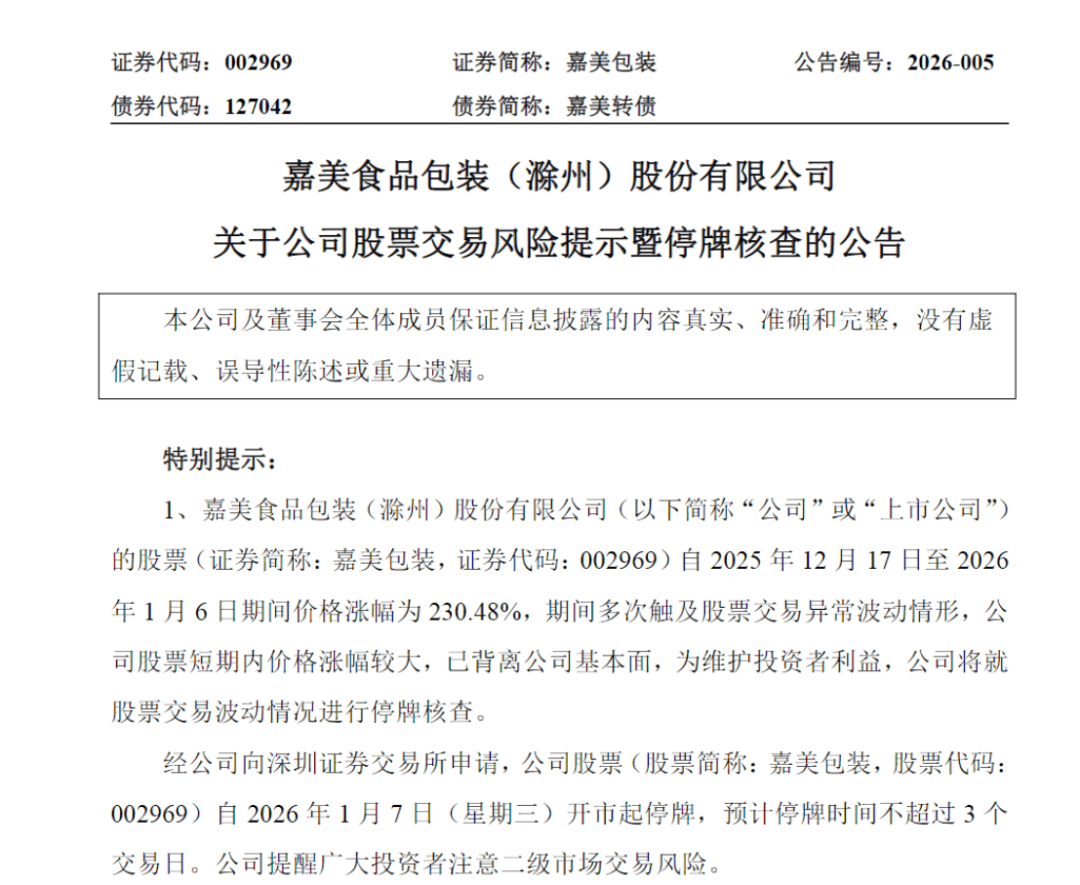
Group 1 - Jia Mei Packaging announced a stock price increase of 230.48% from December 17, 2025, to January 6, 2026, leading to multiple instances of abnormal trading fluctuations [1] - The company will suspend trading for up to three days starting January 7, 2026, to investigate the stock price volatility [1] - The stock's recent surge is attributed to the acquisition of control by Zhu Yue Hong Zhi Technology Development Partnership, with Yu Hao, founder of Chasing Technology, becoming the actual controller [6] Group 2 - Guo Sheng Technology reported a cumulative stock price increase of 370.20% from October 31, 2025, to January 6, 2026, with five instances of abnormal fluctuations and one severe fluctuation [4] - The company will also suspend trading for up to three days starting January 7, 2026, to address the stock price volatility [4] - Guo Sheng Technology has shifted its focus from the photovoltaic sector to solid-state batteries and lithium battery structural components, which has contributed to its stock price surge [10] Group 3 - Fenglong Co., Ltd. disclosed a cumulative stock price increase of 94.92% from December 25, 2025, to January 6, 2026, with a potential for further abnormal price increases leading to a possible suspension [11] - The stock price surge is linked to a significant investment by UBTECH, which plans to acquire 43% of Fenglong's shares for 1.665 billion yuan [11]



大厂涨薪的面子和里子
虎嗅APP· 2026-01-06 13:46
Core Viewpoint - The article discusses the recent trend of salary increases and benefits enhancements among major companies, highlighting the motivations behind these changes and the varying employee perceptions of such adjustments [5][15]. Group 1: Salary Increases - Starting January 1, 2026, employees at CATL will see a basic salary adjustment of 150 RMB, with different increases for various levels at subsidiaries [9][10]. - ByteDance announced a 35% increase in bonus investment for the 2025 performance evaluation cycle and a 1.5 times increase in salary adjustment investment compared to the previous cycle [10][12]. - JD.com reported that 92% of its employees would receive full or excess year-end bonuses, with specific performance-based multipliers for bonuses [12][13]. Group 2: Employee Reactions - Employees at companies like ByteDance and CATL are cautious about the actual impact of salary increases, emphasizing the importance of performance evaluations in determining final compensation [7][12]. - Social media reactions to salary increases show a mix of excitement and skepticism, with some employees questioning the adequacy of the increases [10][11]. Group 3: Company Strategies - Companies are adjusting salaries and benefits in response to their growth stages and competitive pressures within their industries, aiming to attract and retain talent [15][16]. - JD.com is expanding into various sectors, necessitating competitive compensation to build stable teams, while CATL's last salary adjustment for lower-level employees was in early 2022 [15][16]. Group 4: Market Perception - The public and potential job seekers are closely monitoring these salary adjustments, with some expressing hesitation about joining companies that do not offer competitive base salaries [17]. - The narrative around salary increases is often amplified by marketing efforts from companies, blending employee experiences with corporate image promotion [17].




如何让股价8个交易日暴涨100%?答案:被优必选们收购
3 6 Ke· 2026-01-06 12:25
Core Viewpoint - The acquisition of small A-share companies by emerging robotics firms has led to significant stock price increases, with some companies experiencing over 100% growth in just eight trading days, highlighting a trend of acquisitions in the hard technology sector [1][12]. Group 1: Acquisition Trends - Leading humanoid robot company, UBTECH, announced its acquisition of 43% of Fenglong Co., Ltd. for 1.665 billion yuan, becoming its controlling shareholder [2]. - The acquisition strategy employed by these firms typically involves a combination of "agreement transfer + tender offer," allowing them to acquire control at minimal cost while avoiding regulatory scrutiny [2][3]. - Other companies like Zhiyuan Robotics and Qicheng Technology have also engaged in similar acquisition strategies, indicating a mature approach to market entry [3]. Group 2: Financial and Strategic Drivers - UBTECH's revenue growth is steady but it remains unprofitable, necessitating acquisitions to enhance supply chain capabilities and reduce costs [5]. - In contrast, Zhiyuan Robotics is projected to exceed 1 billion yuan in revenue in 2025, while Qicheng Technology has already surpassed its total revenue for 2024 in the first half of 2025 [6]. - The original controlling shareholder of Fenglong Co., Ltd. has committed to donating 83 million yuan to support the company's development post-acquisition, indicating the strong position of the acquirer [6]. Group 3: Market Dynamics and Future Outlook - The current acquisition wave is not merely for "backdoor listings" but is driven by genuine business needs, as evidenced by the strategic fit between UBTECH's robotics and Fenglong's manufacturing capabilities [8]. - The acquisition of listed companies provides a reliable financing channel, allowing acquirers to develop related industries with reduced capital investment [9]. - The robotics industry is approaching a critical turning point, with significant capitalization expected in 2026, as companies prepare for mass production and commercialization [10][11]. Group 4: Stock Market Reactions - The stock prices of companies involved in these acquisitions have surged dramatically, with Fenglong Co., Ltd. experiencing an eight-day trading limit increase and a market capitalization exceeding 8.3 billion yuan [1][12]. - Similar stock price surges have been observed in other companies involved in acquisitions, indicating a broader market optimism towards the robotics sector [12].

大厂涨薪的面子和里子
3 6 Ke· 2026-01-06 11:37
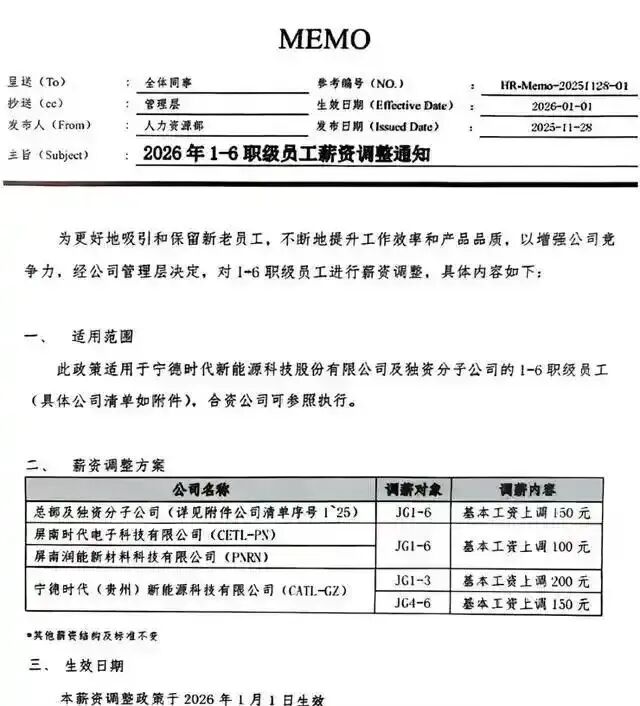
Core Viewpoint - The article discusses the recent trend of salary increases and enhanced benefits across various companies, highlighting the motivations behind these adjustments and the reactions from employees and the public [1][11]. Group 1: Salary Adjustments - Ningde Times will implement a basic salary increase of 150 RMB for levels 1-6 employees starting January 1, 2026, with specific increases of 100 RMB for certain subsidiaries and 200 RMB for others [3][6]. - ByteDance announced a 35% increase in bonus investment for the 2025 performance evaluation cycle and a 1.5 times increase in salary adjustment investment compared to the previous cycle [7][8]. - JD.com stated that 92% of its employees will receive full or excess year-end bonuses, with specific multipliers for performance ratings leading to potential bonuses of up to 24 months' salary [10][11]. Group 2: Employee Reactions - Employees at various companies, including ByteDance and Ningde Times, expressed skepticism about the actual impact of salary increases, emphasizing the need to wait for performance evaluations to understand the real benefits [2][3]. - Some employees view the salary adjustments as insufficient, with comments on social media reflecting mixed feelings about the increases being perceived as "insulting" or "better than nothing" [7][15]. - The public reaction to salary increases often overshadows the employees' more pragmatic concerns about the actual financial benefits and the context of these adjustments [2][11]. Group 3: Company Strategies - The salary increases are seen as a response to competitive pressures and the need to retain talent in a challenging market, with companies like ByteDance emphasizing the importance of maintaining competitive compensation [11][14]. - JD.com is expanding its business into new areas, necessitating a focus on attracting and retaining talent through enhanced compensation and benefits [14][15]. - Companies are navigating the balance between public perception and actual employee satisfaction, with marketing efforts often intertwined with salary announcements to shape a favorable image [15][16].
电厂 | 大厂涨薪的面子和里子
Xin Lang Cai Jing· 2026-01-06 10:57
Core Insights - The article discusses a trend of salary increases and enhanced benefits across various companies, particularly in the tech and manufacturing sectors, as they prepare for 2025 [1][11]. Group 1: Salary Adjustments - Ningde Times will implement a basic salary increase of 150 RMB for levels 1-6 employees starting January 1, 2026, with varying increases for different subsidiaries [3][6]. - ByteDance announced a 35% increase in bonus allocation for the 2025 performance evaluation cycle and a 1.5 times increase in salary adjustment input compared to the previous cycle [7][11]. - JD.com stated that 92% of its employees will receive full or excess year-end bonuses, with specific multipliers based on performance ratings [8][10]. Group 2: Employee Reactions - Employees at various companies, including ByteDance and Ningde Times, expressed skepticism about the actual impact of salary increases, emphasizing the need for performance evaluations to determine final bonuses [2][8]. - Some employees view the salary adjustments as insufficient, with mixed reactions on social media regarding the perceived value of the increases [6][15]. Group 3: Strategic Context - The salary increases are seen as a response to competitive pressures and the need to attract and retain talent in a challenging market environment [11][14]. - Companies like JD.com are expanding into new business areas, necessitating a focus on talent acquisition and retention as part of their growth strategy [14][15].

在拉斯维加斯,看见中国智造的“灵魂”
21世纪经济报道· 2026-01-06 05:23
Core Viewpoint - The article highlights the significant advancements and global expansion of Chinese technology companies showcased at CES 2026, emphasizing their transition from being perceived as low-cost hardware providers to leaders in innovation and technology integration [1][21]. Group 1: Embodied Intelligence - Embodied intelligence has transitioned from being a showcase to practical applications, with companies like Star Motion Era demonstrating robots that can predict outcomes and evolve autonomously [3]. - The market is now focused on the productivity value of real-world applications rather than mere technological gimmicks, as evidenced by Star Motion Era's successful deployment of humanoid robots in various sectors, achieving over 500 million yuan in orders [4]. - The industry faces challenges in model robustness and data efficiency, with ongoing efforts to create a closed-loop system for embodied intelligence [4]. Group 2: Globalization and Market Expansion - Star Motion Era has achieved a 50% share of overseas orders, serving major markets in North America, Europe, and Asia, with significant contributions from global tech giants [5]. - Dreame has expanded its global presence to 120 countries, leading in market share in 22 of them, and is focusing on emotional connections with users through flagship stores [9]. - ULS Robotics has successfully entered key markets like Germany and Canada, emphasizing the importance of technological innovation and user-centric product development in their globalization strategy [14]. Group 3: System Capability and User Experience - The industry is moving away from merely stacking hardware features to enhancing system capabilities, as highlighted by Ninebot's development of an integrated operating system that improves user experience [16]. - The focus is on creating a seamless interaction between hardware and software to provide a stable and intelligent overall experience for users [17]. - Companies are adapting their products to local markets by understanding regional user habits and preferences, which is crucial for successful globalization [18]. Group 4: Cultural and Technological Integration - The competition among Chinese companies is shifting towards a more multifaceted role in globalization, moving beyond manufacturing to include technology, design, and localized operations [20]. - The essence of globalization is to transcend borders while empowering human potential, as articulated by ULS Robotics [21]. - The article concludes that the advancements in technology and the evolving role of Chinese companies at CES signify a new era of global localization and technological value [21].

在拉斯维加斯,看见中国智造的“灵魂”
2 1 Shi Ji Jing Ji Bao Dao· 2026-01-06 02:31
Core Insights - The 2026 CES in Las Vegas highlights the significant advancements of Chinese tech companies, showcasing their transition from being perceived as low-cost hardware providers to leaders in innovative technology [1][2] Group 1: Embodied Intelligence - Embodied intelligence has moved from being a showcase to practical applications, with companies like Star Era demonstrating real-world use cases for humanoid robots [3] - Star Era has achieved a 50% share of overseas orders, indicating strong global market penetration, with major clients including nine of the top ten tech giants [4][19] - The company emphasizes the importance of academic collaboration with institutions like MIT and Stanford to enhance its technological capabilities and establish global influence [5][19] Group 2: Smart Home Innovations - Dreame has expanded its presence at CES, showcasing advancements in AI and embodied intelligence in vacuum cleaners, marking a shift from novelty to essential household infrastructure [7][8] - The company has established a strong global footprint, operating in 120 countries and holding the top market share in 22 of them [8][19] - The vacuum cleaner industry is evolving towards continuous system capability improvements, enhancing user experience and redefining product roles within households [9] Group 3: Exoskeleton Technology - ULS Robotics is transitioning exoskeleton technology from industrial applications to everyday consumer use, focusing on lightweight and intelligent designs [10][12] - The company has successfully entered key markets in Germany, Canada, and the UAE, with operations in over 25 countries [12][19] - ULS Robotics aims to enhance user experience through AI integration and localized adaptations, ensuring their products meet diverse consumer needs [13] Group 4: Systemic Capability and Globalization - Ninebot emphasizes the shift from hardware competition to systemic capability, focusing on integrated software and hardware solutions to enhance user experience [14][15] - The company has over 34 million global users, with a stable 40% of revenue coming from overseas markets, reflecting its successful globalization strategy [17][18] - Ninebot's approach includes deep localization efforts, tailoring products to regional preferences and participating in global standards discussions [16][19]
创创创2026创1创5创,创20创新高
Donghai Securities· 2026-01-05 09:14
Market Overview - The domestic retail market for robotic vacuum cleaners is expected to grow due to policy incentives, with a notable effect from the Q4 base year[7] - In 2025, the online sales of robotic vacuum cleaners increased by 6% in revenue and 9% in volume year-on-year during the first 51 weeks[7] - The average retail price of robotic vacuum cleaners saw a decline of 6% to 3535 RMB during the "Double 11" shopping festival, influenced by increased promotions and brand competition[7] Product Trends - The introduction of active water cleaning technology is leading the innovation cycle in the market, with brands like Ecovacs and Roborock launching new models that enhance cleaning efficiency[10] - The global market for smart robotic vacuum cleaners is projected to ship 2,060.3 million units in 2024, reflecting an 11.2% year-on-year growth, with a total sales value of $9.31 billion, up 19.7%[13] - The average price of robotic vacuum cleaners is expected to rise by 7.6% to $452 in 2024 due to technological upgrades[13] Competitive Landscape - The top five global robotic vacuum manufacturers are all Chinese companies, with Roborock and Ecovacs leading in shipment volumes[13] - Roborock achieved a market share of 21.7% in the global robotic vacuum market during the first three quarters of 2025, with significant sales growth in North America and Europe[13] - The competitive landscape is shifting as iRobot faces challenges, including a 6.7% decline in global shipments and a 2.6 percentage point drop in market share to 13.7%[48] Future Outlook - The market is expected to see increased competition, with a focus on cost control and supply chain efficiency as brands compete on price and technology[49] - The trend towards smart home integration and personalized cleaning solutions is anticipated to drive future product development, with a potential rise in subscription-based services[49] - Companies are advised to focus on understanding consumer needs and enhancing product features to maintain competitiveness in a rapidly evolving market[49]

