云顶新耀

Search documents
港药开盘飙涨!完全剔除CXO的港股通创新药ETF(159570)大涨超2%,标的指数“大提纯”!近2日“吸金”超7.7亿元!
Xin Lang Cai Jing· 2025-07-31 02:30
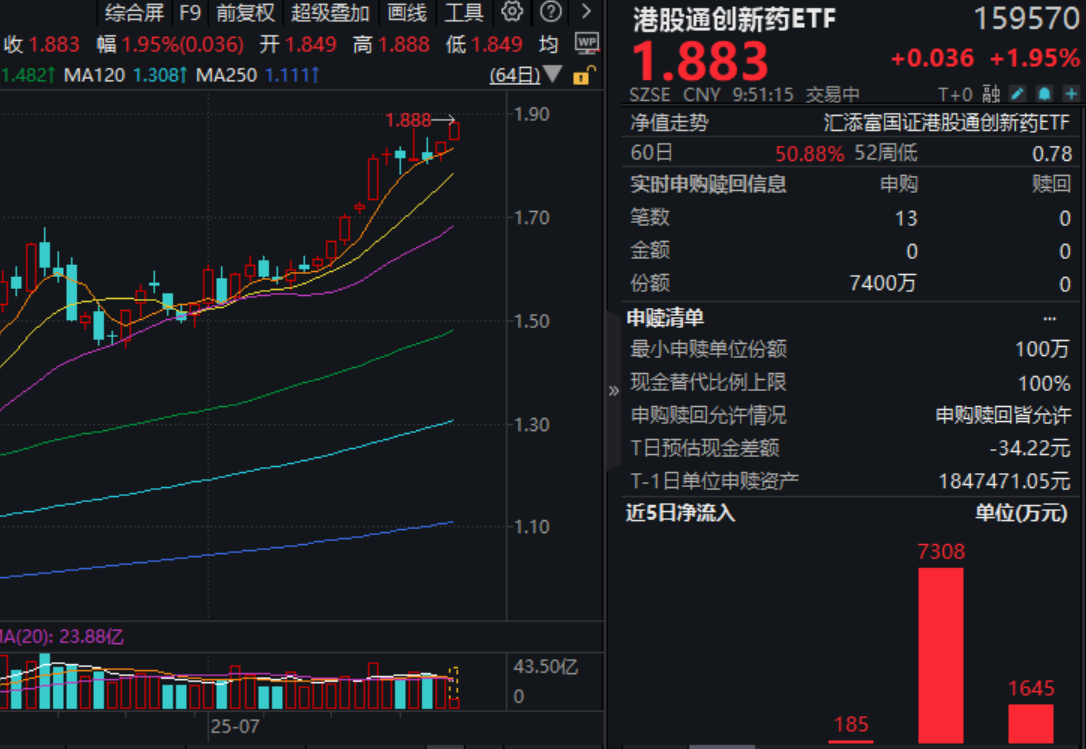
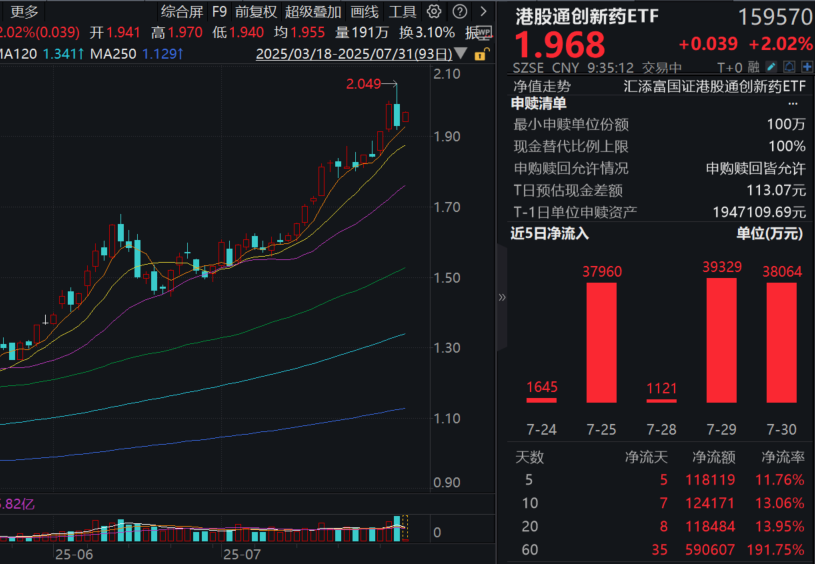
Core Viewpoint - The Hong Kong Stock Connect Innovative Drug ETF (159570) has seen significant inflows and growth, indicating strong investor interest in the innovative drug sector [1][5]. Group 1: ETF Performance - The Hong Kong Stock Connect Innovative Drug ETF (159570) opened with a surge, rising over 2% with a trading volume exceeding 900 million yuan, and net inflows surpassing 770 million yuan in the last two days [1]. - As of July 30, the ETF's latest scale exceeded 11.9 billion yuan, setting a new historical record and leading in scale and liquidity among its peers [1]. Group 2: Index Composition - The majority of the constituent stocks of the Hong Kong Stock Connect Innovative Drug ETF showed positive performance, with Lepu Biopharma rising over 5% and CSPC Pharmaceutical Group increasing over 3% [3]. - The index will be revised to exclude Contract Research Organizations (CROs), ensuring it reflects a 100% purity of innovative drugs, which are directly linked to drug commercialization success [5][6]. Group 3: Major Transactions - CSPC Pharmaceutical Group entered into a significant exclusive licensing agreement with Madrigal Pharmaceuticals, potentially worth up to 2.075 billion USD for the oral GLP-1 receptor agonist SYH2086 [6]. - China National Pharmaceutical Group's subsidiary is expected to receive a milestone payment of 300 million USD for a technology transfer related to a PD-1/VEGF dual antibody [7]. Group 4: Industry Drivers - The innovative drug sector is driven by three main factors: accelerated internationalization, supportive policies, and technological breakthroughs [8]. - Internationalization is highlighted by the increasing presence of domestic innovative drug data at international conferences and a rise in overseas business development transactions [8]. - Recent supportive policies for the innovative drug industry include measures to encourage investment and optimize procurement, indicating a new development cycle for the sector [8]. - Technological advancements in areas such as ADC, GLP-1, and immune-oncology are leading to significant innovations and market opportunities [8].

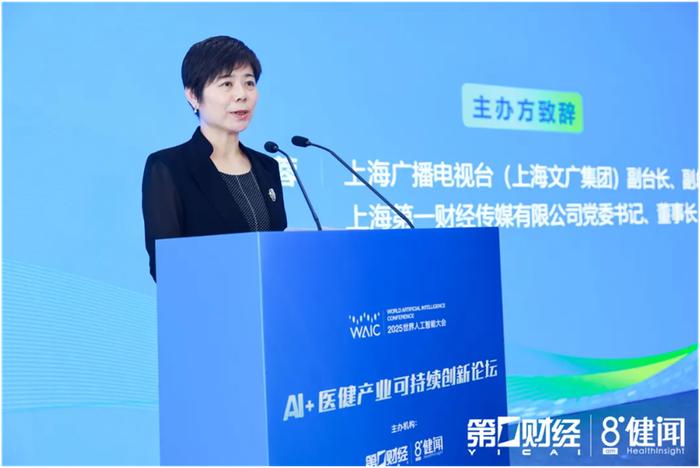
AI+医健产业可持续创新论坛:可持续创新案例推荐榜揭晓,大咖热议AI重塑医疗健康未来
第一财经· 2025-07-30 07:45
Core Viewpoint - The integration of AI technology into the healthcare industry is essential for addressing challenges such as global aging, chronic disease burdens, and uneven distribution of medical resources, positioning AI as a systemic solution for sustainable healthcare development [1][3][4]. Group 1: AI Empowerment in Healthcare - AI has transitioned from pilot scenarios to ecosystem restructuring, enhancing efficiency and accessibility in healthcare services [8][11]. - The forum highlighted the need for a new medical data infrastructure to achieve breakthroughs in efficiency, value, and equity [9][11]. - AI applications in healthcare are rapidly evolving, with significant advancements in areas such as pediatric AI pre-consultation, digital imaging in dentistry, and remote dermatology consultations [11][15]. Group 2: Sustainable Innovation in Healthcare - The "2025 Sustainable Innovation Case Recommendation List" was released, showcasing 37 cases from 36 well-known domestic and foreign companies, focusing on urgent industry needs and aligning with the Healthy China 2030 strategy [6][18]. - The list categorizes cases into "International Innovation Localization," "Local Innovation Globalization," and "ESG Innovation Practices," aiming to promote experience sharing and resource integration within the industry [6][18][35]. Group 3: Globalization and Localization Strategies - Multinational companies are deepening localization strategies, evolving from local production to local R&D innovation, while leveraging their technological and resource advantages to foster local innovation [35][41]. - Chinese pharmaceutical companies are increasingly exploring international markets, integrating into the global innovation ecosystem, and ensuring that local innovations benefit a global audience [35][41]. Group 4: ESG and AI in Healthcare - ESG has become a core issue for sustainable development, with a growing focus on integrating AI technology ethics into ESG evaluation dimensions [48]. - Companies are encouraged to disclose AI model training data sources and bias correction mechanisms, ensuring compliance and ethical standards in AI applications [48]. Group 5: Future Directions and Challenges - The healthcare industry faces challenges in high-quality data sample supply and the translation of clinical research into practical applications [11][13]. - The need for a robust AI infrastructure that supports effective business models and enhances traditional services is emphasized, with a focus on data-driven decision-making [50][51].
AI+医健产业可持续创新论坛:可持续创新案例推荐榜揭晓,大咖热议AI重塑医疗健康未来
第一财经网· 2025-07-30 04:40
Group 1 - The forum focused on the integration of AI in the healthcare industry, addressing challenges such as aging populations and uneven distribution of medical resources, emphasizing AI as a systemic solution for sustainable healthcare development [1][3] - The Shanghai government highlighted the importance of deep integration between AI and healthcare as a strategic choice to enhance public health and foster new productive forces [3] - The forum featured nearly 20 speakers from various sectors discussing topics like AI-driven innovation in healthcare and the globalization of local enterprises [5] Group 2 - The "2025 Sustainable Innovation Case Recommendation List" was launched, showcasing 37 cases from 36 well-known companies, categorized into "International Innovation Localization," "Local Innovation Globalization," and "ESG Innovation Practices" [5][15] - The cases highlighted urgent industry needs and aligned with China's health strategy for 2030, aiming to provide actionable innovation pathways [5][15] - The forum emphasized the need for collaboration among stakeholders to create a vibrant ecosystem for AI in healthcare [3][5] Group 3 - AI in healthcare is transitioning from pilot projects to ecosystem restructuring, with applications like pediatric AI pre-consultation and remote dermatology gaining traction [7][9] - Challenges remain, including insufficient high-quality data samples and the gap between clinical research and application [9][11] - China is evolving from a passive technology importer to an active innovator in the global pharmaceutical landscape, with significant increases in licensing deals [11][22] Group 4 - The "2025 Sustainable Innovation Case Recommendation List" includes notable companies such as Bayer, Pfizer, and Medtronic in the "International Innovation Localization" category [17][19] - Local companies like Aier Eye Hospital and Junshi Biosciences are recognized for their global innovation efforts [18][22] - ESG practices are increasingly important, with companies like Philips and JD Health showcasing their commitment to sustainable development [24][25] Group 5 - The forum discussions highlighted the importance of AI as a foundational infrastructure for healthcare innovation, with ESG serving as a critical framework for sustainable practices [32][34] - The integration of AI in healthcare is seen as essential for addressing common challenges such as resource distribution and operational efficiency [30][36] - The need for a collaborative approach among various stakeholders, including regulatory bodies and healthcare providers, was emphasized to ensure the successful implementation of AI technologies [30][32]
多发性硬化:百亿美金市场,BTKi发展前景广阔
KAIYUAN SECURITIES· 2025-07-30 01:46
Investment Rating - The investment rating for the biotechnology industry is "Positive" (maintained) [1] Core Insights - The global stock of multiple sclerosis (MS) patients is significant, with the market size exceeding $20 billion, primarily focused on relapsing forms of MS (RMS) [6][9] - BTK inhibitors are expected to fill the treatment gap in primary progressive MS (PPMS) and non-relapsing secondary progressive MS (nrSPMS) [7][9] - The anticipated release of clinical data for BTK inhibitors in the second half of 2025 is expected to enhance the attractiveness of the sector [9] Summary by Sections 1. Multiple Sclerosis Overview - MS is an immune-mediated inflammatory demyelinating disease of the central nervous system, characterized by "spatial" and "temporal" multiplicity [5][27] - The global and Chinese stock of MS patients is projected to reach 3.71 million and 60,000 respectively by 2030, with a CAGR of approximately 2.7% and 2.1% from 2025 to 2030 [19][22] 2. Market Size and Product Landscape - The global MS market is approximately $20 billion, with a focus on RMS treatments [6][40] - Existing products include monoclonal antibodies and oral therapies, with CD20 monoclonal antibodies expected to account for over 60% of sales by 2024 [6][46] 3. BTK Inhibitors and Clinical Development - BTK inhibitors are positioned to address unmet needs in the treatment of PPMS and nrSPMS, with several candidates in late-stage clinical trials [7][51] - Tolebrutinib and Fenebrutinib are expected to release pivotal clinical data in the second half of 2025, which could significantly impact their market potential [8][51] 4. Investment Recommendations - The ongoing clinical developments and the large patient base present significant investment opportunities in companies like 诺诚健华, 翰森制药, 云顶新耀, 恒瑞医药, and 百济神州-U [9]
看好小分子偶联药物及相关标的
CAITONG SECURITIES· 2025-07-28 08:00
Core Insights - The report maintains a positive outlook on small molecule drug conjugates (SMDCs) and related companies, highlighting their potential in cancer treatment due to their ability to enhance efficacy while reducing toxicity [1][5][17] - The report emphasizes the clinical advantages of SMDCs, including better tumor penetration, reduced toxicity to normal cells, and easier control over synthesis and costs compared to antibody-drug conjugates (ADCs) [5][11][12] - The report identifies domestic biopharmaceutical companies, particularly Affinivax, as leaders in the SMDC space, showcasing significant advancements in innovative cancer drug development [5][12][17] Industry Overview - The pharmaceutical and biotechnology sector has shown a relative price-to-earnings (P/E) ratio of 51.14 as of July 25, 2025, which is significantly higher than its historical low of 24.38, indicating a premium valuation compared to the broader market [19] - The report notes that the healthcare sector's valuation is 279% higher than the Shanghai Composite Index, reflecting strong investor interest and confidence in the industry [19] - Recent market performance indicates a 1.90% increase in the pharmaceutical and biotechnology sector from July 21 to July 25, 2025, ranking it 16th among 27 sub-industries [26][29] Company Focus - The report suggests monitoring companies involved in the SMDC space, including Affinivax, and those collaborating with them, such as Innovent Biologics and others, which are expected to benefit from the growing interest in innovative cancer therapies [5][17][18] - Specific companies highlighted for their innovative drug development capabilities include Innovent Biologics, Shunyi Pharmaceutical, and others, which are positioned to capitalize on the advancements in SMDC technology [5][18]


医药生物行业周报(7月第4周):医疗大模型再次突破-20250728
Century Securities· 2025-07-28 00:41
Investment Rating - The report does not explicitly state an investment rating for the industry, but it provides insights into market performance and trends [2][4]. Core Insights - The pharmaceutical and biotechnology sector saw a weekly increase of 1.9%, underperforming the Wind All A index (2.21%) but outperforming the CSI 300 index [2][7]. - The medical research outsourcing segment experienced the highest growth at 8.29%, while chemical preparations and other biological products faced declines of -2.02% and -0.58%, respectively [2][8]. - The Quark Health model achieved a significant milestone by passing the written assessment for chief physician in 12 core disciplines, marking a rapid development phase for medical AI models in China [2][11]. - State-owned equity funds are actively acquiring stakes in pharmaceutical companies, with notable transactions including the acquisition of Kanghua Biological and a significant stake in MicroPort Medical [2][11]. Summary by Sections Market Weekly Review - The pharmaceutical and biotechnology sector rose by 1.9% from July 21 to July 25, 2025, with medical research outsourcing leading the gains at 8.29% [2][7]. - Individual stocks such as Haitai Biological (46.9%), Zhendong Pharmaceutical (42.9%), and Saily Medical (31.7%) saw significant increases, while *ST Suwu (-22.3%) and Yong'an Pharmaceutical (-13.7%) faced notable declines [2][10]. Industry News and Key Company Announcements Important Industry Events - The National Medical Insurance Administration announced new measures to optimize drug procurement, emphasizing quality over lowest price and launching a nationwide drug price comparison tool [2][11]. Industry News - Shanghai Biopharmaceutical M&A Fund is set to acquire shares in MicroPort Medical, becoming a strategic shareholder [2][11]. - Kangfang Biologics' new indication application for Ivoris monoclonal antibody has been accepted by the National Medical Products Administration [2][11]. Company Announcements - WuXi Biologics reported a positive mid-year earnings forecast, expecting a 16% revenue increase and a 3.6% rise in gross margin [2][14]. - The Quark Health model's capabilities continue to align closely with human physicians, marking a significant advancement in AI healthcare applications [2][14]. - WuXi AppTec and other companies reported substantial revenue growth, with WuXi AppTec expecting over 60% growth in the first half of 2025 [2][14].


ETF热门榜:香港证券相关ETF成交居前,港股医疗ETF(159366.SZ)交易活跃-20250725
Sou Hu Cai Jing· 2025-07-25 10:09
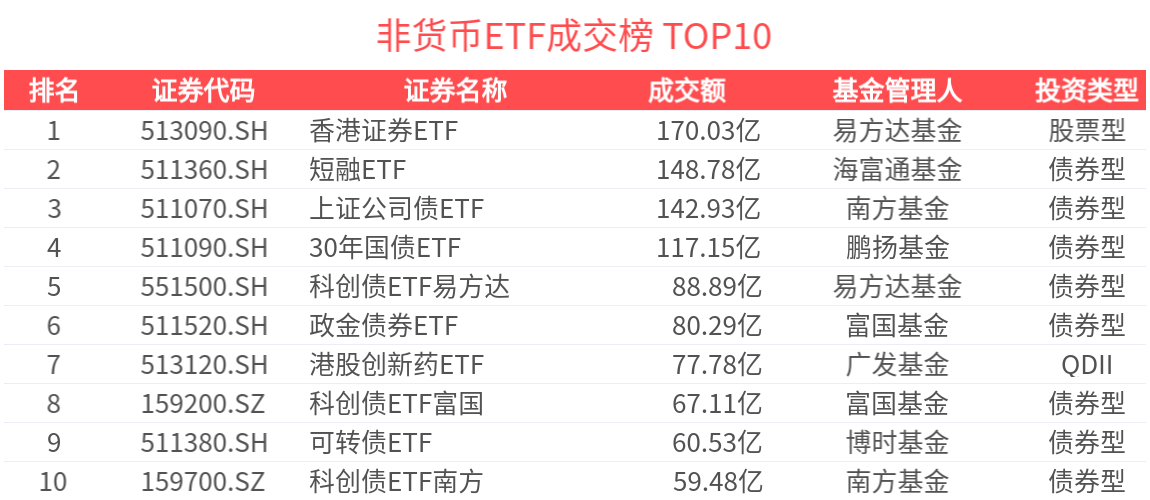
Core Insights - The total trading volume of non-monetary ETFs reached 302.71 billion, with 59 ETFs exceeding 1 billion in trading volume [1] - The top three ETFs by trading volume are Hong Kong Securities ETF, Short-term Bond ETF, and Shanghai Composite Company Bond ETF, with volumes of 17.00 billion, 14.88 billion, and 14.29 billion respectively [1] - The Hong Kong Securities ETF and the Short-term Bond ETF have shown significant recent trading activity, with average daily trading volumes of 19.76 billion and 15.71 billion over the past five and twenty days respectively [2][3] Trading Volume Summary - Hong Kong Securities ETF (513090.SH) has a latest share size of 8.05 billion, with a recent average daily trading volume of 19.76 billion over the past five days, reflecting a 10.56% increase [2] - Short-term Bond ETF (511360.SH) has a latest share size of 0.47 billion, with a recent average daily trading volume of 15.71 billion over the past five days [2] - The Shanghai Composite Company Bond ETF (511070.SH) has a trading volume of 14.29 billion, ranking third in the market [5] Turnover Rate Summary - The Hong Kong Medical ETF has the highest turnover rate at 620.34%, followed by the Short-term Bond ETF at 129.22% and the Hang Seng Innovation Drug ETF at 112.08% [7] - The Hong Kong Securities ETF has a turnover rate of 91.42%, indicating active trading [7] Sector and Index Performance - The Hong Kong Securities ETF tracks the Hong Kong Securities Index, which includes major companies like CITIC Securities and Hong Kong Exchanges [2] - The Hang Seng Innovation Drug ETF tracks the Hang Seng Innovation Drug Index, reflecting the performance of companies involved in innovative drug research and development [3] - The Computer ETF and AI ETFs are focused on the electronic industry, with significant recent trading activity and price movements [8][9]
自免领域中国创新药产出越发丰富,深度参与全球商业化
Tianfeng Securities· 2025-07-25 09:15
Investment Rating - Industry rating is maintained at "Outperform the Market" [2] Core Insights - The global autoimmune disease treatment market is projected to exceed $100 billion, with an estimated market size of approximately $107.9 billion in 2024, expected to grow to $137.59 billion by 2033. The prevalence of autoimmune diseases is estimated to affect about 7.6% to 9.4% of the global population, leading to a long-term medication requirement for patients [3] - The leading drug in the autoimmune market for 2024 is Dupilumab, with sales of $14.2 billion, reflecting a year-on-year growth of 23%. The highest clinical demand is noted for atopic dermatitis, chronic obstructive pulmonary disease, asthma, systemic lupus erythematosus, and inflammatory bowel disease, which have high prevalence rates and complex disease courses [3] - Significant growth in overseas licensing for China's autoimmune sector is observed, with a total transaction amount of $9.132 billion from 2017 to 2024, where 2024 alone accounts for $3.108 billion, representing about one-third of the total, showing a notable increase compared to previous years [4] - Major business development transactions include Roche's acquisition of Telavant for $7.1 billion, Pfizer's acquisition of Arena for approximately $6.7 billion, and Takeda's acquisition of Nimbus for $4 billion, highlighting the substantial deal sizes in the autoimmune sector [4] Recommendations - Companies to watch include Yifang Bio, TianKang, CloudTop, Kexing Pharmaceutical, Zai Lab, Hengrui Medicine, Kangzhe Pharmaceutical, Sanofi, Innovent Biologics, Xiansheng Pharmaceutical, Lizhu Group, Zhixiang Jintai, China Antibody, and Chuanxin Biotech [5]
每日投资策略:恒指收涨129点,连升五日共 1168 点-20250725
Guodu Securities Hongkong· 2025-07-25 05:05
Market Overview - The Hang Seng Index rose by 129 points or 0.5%, closing at 25,667, marking its fifth consecutive day of gains, totaling 1,168 points or 4.8% over this period [2][3] - The trading volume for the day was 294.81 billion HKD, with net inflow from northbound trading amounting to 3.72 billion HKD [2] Company Highlights - HSBC Holdings (00005) increased by 2.2%, closing at 102.2 HKD; Hong Kong Exchanges and Clearing (00388) rose by 1.9% to 448.2 HKD; Tencent (00700) gained 0.9% to 557 HKD; Meituan (03690) also increased by 0.9% to 134.4 HKD [3] - WuXi Biologics (02269) saw a significant rise of 3.8%, closing at 29.85 HKD; however, Alibaba (09988) and JD.com (09618) experienced slight declines of 0.5% and 0.6%, closing at 120.3 HKD and 133.3 HKD respectively [3] Industry Developments - The Hong Kong Trade Development Council Chairman met with the Chairman of Bank of China to enhance cooperation, aiming to strengthen Hong Kong's role as an international financial, shipping, and trade center [6] - The State Development and Reform Commission announced that 735 billion RMB of central budget investment has been allocated, focusing on modern industrial systems, infrastructure, and green development [8] - The State-owned Assets Supervision and Administration Commission emphasized the need to optimize the allocation of state-owned assets and promote technological innovation and industry upgrades [9] Corporate Actions - Pop Mart (09992) is in discussions with Hollywood companies to potentially produce a movie based on its Labubu character, indicating a strategic direction towards media collaboration [11] - XPeng Motors (09868) announced the delivery of its first locally produced XPeng X9 in Indonesia, marking a significant milestone in its global localization strategy [12] - SenseTime's smart automotive business is nearing completion of a significant financing round, with six ecosystem companies reportedly raising a total of 1.8 billion RMB [13] - Genting New Year (01952) announced a share placement to raise approximately 1.573 billion HKD, with proceeds allocated for global R&D and commercialization efforts [14]
港药涨势延续,康龙化成涨超12%!港股通创新药ETF(159570)涨近2%,盘中净流入超2.3亿元!商保创新药目录进入实质性落地阶段
Xin Lang Cai Jing· 2025-07-25 02:45
Core Viewpoint - The Hong Kong Stock Connect Innovative Drug ETF (159570) has seen significant inflows and performance, indicating strong investor interest in the innovative drug sector [1][2][5]. Group 1: ETF Performance - The Hong Kong Stock Connect Innovative Drug ETF (159570) rose nearly 2% today, with a trading volume exceeding 1.3 billion CNY [1]. - As of July 24, the ETF's latest scale surpassed 10.2 billion CNY, leading its peers in the same category [1]. - The ETF's underlying index has shown a 62.78% increase in the first half of 2025, outperforming other medical indices [5][6]. Group 2: Market Dynamics - The ETF has experienced a net inflow of over 230 million CNY in the past four days, reflecting strong market interest [1]. - The financing net purchase amount for the ETF reached 6.2352 million CNY, with the latest financing balance at 206 million CNY [2]. Group 3: Sector Developments - The National Healthcare Security Administration (NHSA) has announced changes to the selection process for medical insurance, moving away from solely considering the lowest bid [3]. - The NHSA's new guidelines are expected to enhance the confidence of companies in R&D investments, particularly in innovative drugs [4]. - The collaboration between dynamic adjustments to the medical insurance catalog and procurement policies is anticipated to shorten the commercialization cycle for innovative drugs [5].