新城控股

Search documents
A股延续“二八分化” 银行、地产板块携手冲高
Shang Hai Zheng Quan Bao· 2025-11-20 18:25
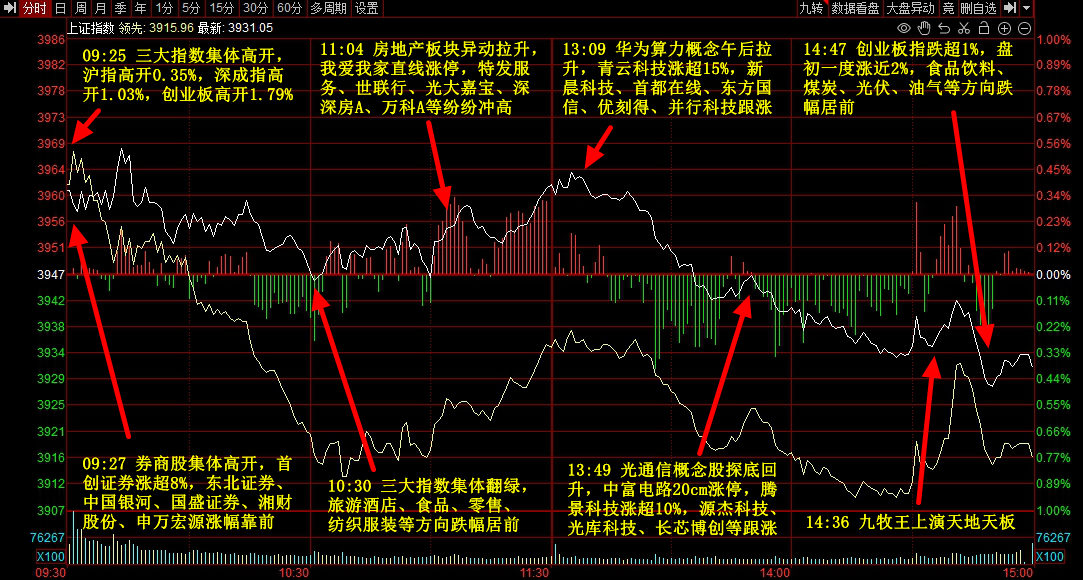
Group 1: Market Overview - The A-share market continues to show a "two-eight differentiation" trend, with banking and real estate sectors leading, while technology stocks, particularly those related to AI, have shown weakness [1] - As of the market close, the Shanghai Composite Index fell by 0.40% to 3931.05 points, the Shenzhen Component Index decreased by 0.76% to 12980.82 points, and the ChiNext Index dropped by 1.12% to 3042.34 points [1] - The total trading volume in the Shanghai and Shenzhen markets was 170.81 billion yuan, a decrease of 17.7 billion yuan from the previous day, with over 3800 stocks declining [1] Group 2: Banking Sector Performance - Bank stocks have been a key factor in stabilizing the market, with China Bank and Industrial and Commercial Bank of China reaching historical highs, with market capitalizations of over 2 trillion yuan and 2.9475 trillion yuan respectively [1] - The report from Kaiyuan Securities emphasizes the importance of focusing on banks' growth potential and long-term value, suggesting a base allocation in large state-owned banks and flexible allocation in quality regional banks [2] Group 3: Real Estate Sector Insights - The real estate sector showed positive movement, with the Shenwan Real Estate Index rising by 0.33% and the construction materials index increasing by 1.40% [2] - Data from the Ministry of Housing and Urban-Rural Development indicates that from January to October, the transaction area of second-hand homes increased by 4.7% year-on-year, with second-hand homes accounting for 44.8% of total transactions [2] Group 4: Technology Sector Analysis - Recent fluctuations in the technology sector have raised concerns about valuation bubbles and the sustainability of AI investments, with a focus on valuation corrections rather than fundamental changes [4] - Despite the volatility, leading tech companies' revenue growth has met expectations, and the return on AI investments continues to accelerate, indicating ongoing potential in the underlying technology [4]


A股五张图:熟悉的老A回来了
Xuan Gu Bao· 2025-11-20 10:30
Market Overview - The market opened high but closed lower, with the Shanghai Composite Index, Shenzhen Component Index, and ChiNext Index down by 0.4%, 0.76%, and 1.12% respectively, indicating a continued money-losing effect across the market [3] - Over 3,800 stocks declined while more than 1,400 stocks rose, with total trading volume shrinking to 1.7 trillion [3] Fujian Local Stocks - Fujian local stocks experienced significant volatility, with HeFu China achieving a 15-day streak of 13 limit-ups, accumulating a rise of over 290% [6] - Other notable performers included Jomoo with 7 consecutive limit-ups, Aerospace Development with 5, and Rongji Software with 4 [6] - Conversely, Longzhou Co. hit the limit down, and several stocks like Zhongfu Tong and Hongxiang Co. fell over 10% [6] - The overall Fujian local stock index saw a slight decline of 0.27% despite an early drop of over 2% [6] Brokerage Firms - Three brokerages, Xinda Securities, Zhongjin Company, and Dongxing Securities, announced a restructuring plan involving a share swap merger [8] - Following the announcement, Dongxing Securities saw a significant intraday rise of over 4.6% [8] - Other brokerages and financial stocks opened higher but ultimately closed lower, with the brokerage sector down by 0.43% [11] Real Estate Sector - The real estate sector experienced a surge due to external media reports, with stocks like I Love My Home and 365 Network hitting limit-ups [12] - The real estate brokerage sector rose by 5.77%, while the broader real estate market saw a slight decline of 0.15% [13] - The market reaction was characterized by rapid price movements following the news, indicating a potential speculative environment [14] Specific Stocks and Trends - Guqi Down Material saw a small fluctuation in the morning but rallied in the afternoon, achieving a 2-day limit-up [16] - The stock's rise is attributed to the cold wave driving demand for down products, alongside other stocks like Jingneng Heat Power benefiting from heating supply concepts [16] - The recent increase in duck down prices has also contributed to market interest in Guqi Down Material, filling a gap for direct duck down concept stocks in the A-share market [19]





房地产开发板块11月20日涨0.28%,财信发展领涨,主力资金净流出3.21亿元
Zheng Xing Xing Ye Ri Bao· 2025-11-20 09:04
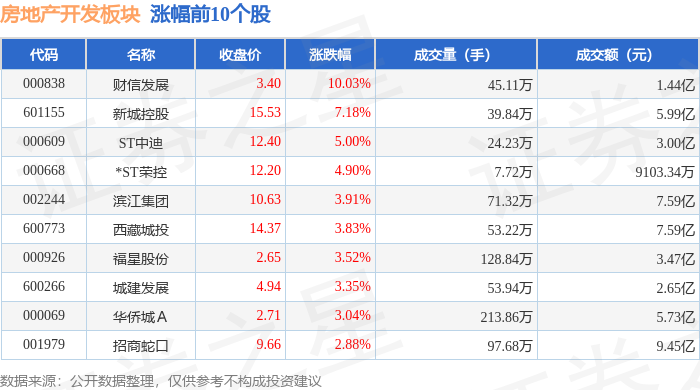
Market Overview - On November 20, the real estate development sector rose by 0.28% compared to the previous trading day, with Caixin Development leading the gains [1] - The Shanghai Composite Index closed at 3931.05, down 0.4%, while the Shenzhen Component Index closed at 12980.82, down 0.76% [1] Top Gainers in Real Estate Sector - Caixin Development (000838) closed at 3.40, up 10.03% with a trading volume of 451,100 shares and a turnover of 144 million yuan [1] - New City Holdings (601155) closed at 15.53, up 7.18% with a trading volume of 398,400 shares and a turnover of 26.67 million yuan [1] - ST Zhongdi (000609) closed at 12.40, up 5.00% with a trading volume of 242,300 shares and a turnover of 300 million yuan [1] Top Losers in Real Estate Sector - Yingxin Development (000620) closed at 3.24, down 10.00% with a trading volume of 5,315,900 shares and a turnover of 1.773 billion yuan [2] - China Wuyi (000797) closed at 3.67, down 9.38% with a trading volume of 2,878,800 shares and a turnover of 1.071 billion yuan [2] - Huaxia Happiness (600340) closed at 3.13, down 9.01% with a trading volume of 8,687,100 shares and a turnover of 2.831 billion yuan [2] Capital Flow Analysis - The real estate development sector experienced a net outflow of 321 million yuan from institutional investors, while retail investors saw a net inflow of 585 million yuan [2] - Major stocks like Vanke A (000002) had a net inflow of 160 million yuan from institutional investors, while it faced a net outflow of 92 million yuan from retail investors [3] - New City Holdings (601155) had a net inflow of 64 million yuan from institutional investors but a net outflow of 93 million yuan from retail investors [3]




运营为核,存量时代商业地产的价值跃迁
Xin Lang Cai Jing· 2025-11-20 07:24
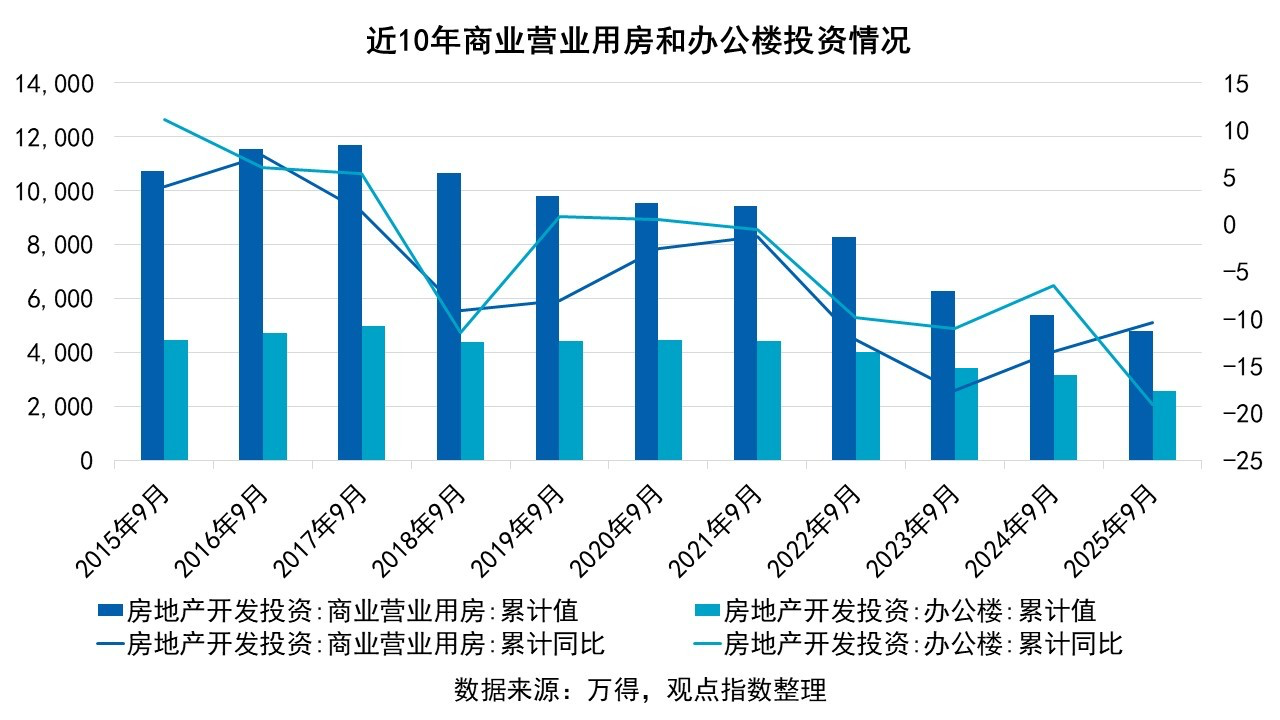
Core Insights - The Chinese commercial real estate sector is undergoing a significant paradigm shift from extensive growth to meticulous management of existing assets, driven by policies aimed at expanding domestic demand and upgrading consumption [1][10] - The market is characterized by a dual trend of recovering consumer spending and pressure on investment, with retail sales reaching 365,877 billion yuan and a growth rate of 4.46% in the first nine months of 2025, while new office construction area has decreased by 22.3% year-on-year [1][2] Market Dynamics - The market is experiencing a deep adjustment that accelerates industry differentiation, with only 8% of commercial real estate companies generating 42% of industry revenue, indicating a growing concentration of market power among leading firms [2] - The top companies are leveraging quality assets and operational capabilities to navigate through cycles, while smaller firms face challenges such as weak operations and low revenues [2] Operational Strategies - In a market dominated by existing assets, light asset operations and stock transformation are key strategies for companies to break through, as exemplified by Vanke's successful transformation of the Shenzhen iN City Square, achieving a 97% occupancy rate [3][4] - The core value of commercial real estate is shifting from physical space to operational capability, with companies adopting innovative strategies to enhance competitiveness and revenue generation [4][10] Consumer Trends - Structural changes in consumer demand are providing new growth opportunities, with the elderly and young populations becoming the main consumer forces, leading to the rise of new business models such as community commerce and pet economy [4][5] - The pet economy alone has surpassed 300 billion yuan, indicating a significant market potential for pet-friendly commercial spaces [4] Innovation and Technology - The commercial operation model is evolving from single leasing to a comprehensive approach that includes content, services, and marketing, with companies focusing on creating differentiated services as a competitive advantage [5][6] - Technological innovations are supporting refined operations, with Vanke utilizing AI and smart service systems to enhance project management efficiency and consumer experience [6] Capital Market Trends - The capital market is undergoing adjustments, with a notable increase in transactions of office assets, totaling approximately 398 billion yuan in the first nine months of 2025, and a shift towards financial institutions and leading industry companies as primary investors [6][9] - The expansion of public REITs for consumer infrastructure is attracting more capital to quality retail properties, fostering a cycle of capital empowerment, operational upgrades, and value enhancement [6][10] Future Outlook - The consensus from the 2025 Commercial Annual Conference indicates that stock updates represent a core opportunity, with over 200 million square meters of commercial properties in first-tier cities over 30 years old, 40% of which are underperforming [10] - The industry is expected to gradually achieve a "spiral" development through enhanced operational capabilities and capital ecosystem improvements, with a focus on projects that can activate value through space transformation and content restructuring [10]

新城控股股价涨5.11%,安信基金旗下1只基金重仓,持有29.62万股浮盈赚取21.92万元
Xin Lang Cai Jing· 2025-11-20 05:28
Group 1 - The core point of the article highlights the recent performance of New城控股, which saw a 5.11% increase in stock price, reaching 15.23 yuan per share, with a trading volume of 270 million yuan and a turnover rate of 0.81%, resulting in a total market capitalization of 34.353 billion yuan [1] - New城控股, established on June 30, 1996, and listed on December 4, 2015, primarily engages in real estate development and sales, with revenue composition as follows: 68.63% from real estate development and sales, 29.06% from property leasing and management, and 2.31% from other supplementary activities [1] Group 2 - From the perspective of major fund holdings, data indicates that Anxin Fund has one fund heavily invested in New城控股. The Anxin New Value Mixed A Fund (003026) increased its holdings by 221,000 shares in the third quarter, totaling 296,200 shares, which represents 0.87% of the fund's net value, ranking as the sixth-largest holding [2] - The Anxin New Value Mixed A Fund (003026) was established on August 19, 2016, with a current size of 98.43 million yuan. Year-to-date returns stand at 9.53%, ranking 5803 out of 8136 in its category; over the past year, returns are at 12.33%, ranking 5137 out of 8055; and since inception, the fund has achieved a return of 104.2% [2] Group 3 - The fund managers of Anxin New Value Mixed A Fund (003026) are Wang Tao and Liang Bingzhe. As of the report, Wang Tao has a cumulative tenure of 10 years and 322 days, managing a total fund size of 9.625 billion yuan, with the best fund return during his tenure being 31.75% and the worst being -5.99% [3] - Liang Bingzhe has a cumulative tenure of 4 years and 84 days, managing a total fund size of 4.75 billion yuan, with the best fund return during his tenure being 27.73% and the worst being -3.81% [3]
A股部分地产股拉升,招商蛇口涨超4%
Ge Long Hui A P P· 2025-11-20 03:32
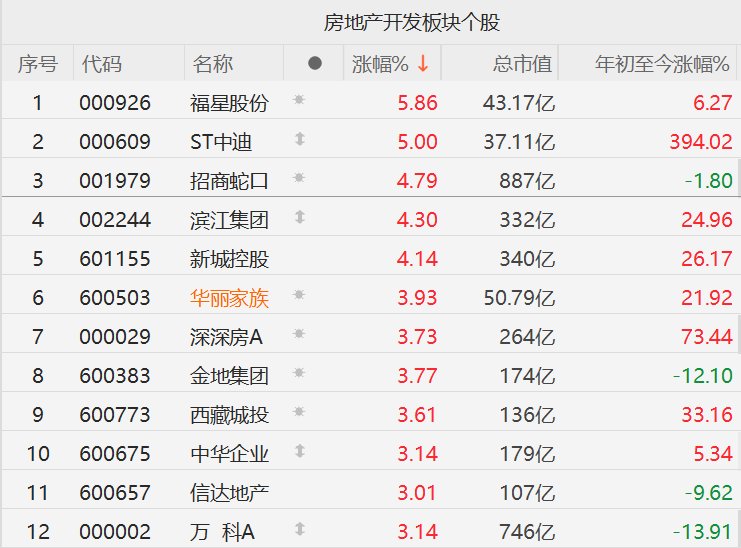
Group 1 - A-share market saw a rise in certain real estate stocks influenced by related rumors, with notable increases in stocks such as China Merchants Shekou, Binjiang Group, and New Town Holdings, which rose over 4% [1] - Other companies like Huayi Family, Shenzhen Housing A, Jindi Group, Tibet City Investment, China Enterprises, Xinda Real Estate, and Vanke A experienced increases of over 3% [1] Group 2 - The real estate development sector showed significant stock performance, with 福星股份 (Fuxing Co.) leading with a rise of 5.86% and a total market value of 4.317 billion [2] - ST中油 (ST Zhongyou) followed with a 5.00% increase and a market value of 3.711 billion, while 招商蛇口 (China Merchants Shekou) rose by 4.79% with a market cap of 88.7 billion [2] - Other notable performers included 滨江集团 (Binjiang Group) with a 4.30% increase and a market value of 3.32 billion, and 新城控股 (New Town Holdings) with a 4.14% rise and a market cap of 3.4 billion [2]


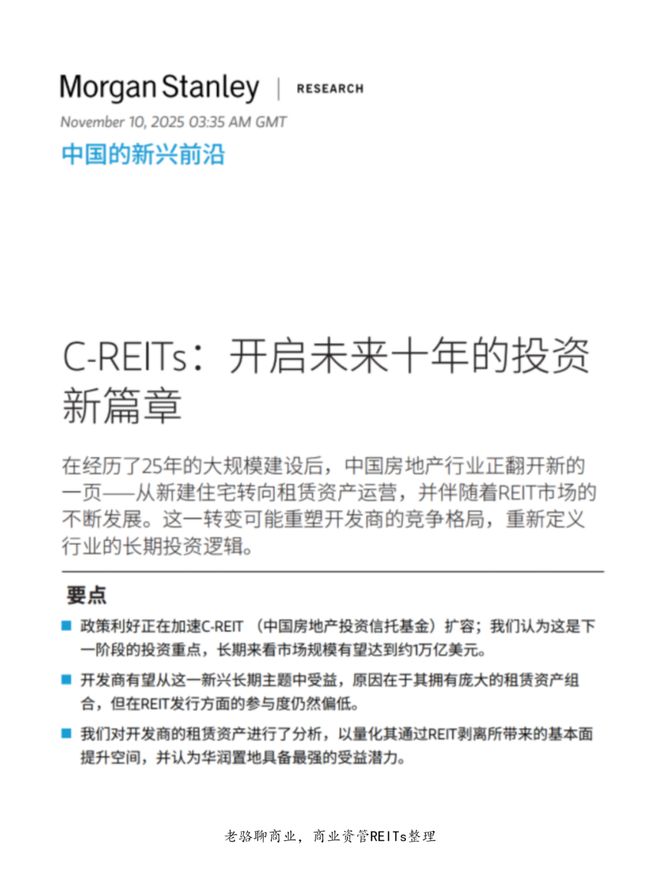
C-REITs:开启未来十年的投资新篇章
Xin Lang Cai Jing· 2025-11-19 04:31
Core Insights - The Chinese real estate industry is transitioning from new residential construction to rental asset operations, alongside the development of the REIT market, which may reshape the competitive landscape for developers and redefine long-term investment logic [1][3]. Group 1: C-REIT Expansion - Policy incentives are accelerating the expansion of C-REITs (China Real Estate Investment Trusts), with the market size expected to reach approximately $1 trillion in the long term [2][4]. - Developers are likely to benefit from this emerging long-term theme due to their large rental asset portfolios, although their participation in REIT issuance remains low [2][4]. - The analysis of developers' rental assets indicates that China Resources Land has the strongest potential for benefit from REIT spin-offs [2][4]. Group 2: Market Dynamics - Since Q3 2025, favorable policies have accelerated the issuance of domestic REITs, expanding the asset range and issuer backgrounds [6]. - C-REITs are expected to become an important asset class over the next 10 to 20 years due to their stable returns and low correlation with the stock market [6]. - The limited trading volume of C-REITs suggests that listed developers are a good entry point into this rapidly expanding theme [6]. Group 3: Key Beneficiaries - In-depth analysis shows that China Resources Land (1109.HK) has the highest short-term benefit potential, followed by New World Development (601155.SS) and Longfor Group (0960.HK) due to their large shopping center portfolios [7]. - Other companies with rich non-retail rental assets, such as China Overseas Land (0688.HK), China Merchants Shekou (001979.SZ), Vanke (2202.HK), and Poly Developments (600048.SS), may also benefit in the medium term as the REIT coverage expands [7]. Group 4: C-REIT Development History - The development of C-REITs over the past 25 years can be divided into four phases: initial preparation, gradual development, accelerated promotion, and full-speed phase [9]. - The regulatory framework for C-REITs was first proposed in the early 2000s, with significant progress made since the first public REIT was listed in mid-2021 [8][9]. Group 5: Current Market Status - As of September 2025, there are 75 publicly listed C-REITs with a cumulative issuance scale of approximately RMB 200 billion and a market value of about RMB 220 billion [10]. - Despite significant growth since the first public REITs were listed, C-REITs currently account for only 0.15% of the total market value of China's stock market [10]. Group 6: Future Potential - The potential market size for C-REITs is estimated to reach $1 trillion, which is 32 times the current market value of approximately $31 billion [15][16]. - The estimated value of commercial properties completed since 2000 is around $4.9 trillion, indicating a significant opportunity for C-REITs to capture a larger market share [14][15].

叶国富要「浪费」一亿签IP,我们和潮玩从业者聊了聊抢IP这件事
3 6 Ke· 2025-11-19 01:12
Core Insights - The industry is currently in a state of chaos, with companies like Miniso aggressively signing original IP artists to enhance their market position and prepare for potential IPOs [1][3] - The competition for IP in the toy industry has intensified, with both large and small companies seeking to establish unique identities and attract consumer interest [3][6] - New entrants are exploring innovative strategies, such as collaborations with celebrities and leveraging social media for IP discovery, to differentiate themselves in a crowded market [8][11] Group 1: Miniso's Strategy - Miniso's founder, Ye Guofu, announced plans to invest 100 million yuan in IP development, having already signed 17 artists [1][3] - The company's approach may be more about channel partnerships rather than exclusive ownership, as some signed artists are linked to other licensing companies [3][8] - Miniso's emphasis on IP could pressure other companies that rely on its distribution channels, potentially leading to a reduction in exposure for many IPs [8] Group 2: Market Dynamics - The toy industry is witnessing an influx of capital and new players, with companies like Letsvan and Mitaki also signing artists and enhancing their offerings [4][6] - The traditional methods of finding IP through exhibitions are becoming less effective, prompting companies to seek new avenues for discovery, including social media platforms [10][11] - The market is evolving towards a more consumer-centric approach, where emotional value and social attributes of products are becoming increasingly important [8][11] Group 3: Designer Perspectives - Designers are becoming more aware of their negotiating power and are seeking to maintain control over their IP, leading to a shift in how they engage with larger companies [14] - The entry of new designers into the market is creating a demand for fresh ideas, as established companies struggle to keep up with changing consumer preferences [14] - The industry is at a critical juncture, with designers needing to develop business acumen to navigate the evolving landscape effectively [14]


申万宏源证券晨会报告-20251119
Shenwan Hongyuan Securities· 2025-11-19 00:45
Group 1: Computer Industry Investment Strategy - The year 2025 marks the beginning of domestic computing power industrialization, with significant advancements in domestic AI chips and server architecture, enhancing overall computing performance [10] - The gap between Chinese and American large models is narrowing, with expectations of further convergence and potential surpassing in certain areas by 2026 [10] - The software industry is entering an optimal layout window as AI revenue for many companies exceeds 10%, indicating a technological revolution [10] - Investment focus areas include Deep Research, AI programming, multi-modal applications, and industry-specific agents [10] Group 2: Real Estate Industry Investment Strategy - The real estate market is expected to structurally bottom out, with five major opportunities identified, including stabilization of residents' balance sheets and improved housing affordability [12][18] - The policy direction will focus on stabilizing demand and promoting high-quality development, which will benefit real estate companies [18] - Predictions for 2025-2026 include a decline in sales volume and prices, but core cities are expected to stabilize sooner due to healthier supply-demand relationships [18] Group 3: Pharmaceutical Industry Investment Strategy - Chinese pharmaceutical companies are increasingly leading global multi-center clinical trials, with a growing number of new drugs successfully commercialized overseas [15] - The shift from "fast following" to "innovation leading" in drug development positions Chinese companies to redefine the global pharmaceutical landscape [15] - Investment directions include biotech transitioning to biopharma and the revaluation of traditional pharmaceutical companies during their innovation transformation [15]
存量时代倒逼运营升级 商业地产迈入“精耕细作”阶段
Zhong Guo Jing Ying Bao· 2025-11-18 03:00
Core Insights - The "14th Five-Year Plan" emphasizes expanding domestic demand as a strategic foundation, focusing on improving people's livelihoods and promoting consumption, which presents new opportunities for retail real estate [2][3] - The commercial real estate sector is entering a phase of differentiation and revitalization, with some companies recovering investment activities despite facing revenue challenges [2][3] - The demand for experiential consumption is increasing, indicating a shift in consumer preferences that retail commercial real estate must adapt to [3][4] Group 1: Market Trends - The total retail sales of consumer goods reached 36.5877 trillion yuan from January to September 2025, with a growth rate of 4.46% [3] - During the recent 8-day National Day and Mid-Autumn Festival holiday, domestic travel reached 888 million people, an increase of 123 million compared to the previous year, with total spending of 809 billion yuan, up 108.2 billion yuan [3] - The commercial real estate development investment is still facing growth challenges, with large enterprises capturing market share but struggling for continuous revenue growth, while small and medium-sized enterprises face operational difficulties [3][5] Group 2: Consumer Behavior - The middle-aged and elderly population, along with young consumers, are identified as key demographics with significant spending potential [4] - The middle-class consumer group is experiencing structural shifts, leading to a complex consumption mindset characterized by a desire for diverse products and services [4] - Companies are adopting strategies that integrate social media and personalized services to enhance customer engagement and attract consumers [4][5] Group 3: Business Strategies - Companies are focusing on optimizing existing assets and exploring new business models, such as the "light asset" approach to expand their market presence [5] - The competition in the commercial sector is intensifying, requiring businesses to innovate in content creation, unique experiences, and refined operations [5][6] - The overall short-term policy effects on consumption are becoming evident, although the recovery of investment remains slow, indicating a gradual restoration of market confidence [6]