鸣鸣很忙

Search documents
视频|鸣鸣很忙IPO新进展,上市备案已获通过
Xin Lang Cai Jing· 2025-12-11 14:17
炒股就看金麒麟分析师研报,权威,专业,及时,全面,助您挖掘潜力主题机会! 来源:零售圈头条 责任编辑:何俊熹 炒股就看金麒麟分析师研报,权威,专业,及时,全面,助您挖掘潜力主题机会! 来源:零售圈头条 责任编辑:何俊熹 ...
鸣鸣很忙:招股书梳理:高效供应链及数字化能力,构筑零食量贩行业头部企业-20251211
Hua Yuan Zheng Quan· 2025-12-11 11:10
Investment Rating - The report does not explicitly state an investment rating for the company Core Insights - The company, Ming Ming Hen Mang, is a leading player in the snack retail industry, with a total of 14,394 stores across 28 provinces in China as of December 31, 2024, indicating significant market penetration [6][2] - The Chinese food and beverage retail market is projected to reach 7.1 trillion yuan in 2024, growing at a CAGR of 5.2% from 2019 to 2024, with the snack retail segment expected to grow from approximately 2.9 trillion yuan in 2019 to 3.7 trillion yuan in 2024 [13][14] - The company primarily generates revenue through franchising, with franchise income accounting for 98.8% of total revenue in 2024, amounting to 38.89 billion yuan [28][37] - The company has a strong supply chain management system, combining self-operated and outsourced logistics, with 25 self-operated warehouses and 11 third-party warehouses, ensuring efficient distribution [50][51] Summary by Sections Company Overview - Ming Ming Hen Mang is positioned as a top player in the snack retail industry, having established a significant presence since its founding in 2016 and the acquisition of Zhao Yi Ming in 2023 [6][2] Market Growth - The food and beverage retail market in China is expected to grow steadily, with the snack retail segment projected to expand significantly, particularly in lower-tier cities [13][14][15] Revenue and Profitability - The company reported a revenue of 39.34 billion yuan and a gross profit of 2.999 billion yuan in 2024, reflecting a year-on-year increase of 282.15% and 288.31% respectively [28][31] - Adjusted net profit reached 910 million yuan in 2024, showing a substantial increase of 288.67% compared to the previous year [31] Franchise Model and Expansion - The company has rapidly expanded its franchise network, adding 8,083 new franchise stores in 2024, with a total of 14,379 stores by year-end [37][42] - Approximately 58% of the stores are located in county and town areas, indicating a strong focus on penetrating lower-tier markets [42] Supply Chain and Digitalization - The company employs a robust supply chain strategy, with a focus on digitalization to enhance efficiency in product selection, logistics, and store management [50][51] - The logistics costs as a percentage of total revenue have been effectively controlled, indicating superior management compared to industry peers [50] Product Offering and Pricing Strategy - The company emphasizes high-quality and cost-effective products, with an average price approximately 25% lower than similar products in offline supermarkets [47] - The product range includes over 1,800 SKUs per store, with a significant portion being custom products developed in collaboration with manufacturers [47]
野村东方国际 “日本化”忧虑渐退的另一视角
野村· 2025-12-11 02:16
Investment Rating - The report suggests a cautious investment approach towards the real estate market, particularly in first-tier cities, while highlighting potential opportunities in non-first-tier cities and developed county economies [10][21]. Core Insights - The Chinese real estate market is fundamentally different from Japan's, with a higher proportion of self-funding and manageable overall leverage, which mitigates systemic risks [1][2]. - Since 2020, China's manufacturing sector has seen an increase in leverage, with high-end manufacturing continuously enhancing global competitiveness, contrasting with Japan's asset-liability issues due to real estate speculation [1][2]. - The report emphasizes the importance of maintaining employment stability and improving household income expectations to avoid a deflationary spiral similar to Japan's [1][2]. - China's regional economy is developing in a multi-point flowering pattern, avoiding the polarization seen in Japan's major cities, with a more balanced distribution of industries [1][5]. - Non-first-tier cities and developed counties present significant growth prospects, with a more equitable distribution of large enterprises and active participation in global competition [1][7]. Summary by Sections Real Estate Market - The report identifies a trend of young people and retirees leaving first-tier cities in search of more suitable living conditions, with significant differences in housing repayment periods across city tiers [21]. - First-tier cities face longer repayment periods for home loans, with Beijing requiring 18 years of income to repay, while non-first-tier cities generally require around 10 years [21]. Consumer Behavior - Lower-tier consumers prioritize brand and symbolic consumption, while higher-tier consumers lean towards shared economy and personalized needs [23]. - The tea beverage industry shows significant growth in lower-tier markets, with brands like Gu Ming achieving a compound annual growth rate of 25.8% from 2022 to 2024 [24]. Economic Development - The report highlights that non-first-tier cities are successfully attracting young talent through improved living conditions and job opportunities, contrasting with the declining attractiveness of first-tier cities [16][17]. - County economies are thriving by leveraging local resources and developing unique economic models, leading to increased property market activity [20]. Investment Opportunities - Investors are advised to focus on consumer companies in non-first-tier cities and developed counties, while exercising caution with investments in first-tier and quasi-first-tier consumer companies [10].
好想你:公司始终以维护全体股东利益为宗旨
Zheng Quan Ri Bao· 2025-11-25 11:13
Core Points - The company "好想你" expressed its commitment to exercising shareholder rights and responsibilities in relation to its investment in "鸣鸣很忙" [2] - The company emphasizes the importance of maintaining the interests of all shareholders while respecting the independent legal status and operational autonomy of "鸣鸣很忙" [2] - The company will stay informed about "鸣鸣很忙's" operational status through participation in shareholder meetings and reviewing financial reports [2] Summary by Categories - **Shareholder Rights and Responsibilities** - The company will legally exercise its rights as a shareholder of "鸣鸣很忙" [2] - Participation in shareholder meetings and financial report reviews will be part of its approach [2] - **Commitment to Shareholder Interests** - The company prioritizes the maintenance of all shareholders' interests [2] - It adheres to relevant regulatory requirements in its operations [2] - **Operational Independence** - The company respects the independent legal status and operational autonomy of "鸣鸣很忙" [2] - Specific operational details of "鸣鸣很忙" should be referenced from its official disclosures [2]


食品饮料行业2026年度投资策略:新消费内部轮动传统消费底部改善
Yin He Zheng Quan· 2025-11-24 11:23
Investment Rating - The report maintains a "Buy" rating for the food and beverage industry, highlighting several key companies as investment opportunities [3][4]. Core Insights - The food and beverage industry is experiencing internal rotation in new consumption and improvement at the bottom of traditional consumption. The overall performance in 2025 was weak, primarily due to the adjustment in the liquor sector, but the long-term recovery trend for mass consumer goods remains intact [3][8]. - For 2026, structural opportunities are expected to continue, with new consumption showing internal rotation and traditional consumption gradually recovering from the bottom [3][15]. Summary by Sections Industry Overview - In 2025, the food and beverage sector's revenue grew by only 0.1% year-on-year, while profits fell by 14.6%, underperforming compared to the previous year. The industry index ranked last among 31 sub-industries with a decline of 4.8% [8][11]. - The adjustment in the liquor sector is identified as the main factor for the overall weak performance, while the recovery trend for mass consumer goods is expected to persist [8][11]. Soft Drinks - The beverage industry is projected to benefit from a rebound in travel demand in 2026, with a revenue increase of 6.2% in the first half of 2025 compared to the previous year [42][45]. - Cost advantages from declining prices of raw materials like sugar and PET are expected to continue, enhancing profit margins for beverage companies [45][49]. Snacks - The konjac snack sector is experiencing high growth, with companies like Salted Fish and Wei Long achieving significant revenue increases in 2025 [66][67]. - The competitive landscape for konjac products is expected to remain manageable, with established brands likely to maintain their market positions despite new entrants [70][76]. Dairy Products - The dairy sector is anticipated to see a recovery in supply-demand balance, with raw milk prices expected to stabilize in 2026 due to ongoing supply adjustments [38][39]. - Policies promoting consumption are expected to benefit liquid milk and milk powder sales, driving demand improvements [38][39]. Frozen and Condiment Products - The frozen food sector is expected to see performance improvements as competition stabilizes, with a focus on recovery in demand [38][39]. - The condiment sector is also projected to benefit from a gradual recovery in consumer demand [38][39]. Liquor - The liquor industry is still in an adjustment phase but is gradually approaching a bottoming out stage, with supply clearing expected to continue into 2026 [6][25]. - The report suggests that the long-term value of liquor stocks will become more apparent as the market stabilizes [6][25]. Investment Recommendations - Key companies to watch include Dongpeng Beverage, Nongfu Spring, and Moutai in the beverage sector, as well as Wei Long and Salted Fish in the snack sector [6][8].





金添动漫赴港上市:渠道、IP依赖症难解 与奥特曼授权方分道?
Xin Lang Zheng Quan· 2025-11-21 10:26
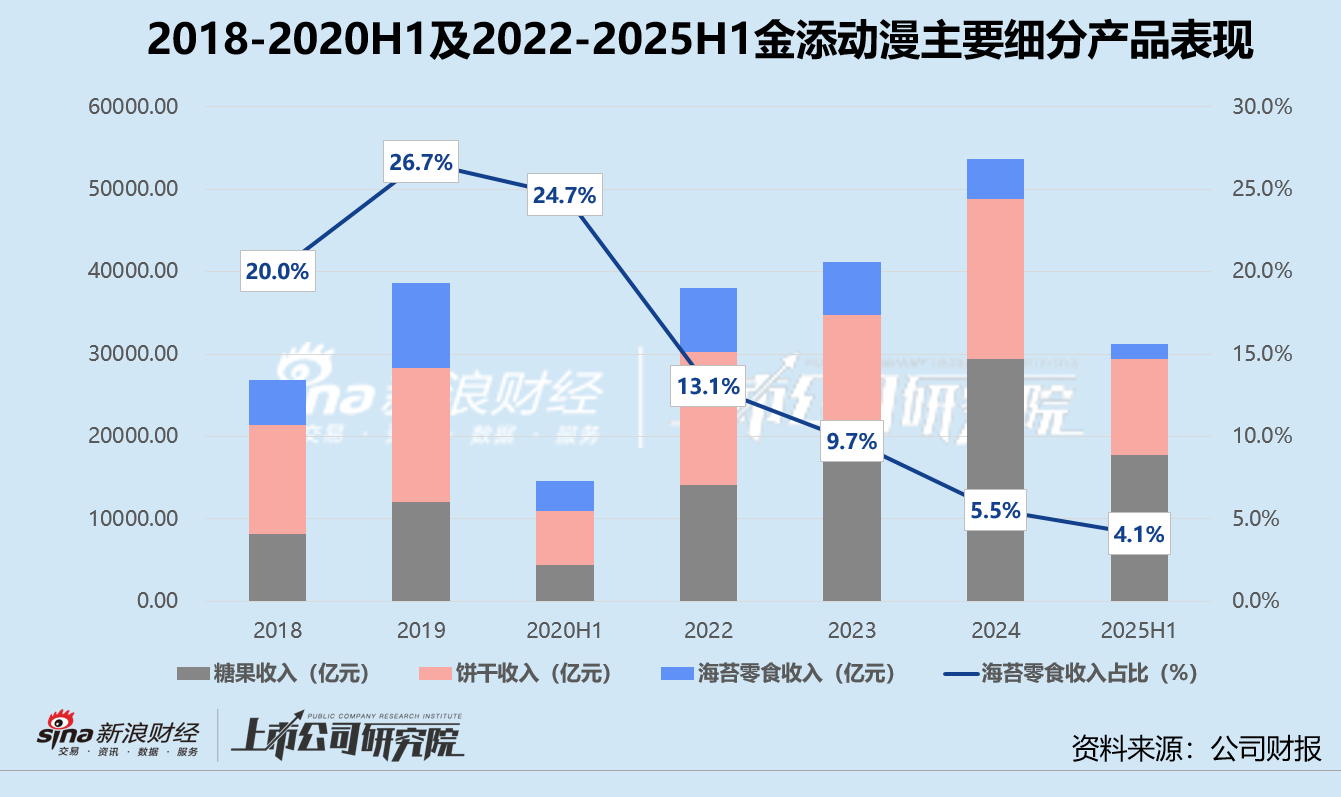
Core Viewpoint - The company Guangdong Jintian Animation Co., Ltd. (Jintian Animation) is preparing for an IPO on the Hong Kong Stock Exchange, aiming to capitalize on the growing market for IP-based consumer products, despite facing challenges in sales growth and reliance on key IPs like Ultraman [1][10]. Financial Performance - Jintian Animation's revenue is projected to grow from 5.96 billion RMB in 2022 to 8.77 billion RMB in 2024, with a compound annual growth rate (CAGR) of approximately 20.9% [1]. - Adjusted net profit is expected to rise from 36.86 million RMB in 2022 to 131 million RMB in 2024, reflecting a CAGR of 52.6% [1]. Sales and Inventory Challenges - The company has experienced a slowdown in growth, with revenue and adjusted net profit for the first half of 2025 increasing by only 9.8% and 13.4%, respectively [2]. - Sales of key product categories, including puffed snacks, chocolate, and seaweed snacks, have declined significantly, with year-on-year decreases of 25.0%, 31.8%, and 30.0% respectively in the first half of 2025 [3]. - Inventory levels have been rising, with total inventory reaching 76.18 million RMB in the first half of 2025, which is 93.6% of the total inventory for 2024 [5]. Customer Concentration and Sales Model Shift - The company has shifted its sales strategy from relying on distributors to direct sales to retail chains, with direct sales revenue increasing from 3.5% in 2022 to 43.2% in the first half of 2025 [6]. - This shift has led to increased customer concentration, with the top five customers accounting for 39.5% of total revenue by mid-2025, compared to only 4.1% in 2022 [7]. IP Dependency and Market Trends - Jintian Animation holds 26 licensed IPs, with Ultraman being the primary revenue driver, contributing 62.6% of total revenue in 2022, but its share has declined to 43.9% in the first half of 2025 [10]. - The company faces risks related to the expiration of IP licenses, with approximately 57.1% of its agreements set to expire within two years [11]. Management and Ownership Changes - Key management figures, including the actual controller of the Ultraman IP, have divested their stakes in the company, raising concerns about the future of the company's IP agreements and overall stability [14].
便宜零食,到底便宜了谁?
远川研究所· 2025-11-19 13:14
Core Viewpoint - The article discusses the challenges faced by snack brands like Three Squirrels in the e-commerce era, highlighting a shift in consumer preferences towards "bulk snack stores" and the impact of rising competition and costs in the online market [4][9][12]. Group 1: Industry Overview - The snack industry has low entry barriers but is highly fragmented, with the top five companies holding only 5.9% market share [8]. - The rise of bulk snack stores has significantly changed the competitive landscape, with these stores capturing 37% of the market share in 2024, surpassing e-commerce and supermarkets [13][15]. - The average profit margin in the snack industry is around 5%, making it sensitive to rising costs and competition [11]. Group 2: Company Performance - Three Squirrels has seen a decline in profitability, with net profit dropping from 411 million to 129 million in 2022 [9]. - The company has shifted its focus back to e-commerce, particularly on platforms like Douyin, which now accounts for 26.98% of its revenue [11]. - Despite the challenges, Three Squirrels remains a significant player, but its growth has stagnated, with revenue increasing without corresponding profit growth [6][9]. Group 3: Market Dynamics - The emergence of bulk snack stores has led to a price war, with these stores offering products at prices 20%-75% lower than supermarkets and 7%-59% lower than e-commerce [18][20]. - The rapid expansion of bulk snack stores, such as "Mingming Very Busy," has resulted in over 40,000 locations across China, with a significant number of stores located in lower-tier cities [15][22]. - The competition between bulk snack store brands has intensified, leading to aggressive marketing strategies and store openings in close proximity to competitors [30]. Group 4: Consumer Behavior - Consumers are increasingly drawn to lower-priced options, leading to a decline in brand loyalty among traditional snack brands [8][26]. - The rise of private label and lesser-known brands in bulk snack stores has contributed to the profitability of these stores, with private label products accounting for 60-65% of their inventory [26][30]. - The shift in consumer preferences towards bulk purchasing and lower prices has created a challenging environment for established snack brands [23][30].



美团闪购“双11”数据:人均消费增长近三成 400个品类、超800个品牌翻倍增长
Zheng Quan Shi Bao Wang· 2025-11-12 11:52
Core Insights - Meituan Flash Sale reported record highs in transaction volume, number of users, and per capita spending during the "Double 11" shopping festival from October 31 to November 11, with nearly 400 product categories seeing over 100% year-on-year growth [1] - High-priced products are driving a nearly 30% increase in per capita spending, with over 800 brands also experiencing more than 100% sales growth [1] - The introduction of the "Brand Official Flagship Lightning Warehouse" has led to a nearly 400% increase in overall sales for hundreds of brand flagship stores compared to pre-"Double 11" levels [1] Product Category Trends - The shopping behavior during "Double 11" reflects a clear trend towards "all categories, new categories, and high-priced items," with traditional and fresh product categories seeing explosive sales [1] - Specific high-demand items include mobile air conditioners, sports cameras, jade, gold, sports apparel, coffee machines, gaming consoles, platinum, and optical glasses, all experiencing over tenfold year-on-year sales growth [1] Flash Warehouse Performance - The Meituan Flash Warehouse has seen significant growth across all retail categories, with 3C home appliances sales increasing nearly 500%, and liquor and baby toys sales growing by 300% [2] - Notable sales increases in the liquor category include a nearly 400% rise in overall sales, with Moutai sales growing over 600% and other brands like Luzhou Laojiao and Jian Nan Chun seeing over 500% growth [2] - In the baby formula segment, sales for brands like Friso and Aptamil have increased by over 100% and nearly 300%, respectively [2] Retailer Performance - Multiple chain retailers have reported explosive sales during "Double 11," with Midea's store sales increasing over 30 times, and other retailers like Mingming Hen Mang and Zhongbai Electric seeing sales growth of over 20 times [2]

休闲食品行业专题报告之一:大浪淘沙,沉者为金
Guoxin Securities· 2025-11-11 11:18
Investment Rating - The report maintains an "Outperform" rating for the leisure food industry and specific companies such as Wei Long Mei Wei, Yan Jin Pu Zi, Jin Zai Food, and Wan Chen Group [4][5]. Core Insights - The leisure food market in China is projected to reach 1.344 trillion yuan in 2024, with a year-on-year growth of 5.3% and a CAGR of 4.4% from 2019 to 2024, expected to increase to 5.5% from 2025 to 2029 [1][15]. - The industry is characterized by a highly fragmented competitive landscape, with the top five and ten companies holding only 5.9% and 10.4% of the market share, respectively [1][22]. - Structural changes are reshaping the industry, including the rise of new retail channels, increased health consciousness among consumers, vertical integration in supply chains, and accelerated globalization efforts by leading companies [1][2][33]. Summary by Sections Industry Overview - The leisure food sector is a multi-billion market with diverse product categories, including snacks, nuts, and baked goods, focusing on fulfilling various consumer needs beyond mere hunger [15][18]. - The market is expected to continue expanding, with significant room for growth in per capita consumption, currently at 954.4 yuan, which is substantially lower than in the US and Japan [2][15]. Competitive Landscape - The industry is marked by intense competition and low concentration, with major players like Mars and Mondelez holding a small market share compared to their counterparts in the US [22][23]. - The competitive dynamics are shifting from price wars to differentiation and efficiency battles, as consumer demands become more diverse and nuanced [2][3]. Structural Changes - New retail formats such as bulk snack stores and instant retail are emerging, challenging traditional retail channels [33][34]. - Health awareness is driving innovation in product offerings, with a notable rise in demand for healthier snack options like konjac products, which are low in calories and high in dietary fiber [66][70]. Future Outlook - The report identifies three core drivers for industry growth: product innovation, scenario extension, and international expansion [2][3]. - Leading brands are expected to strengthen their market positions, with opportunities for both manufacturing and channel-focused companies to benefit from evolving consumer preferences and retail dynamics [2][3][4]. Company-Specific Insights - Wei Long Mei Wei and Yan Jin Pu Zi are highlighted as key players in the konjac snack segment, with significant revenue growth anticipated [3][70]. - Jin Zai Food is undergoing channel reforms and launching new products, while Wan Chen Group is expanding its discount supermarket presence, indicating potential for long-term growth [3][4].
业绩亮眼!2025上半年GMV 411亿元,鸣鸣很忙经营质效领跑行业
2 1 Shi Ji Jing Ji Bao Dao· 2025-11-11 06:49
Core Insights - The company "鸣鸣很忙" has submitted updated listing application materials to the Hong Kong Stock Exchange, showcasing strong financial performance and market leadership in the snack food and beverage retail sector [1][3]. Financial Performance - As of June 30, 2025, the company achieved a Gross Merchandise Value (GMV) of 41.1 billion RMB and revenue of 28.12 billion RMB, with an adjusted net profit of 1.034 billion RMB [1]. - The company reported a cash balance exceeding 2.394 billion RMB and a net current asset value of 2.827 billion RMB, indicating strong liquidity and efficient asset turnover [3]. - The net operating cash flow for the first half of 2025 was 1.395 billion RMB, reflecting robust cash generation capabilities [3]. Market Position - "鸣鸣很忙" has become the first company in the industry to surpass 20,000 stores by September 2025, solidifying its market-leading position [1]. - The company ranks among the top 10 in China's retail chain industry for 2024, being the only representative from the snack food sector [3]. Operational Efficiency - The company has demonstrated high operational efficiency with an inventory turnover period of only 11.7 days, significantly better than the industry average [3]. - The integration of its dual brands "零食很忙" and "赵一鸣零食" has enhanced supply chain and operational efficiency through standardized operations [3]. Industry Context - The Hong Kong IPO market is recovering, with a total fundraising of 107.1 billion HKD in the first half of the year, reflecting a sevenfold increase year-on-year [3]. - There are currently over 300 companies in the queue for listing on the Hong Kong Stock Exchange, indicating strong interest in the market [3].