石头科技

Search documents
2025家电收官:空调价格战白热化,港股上市潮涌
Bei Ke Cai Jing· 2025-12-31 13:41
谈及家电行业"内卷",格力电器董事长董明珠向记者表示,家电行业竞争非常激烈,大家不再追求技术 突破,简单地偷工减料,以价格忽悠用户。如果图便宜买1000元的空调,面临的维修成本远远大于购买 一台质量好的产品,劣质产品耗电量也是正常产品耗电量的翻倍。 市场"价格战"悄然改变行业格局。小米集团合伙人、总裁卢伟冰在2025年年初提到,"小米空调2024年 是中国市场第四名,今年目标坐稳第三名,最近提出2030年目标,在中国市场空调要做到数一数二。虽 然目标蛮难,但我认为小米机会很大。" 2025年收官,家电行业经历了市场竞争与资本布局的双重变革。空调赛道成为最热门领域,政策引导下 的多重补贴引发激烈价格战,"千元机"频现,行业均价结构性下探,不仅导致头部品牌市场份额收缩, 也让小米等新势力借机崛起,行业格局悄然生变。 资本市场方面,A股家电及消费电子企业赴港上市热潮涌动,奥克斯电气成功登陆港股,石头科技、极 米科技、视源股份等纷纷推进"H股上市"计划,以"A股+H股"双平台布局拓展融资渠道、加速全球化进 程,为行业发展注入新的资本动力,2026年行业竞争与布局或将更趋激烈。 价格战下,空调头部企业份额收缩 2025 ...

国投证券:2026年家电以旧换新政策出台 有望提振家电消费景气
智通财经网· 2025-12-31 06:58
智通财经APP获悉,国投证券发布研报称,2026年家电以旧换新政策落地,相较于2025年,明年补贴政 策支持范围有所缩小、补贴比例有所下调、更聚焦高能效产品,整体内容基本符合市场预期,有望刺激 家电内销边际改善,推动行业产品结构优化。预计国内家电消费将保持稳健表现,具有研发、渠道和品 牌优势的白电、黑电企业将更受益于新政策;外销方面,中美贸易冲突趋于缓和,关税压力有望降低, 且家电企业全球产能逐步释放,新兴市场持续贡献增量。 3)实施机制方面,2026年政策明确在全国范围内执行统一的补贴标准;建立补贴资金预拨制度,缓解企 业垫资压力;充分发挥不同销售渠道优势,支持线下实体零售;增加农村地区线下经营主体、引导线上 渠道向农村地区倾斜等方式,提高农村地区消费便利度。 2025年以旧换新政策有效刺激家电消费 据国家统计局数据显示,2025年1-11月份,全国限额以上单位家用电器和音像器材类商品零售额 YoY+14.8%。据央视新闻援引商务部消息,1-11月,全国家电以旧换新超12844万台,测算累计补贴金 额约827亿元,带动家电消费约4395亿元。家电以旧换新补贴政策带动更新需求释放,有效提振家电消 费景气。 2 ...
中企出海新篇:获全球超2000万家庭认可,石头科技以具身智能引领行业再进阶
Huan Qiu Wang· 2025-12-31 04:36
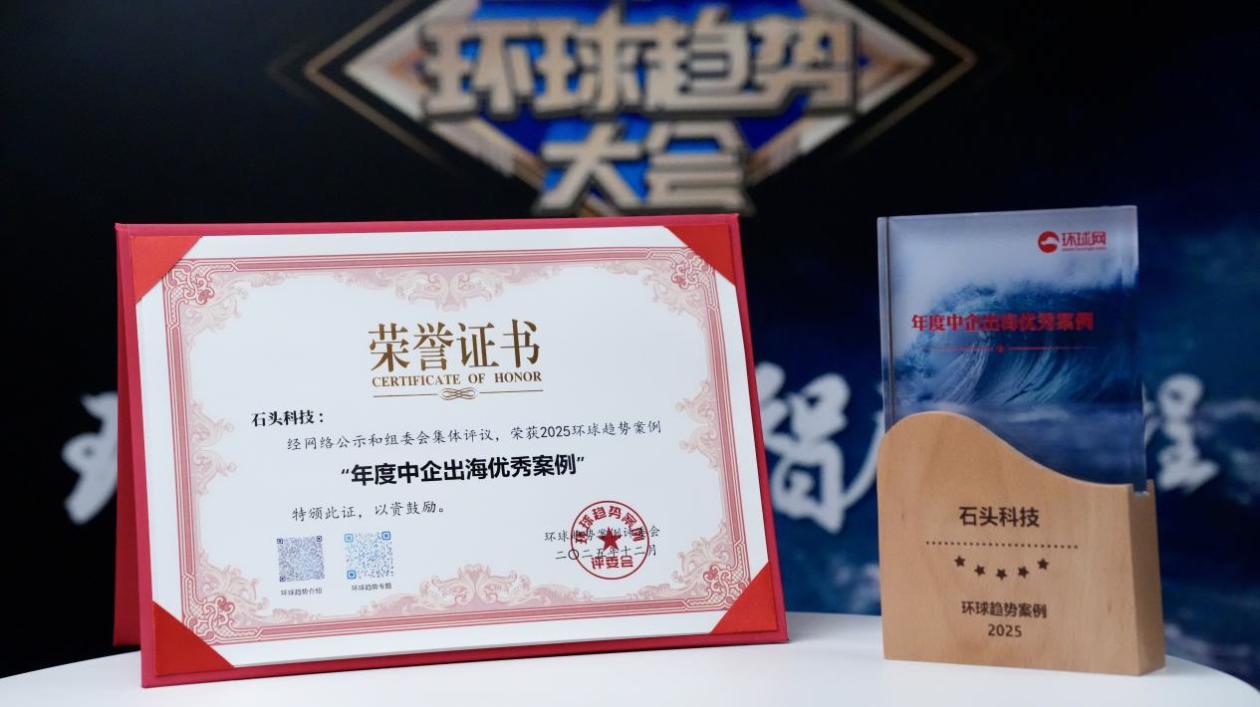
Core Insights - Stone Technology has been awarded the "Outstanding Case of Chinese Enterprises Going Global" for its exceptional global strategy and achievements, marking a significant recognition of its international market performance [1] - The award reflects the company's transition from "product export" to "brand export" and "value export," highlighting its commitment to high-quality and sustainable development [1] Group 1: Global Market Presence - Since its systematic overseas market layout began in 2018, Stone Technology has expanded its reach to over 170 countries and regions, serving more than 20 million households [2] - According to IDC, Stone Technology's smart vacuum robots ranked first in global shipments with a total of 3.788 million units shipped in the first three quarters of 2025, capturing a market share of 21.7% [2] Group 2: Product Development and Localization - The company has developed a mature localized operation system by deeply understanding user needs and market environments in different countries, focusing on "global layout and local deep cultivation" [5] - Stone Technology employs a "user feedback-driven R&D" strategy to quickly respond to regional demands, such as optimizing edge cleaning for the U.S. market and enhancing noise reduction for Japan [5] Group 3: Innovation and R&D Investment - From 2018 to the third quarter of 2025, Stone Technology's R&D investment as a percentage of revenue increased from 3.82% to 8.52%, significantly above the industry average [6] - The company holds 4,694 intellectual property rights as of June 2025, covering key areas such as navigation and obstacle avoidance [6] - The launch of the G30 Space exploration version vacuum cleaner in 2025 represents a significant innovation, featuring a five-axis folding bionic mechanical arm that enhances the robot's capabilities [6] Group 4: Future Outlook - Stone Technology aims to continue focusing on user needs, high-quality products, localized operations, and ongoing technological innovation to further its global brand development [8]


石头科技目标价涨幅近50% 三峡旅游评级被调低丨券商评级观察
2 1 Shi Ji Jing Ji Bao Dao· 2025-12-31 02:55
Group 1 - The core viewpoint of the article highlights the target price increases for listed companies, with notable mentions of Stone Technology and LiuGong, showing target price increases of 47.62% and 38.08% respectively, indicating strong bullish sentiment in the small home appliance and engineering machinery sectors [1][2]. - On December 30, a total of 29 listed companies received broker recommendations, with GuiGuan Electric and LiuGong each receiving recommendations from two brokers, while companies like Wanwei High New received one recommendation [3]. - The highest target price increase was for Stone Technology at 224.10 yuan, followed by LiuGong at 16.50 yuan, with other companies like XianDao Intelligent and BeiJiaJie also showing significant target price increases of 25.61% and 20.12% respectively [2][5]. Group 2 - On the downgrade side, only one company, Sanxia Tourism, had its rating lowered from "Buy" to "Hold" by CITIC Securities, indicating a cautious outlook in the tourism and scenic area sector [4]. - There were 11 instances of first-time coverage on December 30, with notable ratings including "Recommended" for Wanwei High New by China Galaxy Securities and "Buy" for XinZhu Co. by LianChuang Securities, reflecting a positive outlook for these companies in their respective industries [5].


机器人ETF鹏华(159278)盘中净申购5300万份,四部门推动智能机器人多环节规模化应用
Xin Lang Cai Jing· 2025-12-31 02:45
Group 1 - The National Robot Industry Index (980022) has shown a slight increase of 0.11% as of December 31, 2025, with notable gains from companies such as Boke Co., Ltd. (688160) up by 9.51% and iFlytek (002230) up by 2.68% [1] - The Ministry of Industry and Information Technology, along with three other departments, has issued the "Implementation Plan for Digital Transformation in the Automotive Industry," which aims to accelerate the application of artificial intelligence in key areas, promoting the large-scale use of intelligent robots in processes like welding, spraying, and assembly [1] - Huajin Securities indicates that by 2025, humanoid robots will enter a critical stage of industrialization, transitioning from the "0-1" phase to the "1-10" phase, with the demand for complex scene interactions driving an increase in component requirements [1] Group 2 - The top ten weighted stocks in the National Robot Industry Index (980022) as of November 28, 2025, include companies such as Double Ring Transmission (002472) and Ecovacs (603486), collectively accounting for 40.47% of the index [2] - The Robot ETF Penghua (159278) closely tracks the National Robot Industry Index, reflecting the price changes of listed companies related to the robot industry on the Shanghai and Shenzhen stock exchanges [1][3]




393亿“机器人一哥”,要IPO了
3 6 Ke· 2025-12-31 02:22
Core Viewpoint - The global vacuum cleaner robot industry is experiencing a resurgence, with Stone Technology, once a market leader with a market value of 393 billion yuan, officially starting its IPO journey in Hong Kong, potentially becoming the world's first publicly listed vacuum cleaner robot company [1][12]. Group 1: Company Background - Stone Technology, known as the "king of vacuum cleaner robots," attracted significant investment from top venture capital and private equity firms, including Xiaomi Group, and achieved a peak market value of over 1 trillion yuan in 2021 [1][2]. - The company faced challenges as the global market shifted, leading to a decline in its market value to 393 billion yuan, despite efforts to expand its market share and enter the capital-intensive fields of embodied intelligence and humanoid robots [1][10]. Group 2: Recent Developments - In a recent move, Stone Technology showcased its embodied intelligence robot in a documentary, indicating a strategic shift as it prepares for its Hong Kong IPO [2][11]. - The company has launched the "P10 Pro" vacuum cleaner robot, priced at 3,999 yuan, which quickly became a bestseller, contributing to a 15.54% year-on-year increase in overall sales [8][12]. Group 3: Financial Performance - For the first three quarters of 2025, Stone Technology reported revenue of 12.066 billion yuan, a year-on-year increase of 72.22%, but net profit decreased by 29.51% [12]. - The company is facing cash flow challenges, with a net cash flow from operating activities of -1.06 billion yuan due to rising raw material and R&D costs, highlighting the urgency for funding through the upcoming IPO [12].
2026年家电以旧换新政策出台,有望提振家电消费景气
Guotou Securities· 2025-12-31 02:04
Investment Rating - The report assigns an "A" rating for the investment in major appliance companies such as Midea Group, Haier Smart Home, and Gree Electric Appliances, indicating a "Buy" recommendation with target prices of 94.68, 31.81, and 50.60 CNY respectively [4]. Core Insights - The 2026 appliance replacement policy is expected to boost consumer demand for home appliances, focusing on energy-efficient products and providing subsidies of 15% of the product price, capped at 1500 CNY per item [1][2]. - The 2026 policy has optimized the subsidy scope, reducing the number of supported appliance categories from eight to six, and lowering the subsidy rate from 20% to 15% for high-efficiency products [2][11]. - The first batch of funding for the 2026 policy amounts to 625 billion CNY, a 23% decrease from the previous year's 810 billion CNY, indicating a potential decline in total subsidy funds for the year [2][12]. Summary by Sections Policy Changes - The 2026 policy focuses on six categories: refrigerators, washing machines, televisions, air conditioners, computers, and water heaters, excluding other appliances like stoves and microwaves [2][11]. - The subsidy for high-efficiency products is now set at 15% of the sales price, with a cap of 1500 CNY per item, and consumers can only receive one subsidy per product category [2][11]. Market Impact - The 2025 replacement policy effectively stimulated appliance consumption, with retail sales of home appliances increasing by 14.8% year-on-year from January to November 2025, and over 12.84 million units replaced [3]. - The introduction of the 2026 policy is expected to improve domestic appliance sales, despite some pressure on consumption due to earlier demand release and high base effects [3][9]. Investment Recommendations - The report suggests focusing on three investment themes: 1. High-quality white goods companies with strong cash flow and high dividend yields, such as Midea Group and Haier Smart Home [9]. 2. Companies with strong global capabilities, particularly in emerging markets where appliance penetration is low [9]. 3. Technology-driven appliance companies that are expanding into new business areas, leveraging AI and robotics to enhance product offerings [9].



石头科技目标价涨幅近50%;三峡旅游评级被调低
2 1 Shi Ji Jing Ji Bao Dao· 2025-12-31 01:53
Group 1 - The core viewpoint of the article highlights the target price increases for listed companies, with notable gains for Stone Technology and LiuGong, showing increases of 47.62% and 38.08% respectively, indicating strong market confidence in these companies [1][2] - On December 30, a total of 29 listed companies received broker recommendations, with GuiGuan Electric and LiuGong each receiving two recommendations, reflecting their strong market positions in the electric power and engineering machinery sectors [3] Group 2 - On the downgrade side, only one company, Sanxia Tourism, had its rating lowered by CITIC Securities from "Buy" to "Hold," indicating a cautious outlook for this company in the tourism and scenic area [4][5] - A total of 11 companies received initial coverage from brokers on December 30, with notable mentions including Wanwei High-tech receiving a "Recommended" rating from China Galaxy Securities and LiuGong receiving a "Strong Buy" rating from Huachuang Securities, showcasing the interest in these sectors [6]
石头科技目标价涨幅近50%;三峡旅游评级被调低丨券商评级观察
2 1 Shi Ji Jing Ji Bao Dao· 2025-12-31 01:46
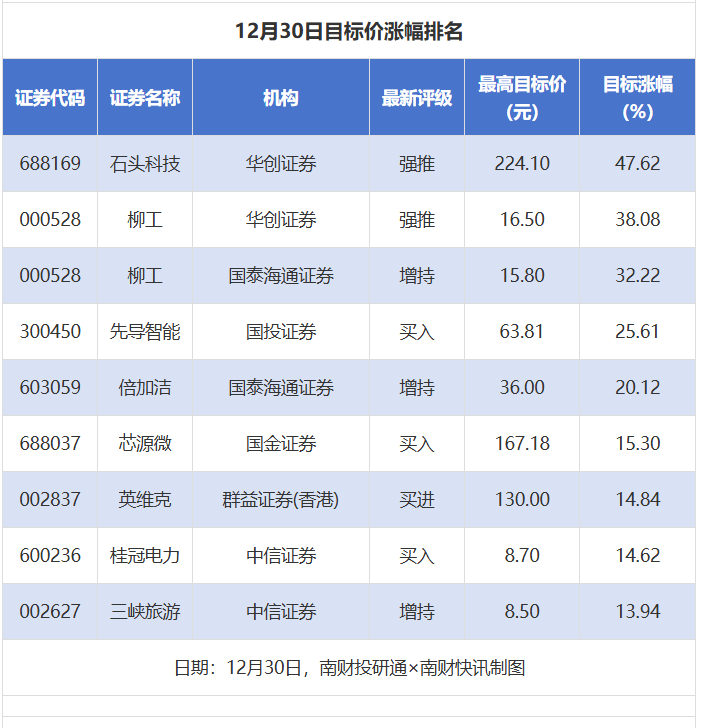
Group 1 - The core viewpoint of the article highlights significant target price increases for certain companies, specifically Stone Technology and LiuGong, with target price increases of 47.62% and 38.08% respectively, indicating strong market confidence in these firms within the small home appliance and engineering machinery sectors [1] - On December 30, a total of 9 target price adjustments were made by brokerages for listed companies, reflecting ongoing market activity and analysis [1] - Additionally, there was a downgrade in the rating of one company, China Citic Securities lowered the rating of Three Gorges Tourism from "Buy" to "Hold," indicating a more cautious outlook for this company [1]
家用电器行业投资策略周报-20251230
CAITONG SECURITIES· 2025-12-30 13:17
Core Insights - The report maintains a positive outlook on the home appliance sector, particularly focusing on the cost reduction potential of aluminum replacing copper in air conditioning systems [2][5] - The adoption of aluminum-copper technology is seen as a significant step towards reducing production costs amid rising copper prices and resource scarcity [10][15] Group 1: Aluminum-Copper Technology Impact - The use of aluminum instead of copper in air conditioning units can lead to substantial cost savings, with estimates suggesting a reduction of 208 to 277 RMB per unit when replacing 50% of copper, and up to 416 to 554 RMB when replacing 100% [11][12] - Copper currently constitutes about 26% to 33% of the cost in standard air conditioning units, with high-end models reaching over 40% [11][12] - The global market has seen significant adoption of aluminum-copper products, particularly in Japan where approximately 40% to 50% of air conditioners use aluminum heat exchangers [15][16] Group 2: Domestic Market Challenges - Despite the cost advantages, the domestic promotion of aluminum-copper air conditioners faces challenges, including inferior thermal conductivity and corrosion resistance compared to copper [19][20] - Consumer perception is a major barrier, as negative opinions about aluminum's reliability persist, complicating market acceptance [19][20] - The first domestic aluminum-copper air conditioner was launched by Wanbao in collaboration with JD.com, targeting the mid-to-low-end market, which may help accelerate industry-wide material transitions [16][17] Group 3: Industry Performance and Trends - The home appliance sector has shown mixed performance, with the overall index increasing by 0.44%, while specific segments like white goods and black goods experienced varied changes [21][22] - Recent data indicates a decline in domestic sales growth for air conditioners, refrigerators, and washing machines, reflecting broader market challenges [33][47] - The report highlights the importance of monitoring raw material prices, with copper and aluminum prices showing significant fluctuations that could impact production costs [29][31]