
喜临门

Search documents
净利增长企业占比不足四成 去年上市家居公司整体承压
Huan Qiu Wang· 2025-05-12 03:31
Core Viewpoint - The home furnishing industry continues to face deep adjustments and transformation pressures, with many leading companies experiencing declines in both revenue and net profit [1][3]. Group 1: Revenue Performance - The top five companies by revenue for 2024 are: Oppein Home (¥18.925 billion), Kuka Home (¥18.480 billion), Henglin Home (¥11.029 billion), Sofia (¥10.494 billion), and Xilinmen (¥8.729 billion) [1]. - Among the top five companies, only Henglin Home (34.59% growth) and Xilinmen (0.59% growth) achieved revenue growth, while Oppein Home (-16.93%), Sofia (-10.04%), and Kuka Home (-3.81%) saw declines [3]. - In a broader analysis of 64 listed home furnishing companies, 39 companies (approximately 60%) reported revenue growth year-on-year [2]. Group 2: Profit Performance - Only Sofia reported a year-on-year increase in net profit among the top five companies, achieving ¥1.371 billion (8.69% growth), while Oppein Home's net profit fell by 14.38% to ¥2.599 billion, and Kuka Home's net profit decreased by 29.38% to ¥1.417 billion [3]. - Overall, 23 out of 64 listed companies (less than 40%) reported a year-on-year increase in net profit [2]. Group 3: Industry Challenges - The home furnishing industry is facing significant challenges due to a reduction in bulk transactions and engineering procurement, as the real estate industry's boom period has ended, prompting companies to focus more on the C-end retail market [1]. - The common challenges highlighted by multiple companies include the weak demand stemming from the adjustment in the real estate market [4]. Group 4: Strategic Shifts - In response to industry adjustments, some leading companies are accelerating their transition to a "big home" model, integrating product categories, optimizing channels, and enhancing services to create new growth drivers [7]. - Oppein Home has expanded its retail "big home" stores to over 1,100, increasing by more than 450 stores since the beginning of the year, and its overseas revenue grew by 34.42% to ¥430 million [7]. - Sofia is also transitioning towards a "big home" strategy, expanding its product offerings across various categories [8]. Group 5: International Expansion - Henglin Home is pursuing growth through "manufacturing overseas + brand overseas" strategies, with overseas revenue reaching ¥9.887 billion, accounting for nearly 90% of total revenue [9]. - The company has seen a 196.47% increase in online sales to ¥4.325 billion, driven by its cross-border e-commerce initiatives [9].
4月出口仍显韧性,Q1全球AI眼镜倍增
Huafu Securities· 2025-05-11 10:40
Investment Rating - The report maintains an "Outperform" rating for the light industry sector [3] Core Insights - In April, China's overall exports showed resilience, with a year-on-year increase of 8.1% in export value, although exports to the U.S. declined by over 20% [8] - The global sales of AI smart glasses reached 600,000 units in Q1 2025, marking a 216% year-on-year growth, driven primarily by the success of Ray Ban Meta smart glasses [8] - The report continues to recommend sectors benefiting from new consumer trends, particularly in personal care and trendy toys [8] Summary by Sections Light Industry Manufacturing - The light industry manufacturing sector outperformed the market with a 3.02% increase in the index from May 6 to May 9, 2025, compared to a 2.00% increase in the CSI 300 index [17] - Sub-sectors such as entertainment products (+3.91%) and home goods (+3.30%) showed strong performance [17] Home Furnishing - In March, the furniture retail sales increased by 29.5% year-on-year, while the furniture export value decreased by 7.8% in April [45] - The report highlights the potential for recovery in the home furnishing sector as consumer confidence gradually improves [6] Paper and Packaging - As of May 9, 2025, the prices of various paper products showed mixed trends, with double glue paper at 5,250 CNY/ton (-56.3 CNY/ton) and boxboard paper at 3,506.6 CNY/ton (+2.4 CNY/ton) [55] - The paper industry experienced a cumulative revenue decline of 1.4% in the first quarter of 2025, with a sales profit margin of 2.7% [69] New Consumer Trends - The report emphasizes the growth in the AI smart glasses market, with expectations of 5.5 million units sold in 2025, driven by new product launches from various brands [8] - Recommendations include focusing on companies like Mingyue Optical and Kangnai Optical, which are positioned to benefit from this trend [8] Textile and Apparel - The textile and apparel sector also outperformed the market, with a 3.47% increase in the index from May 6 to May 9, 2025 [27] - The report suggests monitoring leading brands in apparel and outdoor products as domestic consumption policies begin to take effect [27]
喜临门(603008):24Q4国补带动电商高增 25年加大费用投放优化
Xin Lang Cai Jing· 2025-05-11 00:29
Core Viewpoint - In Q1 2025, the company's revenue decreased by 1.76% year-on-year, with stable performance expected from its own brand, showing a decline in offline sales but over 30% growth online, while engineering business grew steadily by over 10% [1][3] - The net profit attributable to shareholders in Q1 2025 decreased by 4.02% year-on-year, mainly due to the pre-expensing of brand costs [1][3] - The mattress products led growth in 2024, with national subsidies accelerating online growth and offline channels turning positive in Q4 2024 [1][4] Financial Performance - In 2024, the company achieved revenue of 8.729 billion yuan, an increase of 0.59%, while the net profit attributable to shareholders was 322 million yuan, a decrease of 24.84% [2] - In Q1 2025, the company reported revenue of 1.73 billion yuan, down 1.76% year-on-year, and a net profit of 71 million yuan, down 4.02% [2][3] - The basic EPS for Q1 2025 was 0.19 yuan, remaining flat compared to the previous year [2][3] Business Segments - In 2024, the company's mattress, soft bed and supporting products, sofa, and wooden furniture revenues were 5.27 billion, 2.44 billion, 720 million, and 170 million yuan, respectively, with the mattress segment showing steady growth [4][5] - The online revenue for the company's own brand in 2024 was 1.98 billion yuan, an increase of 9.9%, with Q4 growth exceeding 20% [5] Cost and Profitability - The gross margin for 2024 was 33.67%, a decrease of 0.70 percentage points, with the mattress segment gross margin at 38.40% [6] - The net profit margin for 2024 was 3.69%, down 1.25 percentage points, primarily due to increased sales expenses [6] - The company plans to optimize its expense allocation strategy, expecting an improvement in profitability [1][6] Future Outlook - The company aims to focus on the retail sector, optimizing offline channels and enhancing store efficiency while expanding online channels to new platforms [1] - Revenue projections for 2025-2027 are 9.46 billion, 10.11 billion, and 10.76 billion yuan, with expected year-on-year growth rates of 8.3%, 6.9%, and 6.4% respectively [6]

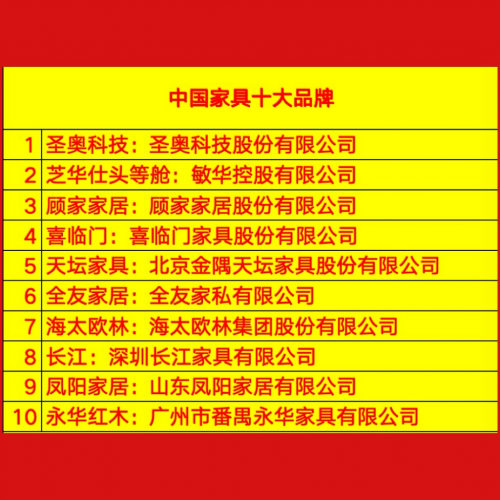
探秘中国家具十大品牌:解码行业 “顶流” 们
Zhong Guo Chan Ye Jing Ji Xin Xi Wang· 2025-05-10 08:42
Industry Overview - The Chinese furniture industry is undergoing profound changes driven by globalization and consumption upgrades, with brand competitiveness becoming a key indicator of maturity [1] - The China Furniture Association has released a list of the top ten furniture brands, highlighting companies like Saint-Ao Technology, Kuka Home, and Qianyu Furniture as industry benchmarks [1] Company Highlights - **Saint-Ao Technology**: Founded in 1991, it focuses on office commercial furniture and has developed a dual-driven strategy for ecological office development. The company emphasizes innovation and has established a global R&D network, leading to a range of smart office furniture products [3] - **Kuka Home**: Established in 1982, it offers a comprehensive range of furniture products, focusing on comfort, fashion, and environmental sustainability. The brand has made significant advancements in smart furniture and maintains a robust sales and logistics network [6] - **Xilinmen**: Founded in 1984, it specializes in high-quality mattresses and has a strong focus on sleep health. The brand integrates advanced materials and manufacturing techniques to enhance product quality and comfort [7] - **Qianyu Furniture**: Established in 1986, it aims to provide one-stop green and personalized home solutions. The brand emphasizes quality, environmental protection, and value, with a strong focus on board furniture and sofas [9] - **Tian Tan Furniture**: Founded in 1956, it offers a diverse range of products and has a strong market presence in China. The brand focuses on green home development and has a comprehensive sales and service network [8] - **Hai Tai Ou Lin**: Established in 1996, it specializes in smart office and healthcare furniture, emphasizing sustainable development and quality craftsmanship [10] - **Changjiang Furniture**: Founded in 1986, it focuses on high-quality office furniture and has a strong technical foundation in product development [11] - **Fengyang Furniture**: Established in 1973, it specializes in mattresses and aims to create a new healthy sleep environment while promoting Eastern sleep culture [12] - **Yonghua Red Wood**: Founded in 1986, it is a leader in the redwood furniture sector, combining traditional craftsmanship with modern design elements [13] Conclusion - The release of the top ten furniture brands not only recognizes their achievements but also showcases the high-quality development of the entire furniture industry. These brands set new benchmarks in product quality, design innovation, market expansion, and social responsibility [13][14]

路桥通、建配套、以水兴城!顺德区111个重点项目集中亮相
Nan Fang Du Shi Bao· 2025-05-09 01:24
Group 1: Key Projects and Investments - In May 2025, Shunde District launched 111 key projects, including 23 completed projects with a total investment of approximately 15.3 billion yuan, 29 new projects with about 9.9 billion yuan, and 59 ongoing projects totaling around 27.5 billion yuan [1] - The Shunde Bridge, a major transportation project, officially opened, significantly alleviating traffic pressure and reshaping the development landscape of the eastern urban area [3] - A total of 18 water environment governance projects were introduced, with investments exceeding 6.3 billion yuan, aimed at enhancing urban quality and promoting a modern waterfront city [5] Group 2: Transportation Development - In 2025, Shunde initiated 22 new transportation projects with a total investment of about 6.9 billion yuan, while 14 ongoing projects have a total investment of 9.7 billion yuan [3] - The construction of the Shunde New Port Phase II is expected to enhance the logistics system in the Guangdong-Hong Kong-Macao Greater Bay Area [3] - Future transportation networks in Shunde aim to achieve a "30-60" time-space goal, connecting major cities within 60 minutes and enhancing internal accessibility [4] Group 3: Energy Supply and Infrastructure - Shunde's electricity consumption has seen significant growth, with a 9.49% increase in total electricity usage and a 12.17% rise in industrial electricity consumption in the previous year [9] - The district is undergoing a historic expansion in power grid construction, with multiple substations being built to improve power supply quality and support economic development [9][10] - A three-year investment plan for the power grid is set to exceed 16.3 billion yuan in Shunde, focusing on enhancing energy supply for industrial upgrades [10] Group 4: Healthcare Projects - Major healthcare projects, including the Guangzhou University of Chinese Medicine Shunde Hospital, are progressing, with the first phase expected to provide services by July [11][12] - The total investment in healthcare infrastructure in Shunde has reached nearly 7 billion yuan, aimed at improving medical services and creating a comprehensive health service model [12]
24、25Q1家居板块综述:国补促经营修复,盈利能力分化,赛道进入精细化运营阶段
Xinda Securities· 2025-05-08 14:01
Investment Rating - The investment rating for the home furnishing sector is "Positive" [2] Core Insights - The report highlights that the national subsidy policy has begun to show effects, leading to a convergence in revenue decline and a differentiation in profitability within the industry. The real estate sector has gradually reached its bottom after a year of adjustment, with new home transactions stabilizing and second-hand home transactions recovering. The home decoration market is expected to maintain a "442" structure in 2024, with new homes accounting for 40%, existing homes for 40%, and second-hand homes for 20% [2][9] - Leading companies in the home furnishing sector are transitioning from store expansion to refined operations, focusing on cost reduction and exploring new market opportunities such as home renovation and e-commerce. For instance, Oppein has encouraged dealers to consolidate resources and close inefficient stores, significantly reducing various assessment indicators to focus on market advantages [2][3][9] Industry Overview - The national subsidy policy has normalized, positively impacting domestic sales. In Q4 2024, leading companies like Kuka and Zhijia showed revenue growth, with Kuka's domestic sales increasing by approximately 12.9% year-on-year in Q1 2025. The report anticipates that orders and revenues for leading companies will see tangible growth starting from Q2 2025 [3][10] - In terms of exports, companies like Kuka and Oppein are expected to maintain double-digit growth in overseas sales, with Oppein establishing a solid sales network in 146 countries and regions, achieving a revenue increase of 34.4% in overseas channels in 2024 [4][11] Segment Analysis - The core categories, particularly cabinets and wardrobes, are showing signs of recovery, with supporting categories also improving. Leading companies are actively implementing whole-home strategies and enhancing scene-based designs. For example, Oppein is building a more comprehensive supply chain system for home products and renovation materials [5][6] - The report notes that the profitability of leading companies is diverging, with Oppein achieving a gross margin of 34.3% in Q1 2025, while others like Zhijia experienced a decline in gross margin due to internal reforms and channel subsidies [7][9] Sales Channels - Retail channels are recovering first, while bulk channels are under pressure, with a general decline of over 20% in Q1 2025. The report indicates that the performance of single stores has improved, with leading companies like Oppein and Zhijia reporting year-on-year revenue increases of 10% and 43%, respectively [6][9]


2024年上市家居企业净利润整体承压,行业仍面临深度调整,专家称“不得不更重视C端零售市场”
Mei Ri Jing Ji Xin Wen· 2025-05-08 07:49
Core Viewpoint - The home furnishing industry is facing significant challenges due to a reduction in bulk transactions and engineering procurement, leading companies to focus more on the retail market for consumers [1] Industry Overview - The home furnishing industry is undergoing deep adjustments and transformation pressures, with many leading companies experiencing declines in both revenue and net profit [2] - By the end of 2024, the top five companies by revenue are: Oppein Home (18.925 billion), Kuka Home (18.480 billion), Henglin Home (11.029 billion), Sofia (10.494 billion), and Xilinmen (8.729 billion) [2] - Among these top companies, only Henglin Home and Xilinmen saw revenue growth, with increases of 34.59% and 0.59% respectively; only Sofia achieved net profit growth of 8.69% [2][3] Performance Analysis - In 2024, 39 out of 64 listed home furnishing companies reported revenue growth, accounting for about 60%; however, only 23 companies reported net profit growth, which is less than 40% [3] - Companies with notable revenue growth include Zhongyuan Home (+45.42%), Henglin Home (+34.59%), and Yongyi Home (+34.22%); while those with significant net profit growth include Qu Mei Home (+46.49%), Sentai Shares (+32.89%), and Songlin Technology (+26.65%) [3] - The top five companies by revenue saw declines: Oppein Home (-16.93%), Sofia (-10.04%), and Kuka Home (-3.81%) [3] Sector Challenges - The custom home furnishing sector is particularly affected, with leading companies like Oppein and Sofia experiencing revenue shrinkage, and others like Shangpin Home and PIANO facing losses exceeding 100 million [4] - The soft furniture sector also shows losses, with Mengbaihe reporting a net loss of 151 million [4] Market Dynamics - The common challenge across the industry is the weak demand stemming from adjustments in the real estate market [8] - The home decoration market is expected to maintain a "442" structure, with new homes (40%), existing homes (40%), and second-hand homes (20%), which puts pressure on both engineering and retail channels [8] Strategic Shifts - In response to industry challenges, some leading companies are accelerating their transition to a "big home" model, integrating product categories and optimizing channels [10] - Oppein Home has expanded its retail "big home" stores to over 1,100, increasing by more than 450 stores compared to the beginning of the year, and has seen overseas revenue grow by 34.42% to 430 million [10] - Sofia is also transitioning to a "big home" strategy, expanding its product categories to cover a wide range of home furnishing needs [11] Growth Initiatives - Henglin Home is pursuing growth through "manufacturing and brand going overseas," with overseas revenue reaching 9.887 billion, accounting for nearly 90% of total revenue [12] - The company has seen a 196.47% increase in online sales, reaching 4.325 billion, and has expanded its product offerings beyond office chairs to include soft furniture and new material flooring [12]
家装厨卫换新:智能化、适老化成心头好
Sou Hu Cai Jing· 2025-05-07 01:15
Core Insights - The new home renovation policy in Shanxi Province, which includes a subsidy of up to 18,000 yuan for 40 categories of products, has significantly boosted sales in the home improvement sector, particularly in smart bathroom products [1][2][5] Group 1: Policy Implementation - The "old for new" policy covers 40 categories of home improvement products, including tiles, smart toilets, and elderly-friendly handrails, with a maximum annual subsidy of 18,000 yuan per household [1][3] - The policy has led to a notable increase in sales, with some stores reporting a doubling of sales in smart bathroom categories during the first quarter of implementation [1][2] Group 2: Consumer Behavior - Consumers are taking advantage of the dual benefits of government and store subsidies, leading to increased purchases of home improvement products, especially in the bathroom category [2][4] - The policy has prompted consumers to upgrade their homes, with many opting for more comfortable and modern products, such as smart toilets and beds [2][4] Group 3: Market Trends - The introduction of smart and elderly-friendly products is driving new consumption patterns in the kitchen and bathroom sectors, with products like AI health toilets gaining popularity [4][5] - The overall retail sales in Shanxi Province reached 192.75 billion yuan in the first quarter, reflecting a year-on-year growth of 5.9%, indicating a release of consumer potential driven by market upgrades and policy support [5] Group 4: Subsidy Details - The subsidy structure allows consumers to receive a 15% discount on eligible products, with an additional 20% discount for energy-efficient items, applicable for up to five purchases per category [3][6] - Consumers must register on a service platform to qualify for the subsidies, which are directly deducted at the point of sale [6]
喜临门家具股份有限公司 关于公司控股股东部分股份解除质押的公告
Zhong Guo Zheng Quan Bao - Zhong Zheng Wang· 2025-05-05 23:22
Core Viewpoint - The announcement details the release of share pledges by the controlling shareholder of Xilinmen Furniture Co., Ltd., indicating a significant reduction in pledged shares and ongoing share repurchase activities by the company [2][3][6]. Group 1: Share Pledge Release - The controlling shareholder, Zhejiang Huayi Intelligent Manufacturing Co., Ltd., holds 84,799,659 shares, accounting for 22.38% of the total share capital. After the release of the pledge, a total of 40,670,000 shares are pledged, representing 47.96% of their holdings and 10.73% of the total share capital [2][3]. - Together with its concerted actions, including Shaoxing Yuecheng Huahan Equity Investment Partnership and the actual controller Chen Ayu, they collectively hold 133,910,234 shares, which is 35.33% of the total share capital. After the release of the pledge, a total of 65,520,000 shares are pledged, representing 48.93% of their holdings and 17.29% of the total share capital [2][3]. Group 2: Share Repurchase Progress - The company plans to repurchase shares using its own funds, with a total repurchase amount not less than RMB 100 million and not exceeding RMB 200 million. The repurchase price is capped at RMB 22 per share, with a timeframe of 12 months from the approval date [5][6]. - As of April 30, 2025, the company has repurchased 7,550,400 shares, which is 1.99% of the total share capital. The highest transaction price was RMB 20.60 per share, and the lowest was RMB 14.83 per share, with a total expenditure of RMB 129.99 million (excluding transaction fees) [6].
轻工行业24A&25Q1业绩综述:新消费表现亮眼,补贴链刺激效果初显
SINOLINK SECURITIES· 2025-05-05 08:23
Investment Rating - The report indicates a positive outlook for the home furnishing sector, driven by domestic consumption stimulus and the gradual recovery of retail channels [1]. Core Insights - The report highlights that the domestic consumption stimulus is beginning to show effects, with a notable recovery in retail channels, while export conditions are experiencing marginal declines [1][3]. - The performance of leading companies in the home furnishing sector is improving, particularly in the context of national subsidies and strategic adjustments [1][3]. Summary by Sections 1. Home Furnishing - Domestic sales show signs of recovery with a year-on-year revenue change of -12.44% in Q4 2024 and +1.75% in Q1 2025, while net profit for the same periods changed from -54.11% to +7.07% [13]. - Export performance for the furniture sector saw a cumulative year-on-year increase of +5.8% for 2024 but a decline of -8.0% in Q1 2025, indicating a downward trend in export conditions [13]. - The report anticipates that the domestic market will continue to recover in the short term due to national subsidy policies, while the export market may face ongoing pressures [13]. 1.1 Domestic - Custom Home Furnishing - Retail channels are showing marginal improvements, while bulk channels remain under pressure, with leading companies like Oppein and Sophia experiencing reduced revenue declines in Q1 2025 compared to previous quarters [20]. - The profitability of leading companies is improving, with a focus on cost control and product development, while second and third-tier brands may struggle to maintain performance [26]. - Prepayment and cash flow indicators show improvements for some leading companies, suggesting a gradual recovery in demand [38]. 1.2 Domestic - Soft Home Furnishing - The soft home furnishing sector is under pressure due to real estate downturns and changing consumer spending patterns, but companies like Kuka and Mengbaihe are showing signs of recovery [39]. - Profit margins are improving in Q1 2025 compared to 2024, with notable changes in gross and net profit margins across leading companies [44]. - Prepayment figures for soft home furnishing companies are showing positive growth, indicating a recovery in domestic demand [46]. 1.3 Export Home Furnishing - The overall export climate is declining, with a significant drop in cumulative export value in Q1 2025, reflecting challenges in the international market [51][53]. - Despite the overall decline, leading companies are still managing to perform well, showcasing resilience and strategic advantages [51].

