Stellantis N.V.

Search documents
UK vehicle output down 14.3% in November
Yahoo Finance· 2025-12-19 13:48
Core Insights - UK vehicle production experienced a significant decline of 14.3% in November, with 65,932 units produced, primarily due to a 1.7% decrease in car output and a drastic 78.0% drop in commercial vehicle production [1][2] Group 1: Vehicle Production Trends - Car production fell for the fourth consecutive month, with only 1,090 fewer cars produced compared to the same month last year, as production stabilizes post-cyber incident at Jaguar Land Rover [2] - Commercial vehicle output has decreased for eight months in a row, influenced by Stellantis/Vauxhall's consolidation of two plants into one, resulting in the closure of the Luton plant and upgrades at Ellesmere Port [2] Group 2: Market Performance - Overall car production for the UK market increased by 46.9% to 14,589 units, while export output declined by 10.6%, with shipments to the top five export markets (EU, US, Türkiye, China, and Japan) all experiencing reductions [3] - A total of 48,537 cars were produced for global markets, accounting for over 76.9% of total output [3] Group 3: Regulatory and Investment Climate - The week was mixed for the sector, highlighted by the commencement of next-generation volume electric car production in Sunderland, contrasted with the European Commission's plans to impose new CO2 targets and public subsidies tied to vehicles made in the EU [4] - The SMMT emphasized the need for the UK to avoid unnecessary complexity and uncertainty that could deter business investment decisions [5]
价格打“骨折”,曾“高攀不起”的进口豪车,找中国车企“求带”
Mei Ri Jing Ji Xin Wen· 2025-12-19 12:44
Core Viewpoint - The imported luxury car market in China is experiencing significant price reductions and declining sales, with domestic brands gaining market share and competitiveness [1][5][7]. Group 1: Price Reductions - Maserati's Grecale model, once priced around 900,000 yuan, is now available for as low as 358,800 yuan, reflecting a discount of over 60% [1][2]. - Aston Martin's DBX model has seen its price drop from 2,448,000 yuan to between 1,600,000 and 1,700,000 yuan, equating to a discount of approximately 35% [3]. - Porsche's 718 model is being offered at a significant discount, with prices as low as 50,000 yuan after adjustments [4]. Group 2: Market Trends - The imported car market in China has seen a decline from 1.43 million units in 2014 to 400,000 units in 2025, marking a 30% year-on-year decrease [5][6]. - Maserati's sales in China have plummeted from 14,400 units in 2017 to just 1,228 units in 2024, a drop of over 70% [5]. - The overall luxury car market is under pressure, with domestic brands capturing 68.5% of the passenger car market share in the first half of 2025, up 6.6 percentage points year-on-year [7][8]. Group 3: Competitive Landscape - Domestic high-end brands are increasingly competitive, offering better technology and features at similar price points, which is impacting the sales of imported luxury vehicles [7][8]. - The shift in consumer preferences towards domestic brands is evident, as they provide more intelligent and higher-configured products compared to traditional imported luxury cars [8][9]. - Foreign luxury brands are adapting by integrating into local supply chains and developing models specifically for the Chinese market, such as BMW and Mercedes-Benz's new production plans [10][11].
特斯拉、Stellantis等车企“躲过一劫”!意监管机构放行 接受整改承诺并不予罚款
智通财经网· 2025-12-19 10:48
Core Insights - The Italian Competition Authority (AGCM) has concluded its investigation into Stellantis, Tesla, BYD, and Volkswagen regarding potential unfair commercial practices related to electric vehicle (EV) range, battery capacity degradation, and warranty disclosures [2] Group 1: Investigation Findings - AGCM initiated the investigation in February, accusing the companies of providing unclear and sometimes contradictory information about EV range on their websites [2] - The authority highlighted that consumers often struggle to obtain accurate information about battery performance and lifespan, which hinders their purchasing decisions [2] Group 2: Company Commitments - The investigated companies have agreed to modify their website information to present clearer details to consumers [2] - AGCM accepted the companies' commitments to improve disclosures and decided not to impose financial penalties [2] - Additionally, the companies will introduce vehicle range simulation tools to allow consumers to compare models within the same market segment [3] - Stellantis, BYD, and Volkswagen are required to enhance their warranty policies regarding battery capacity degradation [3]



特斯拉(TSLA.US)、Stellantis(STLA.US)等车企“躲过一劫”!意监管机构放行 接受整改承诺并不予罚款
Zhi Tong Cai Jing· 2025-12-19 10:45
Core Viewpoint - The Italian Competition Authority (AGCM) has concluded its investigation into Stellantis, Tesla, BYD, and Volkswagen regarding potential unfair business practices related to electric vehicle (EV) range, battery capacity degradation, and warranty disclosures [1] Group 1: Investigation Findings - AGCM initiated the investigation in February, accusing the four automakers of providing unclear and sometimes contradictory information on their websites regarding EV range and battery performance [1] - The authority highlighted that consumers often struggle to obtain accurate information about battery performance and lifespan, which hinders their purchasing decisions [1] Group 2: Company Commitments - The automakers have agreed to modify their website information to present clearer details to consumers [1] - Stellantis, BYD, and Volkswagen will introduce a vehicle range simulation tool to allow consumers to compare models within the same market segment [2] - The companies are also required to enhance their warranty policies concerning battery capacity degradation [2]

放弃内燃机禁令后,欧洲与美国仍有很大差异
Guan Cha Zhe Wang· 2025-12-19 09:19
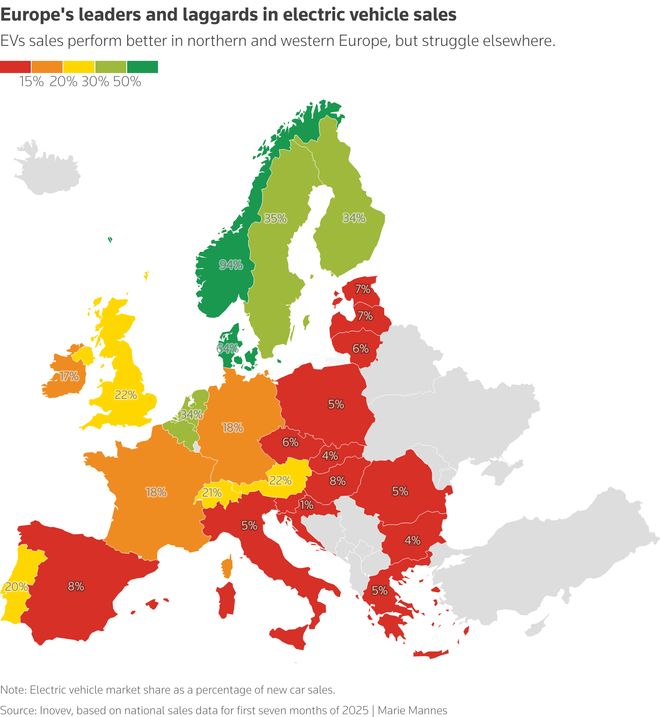
Group 1 - The EU's decision to abandon the 2035 ban on internal combustion engine vehicles provides traditional automakers in Europe with more time to transition, but electric vehicles remain the future, making it difficult for Europe to compete with China's electric vehicle industry in the long run [1] - The new EU rules allow plug-in hybrids, range-extended vehicles, and even fuel vehicles to be sold legally after 2035, and a new category for small electric vehicles has been introduced, providing additional credit for European manufacturers [2][6] - The European Automobile Manufacturers Association (ACEA) reported that electric vehicle sales in the EU increased by 25.7% year-on-year, accounting for 16.4% of total sales, but the market share is still low in Southern and Eastern Europe [2] Group 2 - Analysts predict that by 2035, pure electric vehicles will only account for 62% of sales in Europe, with slow charging infrastructure being a major barrier to higher adoption rates [5] - High-end brands like Porsche, Mercedes, and BMW may benefit the most from the EU's policy shift, as their customer base is more interested in traditional mechanical structures [5] - The EU's decision aims to give European manufacturers time to develop cost-competitive electric vehicles to catch up with Chinese brands, which have been expanding in the European market despite tariffs [6][8] Group 3 - The EU's policy shift has faced criticism from industry stakeholders and environmental organizations, with over 150 CEOs, including those from Volvo and Polestar, supporting the original 2035 ban [12] - The EU's approach contrasts with the U.S. under the Trump administration, which has withdrawn support for electric vehicles [5] - The policy changes have raised concerns among automakers about the impact on their investments, as many have spent billions on electric vehicle development and factory expansions [10]
又来!美国汽车燃效标准“开倒车”
Zhong Guo Qi Che Bao Wang· 2025-12-19 01:34
Group 1 - The Trump administration has announced a rollback of fuel economy standards for new vehicles in the U.S., reducing the average requirement for 2031 models to 34.5 miles per gallon, significantly lower than the current standard of 50.4 miles per gallon [2][4] - The new standards will require only a 0.5% annual increase in fuel efficiency from 2023 to 2026, and a further reduction to 0.25% thereafter, contrasting with the previous administration's requirement of a 2% annual increase [4][10] - The average price of new cars in the U.S. has reached approximately $49,105, with inflation and high production costs being major concerns for consumers [4][5] Group 2 - Major automakers, including General Motors and Ford, have expressed support for the new fuel economy standards, stating that they align better with market realities and will allow for investment in more affordable vehicles [6] - Critics, including environmentalists and some state governments, argue that the rollback will have detrimental effects on air quality and climate change, potentially increasing fuel costs for consumers [6][7] - Analysts have raised concerns that the administration's claims regarding the impact of fuel economy standards on car prices may overlook other significant factors, such as supply chain issues and consumer preferences for larger vehicles [7][8] Group 3 - The Trump administration's policies have systematically reversed the electric vehicle support framework established under the Biden administration, including withdrawing from the Paris Agreement and halting funding for electric vehicle infrastructure [8][9] - The recent "Big and Beautiful" legislation has eliminated penalties for automakers not meeting fuel economy standards, further reducing the incentive for electric vehicle production and impacting the carbon credit market [9] - The ongoing public comment period for the new fuel economy regulations indicates that the final decision will be a contentious issue within the automotive industry, with potential implications for vehicle production strategies [10]

销量腰斩,车企停产,特朗普取消联邦购车退税补贴,美国电动车行业进入寒冬!中美电车行业为何冰火两重天?
Sou Hu Cai Jing· 2025-12-19 01:28
Core Viewpoint - The cancellation of federal electric vehicle tax credits by the Trump administration has plunged the U.S. electric vehicle industry into a downturn, leading to a significant drop in sales and a shift in focus among traditional automakers towards hybrid and gasoline vehicles [2][3][7]. Group 1: Impact of Policy Changes - The federal electric vehicle tax credit, which provided $7,500 for new electric vehicle purchases and $4,000 for used ones, was abruptly terminated, causing a dramatic decline in electric vehicle sales [3][10]. - In September, prior to the policy change, electric vehicle sales surged by 40% year-on-year, but in October, sales plummeted by 30.3% year-on-year and 49% month-on-month, resulting in only 91,000 units sold [3][4]. - By November, sales further declined by 40% year-on-year to 76,000 units, with the market penetration rate dropping to 5.1%, a level not seen since early 2022 [4][6]. Group 2: Market Dynamics and Brand Performance - Tesla's sales fell by 35% and 23% in October and November, respectively, yet its market share increased from 43% to 57% [6]. - Other automakers faced even steeper declines, with Kia's EV6/EV9 sales down 71% and 68%, Ford's Mach-E/F-150 Lightning down 61%, and Honda's Prologue down 80% and 87% [6]. - Rivian was one of the few brands to show growth, with a 7.6% increase in November despite a 15% drop in October [6]. Group 3: Structural Issues in the U.S. Market - The U.S. electric vehicle market's reliance on government support has been highlighted, with analysts predicting a continued decline in demand due to the lack of incentives [7][9]. - The U.S. electric vehicle market is expected to see a slight decline in sales and penetration rate next year, with projections indicating a return to single-digit penetration rates by 2025 [9][10]. - The cancellation of subsidies and the lack of consistent policy have created an unpredictable environment for automakers, hindering long-term planning [9][10]. Group 4: Consumer Sentiment and Market Conditions - The price gap between electric and gasoline vehicles remains significant, with electric vehicles averaging $59,200 compared to $47,500 for gasoline vehicles, a 25% difference [10][11]. - The cancellation of subsidies exacerbates this price disadvantage, making electric vehicles less appealing to consumers, especially as gasoline prices decline [10][11]. - Concerns about charging infrastructure and the overall cost of ownership further deter potential buyers, with a significant shortage of charging stations relative to the number of electric vehicles [13][14]. Group 5: Traditional Automakers' Strategic Shifts - Traditional automakers are scaling back their electric vehicle ambitions, shifting focus to hybrid and gasoline models in response to market realities [14][15]. - General Motors announced a $1.6 billion impairment loss related to its electric vehicle business and adjusted its production targets downward [15][18]. - Ford reported a $19.5 billion asset impairment, with significant losses in its electric vehicle division, leading to a strategic pivot towards hybrid models [19][21]. Group 6: Competitive Landscape and Global Context - The U.S. electric vehicle market is lagging behind China, which accounted for 1.1 million electric vehicle sales last year, representing a 40% year-on-year growth [9][24]. - Ford's CEO acknowledged the technological gap between U.S. and Chinese electric vehicle manufacturers, emphasizing the need for U.S. companies to adapt and innovate [24][26].
销量腰斩,车企停产,美国电动车进入寒冬|硅谷观察
Xin Lang Cai Jing· 2025-12-19 00:06
Core Viewpoint - The cancellation of federal electric vehicle tax credits by the Trump administration has plunged the U.S. electric vehicle industry into a downturn, leading to a significant drop in sales and a shift in focus by traditional automakers towards hybrid and gasoline models [2][28]. Group 1: Impact of Policy Changes - The federal electric vehicle tax credit, which provided $7,500 for new electric vehicle purchases and $4,000 for used ones, was terminated on October 1, marking a significant turning point for the industry [3][29]. - Following the announcement, electric vehicle sales surged by 40% in September, but plummeted by 30.3% year-over-year and 49% month-over-month in October, with sales dropping to 91,000 units and market penetration falling to 5.8% [3][29]. - November saw an even steeper decline, with sales down 40% year-over-year to 76,000 units and market penetration further decreasing to 5.1% [4][30]. Group 2: Market Dynamics and Brand Performance - Tesla's sales fell by 35% and 23% in October and November, respectively, yet its market share increased from 43% to 57% [6][32]. - Other automakers faced severe declines, with Kia EV6/EV9 sales down 71% and 68%, Ford's Mach-E/F-150 Lightning down 61%, and Honda's Prologue down 80% and 87% [6][32]. - Rivian was one of the few brands to show growth, with a 7.6% increase in November despite a 15% decline in October [6][32]. Group 3: Structural Issues in the U.S. Market - The U.S. electric vehicle market's reliance on government support has been highlighted, with analysts predicting a continued decline in sales and market penetration in the coming years [7][33]. - The lack of continuity and predictability in U.S. electric vehicle policies has created challenges for long-term planning among automakers [9][35]. - The average price of electric vehicles remains significantly higher than gasoline vehicles, with a $5,920 difference, exacerbated by the removal of tax credits [10][36]. Group 4: Traditional Automakers' Strategic Shifts - Traditional automakers are shifting from aggressive electrification goals to more conservative strategies, focusing on hybrid and gasoline models due to the current market conditions [14][40]. - General Motors announced a $1.6 billion impairment loss related to its electric vehicle business and adjusted its production targets downward [15][42]. - Ford has also made significant adjustments, including a $19.5 billion asset impairment and a shift in focus from electric to hybrid models, with plans to halt production of the F-150 Lightning electric truck [19][45]. Group 5: Comparison with China - The disparity between the U.S. and Chinese electric vehicle markets is stark, with China accounting for a significant portion of global electric vehicle sales [7][33]. - U.S. automakers face challenges not only in sales but also in technological advancements, with executives acknowledging the need to catch up with Chinese competitors [24][50].


欧盟汽车“禁燃令”缘何松动
Xin Hua She· 2025-12-18 14:41
Core Viewpoint - The European Commission has proposed to relax the 2035 "ban on fuel vehicles" requirements, adjusting the new car "zero-emission" target to a "90% reduction" from 2021 levels, allowing some fuel vehicles to enter the market under specific conditions [1][2]. Group 1: Policy Changes - The European Council passed a regulation in March 2023 to ban the sale of new fuel-powered cars and small commercial vehicles starting in 2035, which was seen as a key strategy for decarbonizing the transport sector [2]. - The recent proposal allows for plug-in hybrid vehicles, range-extended vehicles, mild hybrid vehicles, and internal combustion engine vehicles to be sold after 2035, indicating a significant policy shift [2][4]. - This adjustment is viewed as the largest retreat in green policy by the EU in the past five years, aimed at providing breathing room for the electric transition in Europe [1][4]. Group 2: Industry Reactions - Major automotive manufacturers from Germany and Italy, as well as companies like Stellantis and Mercedes-Benz, have pressured the EU for this policy change, arguing that a single-path transition could undermine the resilience and survival of the European automotive industry [2][4]. - German Chancellor Merz welcomed the proposal, stating it is a pragmatic and economically reasonable approach that aligns with current market realities [2]. - BMW acknowledged the importance of recognizing the viability of internal combustion engines for the future [2]. Group 3: Concerns and Criticism - Critics, including automotive economist Ferdinand Dudenhöffer, argue that the proposal is the "worst possible solution," failing to provide a clear direction for industry transformation and potentially delaying investment and innovation [3]. - The proposal signals hesitation and compromise, which may lead to indecision in corporate strategy and wasted time in the transition process [3]. Group 4: Industry Challenges - The European automotive industry faces structural pressures, with electric vehicles accounting for only 16.4% of new car registrations from January to October this year [4]. - The transition is hindered by an immature electric vehicle market, insufficient charging infrastructure, and supply chain issues [4]. - Rising energy prices and tariffs from the U.S. have increased cost pressures, leading to profit declines among major German automakers [4]. Group 5: Diverging Positions - There are significant divisions within the EU regarding the adjustment of the fuel vehicle ban, with some member states advocating for "technological openness" to ensure investment confidence [5]. - Conversely, some European automakers and environmental organizations oppose the policy relaxation, fearing it will slow the transition and weaken Europe's long-term competitiveness in the new energy sector [5][6]. - Executives from companies like Volvo and Polestar express concerns that policy reversals undermine confidence in EU regulations and could harm climate goals [5][6].
欧盟“撤回”2035全面电动化
Bei Jing Shang Bao· 2025-12-18 14:21
Core Viewpoint - The European Commission has proposed to relax the 2035 ban on the sale of fuel vehicles, adjusting the new car "zero emissions" target to a "90% reduction" in emissions, allowing some fuel vehicles to remain in the market under specific conditions [1][3]. Policy Adjustments - The adjustment of the emission reduction policy is a significant change from the original 2021 target of a complete ban on new fuel vehicles by 2035, which aimed to force the automotive industry towards electrification [3]. - The latest proposal allows for a 90% reduction in emissions compared to 2021 baseline levels, with the remaining 10% potentially offset by using low-carbon steel, synthetic fuels, or non-food biofuels [3][4]. Industry Reactions - Major European automakers, including Volkswagen and Stellantis, have expressed concerns about weak demand for electric vehicles and have called for relaxed carbon emission targets [4]. - German automakers like BMW and Volkswagen support the proposal, viewing it as a pragmatic approach that aligns with current market realities [4]. Internal Divisions - There are significant divisions within the EU regarding the adjustment of the fuel vehicle ban, with some member states advocating for "technological openness" while others, including environmental organizations, oppose the relaxation of policies [5]. - Companies like Volvo and Polestar have voiced strong opposition to the policy shift, arguing it undermines the commitment to electrification and damages trust in EU regulations [5]. Market Dynamics - The European automotive industry is facing structural pressures, with hybrid vehicle registrations increasing while gasoline vehicle registrations have declined [7]. - The cost pressures from high energy prices and tariffs have further complicated the transition to electric vehicles, leading to profit declines among major German automakers [7][8]. Long-term Trends - Despite current challenges, the long-term trend towards electrification remains strong, with the market share of electric vehicles in the EU continuing to grow [8]. - In the first ten months of 2025, new registrations of pure electric vehicles reached approximately 1.47 million, representing a market share of 16.4%, an increase from 13.2% in the previous year [8].