
银华基金

Search documents
这么多QDII跑赢了纳指啊~
Sou Hu Cai Jing· 2026-02-11 12:45
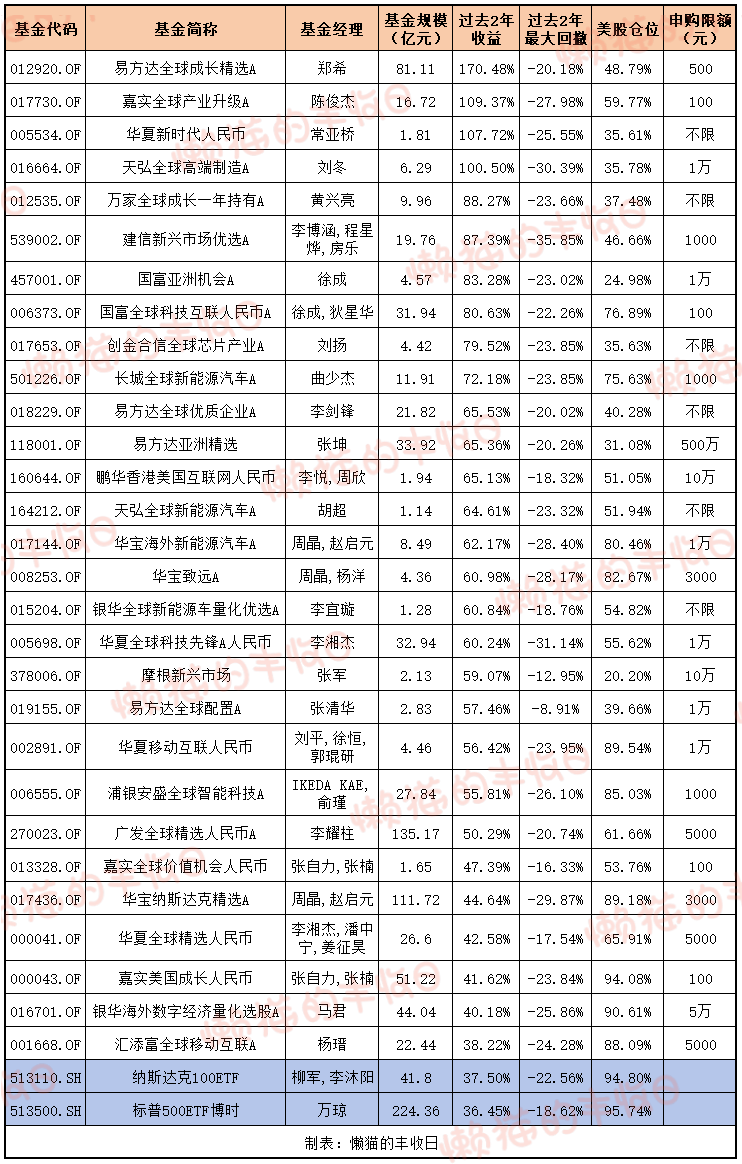
Core Insights - A significant number of QDII active funds have outperformed the Nasdaq 100 ETF and S&P 500 ETF over the past two years, contrary to the common belief that active funds struggle to beat indices [1]. Fund Performance - The top-performing fund, "E Fund Global Growth Select A" managed by Zheng Xi, achieved a return of 170.48% over the past two years, surpassing the Nasdaq 100 ETF by over 130 percentage points [1]. - Other notable funds include "Jia Shi Global Industry Upgrade A" with a return of 109.37% and "Hua Xia New Era RMB" at 107.72% [1]. - The performance of these funds is attributed to significant adjustments in their holdings, particularly in overseas computing power and semiconductor stocks [4][6]. Stock Holdings - Zheng Xi's fund made substantial adjustments in Q2 2025, heavily investing in stocks like Nvidia, Broadcom, AMD, and Microsoft, which contributed to a 43.28% increase in Q2 and a 20.4% rise in Q3 [4]. - The fund's net value continued to rise, with a 132.32% increase since April 8, 2025, and a maximum drawdown of only 8.75% [6]. Comparison with Other Funds - Other funds such as "Jia Shi Global Value Opportunity RMB" and "Hua Bao Nasdaq Select A" also performed well, but did not match the impressive returns of "E Fund Global Growth Select A" [11][13]. - Funds focused on AI applications, innovative pharmaceuticals, and cryptocurrency concepts, like "Wan Jia Global Growth One-Year Holding A," showed more balanced holdings but did not achieve the same level of performance [9]. Market Trends - The overall market trend indicates that while the Nasdaq index has been relatively flat since November, the semiconductor stocks held by these funds have continued to rise, mitigating currency losses and widening the performance gap with the Nasdaq ETF [16]. - The strong earnings growth of major U.S. companies supports the ongoing rise in the stock market, with the median earnings growth of the Russell 3000 reaching a four-year high [30].



指数与创新产品研究系列之十七:2025海外ETF:高拥挤格局下的发展启示
Shenwan Hongyuan Securities· 2026-02-11 10:42
1. Report's Industry Investment Rating No information regarding the industry investment rating is provided in the report. 2. Core Viewpoints of the Report - The US ETF market has witnessed continuous and rapid growth in scale, with an increasing proportion of alternative products. Newly issued products show characteristics such as a focus on single - stock products, a higher number of active products than passive ones, and a significant increase in strategy complexity and comprehensiveness. - The US ETF market presents trend - like features, including intense competition among core broad - based products, significant differences in fees based on strategy complexity and scarcity, large differences in institutional ownership among different product types, and managers' forward - looking layout of potential market concerns. - For the domestic ETF business, it is necessary to focus on management details for highly crowded broad - based products, make forward - looking layouts for industry - themed products, and strengthen the "timely promotion" of different products [2]. 3. Summary According to the Directory 3.1 US ETF Scale Continues to Break Through Rapidly, and the Proportion of Alternative Products Increases - In 2025, the total scale of US ETFs reached $13.45 trillion, with a scale increase of 30%. The number of newly issued ETFs reached 1,078, and the total number of all US ETFs reached 4,814, a net increase of 950 compared to the end of 2024. The proportion of alternative products in the newly issued products increased significantly, driving the proportion of alternative products in the entire market to reach 30%. Newly issued bond and money - market funds also had good scales [2][8][10]. - **Single - stock products become the focus of issuance**: Single - stock products were first issued in 2022, and the number of newly issued products in 2025 was the highest. Leveraged products had the largest scale and number, followed by option products. These products are more and more widely distributed, covering different sectors, and the market capitalization of the underlying stocks is also decreasing. The issuance is related to market attention. The single - stock Covered Call products are mainly for high - volatility stocks, aiming to achieve more certain returns through stable high - option premium dividends [18][19]. - **The number of active products exceeds that of passive products**: As of the end of 2025, the number of active ETF products in the US reached 2,682, exceeding the 2,132 passive products, with a total scale of $1.5 trillion. Alternative products are the category with the highest proportion in terms of both quantity and scale. The scale of option - strategy products exceeds $200 billion, making it the most important type of active ETF. The scale of active ETFs has grown rapidly in the past two years, with a compound annual growth rate of 57% from 2019 to 2025 [24][29]. - **The complexity and comprehensiveness of strategies are significantly improved**: As of the end of 2025, there were 697 option - strategy products in the US, with a scale of $224.727 billion, and 221 new products were issued in 2025. Option strategies are increasingly used as an "add - on" to traditional strategies to increase returns. Other types of products also have more complex strategies, and the standardization of ETF strategies is decreasing [34][38][40]. 3.2 Trendy Features of US ETFs - **Intense competition among core broad - based products, and returns have a certain impact on scale**: In 2025, the scale ranking of S&P 500 ETFs changed significantly. The long - time leader, SPY, was continuously surpassed by VOO and IVV, and the gap widened rapidly. Over the past 10 years, VOO has been the best - performing product in 7 years. In 2025, the total inflow of US ETFs was $1.4753 trillion, with significant inflows into broad - based stock and bond ETFs, and the inflow proportion of alternative products mainly based on option strategies significantly exceeded their scale proportion [43][49]. - **Fees vary greatly based on strategy complexity and scarcity**: As of 2025, the scale - weighted average fee of US ETFs was about 0.17%, with the lowest fee as low as 0.01% and the highest exceeding 5%. Most types of active products have an average fee more than 20 basis points higher than passive products, and alternative products have the same average fee. Different asset types also have different fee levels, with broad - based stock and bond products having the lowest fees, and more focused industry - themed products and alternative option - strategy products having higher fees [53]. - **Large differences in institutional ownership among different product types**: Active products generally have a higher institutional ownership than passive products. Different types of products target different customer groups. For example, leveraged products in alternative products are mainly for individual customers with high - risk preferences, while more complex option - strategy products are mainly for institutional customers [56][59]. - **Managers' forward - looking layout of potential market concerns**: US managers continue to actively layout, and the layout direction is often closely related to market concerns and future possible events. For example, in response to the possible concentration risk of the S&P 500, some managers have launched improved S&P 500 ETFs, which have received recognition from institutional customers [60][61]. 3.3 Thoughts on the Domestic ETF Business - **Focus on management details for highly crowded broad - based products**: As of December 2025, domestic non - monetary ETFs had a total scale of 5.8 trillion yuan and 1,369 products. Broad - based products account for 44% of the total scale, but the homogenization competition is fierce. In the competition of domestic broad - based products, after the fee reduction, the competition has entered a stage of "competing on tracking error" and "competing on excess returns". Lower tracking error and higher excess returns are more likely to attract capital inflows [64][71][72]. - **Continue to make forward - looking layouts for industry - themed products**: Although the number of products tracking the same target is relatively small compared to broad - based products, domestic industry - themed products are numerous, widely distributed, and highly segmented, with fierce competition. Some products that were initially unpopular may attract large - scale capital inflows when the market conditions arrive. Therefore, it is still valuable to make early layouts in long - term promising niche segments, but in - depth fundamental research is required before layout [75][80]. - **Strengthen the "timely promotion" of different products**: In addition to early layout, it is also crucial to promote products reasonably at appropriate times. Overseas institutions' Model Portfolio marketing model has had an important impact on ETFs. Domestic managers are also beginning to try ETF portfolio strategies and investment research services to improve investors' investment experience, and this area still has great development potential [81][82][84].
普冉股份股价回调超9%,主力资金持续流出
Jing Ji Guan Cha Wang· 2026-02-11 07:56
Group 1 - The stock price of Puran Co. experienced a significant decline of approximately 9.18% over the past week, with continuous net outflow of main funds and reports of heavy losses for funds, drawing market attention [1][2] - As of February 11, Puran Co.'s stock closed at 256.92 yuan, down 1.73% on that day, with a cumulative decline of 9.18% over the last five days [2] - On February 9, main funds saw a net outflow of 131 million yuan, accounting for 6.3% of the total trading volume, indicating short-term capital withdrawal [2] Group 2 - A deep research report released on February 10 highlighted that Puran Co. benefits from the super cycle of storage chips and AI demand, with a projected net profit increase of 711.1% quarter-on-quarter in Q4 2025, although the annual net profit is expected to decline by 29.89% year-on-year [3] - The report emphasized the long-term potential of the company's "Storage+" strategy and SHM integration, while also noting that the short-term valuation appears high with a PE-TTM of approximately 300 times, necessitating attention to the company's performance in 2026 [3]

港股消费ETF(159735)跌0.57%,成交额7423.11万元
Xin Lang Cai Jing· 2026-02-11 07:10
Group 1 - The Hong Kong Consumption ETF (159735) closed down 0.57% on February 11, with a trading volume of 74.23 million yuan [1] - The fund was established on May 25, 2021, with a management fee of 0.50% per year and a custody fee of 0.10% per year [1] - As of February 10, 2023, the latest share count of the ETF was 1.09 billion shares, with a total size of 958 million yuan, reflecting an 18.49% increase in shares and a 31.90% increase in size year-to-date [1] Group 2 - The ETF's recent trading activity shows a cumulative trading amount of 1.956 billion yuan over the last 20 trading days, with an average daily trading amount of 97.78 million yuan [1] - Year-to-date, the ETF has recorded a cumulative trading amount of 2.512 billion yuan over 28 trading days, with an average daily trading amount of 89.72 million yuan [1] - The current fund manager is Li Yixuan, who has managed the fund since its inception, with a return of -12.98% during the management period [1] Group 3 - The top holdings of the Hong Kong Consumption ETF include Pop Mart, Yum China, Anta Sports, Nongfu Spring, WH Group, Haier Smart Home, Shenzhou International, Midea Group, Li Ning, and Mengniu Dairy, with respective holding percentages [2] - Pop Mart holds the largest share at 10.42%, followed by Yum China at 9.09% and Anta Sports at 7.76% [2] - The total market value of the top holdings varies, with Pop Mart valued at approximately 75.68 million yuan and Yum China at approximately 66.02 million yuan [2]





视觉中国股价跌5.12%,银华基金旗下1只基金重仓,持有18.02万股浮亏损失28.11万元
Xin Lang Ji Jin· 2026-02-11 05:27
2月11日,视觉中国跌5.12%,截至发稿,报28.93元/股,成交37.49亿元,换手率18.52%,总市值202.68 亿元。 影视ETF(159855)基金经理为张亦驰。 截至发稿,张亦驰累计任职时间4年264天,现任基金资产总规模364.36亿元,任职期间最佳基金回报 78.96%, 任职期间最差基金回报-35.59%。 资料显示,视觉(中国)文化发展股份有限公司位于北京市朝阳区酒仙桥北路甲10号院204号楼2层/3层, 成立日期1994年5月28日,上市日期1997年1月21日,公司主营业务涉及电视剧的摄制出品业务,主题公 园室内智能娱乐和特种影视项目动漫设计,创意类和编辑类视觉素材(图片、视频等)的销售及增值服务业 务。主营业务收入构成为:视觉内容与服务99.92%,其他0.08%。 从基金十大重仓股角度 数据显示,银华基金旗下1只基金重仓视觉中国。影视ETF(159855)四季度减持5300股,持有股数 18.02万股,占基金净值比例为4.36%,位居第八大重仓股。根据测算,今日浮亏损失约28.11万元。 影视ETF(159855)成立日期2021年2月9日,最新规模9852.98万。今年以来收 ...

卫星化学股价涨5.09%,银华基金旗下1只基金重仓,持有8.68万股浮盈赚取9.9万元
Xin Lang Cai Jing· 2026-02-11 02:50
Group 1 - Satellite Chemical's stock increased by 5.09%, reaching 23.55 CNY per share, with a trading volume of 789 million CNY and a turnover rate of 1.02%, resulting in a total market capitalization of 79.332 billion CNY [1] - The company, founded on August 3, 2005, and listed on December 28, 2011, is based in Jiaxing, Zhejiang Province, and specializes in the production and sales of products such as polypropylene, acrylic acid and esters, ethylene glycol, ethylene oxide, and polyethylene [1] - The revenue composition of the company's main business includes functional chemicals (52.08%), other businesses (24.27%), high polymer new materials (22.36%), and new energy materials (1.29%) [1] Group 2 - Silver Hua Fund has one fund heavily invested in Satellite Chemical, specifically the Silver Hua Multi-View Flexible Allocation Mixed Fund (002307), which held 86,800 shares, accounting for 2.36% of the fund's net value, making it the fourth largest holding [2] - The fund has generated a floating profit of approximately 99,000 CNY today, with a total fund size of 65.1335 million CNY [2] - Year-to-date, the fund has achieved a return of 6.52%, ranking 3352 out of 8884 in its category, while the one-year return stands at 25.82%, ranking 4259 out of 8127 [2]

美联储年内降息预期迅速升温,有色ETF银华(159871)盘中涨近2%,机构:关注企稳后的有色金属布局机会
2 1 Shi Ji Jing Ji Bao Dao· 2026-02-11 02:08
有色ETF银华(159871)紧密跟踪中证有色金属指数(930708.CSI),中证有色金属指数选取涉及有色 金属采选、有色金属冶炼与加工业务的上市公司作为样本,以反映有色金属类相关上市公司的整体表 现。 消息面上,据智通财经,零售"零增速"震惊华尔街,美联储年内降息预期迅速升温。美国商务部人口普 查局周二公布的数据显示,去年12月零售销售额与去年同期持平,大幅不及预期的上升0.4%,亦低于 11月0.6%的增速。美国商务部还下调了去年10月份的零售销售数据,表明在生活成本上升的挑战下, 美国消费者出现了疲态,部分原因归咎于进口关税导致的物价上涨。业内人士表示,"零售销售数据让 市场对在非农就业数据公布前做空(美债)更感不安。关键在于劳动力市场疲软是否足以重燃对经济衰 退的担忧,并推动美联储在未来一年大举宽松。" 2月11日,三大指数涨跌不一,有色金属板块走强。中证有色金属指数(930708.CSI)上涨1.85%,该指数 成分股中,厦门钨业与博威合金上涨超5%,国城矿业上涨超4%,雅化集团与华友钴业上涨超3%。 国泰海通证券指出,关注企稳后的有色金属布局机会。市场风险偏好下行,贵金属价格调整。铜战略收 储预 ...
突然大爆发 这只ETF冲涨停
Zhong Guo Ji Jin Bao· 2026-02-10 16:05
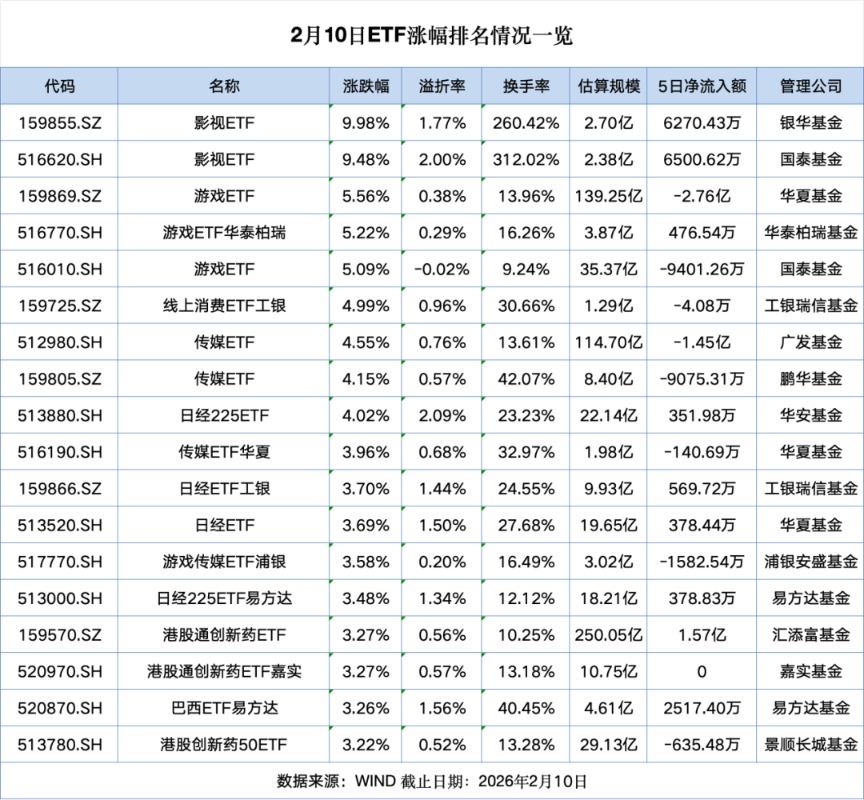
Market Overview - On February 10, 2026, A-shares showed mixed performance with the three major indices fluctuating. The AI application and film sectors experienced a surge, while the photovoltaic, real estate, and consumer sectors weakened [1] - A total of 847 ETFs rose in the market, with the film and gaming ETFs seeing significant increases of 9.98% and 5.56%, respectively [1] ETF Performance - The top-performing ETFs included: - Film ETF (159855.SZ) with a rise of 9.98%, estimated scale of 270 million, and a turnover rate of 260.42% [2] - Gaming ETF (159869.SZ) increased by 5.56%, with an estimated scale of 139.25 billion [2] - Conversely, 468 ETFs declined, with the satellite, real estate, and photovoltaic ETFs leading the losses [2][3] Film Sector Insights - The film sector saw a remarkable rally, with the CSI Film Index (930781) soaring by 9.25%. Major stocks like Jiechuan Co. and Huayi Brothers hit the daily limit [5] - The Silver华 Film ETF (159855) reached its daily limit with a 9.98% increase, while the Guotai Film ETF (516620) rose by 9.48%. Both ETFs experienced significant capital inflows [5][6] Gaming Sector Insights - The gaming sector also performed well, with the Animation and Gaming Index (930901) rising by 5.26%. Key stocks such as Light Media and Aofei Entertainment reached their daily limits [12][13] - The top gaming ETFs included: - 华夏 Gaming ETF (159869) with a 5.56% increase and an estimated scale of 2.93 billion [15] - 华泰柏瑞 Gaming ETF (516770) with a 5.22% increase [14] Fund Flow Analysis - On February 9, the A-share market saw a strong rally, with a net outflow of over 28 billion across all stock ETFs. The top inflow sectors included the CSI 500 Index, which saw a net inflow of 27.3 billion [16] - The CSI 500 ETF was highlighted as a core broad-based index reflecting mid to small-cap stocks in the A-share market [19]
从ETF巨震看中国式市场下一站
Sou Hu Cai Jing· 2026-02-10 12:10
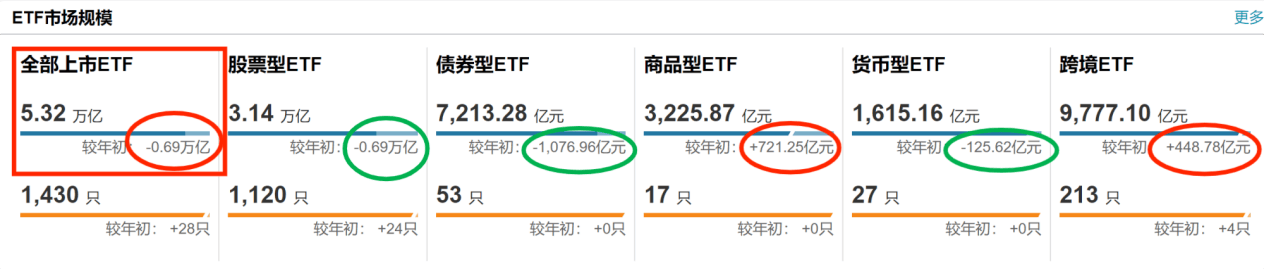
Core Viewpoint - The A-share market has experienced significant fluctuations in early 2026, with a notable reduction of over 690 billion yuan in the overall ETF market, indicating a shift in capital preferences and regulatory intentions [1][2]. Group 1: ETF Market Overview - As of February 6, 2026, the total market size of ETFs has decreased by over 690 billion yuan since the beginning of the year, with stock ETFs accounting for a reduction of 690 billion yuan and bond ETFs decreasing by 107.6 billion yuan [2]. - The issuance of new ETFs has been limited, with only 24 new stock ETFs and 4 cross-border ETFs launched, while no new bond, commodity, or money market ETFs were issued [2]. Group 2: ETF Performance by Theme - The top 25 ETFs with the highest growth rates in terms of share volume include sectors such as oil and gas, general aviation, and semiconductor technology, with some ETFs showing growth rates exceeding 800% [4]. - In terms of absolute value increase, the leading ETFs are in the chemical, communication, and software sectors, indicating strong investor interest in these themes [5]. Group 3: ETF Outflows - The ETFs with the highest reduction rates in share volume include those in financial technology, engineering machinery, and solar energy, reflecting a trend of capital withdrawal from these sectors [6]. - The ETFs with the largest absolute value decrease are also concentrated in financial technology and engineering machinery, suggesting a significant shift in investor sentiment away from these themes [7].
申万金工ETF组合202602
Shenwan Hongyuan Securities· 2026-02-10 09:43
1. Report Industry Investment Rating - Not provided in the given content 2. Core Viewpoints of the Report - The report focuses on constructing multiple ETF portfolios, including macro industry, macro + momentum industry, core - satellite, and trinity style rotation portfolios, aiming to find better investment opportunities by combining macro factors, momentum factors, and style rotation [4][5]. - Different industries have different sensitivities to economic, liquidity, and credit factors. For example, traditional cycle industries are sensitive to the economy, TMT is sensitive to liquidity, and consumption is sensitive to credit [4]. 3. Summary According to Relevant Catalogs 3.1 ETF Portfolio Construction Methods 3.1.1 Based on Macro Method - Calculate macro - sensitivities of broad - based, industry - themed, and Smart Beta ETFs based on economic, liquidity, and credit variables. Combine with momentum indicators for complementary analysis [4]. - Traditional cycle industries are suitable for economic up - periods, TMT for weak - economy but loose - liquidity periods, and consumption for credit - expansion periods. State - owned enterprises and ESG - related themes have low sensitivities to liquidity and credit [4]. - Construct three ETF portfolios (macro industry, macro + momentum industry, and core - satellite) and adjust positions monthly [4]. 3.1.2 Trinity Style Rotation ETF Portfolio Construction - Build a medium - to - long - term style rotation model centered on macro - liquidity, and compare it with the CSI 300 index [5]. - Construct three types of models (growth/value rotation, market - cap, and quality models) by screening macro, fundamental, and market - sentiment factors. The model has 8 style - preference results [5]. - Select ETFs with high exposure to the target style, control industry exposure, and set allocation limits to get the final ETF allocation model [5]. 3.2 Macro Industry Portfolio - Select industry - themed ETFs with over 1 - year establishment and over 200 million current scale. Calculate sensitivity scores of economic, liquidity, and credit factors monthly, adjust scores according to the latest indicators, and sum them up. If liquidity and credit deviate significantly, remove the liquidity score. Select the top 6 industry - themed indices and corresponding largest - scale ETFs for equal - weight allocation [6][7]. - Currently, with falling economic leading indicators, loose liquidity, and tightened credit, the portfolio is biased towards TMT and consumption. The February positions are shown in Table 1 [8]. - The portfolio has large fluctuations and outperformed the benchmark significantly in January [11]. 3.3 Macro + Momentum Industry Portfolio - Combine macro and momentum methods to address the left - side nature of macro - based strategies (low win - rate but high odds). Use clustering to group industry - themed indices and select the highest - rising product in each group in the past 6 months for equal - weight allocation [12]. - The momentum - selected industries still have a high proportion of cyclical industries. The February positions are shown in Table 3 [16]. - The portfolio has performed well this year and outperformed the CSI 300 significantly in January [17]. 3.4 Core - Satellite Portfolio - Design a "core - satellite" portfolio with the CSI 300 as the core to address the high volatility and rapid industry rotation of industry - themed ETFs [19]. - Calculate macro - sensitivities for broad - based, industry - themed, and Smart Beta ETFs, construct three stock portfolios, and weight them at 50%, 30%, and 20% respectively [19]. - The current allocation of broad - based ETFs is biased towards the Sci - tech Innovation Board and the ChiNext. The portfolio has performed stably, outperforming the benchmark in most months except December, and had significant excess returns in January 2026 [23][24]. 3.5 Trinity Style Rotation ETF Portfolio - The model currently favors the small - cap growth - high - quality segment. The factor exposures and historical performance are shown in Table 7 [26]. - The February positions are shown in Table 9 [31]. - The portfolio has achieved certain excess returns, especially in some months such as August 2025 and January 2026 [29].