
赛力斯

Search documents
2026年港股IPO的四大新趋势
券商中国· 2026-01-18 12:28
Core Viewpoint - The Hong Kong IPO market is experiencing a surge in new listings, particularly in the semiconductor and biopharmaceutical sectors, with expectations for continued strong performance in 2026 [1][2]. Group 1: Trends in the IPO Market - In January 2026, 12 new stocks have been listed on the Hong Kong market, including several semiconductor companies and biopharmaceutical firms, indicating a trend of concentrated listings in these sectors [1]. - The 2025 Hong Kong market saw 117 new stocks listed, raising a total of 285.99 billion HKD, surpassing the expected fundraising amount of 23.31 billion HKD, with an average oversubscription of approximately 200 million HKD per stock [1]. - A significant portion of the fundraising in 2025 was dominated by A+H shares, with eight companies alone accounting for 49.82% of the total IPO fundraising [1]. Group 2: Specific Sector Insights - The surge in semiconductor and AI-related companies is attributed to their high capital expenditures and R&D costs, necessitating financing from the capital markets [2]. - The Hong Kong IPO rules, particularly the 18C and 18A regulations, are tailored to accommodate technology and biopharmaceutical companies, with at least 31 companies aiming to list under the 18A rules and 16 under the 18C rules [2]. Group 3: Market Dynamics - The trend of A+H shares is expected to continue but with a reduced proportion compared to 2025, as the concentration of fundraising is anticipated to decrease [2]. - Some H shares are expected to return to A shares as the A-share listing process normalizes and reforms are implemented [3]. - The influx of international capital into the Hong Kong IPO market is driven by a broader search for diversification beyond US dollar assets, with over half of the cornerstone investors in 2025 being international [3].


一季度整车有望反弹,零部件聚焦新产业投资:汽车行业周报(20260112-20260118)-20260118
Huachuang Securities· 2026-01-18 12:26
Investment Rating - The report maintains a positive outlook for the automotive industry, expecting a rebound in vehicle sales in Q1 and focusing on investments in intelligent driving, robotics, and liquid cooling technologies [3]. Core Insights - The automotive sector is experiencing significant dynamics, including sales, pricing, exports, and robotics developments [2]. - The report highlights that January's early sales data shows a substantial year-on-year decline, primarily due to subsidy reductions and rising vehicle prices, leading to consumer hesitation [5]. - The report anticipates that the pressure on vehicle prices will be managed through strict enforcement of anti-competitive practices, aiming to stabilize prices and profit margins [5]. - The export market is expected to grow rapidly, supported by agreements that lower trade barriers for electric vehicles, enhancing profitability for manufacturers and dealers [5]. - The robotics sector is gaining traction, with the Optimus V3 generating market excitement and expectations for product launches [5]. Data Tracking - In early January, the average discount rate remained stable, with a 9.6% increase year-on-year, and the average discount amount reached 22,259 yuan, up by 2,192 yuan year-on-year [4]. - December's wholesale vehicle sales were reported at 2.85 million units, reflecting a year-on-year decline of 8.7% and a month-on-month decline of 6.3% [4]. - Notable sales performance in December included significant year-on-year growth for new energy vehicle manufacturers like NIO and Li Auto, while traditional automakers like SAIC and Changan showed mixed results [6]. Industry News - The report discusses various industry developments, including the price commitments for electric vehicles between China and Europe, which aim to facilitate trade [27]. - The Ministry of Industry and Information Technology is focusing on enhancing the competitiveness of the new energy vehicle sector and regulating market practices to prevent price wars [27]. - Recent data indicates a significant drop in retail sales of passenger vehicles in early January, with a 32% year-on-year decline [27]. Market Performance - The automotive sector saw a weekly increase of 0.71%, ranking 8th out of 29 sectors, while the overall market indices showed mixed results [10].




汽车行业周报:中欧电动汽车反补贴案取得阶段性进展,机器人量产进程提速-20260118
SINOLINK SECURITIES· 2026-01-18 12:11
Investment Rating - The report suggests a focus on the automotive industry, particularly on companies like BYD and Geely for vehicle manufacturing, and companies like Li Auto, Xpeng Motors, and others in the smart technology and robotics sectors [3][20]. Core Insights - The EU's implementation of a price commitment mechanism is expected to significantly alleviate the tariff pressure faced by Chinese electric vehicle manufacturers exporting to Europe, improving their profitability per vehicle [1][13]. - Boston Dynamics' Atlas humanoid robot is set to begin mass production in 2026, marking a shift from technology validation to commercial deployment, with significant partnerships in manufacturing and logistics [2][14]. - The first week of 2026 saw a decline in retail sales of passenger vehicles, but there is optimism for recovery in Q1 2026 due to upcoming policy support and seasonal demand [19][3]. - The report highlights the ongoing trend of increasing exports of passenger vehicles, particularly in the context of recovering demand in markets like Russia and the growing penetration of new energy vehicles [3][19]. Industry Data Tracking - The Shanghai Composite Index decreased by 0.57%, while the automotive index increased by 0.49%, ranking 10th among 31 sectors [21]. - In the first week of January 2026, wholesale passenger vehicle sales were 381,000 units, down 40% year-on-year, with new energy vehicle sales at 167,000 units, also down 30% [5][27]. - In December 2025, the total wholesale passenger vehicle sales were 2.787 million units, a year-on-year decrease of 9.3%, while new energy vehicle sales increased by 3.4% [6][34]. - Exports of passenger vehicles in December 2025 reached 588,000 units, a year-on-year increase of 45.5%, with new energy vehicle exports at 270,000 units, up 122.9% [6][50][54]. Industry Dynamics - The report notes significant developments in the automotive sector, including the establishment of a new company by Jetta to focus on new energy vehicles, and plans by XPeng to build an independent overseas supply chain team [62][64]. - The Hong Kong government is advancing autonomous driving tests, which could provide valuable insights for the application of such technologies in urban environments [61].


AI应用爆发前夜,大模型等待黎明
Tai Mei Ti A P P· 2026-01-18 12:01
Core Insights - The AI industry continues to gain momentum in 2026, with significant stock performance in the A-share market, particularly in AI application sectors [1] - Minimax has successfully launched on the Hong Kong stock market, achieving a market capitalization exceeding 100 billion [2] - Major tech companies are preparing for an AI application battle, with Alibaba, ByteDance, and Tencent all investing heavily in AI applications [4] Industry Trends - The rapid iteration of large models is evident, with 29 versions released by 11 tech companies in just 206 days, averaging a new version every 7.1 days [7][8] - User demand for AI applications is surging, with Doubao's monthly active users surpassing 200 million and Qianwen APP reaching 30 million in just 23 days [9] - The AI market in China is projected to grow to 993 billion by 2030, with a compound annual growth rate of 35.5% from 2024 to 2030 [10] Investment and Financials - Major companies are significantly increasing their capital expenditures on AI, with Baidu planning 30 to 50 billion, Tencent 70 to 100 billion, and Alibaba potentially increasing its 380 billion investment due to high demand [11] - AI companies are accelerating their IPOs, with multiple firms, including Zhiyuan AI and Minimax, recently listing on the Hong Kong Stock Exchange [12][14] - AI talent is in high demand, with salaries reaching up to one million and companies offering competitive packages to attract top talent [15] Challenges and Market Dynamics - Despite the growth, profitability remains a challenge, with Zhiyuan AI reporting losses exceeding 6.2 billion from 2022 to mid-2025, and Minimax over 8.7 billion from 2023 to Q3 2025 [18] - The competitive landscape remains unchanged as all major internet platforms integrate AI, leading to a potential homogenization of services [19][22] - The cost of using large models is decreasing rapidly, with significant price reductions observed in 2024, which is essential for the explosion of AI applications [27] Future Outlook - The AI industry is expected to experience an application explosion, with companies believing that revenue growth will eventually cover model costs [36] - The survival of companies in the AI sector will determine who defines the future, emphasizing the importance of endurance in the current challenging environment [37]
汽车行业周报:2025年中国重卡销量达114.5万,加拿大将中国电动汽车配额内关税降至6.1%-20260118
KAIYUAN SECURITIES· 2026-01-18 12:01
Investment Rating - The industry investment rating is "Positive" (maintained) [1] Core Insights - The Chinese heavy truck market's total sales for 2025 reached 1.145 million units, marking a 27% increase from the previous year [5][13] - The China Automobile Association forecasts total automobile sales in 2026 to be 34.75 million units, a 1% year-on-year growth [15] - The demand for high-end luxury passenger cars in China is exceeding expectations, with a favorable competitive landscape [7] Industry News - Tesla will stop selling Full Self-Driving (FSD) after February 14, transitioning to a monthly subscription model [14] - Shanghai aims to achieve large-scale application of high-level autonomous driving scenarios by 2027 [16] - Great Wall Motors launched the world's first native AI all-power platform "Guiyuan," supporting multiple power systems [17] - Canada has reduced tariffs on Chinese electric vehicles to 6.1%, eliminating the previous 100% additional tax [18] Market Performance - The A-share automotive sector outperformed the market with a weekly increase of 0.71%, ranking 8th among A-share primary industries [25] - The passenger vehicle index decreased by 1.87%, while the commercial vehicle index increased by 5.53% [6] - The automotive parts index rose by 1.26%, with notable gains in the electric control systems and lightweight components [6][35] Investment Recommendations - For passenger vehicles, recommended stocks include JAC Motors and Seres, with beneficiaries being Geely Automobile [7] - In the parts sector, recommended stocks include Desay SV Automotive, Zhejiang Xiantong, and Meili Technology, with beneficiaries being Weichai Power and others [7]




“难以解释”!业绩暴增,股价微涨
Zhong Guo Ji Jin Bao· 2026-01-18 11:31
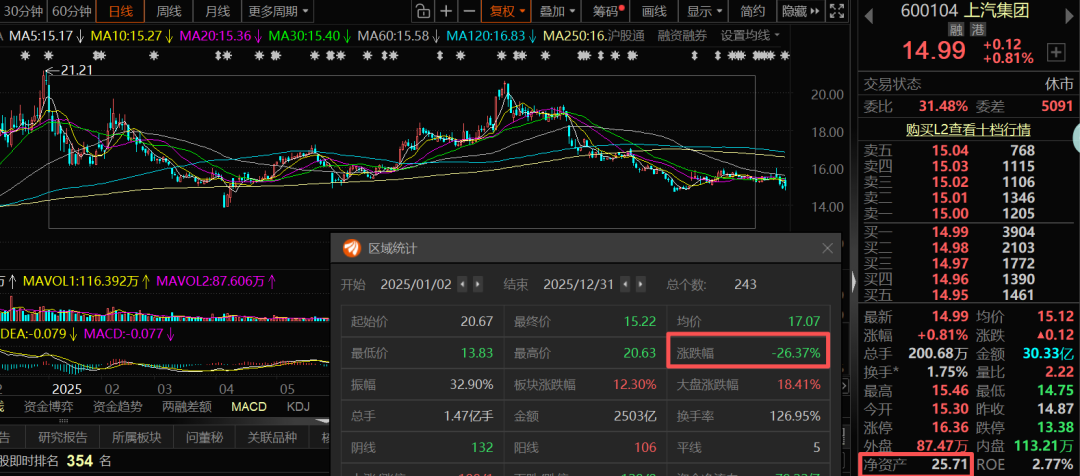
Core Viewpoint - SAIC Motor Corporation has announced a significant increase in expected net profit for 2025, projecting a year-on-year growth of 438% to 558%, yet its stock price remains under pressure, reflecting a mismatch between market valuation and performance [2][3]. Group 1: Company Performance and Market Reaction - On January 15, SAIC Motor released an impressive earnings forecast, leading to a brief stock price increase of over 3% on January 16, but it closed with only a 0.81% gain, still trading below its net asset value [1][2]. - As of January 16, SAIC Motor's market capitalization stood at 172.3 billion yuan, significantly lower than BYD's 874 billion yuan, highlighting a substantial valuation gap among leading automotive companies [3][8]. - The company is currently in a "broken net" state, with its stock price at 14.99 yuan per share, below the latest audited net asset value of 25.71 yuan per share [7][8]. Group 2: Investor Concerns and Market Management - Investors have raised questions regarding SAIC Motor's market value management, expressing skepticism about the effectiveness of its strategies [4][11]. - The company has not announced any share repurchase plans since the release of its 2025 valuation enhancement plan, which is a key measure for market value management [12][13]. - Despite having executed three rounds of share repurchase plans totaling 4.747 billion yuan, the results have been deemed unsatisfactory [14][13]. Group 3: Industry Context and Challenges - The automotive industry is facing intense competition and rapid transformation towards new energy and smart technologies, complicating investment prospects [19][20]. - Many listed automotive companies are struggling with market valuations below 200 billion yuan, with only a few like BYD and Great Wall Motors exceeding this threshold [18]. - The market is characterized by a high number of listed automotive companies, which diminishes individual company visibility compared to global players like Tesla [20]. Group 4: Strategic Focus and Future Outlook - Industry experts emphasize the importance of improving operational quality as a core aspect of market value management, rather than relying solely on share buybacks or short-term market trends [22][29]. - Companies are encouraged to focus on developing standout products to enhance their market valuation directly, as seen with NIO's recent successful model launches [24][29]. - The consensus among industry leaders is that the automotive sector is entering a critical phase, with a clearer picture of market dynamics expected in the next five years [21].
“难以解释”!业绩暴增,股价微涨......
中国基金报· 2026-01-18 11:02
【导读】上汽集团业绩大幅预增后股价微涨,上市车企集体遭遇市值烦恼 中国基金报记者 邱德坤 1月16日开盘,上汽集团一度涨超3%,但收盘涨幅仅有0.81%,并且仍处于破净状态。 这发生在上汽集团刚抛出"惊艳"市场的业绩预告之后。1月15日晚间,上汽集团发布公告称,预计2025年的归母净利润同比增长438%至 558%。 "我们也觉得难以解释,(公司)发的业绩也是还可以的。"上汽集团证券部工作人员向中国基金报记者表示,公司认为在资本市场是被低 估了。 作为国内头部上市车企,上汽集团遭遇的市值与业绩不匹配问题,也是多家上市车企共同面临的烦恼。多位车企人士表示,资本市场应该 重估其所在车企的价值。 上汽集团是一家国有控股的上市车企。近年来,从国务院国资委到各个地方国资委均要求,国有控股的上市公司要加强市值管理。 问题在于,国有控股上市车企在资本市场较为弱势。截至1月16日收盘,上汽集团以1723亿元的市值排名国有控股上市车企首位,但比亚 迪的市值达8740亿元,两者差距明显。 | 证券简称 | 市盈率(倍) | | 市净率(倍)总市值(亿元) 近一年涨幅(%) | | | --- | --- | --- | --- ...

汽车行业周报:泛AI&机器人赛道进入景气验证期 关注业绩确定性
Xin Lang Cai Jing· 2026-01-18 10:35
Industry Overview - The EU and China reached a preliminary agreement on electric vehicle tariffs, establishing a minimum import price to replace high anti-subsidy tariffs set to take effect in 2024 [2] - ZhiYuan Robotics has spun off its dexterous hand business into a new company named "Critical Point," signaling a move towards specialization and commercialization [2] - A U.S. House committee held a hearing to discuss legislation aimed at simplifying the deployment process for autonomous vehicles, potentially increasing the annual limit on new autonomous vehicles from 2,500 to 90,000 [2] Company Updates - SAIC Motor Corporation announced a profit forecast for 2025, expecting a net profit attributable to shareholders of 9 to 11 billion yuan, representing a year-on-year increase of 438% to 558% [3] - JAC Motors released a profit forecast for 2025, projecting a net loss of approximately 1.68 billion yuan, which is a reduction in loss of about 100 million yuan compared to the previous year [3] - WeRide's global Robotaxi fleet surpassed 1,000 vehicles, reaching 1,023 units as of January 12, 2026 [3] Investment Insights - The automotive market is expected to enter an upward recovery phase, supported by the implementation of vehicle trade-in policies in 2026, which may boost domestic demand [4] - The AI sector is entering a verification phase, with clear marginal catalysts in robotics and AIDC, as Tesla's robot is set to enter mass production in 2026 [4] - Long-term focus on stable growth is recommended, with significant potential in overseas markets, as China's automotive export volume is projected to reach 6.34 million units in 2026, a year-on-year increase of about 13% [4] Related Stocks - Key stocks include Weichai Power, Yutong Bus, China National Heavy Duty Truck Group, BYD, SAIC Motor, Geely Automobile, Leap Motor, Xpeng Motors, Seres, Fuyao Glass, Songyuan Safety, Sanhua Intelligent Control, Zhejiang Rongtai, Top Group, Yinlun Holdings, Junsheng Electronics, Horizon Robotics, BYD Electronics, Hesai Technology, and SUTENG [5]

“中国汽车第一城”争夺战
Jing Ji Guan Cha Wang· 2026-01-18 09:53
Group 1 - The competition for "China's Automotive Capital" has evolved from a focus on production volume to a comprehensive contest of development models and industrial ecosystems by 2025 [2] - Chongqing has secured the title of "China's Automotive Capital" with an annual production of nearly 2.8 million vehicles, driven by the success of Seres and the steady growth of Changan Automobile [3][4] - Chengdu, while not in the top tier, has achieved rapid automotive industry growth through collaborations with FAW and industrial synergies with Chongqing [2][3] Group 2 - Hefei has emerged as a significant player in the new energy vehicle sector, achieving the highest production of new energy vehicles in China by November 2025, with a production of 1.25 million units [2][10] - The automotive industry in the Yangtze River Delta is becoming more diversified, with Anhui's automotive production reaching 2.76 million vehicles, indicating a shift from Shanghai's dominance [8][9] - The collaboration between Chengdu and Chongqing aims to enhance regional cooperation in the automotive industry, with a focus on breaking the previous competitive mindset [6][7] Group 3 - The Seres brand, in partnership with Huawei, has significantly contributed to Chongqing's automotive growth, with over 420,000 vehicles delivered in 2025 [4][5] - Chengdu's automotive production reached 820,000 units by November 2025, with a remarkable 198.3% increase in new energy vehicle production [5] - The new Jetta brand in Chengdu aims to become a leading enterprise in the province's automotive industry, focusing on electric vehicle transformation [6] Group 4 - The automotive industry in Guangdong has faced challenges, with Guangzhou's production declining significantly, while Shenzhen has taken the lead in both overall and new energy vehicle production [12][14] - BYD, based in Shenzhen, achieved a new energy vehicle production of 4.54 million units in 2025, becoming the global leader in this sector [12][13] - Guangzhou's automotive industry is under pressure to transform, with a focus on integrating traditional manufacturing with new technologies and exploring innovative areas like flying cars [14][15]

宁德时代与川渝高竹新区签署合作协议
Xin Lang Cai Jing· 2026-01-18 00:48
Core Viewpoint - CATL has signed a cooperation agreement with the Chuan-Yu Gaozhu New District to invest 5.5 billion yuan in a power battery project, indicating a strategic move beyond traditional capacity expansion and point investments in Chongqing's automotive industry [1] Group 1 - The investment of 5.5 billion yuan is aimed at establishing a power battery project [1] - CATL's activities in Chongqing are characterized by a comprehensive approach, integrating production line collaboration within the Seres super factory [1] - The company is enhancing the energy supply of urban logistics networks and facilitating cross-regional industrial chain connections [1]
