
中国平安

Search documents
2月3日华宝港股通恒生中国(香港上市)30ETF(520560)遭净赎回369.86万元
Xin Lang Cai Jing· 2026-02-04 02:22
Group 1 - The core point of the article highlights the net redemptions of the Hua Bao Hong Kong Stock Connect Hang Seng China (Hong Kong Listed) 30 ETF (520560), which faced a net outflow of 3.6986 million yuan on February 3, ranking 40th out of 212 in cross-border ETF net outflows [1] - As of February 3, the latest scale of the Hua Bao Hong Kong Stock Connect Hang Seng China (Hong Kong Listed) 30 ETF is 755 million yuan, down from 766 million yuan the previous day, indicating a net outflow of 0.48% relative to the previous day's scale [1] - Over the past 5 days, the fund experienced net redemptions totaling 35.4312 million yuan, ranking 25th out of 212 in cross-border ETF net outflows [1] - The fund's scale has decreased by 7.60% and its assets by 7.01% since the beginning of the year, with the latest share count at 814 million [2] Group 2 - The fund's management fee is 0.50% annually, and the custody fee is 0.10% annually [2] - The fund is managed by Zhang Fang and Jiang Junyang, both of whom have recorded a return of -7.27% since the fund's inception on September 24, 2025 [3] - The top holdings of the fund include Tencent Holdings (14.92%), Alibaba-W (13.98%), and China Construction Bank (7.23%), among others, with significant investments in major Chinese companies [3]





未知机构:浙商计算机量子科技产业催化密集投资窗口开启政策顶层推动-20260204
未知机构· 2026-02-04 02:15
Summary of Quantum Technology Industry Conference Call Industry Overview - The conference call focuses on the **quantum technology industry**, highlighting its potential as a future industry and a new economic growth point as outlined in the **14th Five-Year Plan** [1][3]. Key Insights and Arguments - **Policy Support**: Recent documents from four ministries emphasize that government investment funds will prioritize areas that contribute to the development of new productive forces and future industries, with a focus on "early, small, long-term, and hard technology" investments [1][3]. - **Upcoming Policy Catalysts**: As the Two Sessions approach, further policy catalysts are expected in the quantum field, indicating a favorable regulatory environment [2][4]. - **Industry Clusters Formation**: - Major cities like **Beijing** and **Shanghai** have established innovation alliances that integrate quantum and artificial intelligence, promoting technological intersections and expanding application scenarios [5]. - **Hefei** has developed the "Quantum Avenue," attracting key enterprises in the industry chain, creating a clustering effect [5]. - **Chengdu** has announced the "Quantum Corridor" plan, which aims to create a synergistic space for research, manufacturing, and application, along with the establishment of a **1 billion yuan** quantum technology industry fund, showcasing local capital's proactive engagement [5]. Commercialization Progress - **Accelerated Industrialization**: - **Boson Quantum** has built the first large-scale dedicated optical quantum computer manufacturing facility in Shenzhen. Collaborations with leading institutions like **Guangzhou National Laboratory**, **China Mobile**, and **Ping An Group** are underway to validate the advantages of optical quantum computing in various fields such as drug development, traffic scheduling, and financial modeling [6]. - The path to commercialization is becoming clearer as these applications demonstrate efficiency and quality improvements [6]. Risk Factors - Potential risks include: - Technology performance not meeting expectations - Commercialization challenges - Policy uncertainties - Competitive risks [7].
涨超1.6%,上证180ETF指数基金(530280)成立以来超越基准年化收益达2.22%
Sou Hu Cai Jing· 2026-02-04 02:09
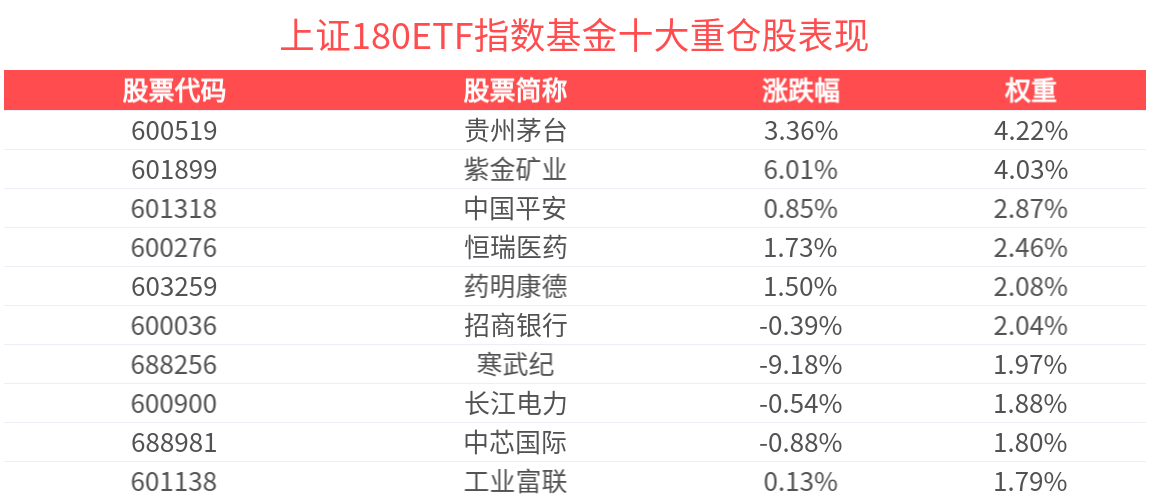
Core Viewpoint - The Shanghai 180 Index and its corresponding ETF have shown strong performance, with significant increases in key constituent stocks, indicating a positive market sentiment and potential investment opportunities in the Shanghai securities market [1][2]. Group 1: Index Performance - As of February 3, 2026, the Shanghai 180 Index rose by 1.40%, with notable gains from stocks such as JinkoSolar (up 13.27%) and Sany Heavy Industry (up 7.95%) [1]. - The Shanghai 180 ETF (530280) increased by 1.64%, with a latest price of 1.24 yuan, and has seen a cumulative rise of 1.81% over the past month [1]. - The ETF has a year-to-date maximum drawdown of 4.28%, with a relative benchmark drawdown of 0.06% [1]. Group 2: Liquidity and Trading Data - The Shanghai 180 ETF had a turnover rate of 0.78% during the trading session, with a transaction volume of 458,700 yuan [1]. - The average daily trading volume over the past year for the ETF was 159,160 yuan [1]. Group 3: Fund Metrics - The ETF has a Sharpe ratio of 2.08 since its inception as of January 30, 2026 [1]. - The management fee for the ETF is 0.15%, and the custody fee is 0.05% [1]. - The tracking error for the ETF over the past six months is 0.023% [1]. Group 4: Top Constituent Stocks - The top ten weighted stocks in the Shanghai 180 Index account for 24.85% of the index, with major contributors including Zijin Mining, Kweichow Moutai, and Ping An Insurance [2]. - The individual weightings of these stocks range from 4.22% for Kweichow Moutai to 1.79% for Industrial Fulian [3].

每日投资策略-20260204
Zhao Yin Guo Ji· 2026-02-04 02:00
Market Performance - The Hang Seng Index closed at 26,835, up 0.22% for the day and up 4.70% year-to-date [1] - The Shanghai Composite Index closed at 4,068, up 1.29% for the day and up 2.49% year-to-date [1] - The US markets saw declines, with the Dow Jones down 0.34% and the S&P 500 down 0.84% [1] Sector Performance - The Hang Seng Financial Index rose by 0.99% with a year-to-date increase of 7.80% [2] - The Hang Seng Real Estate Index increased by 1.65%, showing a year-to-date growth of 14.84% [2] - The Hang Seng Technology Index fell by 1.07%, with a year-to-date decline of 0.88% [1][2] Chinese Stock Market Insights - The Chinese stock market rebounded, with materials, industrials, and defense sectors leading gains, while information technology and telecommunications sectors declined [3] - Southbound capital saw a net inflow of HKD 952 million, with Tencent, China Mobile, and Xiaomi being the top net buyers [3] - Concerns over potential VAT increases on financial and internet services led to declines in internet platform stocks, although these rumors were debunked by experts [3] Aluminum Industry Analysis - The global supply of electrolytic aluminum is expected to remain tight until 2026, supporting higher aluminum prices, projected to increase by 15% year-on-year [4] - China's electrolytic aluminum capacity utilization is nearing saturation, with a forecasted capacity limit of 45 million tons by December 2025 [4] - The report initiates coverage on Innovation Industries (2788 HK) with a "Buy" rating and a target price of HKD 32, citing cost advantages from green energy and expansion in Saudi Arabia [7] Insurance Industry Insights - The insurance sector in China is projected to see premium income growth, with life insurance premiums expected to reach CNY 3.56 trillion, a year-on-year increase of 11.4% [5] - December saw a recovery in premium income, with life insurance premiums growing by 10.1% year-on-year [5] - The report maintains a positive outlook on the insurance sector, recommending stocks like China Ping An (2318 HK) and AIA Group (1299 HK) with target prices of HKD 90 and HKD 89, respectively [7]
涨超1.8%,大湾区ETF(512970)成立以来超越基准年化收益达3.33%
Xin Lang Cai Jing· 2026-02-04 01:55
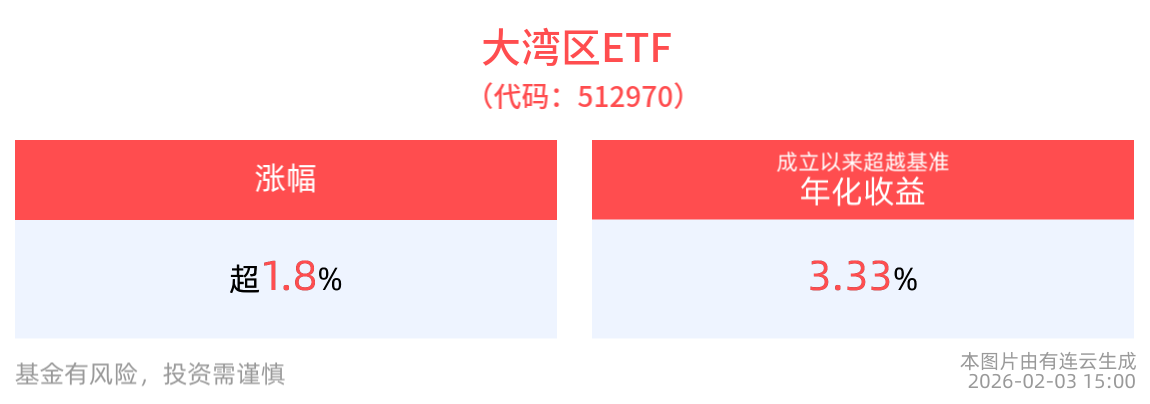
Core Viewpoint - The performance of the Zhuhai-Hong Kong-Macao Greater Bay Area Development Theme Index and its related ETF indicates a strong upward trend, reflecting positive market sentiment towards companies benefiting from the Greater Bay Area development [2][3]. Group 1: Index Performance - As of February 3, 2026, the Zhuhai-Hong Kong-Macao Greater Bay Area Development Theme Index (931000) increased by 1.50%, with notable gains from component stocks such as XW Communication (up 13.12%) and Mingyang Smart Energy (up 7.63%) [2]. - The Greater Bay Area ETF (512970) rose by 1.83%, with a latest price of 1.5 yuan, and has accumulated a 16.77% increase over the past six months [2]. - The ETF's trading volume showed a turnover rate of 1.59% with a transaction value of 1.3822 million yuan, and an average daily transaction of 1.0538 million yuan over the past week [2]. Group 2: Risk and Return Metrics - The Greater Bay Area ETF recorded a Sharpe ratio of 1.51 over the past year as of January 30, 2026, indicating a favorable risk-adjusted return [2]. - The maximum drawdown for the ETF this year was 5.52%, with a relative benchmark drawdown of 0.02% [2]. - The management fee for the ETF is set at 0.15%, while the custody fee is 0.05% [2]. Group 3: Index Composition - The index closely tracks companies that benefit from the Greater Bay Area development, including a selection of up to 50 Hong Kong market securities, 300 companies from the Shanghai-Hong Kong-Shenzhen markets, and 100 mainland market securities [3]. - As of January 30, 2026, the top ten weighted stocks in the index accounted for 44.55% of the total, with major companies including Ping An Insurance, Luxshare Precision, and BYD [3][4].
东吴证券:保险负债端、资产端均持续改善 估值仍有较大向上空间
智通财经网· 2026-02-04 01:33
Group 1 - The insurance market demand remains strong, with a downward adjustment in the preset interest rate and a transformation of dividend insurance expected to continuously optimize liability costs, alleviating pressure from interest spread losses [1] - The ten-year government bond yield has recently fallen to around 1.82%, and the company anticipates that as the domestic economy recovers, long-term interest rates may rise, easing the pressure on new fixed-income investment returns for insurance companies [1] - The current public fund holdings in insurance stocks are still under-allocated, with the insurance sector's valuation for 2026 estimated at 0.65-0.86 times PEV and 1.14-2.31 times PB, which is at a historical low, maintaining an "overweight" rating for the industry [1] Group 2 - The company expects listed insurance firms to experience rapid year-on-year growth in net profit attributable to shareholders in 2025, with Q4 net profit potentially impacted by short-term investment fluctuations [1] - The projected year-on-year growth rates for net profit attributable to shareholders in 2025 are: China Life (+48.6%), New China Life (+43.6%), PICC (+15.8%), and China Pacific (+15.3%) for A-shares; and China Taiping (+220%), ZhongAn Online (+134.5%), PICC Property (+34.7%), Sunshine Insurance (+9.4%), and AIA (+6.2%) for H-shares [1] - The company anticipates slight pressure on Q4 net profit growth, primarily due to a temporary pullback in growth sectors, with high equity holdings since 2025 leading to direct impacts on current profits from stock price declines [1] Group 3 - The company expects the new business value (NBV) of listed insurance firms to grow rapidly, driven by an increase in new single premiums and an improvement in NBV margin [2] - The projected year-on-year growth rates for NBV in A-shares are: PICC Life (+65.4%), New China Life (+42.7%), Ping An (+36.5%), China Life (+35.6%), and China Pacific (+26.8%); for H-shares: Sunshine Insurance (+48.6%), China Taiping (+32.5%), and AIA (+16.3%) [2] - The demand for savings-type insurance products remains strong under the current "deposit migration" context, with expectations for continued growth in the liability side in 2026, primarily driven by the bancassurance channel [2] Group 4 - The company anticipates steady growth in premium income for property insurance, with a year-on-year increase of 3.9% in premium income reaching 16,157 billion yuan in the first eleven months of 2025 [2] - The company expects the market share of listed insurance firms in the property insurance sector to remain stable, with premium income continuing to grow steadily [2] - The company projects an improvement in the combined operating ratio (COR) for various firms, benefiting from ongoing business structure improvements and cost reduction efforts, with expected CORs of: PICC 97.0% (down 0.9 percentage points), Ping An 97.3%, and China Pacific 97.6% (down 1.0 percentage points) [2]

2025年保险业成绩单出炉:人身险撑起增长大旗,非车险占比持续提升
第一财经· 2026-02-03 13:58
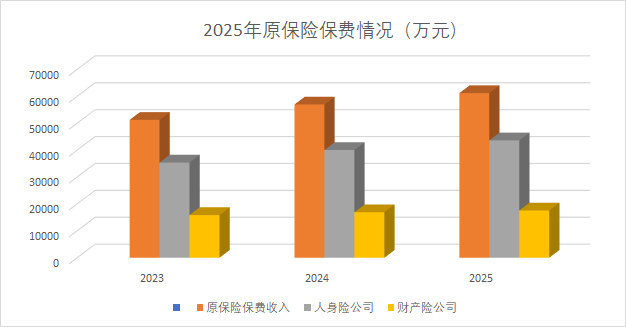
2026.02. 03 本文字数:1955,阅读时长大约3.5分钟 作者 | 第一财经 杨倩雯 2025年保险行业成绩单正式出炉。 金融监管总局近日发布2025年保险业经营情况。数据显示,截至2025年末,保险业总资产达到41万亿元;总保费收入突破6万亿元,同比增长7.4%。 其中,人身险保费撑起了增长的"大旗",增幅接近9%。 "储蓄需求旺盛推动2025年人身险保费景气增长。"国泰海通研究所副所长、非银金融首席分析师刘欣琦团队表示。 储蓄需求推动寿险增长 业内人士分析称,银保渠道近两年的崛起一方面是因为银保合作网点限制放开后渠道扩张赋能新单增长,同时多家曾以个险为主的大型保险公司在个险 渠道深度改革的情况下也将银保渠道重新放在了重要的战略发展位置上;另一方面,银保渠道近期能够更直接地承接"存款搬家"的效应。 根据东吴证券预计,当前"存款搬家"趋势延续,保险产品预定利率仍高于银行存款,相对吸引力仍然明显,预计上市险企2026年开门红表现亮眼,对 寿险全年新单保费增长亦持乐观预期,同时新单中分红险占比预计进一步提升,利好险企负债成本持续改善。 金融监管总局数据显示,2025年人身险公司原保费收入为4.36万亿元 ...

2025年保险业成绩单出炉:人身险撑起增长大旗,非车险占比持续提升
Di Yi Cai Jing· 2026-02-03 12:49
2025年保险行业成绩单正式出炉。 储蓄需求推动寿险增长 金融监管总局数据显示,2025年人身险公司原保费收入为4.36万亿元,同比增长8.9%,成为今年总保费 增长的主要推动力。 "我们预计人身险保费的增长主要为保险储蓄需求旺盛下新单及续期保费共同推动。"刘欣琦团队称。 储蓄需求旺盛主要带来的是人身险中的寿险保费增长。在金融监管总局披露的人身险公司三大产品类型 中,除了寿险保费实现11.4%的增长,意外险及健康险均呈现同比下降的态势。刘欣琦团队认为,这说 明保障类产品的客户需求仍然偏弱。 根据东吴证券数据,2025年第四季度单季人身险公司原保费规模达5191亿元,同比增长0.3%,较第三 季度增速回落24.7个百分点,这主要受预定利率下调后市场需求短期偏弱和筹备开门红影响。不过, 2025年12月单月人身险公司原保费规模又从11月的负增长中转正,同比增长6.0%,达2152亿元。刘欣 琦团队称,12月人身险保费的增速转正预计主要由部分保险公司冲刺年度业务目标所致。 从渠道方面来说,2025年寿险的增长延续近两年的由银保渠道驱动的趋势,多家大型上市险企的银保渠 道增幅均大幅高于个险渠道。以中国太保披露的全年保 ...
稳住了!港股AI探底回升,阿里一度跌近5%,一则消息有关,AI应用酝酿主线,513770低位揽金
Xin Lang Ji Jin· 2026-02-03 11:27
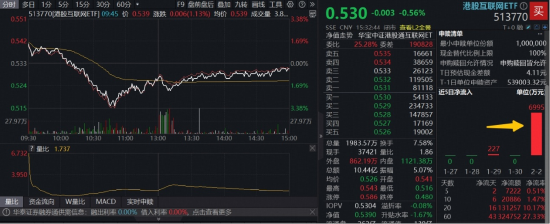
Core Viewpoint - The Hong Kong stock market experienced significant volatility, with major tech stocks like Alibaba and Tencent seeing sharp declines before stabilizing, influenced by rumors regarding tax adjustments for high-tech enterprises [1][3]. Market Performance - The Hong Kong Internet ETF (513770) saw a price drop of 0.56%, with a peak decline of over 3% during the day, marking a three-day losing streak, although there was a net inflow of 69.95 million yuan yesterday and a total of 1.313 billion yuan over the past 20 days [1][3]. - The current price-to-earnings (P/E) ratio of the Hong Kong Internet ETF is 25.31, which is significantly lower than the P/E ratios of the ChiNext Index (41.62) and the Nasdaq 100 (36.37), indicating a favorable valuation compared to other markets [3][4]. Industry Trends - The competition for AI market entry is intensifying as major players like Tencent and Alibaba ramp up their marketing efforts, with Alibaba planning to launch its new AI model during the Spring Festival to capitalize on high traffic [3][4]. - The AI application industry is expected to become a "must-have" by 2026, with a projected turning point in revenue contributions occurring in the second half of 2025, supported by strong profit elasticity and operational leverage [3][7]. Investment Opportunities - The top holdings in the Hong Kong Internet ETF include major companies such as Alibaba, Tencent, and Kuaishou, which collectively account for nearly 77% of the fund, highlighting the dominance of leading tech firms in the sector [3][4]. - For investors seeking to mitigate volatility while still gaining exposure to technology, the Hong Kong Large Cap 30 ETF (520560) is recommended, as it combines high-growth tech stocks with stable dividend-paying companies [4].
电话会议纪要(20260201)
CMS· 2026-02-03 10:35
Macro Insights - The Federal Reserve paused interest rate cuts during the January meeting, with Powell indicating a higher threshold for future cuts due to reduced inflation and employment risks[2] - The upcoming change in tariff base mid-year is expected to facilitate monetary easing under the new chairmanship, reflecting the Fed's policy independence[2] Market Strategy - A-shares are expected to experience volatility in February, with a lack of catalysts before the Spring Festival leading to decreased market activity[4] - Post-Spring Festival, policy catalysts are anticipated to accelerate, potentially improving index performance[4] Investment Recommendations - Focus on cyclical and technology sectors, with particular attention to semiconductor and AI-related stocks, as well as sectors benefiting from the 14th Five-Year Plan[5] - Recommended index combinations include large-cap indices like CSI 1000 and ChiNext 50, with a preference for growth styles over value[5] Liquidity and Fund Flows - February is projected to see continued net inflows of incremental funds, with foreign capital expected to flow in before the Spring Festival[7] - The stock market experienced net outflows in January, but financing is becoming a primary source of incremental capital[7] Sector Performance - Industrial profits turned positive in December, with high growth areas identified in resource products and AI-driven sectors[8] - The insurance sector is expected to perform strongly in 2026, with significant growth in new policy premiums driven by favorable market conditions[15]