
TCL电子

Search documents
TCL电子(1070.HK)荣膺“ESG环境友好卓越企业”,引领绿色可持续发展浪潮
Ge Long Hui· 2025-07-07 01:51
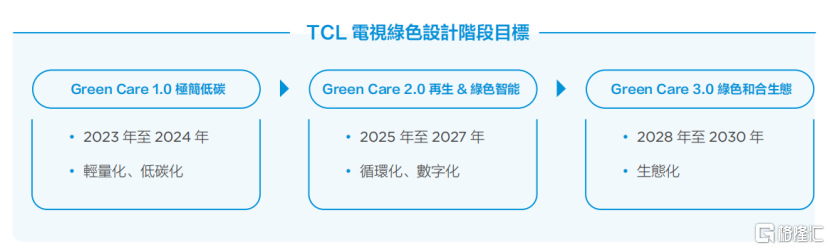
在ESG(环境、社会与治理)标准日益成为全球资本市场"通行证"的背景下,TCL电子(1070.HK)凭借其在环境管理 领域的系统性实践与可量化成果,于格隆汇"全球投资嘉年华·2025"斩获"ESG环境友好卓越企业"大奖。 该荣誉的授予并非偶然,而是建立在对企业环境绩效深度考察的基础之上。在"双碳"战略实践和全球ESG浪潮之中, TCL电子展现出领先的环境保护意识和行动力。 一、将环境友好原则贯穿产品全生命周期 TCL电子深耕绿色理念,将环境友好原则贯穿产品全生命周期:从前期的绿色设计生产、使用中的高能效,到末端的 便捷回收与循环再造,构建起可持续的产品生态。 首先,TCL电子将绿色关爱设计理念作为产品开发的起点。公司制定了明确的绿色设计策略,致力于在产品的设计阶 段就实现环境友好和资源节约的目标。公司将绿色设计阶段目标分为三个阶段:2023年至2024年阶段,注重产品的轻 量化和低碳化设计;2025年至2027年阶段,强调产品的循环利用和数字化管理;2028年至2030年的"生态化"阶段,则 旨在构建一个绿色和谐的生态体系。通过这些分阶段的目标和策略,TCL电子确保产品从设计之初就具备环保基因, 为后续的生产 ...

周专题:美国与越南达成最新贸易协议,关注家电行业的越南产能布局
HUAXI Securities· 2025-07-06 12:58
证券研究报告|行业研究周报 [Table_Date] 2025 年 07 月 06 日 [Table_Title] 周专题:美国与越南达成最新贸易协议,关注家电行业的 越南产能布局 [Table_Title2] 家电行业周报 [Table_Summary] ► 周专题:美国与越南达成最新贸易协议,关注 家电行业的越南产能布局 据美国当地时间 7 月 2 日,美国总统特朗普宣布,美国与越 南达成贸易协议,美国将对进口越南的商品征收 20%关税, 对通过越南转运输美国的其他国家商品征收 40%关税,而越 南将对美国"完全开放市场"。其中,本次贸易协定的 20% 基础关税适用于所有从越南直接出口到美国的商品,高于此 前 10%的临时税率,但低于今年 4 月初特朗普宣布征收的 "对等关税"中针对越南出口美国商品进口关税税率 46%; 而 40%的惩罚性关税适用于"转口贸易"商品,包括仅在越 南进行简单加工或直接进行转运以规避原产国关税的第三国 商品。 我们认为,本次美国与越南达成新的贸易协议,相较于"对 等关税"时的税率有所好转,对有越南本土产能建设的企业 而言,关税成本得到一定程度上的降低,此前对相关企业的 担忧或 ...
家用电器25W27周观点:关税豁免即将到期,关注出口链修复机会-20250706
Huafu Securities· 2025-07-06 08:19
行 华福证券 家用电器 2025 年 07 月 06 日 业 研 究 家用电器 关税豁免即将到期,关注出口链修复机会—— 25W27 周观点 投资要点: 关税豁免即将到期,关注出口链修复机会 行 业 定 期 报 告 关税豁免期将于 7 月 9 日结束,近期越南、柬埔寨已陆续与美国 达成贸易协议。关税政策陆续落地,出口链确定性增强,基本面、估 值均有望修复。此次越南关税整体符合预期,关税政策落地,短期下 单排产恢复正常,基本面有望逐步修复,而美国对转口贸易的严格管 控意味着国内企业需要提升海外本土化生产能力、完善原产地合规体 系,更加有利于海外产能布局完善的龙头企业,建议关注家电龙头海 尔智家、美的集团、海信家电、TCL 电子、海信视像,工具龙头巨星 科技、创科实业,纺服代工龙头华利集团、申洲国际、伟星股份,海 外产能布局完善的出口链企业春风动力、涛涛车业。 行情数据 本周家电板块涨跌幅+1.7%,其中白电/黑电/小家电/厨电板块涨跌 幅分别+2.5%/+0.2%/+0.8%/+0.5%。原材料价格方面,LME 铜、LME 铝环比上周分别-0.80%、+0.15%。 本周纺织服装板块涨跌幅+1.36%,其中纺织 ...
家电行业2025年度中期投资策略:韧性与弹性
Changjiang Securities· 2025-07-06 05:43
Core Insights - The home appliance sector, including major segments like white goods and black goods, is currently valued at relatively low levels, while the holding levels are at historical highs, with performance being the key driver for excess returns in the sector [3][20][32] - Domestic sales are expected to maintain high resilience due to national subsidies, while external sales will show high elasticity driven by increasing demand penetration in emerging markets and the rising market share of Chinese brands [3][7][8] Review: Performance-Driven Sector Achieving Excess Returns - As of June 20, 2025, the home appliance index has declined by 1.2%, ranking eighteenth among all major industries, with all segments except black goods achieving positive relative returns [20][21] - The home appliance sector's valuation is currently at a relative low, influenced by ongoing tariff fluctuations, with the kitchen appliance sector above the median [6][28][32] - The public fund holding ratio for the home appliance industry in Q1 2025 was 6.28%, with a slight increase of 0.14 percentage points, indicating a high allocation level historically [6][35][40] Resilience: National Subsidies Driving Domestic Demand - The continuation and expansion of national subsidies for home appliances have shown significant results, with retail sales of home appliances experiencing double-digit growth for eight consecutive months from September 2024 to April 2025 [7][44] - The average selling price of air conditioners has seen a controlled decline, with leading brands maintaining a positive price premium over the industry average [7][46] - Categories with low penetration, such as coffee machines and cleaning appliances, have shown strong growth, indicating a favorable competitive environment for profitability improvement [7][46] Elasticity: Limited Tariff Disturbances and Emerging Market Contributions - Despite high tariffs on Chinese home appliance products in the U.S., the impact on most listed companies is limited due to their low exposure to the U.S. market [8][30] - Emerging markets are expected to become significant sources of incremental exports for Chinese home appliances, with rapid penetration rates in regions like Latin America and the Middle East [8][30] Investment Recommendations: Focus on Quality Leaders with Growth Certainty - For the second half of 2025, it is recommended to focus on high-certainty growth leaders with low exposure to the U.S. market, such as Gree Electric, Midea Group, and Hisense Home Appliances [9][12] - Companies benefiting from domestic sales and the old-for-new replacement policy, like Aima Technology and Yadea Holdings, are also highlighted for their strong growth certainty [9][12] - Emerging leaders with U.S. exposure and strong brand power, such as Anker Innovations and Roborock, are recommended for their potential recovery [9][12]



618家电零售增长稳健,美越关税落地有望带动出口链情绪回温
SINOLINK SECURITIES· 2025-07-06 05:21
Investment Rating - The report suggests a positive outlook for the home appliance industry, indicating a strong growth potential driven by domestic demand and favorable policies [7][47]. Core Insights - The 618 home appliance market in 2025 showed robust growth, with major categories experiencing increases in both retail volume and value, particularly in white goods and black goods [2][13]. - The recent US-Vietnam trade agreement is expected to boost sentiment in the Chinese home appliance export chain, providing greater policy certainty for regional export chains [3][21]. - The home appliance sector is transitioning from price-driven competition to a focus on user experience and product value, with significant upgrades in product structures [20][45]. Market Performance Tracking - The overall market is showing a recovery trend, with white goods maintaining stable prices and black goods experiencing significant growth, particularly in the TV market, which saw a 9.7% increase in volume and a 14.5% increase in value during the 618 period [2][13]. - The air conditioning segment demonstrated strong growth, with retail sales increasing over 15% both online and offline, driven by leading brands like Midea, Xiaomi, and Haier [15][20]. - The washing machine market also saw substantial growth, with online and offline retail sales increasing by 17.1% and 12.1% respectively, indicating a shift towards larger capacity and upgraded features [15][20]. Raw Material Price Tracking - Recent trends show a decrease in copper and aluminum prices, with copper down 0.69% and aluminum down 0.23% in the last week, while cold-rolled steel prices increased by 2.58% [29][34]. Exchange Rate and Shipping Price Tracking - As of July 4, 2025, the USD to RMB exchange rate was reported at 7.15, with a slight decrease of 0.01% week-on-week [35][36]. Investment Recommendations - The report highlights three main investment themes: 1) Opportunities in new product forms and industry phases 2) Quality companies with solid fundamentals focusing on robotics 3) Leading companies in the black and white goods sectors [7][47].

美越协议落地,如何看出口企业投资机会
2025-07-03 15:28
Summary of Conference Call Records Industry Overview - The conference call discusses the impact of the US-Vietnam tariff agreement on the textile, light industry, and home appliance sectors, highlighting the benefits for companies with established production capabilities in Southeast Asia due to lower tariffs [1][3][4]. Key Points and Arguments Textile and Apparel Industry - The zero tariffs for imports from the US to Vietnam benefit companies with production in Southeast Asia, enhancing their market competitiveness [1][3]. - Brand manufacturers in the textile sector are managing tariff impacts through improved procurement structures, slight price increases at the consumer level, and cost reduction strategies [1][5]. - The burden of tariffs on manufacturers is relatively small, typically limited to single-digit percentages, allowing for stable order rhythms [5]. Home Appliance Industry - The home appliance sector is also affected by the tariff changes, with strong companies able to maintain stable export pricing and minimal impact on net profit margins [1][4]. - Leading companies like Xiangxin Home and others are expected to perform well in Q2, with a gradual recovery in order rhythms anticipated [4]. - The local component localization rates in Vietnam exceed 50% for major white goods companies, which mitigates the impact of the tariffs [8][9]. Nike and Related Companies - Nike's recent financial report indicates that the most challenging period has passed, with expectations for positive order growth in various regions (excluding China) for the 2025 Christmas season [6]. - Companies closely linked to Nike's supply chain are recommended for investment due to their stable order volumes and strong partnerships [6][7]. Additional Insights - The tariff agreement has created a significant gap in export tariffs between China and Vietnam, favoring companies with high localization rates in Southeast Asia [3]. - The overall impact of a 10% tariff increase is estimated to raise end prices by 6%, but Southeast Asia remains cost-competitive compared to Mexico [9]. - Companies such as Haier and Midea are positioned well due to their production strategies, with limited impact from the tariff changes [10]. Recommended Companies - Three notable companies in the apparel sector include: - A company with a valuation of approximately 12 times earnings, achieving domestic and international dual circulation [7]. - Huali Group, a key supplier to Nike, with a valuation of around 15 times earnings [7]. - Jinyuan International, known for double-digit growth in revenue and profit, with a valuation slightly above 7 times earnings and a 60% dividend rate [7]. - In the home appliance sector, TCL Electronics is highlighted for its strong market presence and stable pricing strategy, with a valuation of about 10 times earnings [10].
港股收评:恒指跌0.63%,创新药、苹果概念、有色金属集体大涨
Ge Long Hui· 2025-07-03 08:42
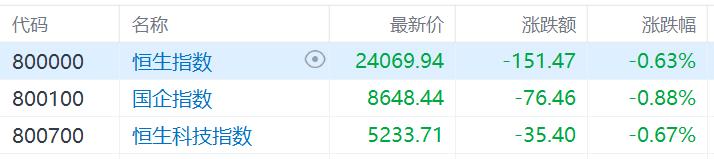
Market Overview - The Hong Kong stock market showed a general decline, with the Hang Seng Index closing down 0.63% at 24,069.94 points, while the Hang Seng China Enterprises Index and the Hang Seng Tech Index fell by 0.88% and 0.67% respectively [1][2] - Major technology stocks experienced a downturn, with Xiaomi dropping 3.4%, Alibaba nearly 3%, Meituan 2.5%, JD.com over 2%, and Tencent also in the red [2] Sector Performance - Steel stocks, which had surged previously, saw a significant drop, with Chongqing Steel falling over 23% after a previous rise of over 91%, and Maanshan Steel down nearly 5% [3][15] - New consumption concept stocks and stablecoin-related stocks also declined, with Nayuki Tea dropping over 10% and other companies like Manner Coffee and Pop Mart falling over 3% [4][17] - Conversely, Apple-related stocks saw a notable increase, with Rongyang Industrial rising over 6% and several others like Sunny Optical and BYD Electronics gaining over 4% [5][7] - Innovative drug concept stocks accelerated their rise, with Huahao Zhongtian Pharmaceutical soaring over 55% and other companies like Kangfang Biotech and Innovent Biologics also showing significant gains [6][9] Other Notable Movements - The gaming software sector performed well, with Seventh Avenue surging over 74% and other companies like Empire Technology Group and Boyaa Interactive also seeing gains [10] - Non-ferrous metal stocks rose, with China Dajian Nonferrous Metals increasing over 14% and other companies like Minmetals Resources and Zijin Mining gaining over 3% [11] - Home appliance stocks showed positive movement, with JS Global Lifestyle rising over 6% and TCL Electronics up over 2% [12] - Chinese brokerage stocks were active, with Xingsheng International rising over 6% and Citic Securities up over 3% [13] - Gaming stocks mostly rose, with MGM China up over 3% and Sands China up over 2% [14] Capital Flow - Southbound funds recorded a net sell of HKD 30.48 billion, with the Shanghai-Hong Kong Stock Connect seeing a net sell of HKD 18.67 billion and the Shenzhen-Hong Kong Stock Connect a net sell of HKD 11.81 billion [20] Future Outlook - According to CMB International, a transition from a structural market to a broader rally in Hong Kong stocks requires stronger fundamental support and policy catalysts to enhance market sentiment and participation [20]
家电板块投资机会梳理&基本面更新
2025-07-02 15:49
Summary of Key Points from the Conference Call Industry Overview - The home appliance sector is experiencing a notable performance, particularly in the white goods segment, despite a decline in government subsidies affecting valuations [2][11] - The central government announced a new subsidy plan of approximately 130 billion, boosting market confidence [2] Core Insights and Arguments - **White Goods Performance**: The white goods segment showed strong sales demand in Q2, with leading companies like Midea and Haier experiencing significant growth in installation cards [1][2] - **Subsidy Impact**: The reduction in government subsidies has had a limited impact on performance, primarily affecting sentiment rather than actual results [3][11] - **Market Dynamics**: The shift in market style has led to a transition of funds from small-cap to large-cap stocks, contributing to the recent performance of the home appliance sector [2] - **Sales Trends**: Sales of small appliances have improved since Q4 of the previous year, with notable revenue growth for leading companies like Bear and Supor during the 618 shopping festival [1][4] Segment Performance - **Major Appliances**: The white goods segment is expected to maintain strong competitiveness, with leading companies achieving double-digit profit growth in Q2 [5] - **Black Goods**: The upgrade in product structure, particularly in high-end Mini LED TVs, has led to a significant increase in average prices for leading brands [3][4] - **Small Appliances**: The competitive landscape for small appliances has improved, with profit margins showing significant recovery [1][4][9] Valuation and Dividend Insights - **Valuation Metrics**: - Gree: Valuation around 7x, dividend yield approximately 7% [6] - Midea: Valuation around 12x, dividend yield including buybacks about 6% [6] - Haier: Valuation around 10x, dividend yield between 4-5% [6] - **Market Performance**: These valuation levels are expected to support market performance for these companies [6] Future Outlook - **Market Expectations**: The probability of continued government subsidies next year is high, although the marginal effect may weaken [5] - **Export Dynamics**: Leading white goods companies derive over half of their business from overseas markets, which may offset domestic fluctuations due to subsidy reductions [7][11] - **Investment Recommendations**: Companies with solid performance and elasticity, such as Hisense, Bear, and TCL, are recommended for investment [12] Additional Insights - **Competitive Landscape**: Stone Technology has emerged as a leading brand in the vacuum cleaner market, with expectations for profitability to improve in Q3 despite short-term pressures [10] - **Sector Resilience**: The home appliance sector is expected to maintain positive growth in annual or quarterly profits, even with potential short-term declines in retail sales [7]

爆了!超级盛宴,错过等一年
格隆汇APP· 2025-06-30 09:37
变局加速,机遇涌动!走过充满韧性的 2024 ,中国经济正以"新质生产力"为引擎,在 2025 年深化转型。政策红利持续释放,资本市场改 革深化,外资加速回流人工智能、高端制造、绿色能源等新经济赛道,一场以"新质"为核心的估值重构已然展开。 然而,全球棋局波谲云诡:地缘冲突未息、货币政策分化、供应链重塑承压、多国政治周期叠加 ……如何在百年大变局的深化期,把握未来航 向? 2025 年下半年,机遇与风险并存,投资者如何优化策略,行稳致远? 答案,就在深圳! 2025 年 7 月 4 日 -5 日,格隆汇 2025 中期策略峰会 将再度点亮鹏城! 我们力邀顶尖思想领袖与实战精英,为您: 深度剖析全球与中国经济核心变局; 前瞻 "新质生产力"驱动的投资主脉络; 拆解复杂环境下的风险与机遇; 共话资本市场改革红利与布局良机; TOP 级机构(合计管理超千亿)分享投资策略和方向。 这是一场智慧碰撞的盛宴,一次拨云见日的集结! 与远见者同行,与担当者共进! 会议组成及嘉宾阵容: 7 月 4 日上午 格隆汇 ·中期策略峰会· 2 025 宏观、策略、风投、实业大咖云集,莅临现场共同剖析中国资本市场发展趋势,共同展望 20 ...
新消费创造成长主线,结构性牛市曙光已现 - 2025年可选消费中期策略
2025-06-30 01:02
Summary of Conference Call Notes Industry Overview - The focus is on the new consumption sector, which is expected to experience a structural bull market due to anticipated economic recovery and policy support in the fourth quarter of 2024. [1][2] - The new consumption sector is characterized by a three-year investment cycle influenced by supply-demand dynamics and social changes. [4] Key Directions in New Consumption - Four main directions in the new consumption sector are identified: emotional value, overseas consumption, shared value, and channel transformation. [3] - Companies like Pop Mart, Ruoyuchen, and Wanren Group have shown exceptional performance since mid-2024, making them noteworthy investment targets. [1][3] Investment Strategy - The strategy for the second half of 2025 involves holding high-conviction leading companies while also focusing on emerging companies that may outperform the leaders. [11] - The investment approach combines Beta (market trends) and Alpha (individual company performance) to identify opportunities. [7][8] Market Dynamics - The new consumption sector is expected to transition through three stages: thematic investment, institutional comfort, and potential bubble formation. [5] - Traditional consumption sectors may present rebound opportunities, especially if they align with leading companies' performance. [6][17] Specific Investment Opportunities - Notable companies for investment include Pop Mart, Chaohongji, and Chenguang, which are expected to benefit from market recovery and structural opportunities. [12] - Emotional consumption companies with strong safety margins and good odds are also highlighted as potential investments. [13] Functional Value and Channel Transformation - AI integration in consumer products is identified as a strong trend, with companies like Kande Optical and Mousse showing promise in this area. [14] - Channel transformation is segmented into online channels, discount retail, and quality retail, with companies like Meituan and Hailan Home being key players. [15] Brand Expansion - Brand expansion is categorized into independent brand growth and OEM chain expansion, with companies like Hisense and TCL benefiting from increased market penetration. [16] - The potential for companies like Simoer International to enhance their market value through successful product reception in Japan is noted. [16] Economic Outlook - The overall economic environment is expected to weaken, leading to a shift in investment focus from Alpha to Beta for domestic demand and vice versa for external demand. [20] - The potential for price increases in consumer goods is highlighted, particularly if CPI returns to a normal range of 2-3%. [19] Future Investment Themes - Observing primary market investments can provide insights into emerging consumption themes for the secondary market. [23] - The third quarter is seen as a time for dividend opportunities, while the fourth quarter may yield excess returns across both traditional and emerging sectors. [22]