
宝钢股份

Search documents
未来一季度迎险资配置窗口,红利资产有望重获关注
Sou Hu Cai Jing· 2025-12-09 01:29
Core Viewpoint - The recent adjustments in insurance company risk factors are expected to encourage long-term allocations in quality equity assets, particularly in dividend stocks, as institutional investors increase their equity asset allocations amid a supportive policy framework [1][25]. Group 1: Market Trends and Fund Flows - The China Securities Dividend ETF (515080) saw a net subscription of 59.78 million yuan yesterday, with a cumulative net subscription of 125 million yuan over the past three days [1]. - The insurance sector is anticipated to allocate 30% of new premiums to A-shares annually, with December to the first quarter being a traditional allocation window for insurance funds [25]. Group 2: Policy Implications - The recent notification from the Financial Regulatory Bureau regarding the adjustment of risk factors for insurance companies aligns with the trend of increasing investment in dividend stocks by insurance firms [2][25]. - The policy focus is on capital market and consumption policies, with an emphasis on stimulating domestic demand and supporting emerging industries [25]. Group 3: Dividend Stock Analysis - Huatai Securities estimates that the industry is currently under-allocated in dividend stocks by approximately 0.8 to 1.6 trillion yuan, which may be addressed in the next two to three years [2]. - The average dividend yield of the newly included stocks in the index is 4.15%, compared to 3.89% for those being removed, indicating a trend towards higher-yielding stocks [20]. Group 4: Performance Metrics - The latest PE ratio for the China Securities Dividend Index is 8.48 times, with a historical percentile of 98.43% over the past five years [14]. - The China Securities Dividend Total Return Index has shown a 40-day return difference of 1.54% relative to the Wind All A Index as of December 5 [8].


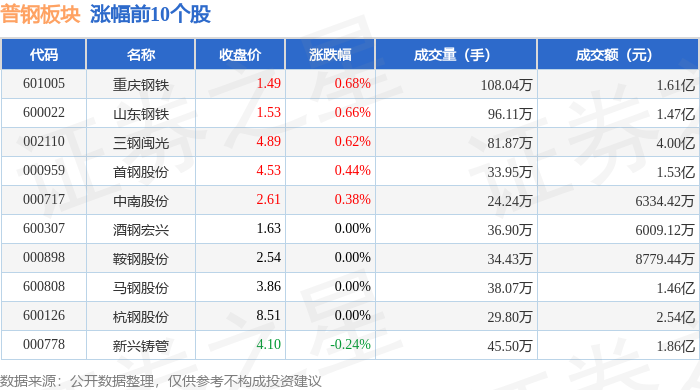
普钢板块12月8日跌0.92%,华菱钢铁领跌,主力资金净流出1.06亿元
Zheng Xing Xing Ye Ri Bao· 2025-12-08 09:04
Market Overview - The steel sector experienced a decline of 0.92% on December 8, with Hualing Steel leading the drop [1] - The Shanghai Composite Index closed at 3924.08, up 0.54%, while the Shenzhen Component Index closed at 13329.99, up 1.39% [1] Individual Stock Performance - Hualing Steel (code: 000932) closed at 5.51, down 2.13% with a trading volume of 744,700 shares and a transaction value of 412 million yuan [2] - Baosteel (code: 600019) closed at 7.18, down 2.05%, with a trading volume of 1,169,000 shares and a transaction value of 842 million yuan [2] - Other notable performers include: - Wujin Stainless Steel (code: 603878) at 10.79, down 1.55% [2] - Anyang Steel (code: 600569) at 2.32, down 1.28% [2] Capital Flow Analysis - The steel sector saw a net outflow of 106 million yuan from main funds, while retail investors contributed a net inflow of 81.85 million yuan [2][3] - Notable capital flows include: - Baosteel had a main fund net inflow of 35.68 million yuan, but retail investors had a net outflow of 21.32 million yuan [3] - Heibei Steel (code: 000709) saw a main fund net inflow of 17.14 million yuan [3] - Chongqing Steel (code: 601005) had a main fund net inflow of 7.43 million yuan [3]


2025年中国钢铁行业绿电消费的进程、挑战与建议报告
Sou Hu Cai Jing· 2025-12-08 08:19
Core Insights - The report discusses the acceleration of green electricity consumption in China's steel industry, highlighting its significance in the sector's low-carbon transition and the challenges it faces [1][11]. Group 1: Acceleration of Green Electricity Consumption - The steel industry, being a high energy-consuming and high carbon-emitting sector, is focusing on green electricity consumption as a core pathway for low-carbon transformation [1]. - The acceleration is driven by multiple factors, including policy shifts from energy consumption control to carbon emission control, clear compliance directions for green electricity consumption, and increasing demand for low-carbon steel from downstream industries like automotive and construction [1][12]. - Major steel companies are integrating green electricity consumption into their long-term strategies, responding to both regulatory requirements and market demands [1][12]. Group 2: Consumption Models - Three mainstream models of green electricity consumption have emerged: green electricity trading, green certificate trading, and self-built/invested renewable energy projects [2][14]. - Green electricity trading requires no initial investment and can lock in power supply and environmental value, with companies like Baowu Steel and Hebei Steel engaging in large-scale transactions [2]. - Self-built renewable energy projects, while having higher initial costs, can optimize long-term energy costs, as seen with companies like Ansteel and Jiugang [2][14]. Group 3: Long-term Value and Challenges - Green electricity consumption brings multiple long-term benefits, including enhanced green competitiveness, compliance with domestic and international regulations, and the development of the green certificate market [2][12]. - Challenges include mismatches between steel industry locations and renewable energy-rich areas, unclear cost-sharing mechanisms for green electricity premiums, and the need for clearer policy connections and compliance details [2][12]. Group 4: Policy and Corporate Recommendations - To promote sustainable development in green electricity consumption, the report suggests improving incentive mechanisms, fostering industry collaboration, and enhancing energy management levels within companies [3][15]. - Companies are encouraged to set green electricity consumption targets, develop diversified consumption strategies, and advance technology integration with core production processes [3][15]. Group 5: Market Dynamics and Downstream Demand - The demand for low-carbon steel from key downstream sectors, such as construction and automotive, is increasing, influencing steel companies' energy consumption decisions [2][41]. - Major automotive manufacturers are setting carbon reduction targets that directly impact their steel suppliers, creating a supply chain responsibility that drives steel companies to enhance their green electricity consumption [2][41]. Group 6: Future Outlook - The report anticipates that the synergy between renewable energy development and the steel industry will expand, with green electricity consumption facilitating deeper decarbonization and structural transformation in the steel sector [1][17]. - The ongoing evolution of policies and market mechanisms will provide robust support for the steel industry's transition to green electricity consumption [20][31].



视界 | 一部国企史,半部新中国经济史:从“一五”计划到“十五五”规划
Sou Hu Cai Jing· 2025-12-08 07:54
在承接"一五"计划奠定的工业基石之上,"二五"计划(1958-1962年)的国有经济延续了国家资本主导 工业化进程的核心逻辑。面对苏联技术援助中断的严峻挑战,中国毅然确立了"自力更生为主,争取外 援为辅"的自主发展路线。国有企业作为国民经济的物质载体,在冶金、机械制造等领域取得标志性突 破:钢铁产能较1957年提升33.6%,原油产量实现四倍增长。这些成就彰显了国家资本在极端条件下维 持工业体系运行的根本作用。国有经济布局的战略纵深在此时期显著深化。通过"军民结合"模式,156 项工程催生的骨干企业不仅保障了基础工业运转,更支撑起"三线建设"的产业迁移。在苏联专家撤离的 背景下,国有企业独立完成万吨水压机、大型发电机组的国产化攻关,使发电设备制造能力跃居世界第 五位。技术自主权的获取路径,验证了"用人民积累的黄金建设不可想象的工业体系"的制度优越性。 三五计划(1966-1970年)贯彻毛泽东同志确立的"独立自主、自力更生为主,争取外援为辅"的根本方 针,集中资源保障三线建设的战略实施,将国有企业确立为技术攻坚的核心载体,实现了工业骨干体系 的内陆战略纵深布局。在"打破洋框框,走自己工业发展道路"的号召下,以 ...
为何钢铁的需求侧具有韧性?
Changjiang Securities· 2025-12-08 04:33
行业研究丨行业周报丨钢铁 [Table_Title] 为何钢铁的需求侧具有韧性? 报告要点 [Table_Summary] 回顾 2025 年钢铁需求侧表现, 1~10 月粗钢、钢材产量同比分别-3.9%、+4.7%。钢材产量由 于涉及冷轧、钢管等二次材重复计算的问题,伴随钢铁产品结构升级和二次材占比的提升,或 对实际产量有所高估。粗钢产量由于系钢企自行上报,缺乏严格监督机制,不涉及流转税数据 的检验,导致实际的产量或有所低估。由此,实际钢铁产量或介于统计局粗钢产量和钢材产量 之间。结合钢材库存整体去化至低位,当前库存水平和年初库存水平差异也不大,表明 2025 年 钢铁总需求相对 2024 年是较为平稳的。为何钢铁的需求侧具有韧性? 丨证券研究报告丨 分析师及联系人 [Table_Author] 王鹤涛 赵超 易轰 吕士诚 SAC:S0490512070002 SAC:S0490519030001 SAC:S0490520080012 SAC:S0490525080005 SFC:BQT626 SFC:BUY139 SFC:BUZ394 请阅读最后评级说明和重要声明 %% %% %% %% research ...
场景建设按下“快进键”央地联手描绘智能未来新图景
Zhong Guo Jing Ying Bao· 2025-12-08 04:28
中经记者索寒雪北京报道 在广东南沙明珠湾的"海陆空全空间无人体系示范点",无人驾驶的游船在海面航行,送餐机器人穿梭于 步道,无人驾驶出租车有序接驳……这些曾经存在于科幻构想中的画面,或许会成为我们未来随时可见 的生活场景。 这一变化的背后,是场景培育与开放进程的全面提速。11月初,国务院办公厅印发的《关于加快场景培 育和开放推动新场景大规模应用的实施意见》明确提出"打造一批新领域新赛道应用场景",数字经济领 域被列为关键方向之一。在国家发展改革委、工业和信息化部的推动下,地方政府与国有企业正加速开 放场景资源,推动数字新基建从"规划蓝图"迈向"现实应用"。 广东经验:地方构建数字经济场景生态 广东省出台全省行动方案,在先进制造、海洋经济、低空经济等20个重点领域实施全流程场景创新。 在央地协同的框架下,广东省以其活跃的经济生态与前瞻的布局意识,正走在全国场景开放与创新的前 沿,成为将国家战略转化为地方实践的生动样本。 近日,在国新办新闻发布会现场,广东省发展改革委主任艾学峰介绍,广东省持续深化应用场景培育与 开放。 广州数字科技集团有限公司多次参与广东省城市运营场景建设。近日,在国务院国资委的内部会议上, 广 ...
风险因子调降释放红利,300红利低波ETF(515300)有望持续受益
Xin Lang Cai Jing· 2025-12-08 03:11
Group 1 - The core viewpoint of the news is the adjustment of risk factors for insurance companies' holdings in certain indices, which is expected to encourage long-term capital investment in the market [1][2] - The Financial Regulatory Authority announced a reduction in the risk factor for stocks held by insurance companies for over three years in the CSI 300 Index and the CSI Dividend Low Volatility 100 Index from 0.3 to 0.27 [1][2] - The adjustment is based on a weighted average holding period over the past six years, indicating a trend towards strengthening long-term capital in the market [1][2] Group 2 - As of November 28, 2025, the top ten weighted stocks in the CSI 300 Dividend Low Volatility Index include China Shenhua, Shuanghui Development, Sinopec, Gree Electric Appliances, and others, accounting for a total of 35.7% of the index [1] - The CSI 300 Dividend Low Volatility ETF (515300) closely tracks the CSI 300 Dividend Low Volatility Index, highlighting its advantages in a volatile market [2] - Investors without stock accounts can access investment opportunities through the corresponding CSI 300 Dividend Low Volatility ETF linked fund (007606) [3]
央企ETF(159959)开盘涨0.45%,重仓股澜起科技涨0.65%,中芯国际涨0.03%
Xin Lang Cai Jing· 2025-12-08 01:39
Core Viewpoint - The Central Enterprise ETF (159959) opened with a slight increase of 0.45%, priced at 1.552 yuan, indicating a stable performance in the market [1] Group 1: ETF Performance - The Central Enterprise ETF (159959) has a benchmark performance comparison with the China Securities Central Enterprise Structural Adjustment Index return rate [1] - Since its establishment on October 22, 2018, the fund has achieved a return of 54.80% [1] - The fund's return over the past month has been -2.14%, reflecting a recent decline [1] Group 2: Major Holdings - Key stocks in the Central Enterprise ETF include: - 澜起科技 (Lianqi Technology) with an opening increase of 0.65% - 中芯国际 (SMIC) with a slight increase of 0.03% - 海康威视 (Hikvision) with an increase of 0.27% - 国电南瑞 (Guodian NARI) with an increase of 0.22% - 招商银行 (China Merchants Bank) with a decrease of 0.02% - 宝钢股份 (Baosteel) with a decrease of 0.14% - 中国神华 (China Shenhua) with a decrease of 0.10% - 长安汽车 (Changan Automobile) with an increase of 0.08% - 中国电信 (China Telecom) unchanged - 中国建筑 (China State Construction) unchanged [1]





金属、新材料行业周报:供应格局趋紧,工业金属价格大幅上行-20251207
Shenwan Hongyuan Securities· 2025-12-07 13:13
行 业 及 产 业 行 业 研 究 / 相关研究 - 证券分析师 郭中伟 A0230524120004 guozw@swsresearch.com 马焰明 A0230523090003 maym@swsresearch.com 陈松涛 A0230523090002 chenst@swsresearch.com 马昕晔 A0230511090002 maxy@swsresearch.com 研究支持 郭中耀 A0230124070003 guozy@swsresearch.com 联系人 郭中耀 A0230124070003 guozy@swsresearch.com 2025 年 12 月 07 日 供应格局趋紧,工业金属价格大幅 上行 看好 ——金属&新材料行业周报 20251201-20251205 本期投资提示: 行 业 点 评 券 研 究 报 告 请务必仔细阅读正文之后的各项信息披露与声明 本研究报告仅通过邮件提供给 博时基金 博时基金管理有限公司(researchreport@bosera.com) 使用。1 证 有色金属 、 ⚫ 一周行情回顾:据 ifind,环比上周 1)上证指数上涨 0.37% ...




年,月:金属的分化
GOLDEN SUN SECURITIES· 2025-12-07 08:18
Investment Rating - The report maintains a "Buy" rating for several key companies in the steel sector, including Hualing Steel, Nanjing Steel, Baosteel, and New Steel [9]. Core Insights - The steel industry is experiencing a divergence in performance compared to non-ferrous metals, with non-ferrous metals benefiting more from manufacturing sectors like electrical machinery and telecommunications, while steel is more reliant on real estate and automotive industries [2]. - The average daily pig iron production has decreased, with a notable drop in steel output, particularly in rebar production [12][18]. - Total steel inventory has seen a significant reduction, with a week-on-week decline of 2.5% [24]. - Apparent consumption of steel has weakened, with rebar demand declining more than hot-rolled coil demand [40]. - Iron ore prices have strengthened, influenced by supply adjustments and market dynamics [50]. Summary by Sections Supply - Daily pig iron production has decreased by 23,000 tons to 2.323 million tons, with a significant drop in steel output [12][18]. - The capacity utilization rate for blast furnaces across 247 steel mills is at 87.1%, down 0.9 percentage points from the previous week [18]. Inventory - Total steel inventory has decreased by 2.5% week-on-week, with social inventory down 2.9% and steel mill inventory down 1.6% [24][26]. Demand - Apparent consumption of the five major steel products is 8.642 million tons, down 2.7% week-on-week [51]. - Weekly average transaction volume for construction steel is 99,000 tons, reflecting a 5.3% decrease [41]. Raw Materials - The iron ore price index for 62% Fe is at $107.1 per ton, with a week-on-week increase of 1.0% [61]. - Australian iron ore shipments have decreased slightly, while Brazilian shipments have increased [61]. Prices and Profits - The comprehensive steel price index has increased by 0.6% week-on-week, indicating a slight improvement in the industry's profitability [75]. - The current cost of long-process rebar is 3,533 RMB per ton, with a loss of 233 RMB per ton [75][81].


