
宝马

Search documents
广州车展来袭 8款重磅车型抢先看
Xi Niu Cai Jing· 2025-11-20 12:19
Core Insights - The Guangzhou Auto Show, themed "New Technology, New Life," will commence on November 21, featuring 93 global debut vehicles among 1,085 total exhibits, with 629 being new energy vehicles, marking a penetration rate of 57% [1] Group 1: New Vehicle Highlights - Xiaopeng X9 Super Extended Range: First extended range model from Xiaopeng, featuring a 60L fuel tank and 63.3 kWh battery, offering a pure electric range of 452 km and a comprehensive range of 1,602 km, with a combined energy consumption of 16.5 kWh/100 km and fuel consumption as low as 2.53 L/100 km [1] - Xiaopeng G01: A larger six-seat extended range model based on the G9, expected to have a pure electric range exceeding 400 km, equipped with 800V high-voltage architecture and 5C ultra-fast charging technology [2] - Leap Motor D19: The first model in Leap's flagship D series, targeting the 200,000-300,000 yuan market, offering both extended range and pure electric versions, with a battery capacity of 80.3 kWh and a pure electric range of 500 km [3] - Leap Motor A10: An entry-level small SUV with a starting price expected to be under 80,000 yuan, featuring laser radar for advanced driver assistance, competing with models like BYD Yuan UP [4] - Xiangjie S9: The annual flagship model from Hongmeng Zhixing, has received over 8,000 pre-orders in just 2 hours, featuring upgraded four-laser radar and enhanced cabin comfort options [5] - Lantu Taisan: The flagship model of Lantu, equipped with a 65 kWh battery, offering a pure electric range of 370 km and a comprehensive range of 1,400 km, featuring advanced suspension and driving assistance technologies [6] - Lantu Zhuiguang L: A mid-large plug-in hybrid sedan with a pure electric range of 410 km, featuring a 63 kWh battery and advanced suspension systems [7] - BMW iX3: Built on the new NCAR pure electric platform, featuring a redesigned front grille and enhanced local adaptations, including integration with Alibaba and Huawei technologies [8] Group 2: Market Trends - The upcoming Guangzhou Auto Show is set to showcase a competitive landscape among fuel, hybrid, and pure electric vehicles, highlighting the latest automotive technologies and indicating future directions for the Chinese automotive market [8][9]



德国汽车业遇“暴风雨”!数万岗位削减,供应商裁员幅度远超整车制造商
Di Yi Cai Jing· 2025-11-20 11:22
德国汽车行业就业人数已降至十多年来的最低水平。 德国举步维艰的汽车行业再迎风雨。 20日,德国联邦统计局发布最新数据显示,德国工业近期遭遇了显著的就业岗位流失,其中汽车行业受 冲击尤为严重。由于数万个工作岗位被裁撤,德国汽车行业就业人数已降至十多年来的最低水平。 具体而言,截至2025年第三季度末,骑车业就业人数较上年同期减少逾48700人,降幅达6.3%,在员工 规模超过20万人的主要工业部门中居首位。 值得注意的是, 在汽车产业内部,供应商受裁员冲击远大于整车制造商。 柏林自由大学现代中国学院客座研究员、中国欧洲学会经济研究分会理事史世伟教授长期在欧洲追踪德 国工业发展和政策。他对第一财经记者表示,德国汽车业在全球各地发展不同,在美国市场面临关税和 销售下降,在中国市场面临电动车的强力竞争,目前也在"卷价格"和试图在生产上流程创新,不过在欧 洲市场上德国汽车在关税等因素的影响下,仍有相对优势。 供应商裁员幅度远超整车制造商 德国联邦统计局数据显示,德国汽车业从业人数降至72.14万人,创历史新低。此前的低点为2011年第 二季度末(71.8万人)。尽管如此,汽车工业仍是机械工程之后的德国第二大就业部门。 ...

雷军发文庆祝小米第50万辆整车下线;广汽丰田高管回应“将停产多款主销油车”丨汽车交通日报
创业邦· 2025-11-20 10:31
Group 1 - Xiaomi celebrates the production of its 500,000th vehicle, marking a significant milestone in its automotive journey, achieved in just over 1 year and 7 months. This indicates the validation of Xiaomi's capabilities across the entire automotive ecosystem, including R&D, manufacturing, sales, delivery, and service [2] - Xiaomi's CEO emphasizes the importance of safety and quality as foundational elements, committing to enhance production while ensuring these standards. The company plans to continue focusing on technological innovation and the integration of AI and smart manufacturing [2] Group 2 - The pure electric large three-row SUV market has seen a significant increase in sales, leading the market for two consecutive months. In October 2025, sales reached 39,921 units, surpassing plug-in hybrids (35,217 units), fuel vehicles (34,031 units), and range-extended vehicles (24,562 units) [2] - The sales growth of pure electric large three-row SUVs is driven by models such as NIO's new ES8, Leado L90, and Tesla's Model Y L, indicating a widening lead over other powertrain types [2] Group 3 - BMW China announces the launch of the new BMW X5, which will feature the Pro intelligent driving assistance system as standard across all models starting from January 2026. The new models are priced between 598,000 and 748,000 yuan [2] - The new BMW X5 will also include front seat ventilation and heating for both front and rear seats as standard from November 2025 [2] Group 4 - GAC Toyota's sales vice president refutes rumors regarding the discontinuation of several key fuel vehicle models, clarifying that such information is false. Previous market speculation suggested that at least two main fuel models would be discontinued by 2026 [2]

安世之争,迈出关键一步
虎嗅APP· 2025-11-20 10:18
Core Viewpoint - The semiconductor dispute involving Nexperia has escalated into a significant geopolitical issue affecting the global automotive supply chain, with China and the Netherlands engaged in negotiations to resolve the crisis [5][6]. Group 1: Background of the Dispute - The conflict originated from a unilateral action by the Netherlands on September 30, 2025, which involved freezing Nexperia's global assets and operations for one year under the guise of national security [8]. - Following the Dutch government's actions, Nexperia's management faced immediate legal challenges, leading to a rapid court ruling that suspended the CEO and placed the company's shares under third-party control [8][9]. - The situation worsened when Nexperia announced a halt in supply to its Dongguan factory, impacting 70% of its production capacity and further straining the global automotive chip supply chain [11]. Group 2: Impact on the Automotive Industry - Major automotive manufacturers, including Volkswagen, BMW, and Mercedes, reported supply chain disruptions, with some factories nearing shutdown due to chip shortages [10]. - The European Automobile Manufacturers Association issued warnings about potential production halts if the semiconductor supply issue was not resolved promptly [10]. Group 3: Recent Developments - In early November, the Dutch government indicated a willingness to negotiate, leading to discussions in Beijing on November 18 and 19, where the Netherlands announced a suspension of its previous intervention measures [13][14]. - Despite the Dutch government's pause, Nexperia's control issues remain unresolved, with ongoing legal measures still in effect [14]. Group 4: Importance of Nexperia - Nexperia is a critical player in the automotive semiconductor market, supplying 40% of the global automotive power semiconductors and holding significant market shares in various semiconductor components [15]. - The company has established a robust supply chain in China, which has proven resilient despite the geopolitical tensions, with sufficient inventory to meet customer demands [15][17]. - Nexperia's history reflects its evolution from a Philips subsidiary to a key global semiconductor company, highlighting the complexities of international ownership and control in the semiconductor industry [16][17].


“得用户者得天下”!2025年新能源车渗透率或超60%,智能出行是未来3至5年竞争高地
Mei Ri Jing Ji Xin Wen· 2025-11-20 04:28
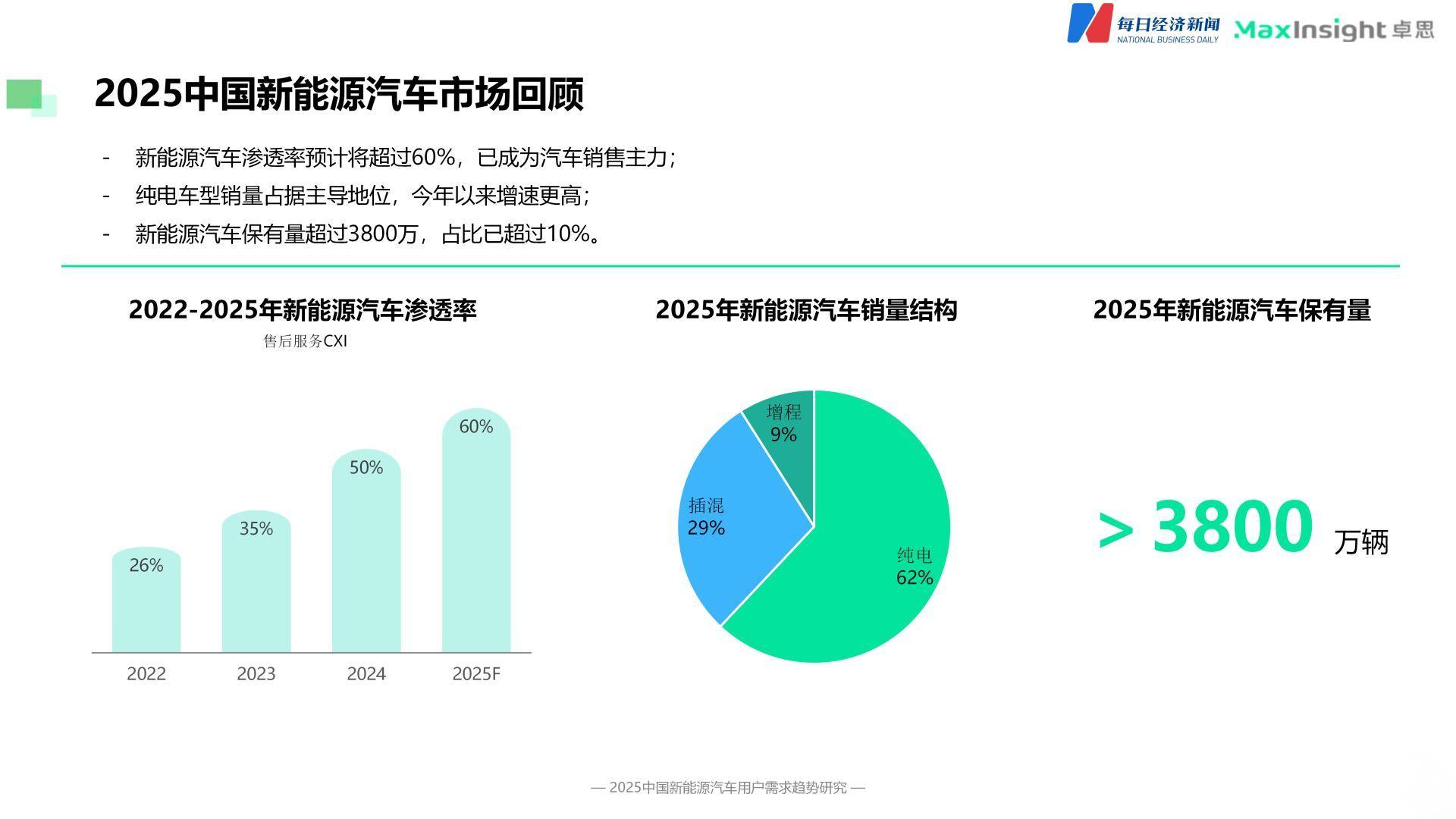
Core Insights - In 2025, China's new energy vehicle (NEV) ownership is expected to exceed 38 million, accounting for over 10% of total vehicle ownership, with a market penetration rate projected to surpass 60% [1][5] - The shift in consumer decision-making reflects a transition from policy-driven motivations to a focus on user experience, with driving experience, comfort, and intelligent features becoming the primary drivers of purchase decisions [5][6] Market Trends - The average number of factors considered by consumers during the car-buying process has increased from 4.2 to 5.9, with a heightened focus on vehicle safety and intelligent configurations [6] - The competitive landscape is evolving, with consumers increasingly comparing electric models against each other rather than against traditional fuel vehicles [11] User Preferences - Users are moving from "basic anxiety" regarding range to a pursuit of quality, as the average range of pure electric vehicles has improved from 450 km in 2022 to 530 km in 2025 [12] - Key consumer demands include high cost-performance ratio, absolute safety, and advanced intelligent features, which are now essential for market competitiveness [12][21] Future Outlook - The market is expected to face intensified competition by 2026, with challenges such as reduced subsidies and increased product homogeneity, yet opportunities exist for products that genuinely meet consumer needs [22] - The implementation of new safety standards for electric vehicle batteries in July 2026 will raise safety requirements, pushing the industry towards healthier value recovery [22]

新能源车零售渗透率达57.2% 广州车展勾勒2026年市场格局
Zhong Guo Zhi Liang Xin Wen Wang· 2025-11-20 03:32
Core Viewpoint - The 2025 Guangzhou International Auto Show will highlight the advancements in the domestic and international electric vehicle (EV) market, showcasing strategic changes among participating brands that outline the new market landscape for 2026 [1] Group 1: Market Performance - The domestic EV market has achieved a historic breakthrough in 2025, with over 10 million applications for vehicle trade-in subsidies, of which 57.2% are for EVs, leading to a 24.4% year-on-year increase in retail sales of new energy passenger vehicles from January to September [2] - In October, new energy vehicle sales reached 51.6% of total new car sales, indicating a significant structural shift in the domestic automotive market [2] Group 2: Sales and Production Data - In terms of production and sales, pure electric vehicles (BEVs) produced 841.0 thousand units (up 43.4% year-on-year) and sold 833.0 thousand units (up 42.9% year-on-year) [3] - Plug-in hybrid electric vehicles (PHEVs) saw production of 460.2 thousand units (up 17.7% year-on-year) and sales of 461.0 thousand units (up 17.8% year-on-year) [3] - Fuel cell vehicles experienced a decline, with production at 0.3151 thousand units (down 32.7% year-on-year) and sales at 0.3164 thousand units (down 32.6% year-on-year) [3] Group 3: Policy and Market Demand - The sustained growth in EV sales is attributed to both policy incentives, such as trade-in subsidies and tax exemptions, and increasing market demand driven by a diverse product matrix and technological advancements [5] - The Guangzhou Auto Show will feature 58% of its exhibits as new energy models, significantly surpassing previous years, with 93 new models debuting, most of which emphasize electrification and intelligence [5] Group 4: Competitive Landscape - Major global brands will participate in the auto show, showcasing a diverse competitive landscape, with traditional brands accelerating their electrification efforts and new entrants focusing on smart technology [7] - Data from October indicates that domestic brands achieved a 77.9% penetration rate in new energy vehicle retail, while joint ventures only reached 7%, suggesting a strong competitive advantage for domestic manufacturers [7] Group 5: Future Market Trends - The 2026 EV market is expected to feature three parallel technology routes: pure electric, range-extended, and plug-in hybrid, with competition focusing on ultra-fast charging, long range, and smart features [9] - The emphasis will shift from range and aesthetics to smart driving assistance systems and intelligent cabins, with advanced features becoming standard in mid-to-high-end models [11] - The collaboration between tech companies and automakers is expected to enhance the implementation of smart technologies, creating a synergistic effect that optimizes user experience [11] Group 6: Market Outlook - The 2026 Chinese EV market is projected to expand in scale, with increased competition and improved quality, supported by ongoing policies like trade-in incentives and charging infrastructure [13] - The penetration rate of new energy vehicles is anticipated to exceed 60%, with a growing share of high-end models and intensified competition in the mainstream market [13] - Technological advancements in battery energy density, reliability of smart driving systems, and charging efficiency are expected to attract consumers seeking quality and technological sophistication in their transportation choices [13]
观察 | 新能源车零售渗透率达57.2% 广州车展勾勒2026年市场格局
Zhong Guo Zhi Liang Xin Wen Wang· 2025-11-20 03:31
Core Insights - The 2025 Guangzhou International Auto Show will open on November 21, showcasing the achievements of domestic and international electric vehicles and outlining the new market landscape for 2026 [1] - The domestic electric vehicle market has achieved a historic breakthrough in 2023, with over 10 million applications for vehicle trade-in subsidies, of which 57.2% are for electric vehicles, leading to a 24.4% year-on-year increase in retail sales of new energy passenger vehicles from January to September [2][5] - The market structure of the domestic automotive industry has shifted, with electric vehicles accounting for 51.6% of total new car sales in October [2] Policy and Market Dynamics - The sustained growth in electric vehicle sales is driven by both policy incentives and market demand, including trade-in subsidies and tax exemptions, which enhance consumer purchasing power [5] - The variety of domestic electric vehicle products, technological upgrades, and improved charging infrastructure are meeting diverse consumer needs, making the Guangzhou Auto Show a significant platform for showcasing electric vehicles [5] Competitive Landscape - Major global brands will participate in the auto show, indicating a diversified competitive landscape, with traditional brands accelerating their electrification efforts and new entrants focusing on smart technology [7] - Data from October shows that domestic brands have a retail penetration rate of 77.9% in the new energy vehicle market, while joint ventures only account for 7% [7] Technological Trends - The 2026 electric vehicle market will feature three parallel technological routes: pure electric, range-extended, and plug-in hybrid, with a focus on ultra-fast charging, long range, and smart features [9] - The competition will shift towards intelligent driving assistance systems and smart cockpit features, with high-end models increasingly equipped with advanced technologies [11] Future Market Outlook - The Chinese electric vehicle market is expected to continue expanding, with a penetration rate projected to exceed 60% by 2026, maintaining its lead in the global market [13] - The competition in the mainstream market (priced between 100,000 to 200,000 yuan) will intensify, focusing on product performance and cost-effectiveness [13]


金杯汽车计划收购 中拓科技52%股权
Zheng Quan Shi Bao· 2025-11-19 23:07
Core Viewpoint - Jinbei Automotive plans to invest 158 million yuan to acquire a 52% stake in Zhongtuo Technology, making it a subsidiary, enhancing its position in the automotive parts industry [1][2] Group 1: Investment Details - Jinbei Automotive will invest 89.583 million yuan to subscribe for 25 million yuan of new registered capital in Zhongtuo Technology, resulting in a 29.41% stake [2] - Following the capital increase, Jinbei Automotive will acquire an additional 22.59% stake from existing shareholders for 68.8 million yuan, bringing its total ownership to 52% [2] - The total registered capital of Zhongtuo Technology will be 442 million yuan after the investment [2] Group 2: Company Profile and Market Position - Zhongtuo Technology is a high-tech enterprise specializing in the R&D, production, and sales of automotive parts, with manufacturing bases in Changchun, Chengdu, and Tianjin [1] - The company serves a diverse range of clients, including major automotive manufacturers such as FAW Hongqi, Volkswagen/Audi, BMW, and emerging companies like Xiaomi and Xpeng [1][2] - Zhongtuo Technology is recognized as a leading Tier 2 supplier in the Northeast automotive industry, particularly in plastic parts spraying [2] Group 3: Strategic Implications - The investment aligns with Jinbei Automotive's growth strategy focused on innovation and market expansion through joint ventures [2] - This acquisition will allow Jinbei Automotive to enter the lightweight components sector, creating new business growth opportunities and enhancing its profitability and overall strength [2]


16家企业荣获中国欧盟商会第12届企业社会责任奖项
Yang Zi Wan Bao Wang· 2025-11-19 14:31
Core Points - The 12th Corporate Social Responsibility (CSR) Award Ceremony was held by the China-EU Chamber of Commerce in Nanjing, recognizing 16 leading companies for their outstanding CSR practices [1][2] - The event featured a keynote speech on "New Trends in China-EU ESG Rules" by Dr. Bu Maoliang, providing forward-looking industry insights [1] - The awards covered key areas of CSR and sustainability, including supply chain, decarbonization, and gender equality, promoting deeper communication and cooperation between Chinese and European enterprises [2] Award Highlights - Companies such as Deka, Bosch Home Appliances, DSV, and Arkema received the "Corporate Social Responsibility and Sustainable Development Leadership Award" [2] - The "Green Impact Pioneer Award" was awarded to Gaillard and BASF Shanghai Coatings [2] - Ericsson Nanjing, Airbus, and Schaeffler were recognized with the "Climate Action Leader Award" [2] - Ernst & Young and Dittop received the "Gender Equality and Empowerment Excellence Award" [2] - Siemens, Vitas, and BMW were honored with the "Employee Development and Engagement Award" [2] - Susphor won the "Sustainable Supply Chain Award" [2] - Netspring received the "Social Innovation Excellence Award" [2]

因芯片短缺,曝博世3大工厂面临停产风险
Ju Chao Zi Xun· 2025-11-19 14:27
Core Insights - The chip supply shortage caused by the trade dispute involving Nexperia has put Bosch's factories in Ansbach, Salzgitter, and Braga at risk of shutdown, affecting approximately 3,500 employees [2][3] Factory Impact Summary - **Ansbach, Germany**: 2,500 employees, approximately 650 affected, facing temporary shutdown [3] - **Salzgitter, Germany**: 1,300 employees, 300-400 affected, facing temporary shutdown [3] - **Braga, Portugal**: 3,300 employees, approximately 2,500 affected, facing temporary work hour adjustments or furloughs [3] Background of the Dispute - On September 30, the Dutch government took control of Nexperia citing "national security" and "intellectual property protection" concerns [4] - On October 3, China's Ministry of Commerce retaliated by banning Nexperia China and its subcontractors from exporting domestically produced automotive-grade power semiconductors, impacting about 70% of Nexperia's chip supply globally [4] - On October 26, Nexperia Netherlands suspended wafer supply to its Chinese subsidiary, exacerbating the supply chain disruption [4] - Nexperia holds over 30% market share in the automotive-grade power chip market, with its chips widely used in automotive electronic systems [4] Bosch's Response Measures - Bosch is seeking alternative chip suppliers and evaluating multiple backup options [5] - Implementing a "wafer direct delivery" plan to purchase silicon wafers directly from Nexperia's European factories for packaging in Dongguan, China [5] - Adjusting production plans to prioritize core product lines and customer orders [5] Broader Industry Impact - The crisis has extended to the global automotive supply chain, with major German automakers like Volkswagen and BMW facing chip inventory that can only sustain production for 10-20 days [5] - Honda has been forced to halt production at its Mexican factory, and first-tier suppliers like ZF and Omron are also facing production cuts [5] - On November 19, the Dutch Ministry of Economic Affairs announced a suspension of intervention in Nexperia, returning control to Wingtech Technology [5] - Analysts believe this crisis highlights the vulnerability of the global automotive supply chain's over-reliance on a single chip supplier, predicting a shift towards supply chain diversification among automakers and component manufacturers [5]
