兴业证券

Search documents
非银金融行业投资策略周报:开年政策及资金延续向好,看好板块补涨机遇-20260223
GF SECURITIES· 2026-02-23 07:54
Core Viewpoints - The report highlights a positive outlook for the non-bank financial sector, driven by favorable policies and continued capital inflow, suggesting potential for sector rebound [1][6]. - The report maintains a "Buy" rating for the sector, indicating expected strong performance relative to the market [2]. Market Performance - As of February 14, 2026, the Shanghai Composite Index rose by 0.41%, while the Shenzhen Component Index increased by 1.39%. The CSI 300 Index saw a modest gain of 0.36% [12]. - The average daily trading volume in the Shanghai and Shenzhen markets was 2.11 trillion yuan, reflecting a 12.3% decrease week-on-week [6]. Industry Dynamics and Weekly Commentary Insurance Sector - The report indicates that listed insurance companies are expected to maintain high growth, with a marginal improvement in long-term interest margins. The insurance fund utilization scale reached 38.5 trillion yuan in Q4 2025, up 15.7% year-on-year [18]. - The report suggests that the upcoming spring market rally may drive better-than-expected performance for insurance companies in Q1 2026, supported by a stable long-term interest rate and an upward trend in the equity market [18]. Securities Sector - The report discusses the recent optimization measures for refinancing announced by the three major exchanges, which aim to enhance financing efficiency and support high-quality enterprises [19]. - The new refinancing rules are expected to create structural opportunities for securities firms, shifting the focus from compliance to the ability to identify and serve quality clients [20]. - The report emphasizes that the optimization of refinancing will lead to a more differentiated regulatory system, benefiting quality companies while tightening controls on weaker entities [22]. Key Company Valuations and Financial Analysis - The report provides detailed valuations for several key companies in the sector, including: - China Ping An (601318.SH) with a target price of 85.17 yuan and a "Buy" rating [7]. - New China Life (601336.SH) with a target price of 94.21 yuan and a "Buy" rating [7]. - China Life (601628.SH) with a target price of 55.47 yuan and a "Buy" rating [7]. - The report also highlights the expected earnings per share (EPS) growth for these companies, indicating a positive outlook for their financial performance in 2025 and 2026 [7].



兴业证券:美关税判决是行政权受限带来的长期叙事变化 关注税率下降对A股出口链影响
智通财经网· 2026-02-22 10:56
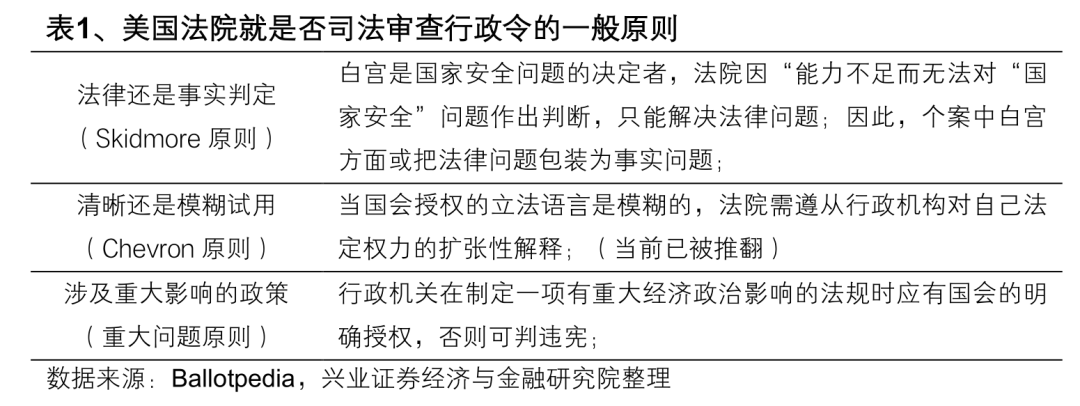
智通财经APP获悉,兴业证券发布研报称,2月20日,美国最高法院以6:3裁定美国对等关税和对华芬太尼关税违宪。判决将反映在资产价格上,美股受到 支撑而美债承压。与此同时,判决是一种行政权受限带来的长期叙事变化,未来将增加美国后续政策的"混沌性",刺激贵金属等"弱美元资产"和美债收益 率上行。轻工家电、消费电子、电池、汽车零部件以及医疗器械等对美营收敞口大、且在此前对等关税较高的东盟地区有大量产能布局或贸易转口的行业 将重点受益于本轮关税下降。 兴业证券主要观点如下: 前言:2月20日,美国最高法院以6:3裁定美国对等关税和对华芬太尼关税违宪。随后,特朗普宣布根据IEEPA加征关税将不再生效,同时对全球新加征 10%的122关税,于2月24日凌晨生效。此外,特朗普计划发布新的关税调查,预计需要5个月时间。新关税豁免了部分关键矿产、原料、电子和机械产 品。同时,特朗普重申对小额包裹的免税政策取消仍然生效。 如何理解美国最高法院的判决书? 一是关税属于法定的国会权力。判决书提到,美国宪法第一条第八款明确规定,征收税收、关税的权力属于国会,制宪者并未将任何征税权授予行政部 门。(The Framers gave "C ...

创识科技实控人张更生获刑 2021年上市兴业证券保荐

Zhong Guo Jing Ji Wang· 2026-02-22 01:29
Core Viewpoint - The company announced that its controlling shareholder and actual controller, Zhang Gengsheng, received a criminal judgment for bribery, which does not significantly impact the company's operations or governance [1][2]. Group 1: Legal Proceedings - The Shanghai Pudong New District People's Court issued a criminal judgment on February 12, 2026, sentencing Zhang Gengsheng to two years in prison with a two-year suspension and a fine of 300,000 RMB [1]. - The judgment is a first-instance ruling and has not yet taken effect, with the possibility of appeal within ten days [2]. Group 2: Company Operations - Zhang Gengsheng does not hold any director or senior management positions in the company, and the judgment does not affect his shareholder rights [2]. - The company’s daily operations are normal, and the board and management team continue to fulfill their responsibilities [2]. Group 3: Financial Information - The company was listed on the Shenzhen Stock Exchange's Growth Enterprise Market on February 9, 2021, issuing 34.125 million shares at a price of 21.31 RMB per share [2]. - The total funds raised amounted to 727 million RMB, with a net amount of 667 million RMB after deducting issuance costs, exceeding the original plan by 222 million RMB [2]. - The funds are intended for upgrading electronic payment solutions, merchant service network construction, and research and development center establishment [2].
兴业证券:2026年关注电新、TMT、新消费等出海机会
智通财经网· 2026-02-21 07:29
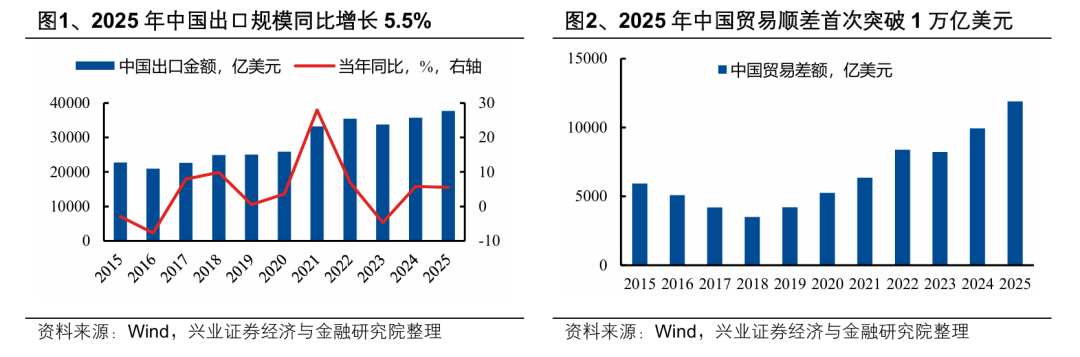
Core Viewpoint - The global industrial system is undergoing a significant paradigm shift from "efficiency first" to "security and autonomy," leading to increased demand for infrastructure and industrial construction, with China transitioning from a "final product exporter" to a "global basic industrial provider" [1][39]. Group 1: China's Foreign Trade Trends - China's foreign trade is diversifying and moving towards higher-end products, with exports reaching a historical high of $2.5 trillion in 2025, a year-on-year increase of 5.5% [2]. - The trade surplus surpassed $1 trillion for the first time, marking a significant year-on-year increase of 19.8% [2]. - Net exports contributed 1.64 percentage points to GDP growth in 2025, the second-highest level since 2007 [5]. Group 2: Regional and Product Structure - The diversification of external demand is strengthening, with emerging markets compensating for declines in the U.S. market. Exports to the U.S. fell by 19.79% year-on-year, while exports to ASEAN, Africa, and the Middle East grew by 13.64%, 25.9%, and 9.7%, respectively [8]. - High-end manufacturing products such as electrical machinery, machinery, automobiles, and ships remain the mainstay of exports, contributing 44.10%, 17.67%, 16.05%, and 6.99% to the total export scale [13]. Group 3: Opportunities for Overseas Expansion - In 2026, there are strong overseas opportunities in sectors such as electric new (batteries, grid equipment), machinery, TMT (electronics, communication, gaming), innovative pharmaceuticals, new consumption, shipbuilding, commercial vehicles, automotive parts, and chemical products [57]. - The restructuring of global supply chains is accelerating the globalization of Chinese enterprises' production capacity, with 229 companies establishing production facilities or subsidiaries in ASEAN, India, and Mexico by 2025, nearly doubling from 2024 [29]. Group 4: AI Expansion Cycle - The AI expansion cycle is a core focus in the Chinese capital market, with significant capital expenditure expected from major tech companies. For instance, capital expenditures from major cloud service providers in North America are projected to reach $598.7 billion in 2026, a 67% increase year-on-year [45][46]. - The demand for AI-related hardware is expected to drive growth in related sectors, benefiting domestic manufacturing leaders in robotics and consumer electronics [48]. Group 5: Cultural and Technological Output - Chinese enterprises are also focusing on cultural and technological exports, with significant growth in overseas revenue from IP (e.g., toys, games) and lifestyle brands (e.g., new tea drinks, e-commerce) [49][50]. - The innovative pharmaceutical sector is becoming a key player in the global market, with several new drugs commercialized in the U.S. and Europe, indicating strong potential for further overseas opportunities in 2026 [53].
芝麻AI速递:昨夜今晨财经热点要闻|2026年2月19日
Sou Hu Cai Jing· 2026-02-18 22:15
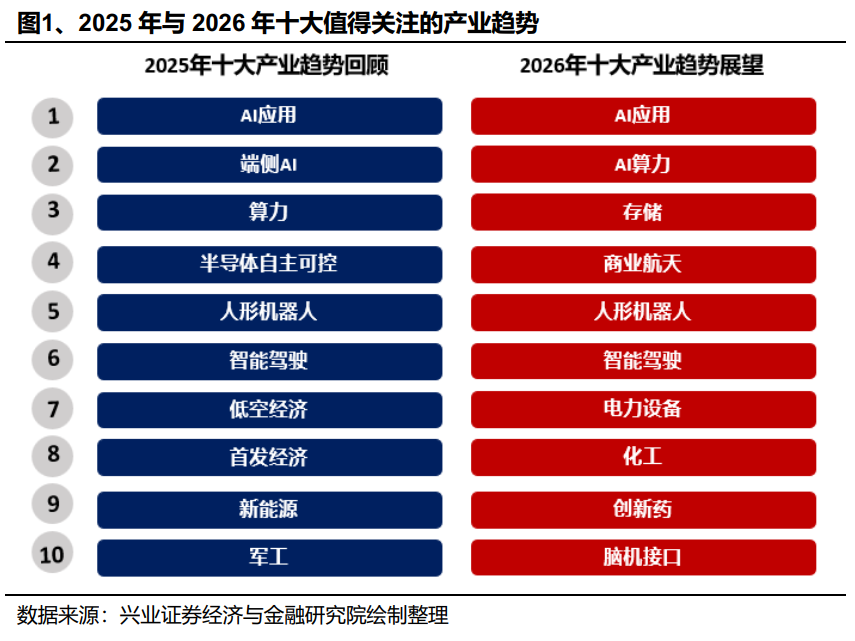
Group 1: Investment Moves - Warren Buffett significantly reduced his technology stock holdings, selling over 10.29 million shares of Apple, a 4.3% decrease, and cutting his Amazon stake by over 77% [2] - Berkshire Hathaway also sold nearly 50.8 million shares of Bank of America, while initiating a new position by purchasing 5.067 million shares of The New York Times [2] - This adjustment in holdings has drawn attention from investors regarding Buffett's future investment strategies [2] Group 2: AI and Technology Developments - Nvidia and Meta have announced a strategic partnership, with Meta set to purchase millions of Nvidia chips to enhance AI inference performance and energy efficiency [2] - This agreement supports Meta's plan to invest $600 billion in building 30 data centers by 2028, indicating a potential shift away from in-house chip development [2] Group 3: Market Trends and Economic Indicators - Gold prices experienced volatility, dropping below $4,900 per ounce due to cooling interest rate expectations from the Federal Reserve and profit-taking by investors [2] - However, banks predict a recovery in gold prices, driven by geopolitical tensions and concerns over Fed policies [2] - The U.S. stock market showed fluctuations, with financial stocks performing well while software stocks faced declines [3] Group 4: Industry Insights - The robot industry is gaining momentum, with nearly $3 billion flowing into robot ETFs since February, driven by favorable policies and new product launches [3] - India aims to attract over $200 billion in AI-driven investments within two years, with significant participation from global leaders and companies like Google and Adani Group [3] - The chemical sector is showing signs of recovery, with expectations of improved demand and a potential cyclical upturn by 2026 [5] Group 5: Emerging Trends - A report highlights ten key trends for 2026, including advancements in AI applications, domestic substitution of computing power, and breakthroughs in commercial space and humanoid robotics [5] - These trends are supported by favorable policies and present significant opportunities for investors [5]
兴业证券:2026年值得关注的十大产业趋势
智通财经网· 2026-02-18 03:45
Group 1: AI Applications - The global AI competition is intensifying, with model iterations driving deeper application scenarios, and the focus is on whether significant capital expenditures by tech giants can lead to commercial applications [2][3] - The competitive landscape for AI applications is shifting from dominance by OpenAI to a more multipolar environment, with major players like Google and Meta integrating AI into their ecosystems [3] - In China, AI applications are experiencing a breakthrough, with major tech companies accelerating model iterations and application deployments, leading to a transformation from model landing to scenario monetization [5] Group 2: AI Computing Power - Overseas, major cloud service providers are maintaining high capital expenditures, with a projected increase of 67% in 2026, reflecting a strong demand for AI computing power [7][8] - In China, leading tech companies are increasing capital expenditures and accelerating the iteration of domestic large models, promoting the performance of domestic chips amid tightening supply from foreign sources [9] Group 3: Storage - The demand for storage is entering a new super cycle driven by AI training and inference needs, with AI servers consuming significantly more memory than traditional servers [11][16] - Supply constraints are expected to persist, leading to continued high prices for storage components, as major manufacturers shift production focus to advanced memory types [16] Group 4: Commercial Aerospace - Commercial aerospace is becoming a key battleground in US-China competition, with significant policy support and funding initiatives in both countries to accelerate industry development [19][21] - Domestic companies are achieving breakthroughs in satellite mass production and reusable rocket technologies, transitioning from technical validation to commercialization [22] Group 5: Humanoid Robots - Major overseas companies are ramping up production plans for humanoid robots, benefiting domestic component suppliers, with Tesla aiming for a production capacity of 500,000 units by 2026 [27][30] - Chinese manufacturers are leading in humanoid robot shipments, with significant contracts and production milestones achieved in 2025 [30] Group 6: Intelligent Driving - Domestic policies are expected to facilitate the commercialization of L3 autonomous driving in 2026, with several manufacturers preparing to launch L3 models [32][33] - Tesla's Full Self-Driving (FSD) technology is setting the direction for autonomous driving, with significant advancements in AI capabilities [35] Group 7: Energy Storage - The expansion of AI computing power in North America is driving electricity demand, with domestic power equipment expected to accelerate exports [37][40] - China's "14th Five-Year Plan" includes significant investments in the power grid and energy storage, creating a favorable environment for industry growth [40][43] Group 8: Chemicals - The chemical industry is undergoing a transformation driven by policies aimed at supply-side reform, with a focus on optimizing supply structures and reducing excess capacity [44][47] - New economic sectors are boosting demand for chemical materials, particularly in AI, renewable energy, and robotics, leading to a favorable outlook for new materials [47][48]

“6.8时代”,离岸人民币汇率继续上涨
Sou Hu Cai Jing· 2026-02-17 03:30
Group 1 - The offshore RMB exchange rate broke through 6.89, closing at 6.8835 against the USD, with an increase of 176 points [2] - As of February 17, at 10:45 AM, the offshore RMB was reported at 6.887 against the USD [2] Group 2 - Industrial Securities noted that the RMB exchange rate is supported by multiple favorable factors, leading to appreciation against the USD and enhancing the attractiveness of Chinese assets for foreign investors [3] - The weakening of the USD due to its disruptive impact on global order is beneficial for emerging market assets, particularly stable currency and improving fundamental RMB assets [3]
存款搬家加速?1月非银存款同比多增2.56万亿 最新解读来了
天天基金网· 2026-02-16 07:30
Core Viewpoint - The article highlights a significant trend of residents shifting their savings from traditional bank deposits to asset management products, driven by recent financial data and changing market conditions [2][6]. Group 1: Financial Data Overview - In January, household deposits increased by 2.13 trillion yuan, non-financial enterprise deposits rose by 2.61 trillion yuan, and non-bank financial institution deposits grew by 1.45 trillion yuan [2][3]. - The broad money supply (M2) reached 347.19 trillion yuan, with a year-on-year growth of 9%, while the narrow money supply (M1) was 117.97 trillion yuan, growing by 4.9% [3][4]. - Compared to the same period in 2025, non-bank deposits increased significantly by 2.56 trillion yuan, while household deposits saw a decrease of 3.39 trillion yuan [4][5]. Group 2: Analysis of Deposit Trends - Analysts note that the acceleration of household deposit migration is evident, with the growth rate of household deposits turning negative for the first time in 7.5 years [5]. - The difference between household deposit growth and M2 growth is -1.82 percentage points, indicating a significant shift in savings behavior [5]. - The trend of residents moving their savings to non-bank financial institutions reflects a broader movement towards asset management products [6][7]. Group 3: Future Implications - The upcoming maturity of a large volume of household fixed-term deposits, estimated between 30 trillion to 70 trillion yuan, is expected to influence where these funds will be allocated, particularly towards equity markets [6][7]. - Analysts suggest that while there may be a flow of funds into low-risk assets, the actual movement into riskier assets like equities will depend on market conditions [7][8]. - The potential for continued adjustment in asset allocation between stocks and bonds is anticipated, especially in light of fixed asset investment trends and economic growth expectations [8].

存款搬家加速?1月非银存款同比多增2.56万亿,最新解读来了
Xin Lang Cai Jing· 2026-02-15 23:33
Core Viewpoint - The recent data from the central bank indicates a significant shift in household deposits towards non-bank financial institutions, reflecting an acceleration in the trend of residents moving their savings from traditional deposits to asset management products [1][4][12]. Group 1: Financial Data Overview - In January, household deposits increased by 2.13 trillion yuan, non-financial corporate deposits rose by 2.61 trillion yuan, and deposits in non-bank financial institutions grew by 1.45 trillion yuan [1][8]. - The total balance of broad money (M2) reached 347.19 trillion yuan, with a year-on-year growth of 9%, while narrow money (M1) stood at 117.97 trillion yuan, growing by 4.9% [8][9]. - Compared to the same period in 2025, non-bank deposits increased by 2.56 trillion yuan year-on-year, while household deposits decreased by 3.39 trillion yuan [1][9]. Group 2: Analysis of Deposit Trends - Analysts from various brokerages agree that the data indicates an acceleration in the migration of household deposits, with the growth rate of household deposits declining sharply [3][10]. - The difference between the growth rates of household deposits and M2 has turned negative for the first time in 7.5 years, indicating a significant shift [10][11]. - The increase in non-bank deposits is attributed to both a low base effect from previous self-regulation in interbank deposit pricing and a potential shift of household savings towards the stock market [2][9]. Group 3: Wealth Migration to Asset Management Products - There is a growing discussion regarding the reallocation of deposits as a large volume of fixed-term deposits is set to mature, estimated to be between 30 trillion and 70 trillion yuan by 2026 [4][12]. - By the end of 2025, deposits in non-bank financial institutions are projected to reach 34.6 trillion yuan, marking a 22.8% year-on-year increase, the highest in a decade [12]. - The balance of asset management products sourced from households and enterprises is expected to grow to 56.3 trillion yuan by the end of 2025, reflecting a 9.7% increase [12]. Group 4: Market Implications - Despite the migration of deposits, analysts caution that this does not necessarily imply a significant influx of capital into the equity market, as much of the funds may flow into low-risk assets rather than riskier investments [5][13]. - The expected path of fund flow is projected to be from household deposits to non-bank deposits, then to financial products, and finally into the bond and stock markets [6][13]. - Analysts suggest that the liquidity in the equity market will depend on various macroeconomic indicators, and the sentiment may shift as the high point of deposit maturity pressure approaches in early 2026 [13][14].
存款搬家加速?1月非银存款同比多增2.56万亿,最新解读来了
券商中国· 2026-02-15 23:31
Core Viewpoint - The recent financial statistics from the central bank indicate a significant shift in household deposits towards non-bank financial institutions, reflecting a broader trend of wealth migration from traditional savings to asset management products [2][6][7]. Group 1: Financial Data Overview - In January, household deposits increased by 2.13 trillion yuan, while non-financial corporate deposits rose by 2.61 trillion yuan, and deposits from non-bank financial institutions grew by 1.45 trillion yuan [1][3]. - The total balance of broad money (M2) reached 347.19 trillion yuan, with a year-on-year growth of 9%, while narrow money (M1) stood at 117.97 trillion yuan, growing by 4.9% [3][4]. Group 2: Deposit Migration Trends - Compared to the same period in 2025, non-bank deposits increased by 2.56 trillion yuan, while household deposits decreased by 3.39 trillion yuan, indicating a clear trend of "deposit migration" [2][4]. - Analysts noted that the decline in household deposits and the increase in non-bank deposits are influenced by factors such as the timing of the Spring Festival and a shift in investment preferences towards the stock market [4][5]. Group 3: Asset Management Product Migration - The discussion around the "massive maturity of deposits" has led to speculation about where these funds will be reallocated, with estimates suggesting that between 3 trillion to 7 trillion yuan of household time deposits will mature in 2026 [6][7]. - By the end of 2025, the balance of deposits in non-bank financial institutions is projected to reach 34.6 trillion yuan, marking a 22.8% year-on-year increase, which reflects the ongoing trend of deposit migration [6][7]. Group 4: Market Implications - Analysts express caution regarding the potential impact of deposit migration on the equity market, suggesting that the primary destination for matured deposits may be low-risk assets rather than high-risk equities [7][8]. - The outlook for 2026 indicates that if household investment remains stable, funds may flow from household deposits to non-bank deposits, and subsequently into financial products like funds and insurance, before reaching the bond and stock markets [7][8].