德勤

Search documents
特斯拉七连跌,中概股深夜狂飙,百度大涨15%,加密货币超11万人爆仓
2 1 Shi Ji Jing Ji Bao Dao· 2026-01-02 23:27
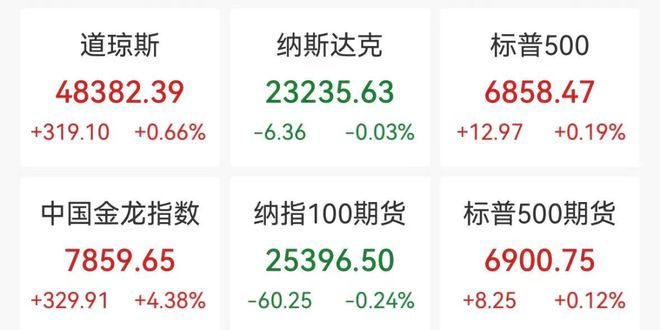
记者丨金珊 庞华玮 编辑丨陈思颖 1月2日,2026年首个交易日,美国三大股指收盘涨跌不一,道指涨0.66%,标普500指数涨0.19%,纳指 跌0.03%。 | 道琼斯 | 纳斯达克 | 标普500 | | --- | --- | --- | | 48382.39 | 23235.63 | 6858.47 | | +319.10 +0.66% | -6.36 -0.03% | +12.97 +0.19% | | 中国金龙指数 | 纳指100期货 | 标普500期货 | | 7859.65 | 25396.50 | 6900.75 | | +329.91 +4.38% | -60.25 -0.24% | +8.25 +0.12% | 贵金属方面,现货黄金涨0.33%,报4332.5美元/盎司,COMEX黄金期货涨0.02%,报4341.90美元/盎 司。现货白银涨1.74%,报72.8美元/盎司,COMEX白银期货涨2.35%,报72.27美元/盎司。 国际油价方面,WTI 2月原油期货收跌0.17%,报57.32美元/桶。布伦特3月原油期货收跌0.16%,报 60.75美元/桶。 加密货币方面,多个主要币种 ...


德勤:2026年中国内地A股市场将继续稳定增长 香港新股融资额有望再破3000亿港元
Zhong Guo Jing Ying Bao· 2026-01-01 13:49
Group 1 - The report by Deloitte China indicates that despite geopolitical tensions and the impact of the US "reciprocal tariff" policy, the global IPO financing amount for the top ten new stocks in 2025 shows slight improvement compared to 2024 [1] - The Hong Kong Stock Exchange is expected to lead in new stock financing in 2025, with four out of eight super-large IPOs ranking among the top ten globally [1] - The A-share market in 2025 continues the momentum from 2024, with an increase in the number of new stocks and a significant rise in financing amounts, supported by new policies [1][2] Group 2 - The Hong Kong IPO market is projected to rebound strongly in 2025, with expectations to reach a record financing amount of at least 300 billion HKD in 2026, driven by measures encouraging mainland enterprises to list in Hong Kong and the return of international capital [2] - By December 31, 2025, 114 companies are expected to list in the A-share market, raising 129.6 billion RMB, with the Shanghai Stock Exchange leading in financing amount [2] - The report anticipates that the A-share market will continue to see stable growth in new stock issuance in 2026, particularly in sectors like AI and those prioritized in the "14th Five-Year Plan" [1][3] Group 3 - Deloitte's partner in East China noted that the A-share market's performance in 2025 surpasses that of 2024, with an increase in average financing scale among the top five new stocks, indicating a healthy supply of quality IPOs [3] - The Hong Kong market achieved significant success in 2025, reclaiming its position as the leading global IPO market, attributed to various reforms and measures implemented by the Hong Kong Stock Exchange and the Securities and Futures Commission [3] - Predictions for 2026 suggest around 160 new IPOs in Hong Kong, with financing expected to exceed 300 billion HKD, including several large-scale listings from mainland enterprises [3][4] Group 4 - The outlook for the Hong Kong IPO market may still be influenced by macroeconomic and geopolitical factors, including US monetary policy and global capital allocation trends [4] - Continuous reforms and institutional optimizations in the capital market are expected to enhance Hong Kong's overall competitiveness, liquidity, and valuation levels, improving the IPO market's ecosystem [5]
中航畅宏:外资持续看好中国资产:盈利接棒估值,科技仍是主线
Sou Hu Cai Jing· 2025-12-30 14:05
Core Viewpoint - Major foreign financial institutions have expressed a positive outlook for China's stock market, driven by accelerating corporate earnings growth, macro policy coordination, and the appreciation of the RMB [1][3]. Group 1: Market Outlook - Foreign institutions believe that the driving force behind the rise of China's stock market is shifting from "valuation correction" in 2025 to "earnings growth" in 2026 [3][4]. - Goldman Sachs predicts a 38% increase in the Chinese stock market by the end of 2027, primarily driven by a 14% and 12% increase in corporate earnings in 2026 and 2027, respectively [4][5]. - UBS has set a target of 7100 points for the Hang Seng Tech Index and 100 points for the MSCI China Index by the end of 2026, indicating significant upside potential [5]. Group 2: Investment Trends - There has been a net inflow of $83.1 billion into Chinese assets through ETFs since the beginning of 2025, with the technology sector receiving the most inflow at $9.5 billion [10][11]. - Active foreign capital is expected to return more rapidly, with some foreign institutions increasing their positions in the Chinese stock market in preparation for 2026 [12][13]. - The investment opportunities are highly structured, with a focus on technology innovation, green energy transition, and high-quality brands benefiting from consumer recovery [7][9]. Group 3: Sector-Specific Insights - The technology sector is highlighted as having the greatest profit growth potential, with revenue less affected by trade policies [7]. - Traditional sectors are also attracting foreign interest, with improvements in state-owned enterprise earnings and dividend increases drawing long-term capital [8]. - Under the "anti-involution" framework, sectors like cement, solar energy, and chemicals are expected to receive policy support and have attractive valuations [9].



美家族办公室热潮黄金现多空梯队
Jin Tou Wang· 2025-12-30 03:03
摘要今日周二(12月30日)亚盘时段,现货黄金目前交投于4360.56美元附近,截至发稿,现货黄金最新报 4353.09美元/盎司,涨幅0.50%,最高上探至4360.99美元/盎司,最低触及4322.53美元/盎司。目前来 看,现货黄金短线偏震荡走势。 今日周二(12月30日)亚盘时段,现货黄金目前交投于4360.56美元附近,截至发稿,现货黄金最新报 4353.09美元/盎司,涨幅0.50%,最高上探至4360.99美元/盎司,最低触及4322.53美元/盎司。目前来 看,现货黄金短线偏震荡走势。 【要闻速递】 支撑梯队由上至下依次为:4330-4335美元区间,既是昨日黄金价格低点,也是日内资金成交密集区, 对金价形成强支撑,短期守住有望缓解下行压力;4300美元整数关口,作为市场普遍关注的心理防线且 具技术属性,构成极强支撑,是本周多头防守核心;4270-4280美元区间,重合20日均线与中期上升趋 势线,技术支撑逻辑强,属强支撑区,回落至此或触发技术性买盘;4230-4250美元区间,为12月中旬 起涨点及前期回调底部,市场支撑基础扎实,属中强支撑。 阻力梯队由下至上依次为:4380-4390美元区 ...
外资做多中国股市新动向曝光
21世纪经济报道· 2025-12-29 14:15
Core Viewpoint - Major foreign institutions are optimistic about the Chinese stock market for 2026, shifting their focus from "valuation repair" in 2025 to "profit growth" in 2026, driven by accelerating corporate earnings, macro policy support, and RMB appreciation [1][3][6]. Group 1: Market Outlook - Goldman Sachs predicts a 38% increase in the Chinese stock market by the end of 2027, with corporate earnings expected to grow by 14% in 2026 and 12% in 2027 [4]. - UBS sets the target for the Hang Seng Tech Index at 7100 points and the MSCI China Index at 100 points by the end of 2026, indicating significant upside potential [4]. - HSBC forecasts the Shanghai Composite Index to reach 4500 points, the CSI 300 Index to 5400 points, and the Shenzhen Component Index to 16000 points by the end of 2026, driven primarily by corporate earnings growth rather than valuation increases [4]. Group 2: Investment Opportunities - Foreign institutions highlight structured investment opportunities, particularly in technology innovation, with a focus on artificial intelligence, semiconductors, and high-end manufacturing [8]. - Traditional industries are also attracting foreign investment, with expectations of valuation recovery and improved profitability in state-owned enterprises [8]. - The influx of foreign capital is primarily directed towards high-quality assets, including technology leaders and high-dividend stocks, emphasizing value investment [8][10]. Group 3: Foreign Capital Inflow - Since the beginning of 2025, global investments in Chinese assets have seen a net inflow of $83.1 billion, with the technology sector receiving the most significant inflow of $9.5 billion [10]. - Active foreign capital is expected to return to the Chinese market, with institutions like Citigroup maintaining an "overweight" rating on China while reducing exposure to other Asian emerging markets [10][12]. - The anticipated return of active funds is supported by improving corporate fundamentals, a weaker dollar, and the attractiveness of RMB assets [11][12].

外资持续看好中国资产:盈利接棒估值,科技仍是主线
2 1 Shi Ji Jing Ji Bao Dao· 2025-12-29 14:08
Core Viewpoint - Foreign institutions are optimistic about the Chinese stock market for 2026, shifting their focus from "valuation repair" in 2025 to "profit growth" in 2026, driven by accelerating corporate earnings, macro policy support, and RMB appreciation [1][2][5]. Investment Trends - As of December 20, 2025, global investment in Chinese assets through ETFs has seen a net inflow of $83.1 billion, with the technology sector receiving the most inflow at $9.5 billion [1][9]. - Active foreign capital is expected to return to the Chinese stock market, with some institutions already increasing their positions in preparation for 2026 [10][12]. Earnings Forecasts - Goldman Sachs predicts a 38% increase in the Chinese stock market by the end of 2027, with corporate earnings expected to grow by 14% in 2026 and 12% in 2027 [3]. - UBS forecasts an increase in the Hang Seng Tech Index target to 7,100 points and the MSCI China Index target to 100 points by the end of 2026, indicating significant upside potential [3]. Valuation Insights - Morgan Stanley and Goldman Sachs believe there is still about a 10% potential for valuation repair in the Chinese stock market, which will support market growth [4][5]. - JPMorgan has upgraded its rating on the Chinese market to "overweight," citing reasonable valuations and light positions among international investors [4]. Sector-Specific Opportunities - The technology sector is highlighted as a core focus for profit growth, with opportunities in artificial intelligence, semiconductors, and high-end manufacturing [6]. - Traditional industries are also attracting foreign investment, with improvements in state-owned enterprise profitability and dividend increases acting as a dual engine for market growth [7][8]. Market Dynamics - The report indicates that the Chinese stock market will enter a new phase dominated by fundamentals, with a focus on structural investment opportunities [2][5]. - The anticipated return of active foreign capital is expected to be driven by improving corporate fundamentals, a weaker dollar, and the attractiveness of RMB assets [12].

拜登预言成真,让特朗普干完这4年,美国或将成为世界老二?
Sou Hu Cai Jing· 2025-12-27 06:33
Economic Impact - The overall tariff rate in the U.S. has surged from 2.4% to 16.8%, the highest level since 1935, leading to increased consumer prices and higher corporate costs [1] - The Federal Reserve estimates that tariffs have raised core inflation by 0.4 to 0.5 percentage points, with consumer prices for appliances and electronics rising over 10% [1] - The contribution of tariffs to personal consumption expenditure inflation reached 10.9% over the past 12 months [1] GDP and Employment Forecasts - The U.S. GDP growth rate for Q3 was 4.3%, driven mainly by consumption and a reduction in the trade deficit, but long-term tariff policies may slow economic growth [3] - Economic forecasts for U.S. growth in 2025 have been downgraded from 2.1% to 1.9%, with 2026 expected at 1.8% [5] - The unemployment rate has risen from 4.1% to 4.6%, with projections suggesting it could reach 5% if tariff policies persist [5] Comparison with China - China's GDP is projected to grow by 4.5% in 2025, significantly outpacing the U.S. growth forecast of 1.9% [7] - By 2028, China's GDP may reach $23.45 trillion, positioning it as a leading economic engine in Asia [7] - The U.S. manufacturing sector has not seen significant changes despite tariff policies, as supply chain disruptions have led to increased imports [7] International Relations and Influence - Trump's tariff policies have strained relationships with allies, diminishing U.S. international influence and leading to a perception of the U.S. as a source of trouble rather than a leader [15] - The trend of de-dollarization is gaining momentum, with countries like Saudi Arabia considering non-dollar payment methods for oil exports [11][13] - China's Belt and Road Initiative and its growing partnerships, including a $3 billion commercial agreement with Saudi Arabia, highlight its expanding global influence [15]

“隐形金主”崛起:家族办公室在华尔街重塑资本版图
Huan Qiu Wang· 2025-12-27 01:00
Group 1 - The core viewpoint of the article highlights the explosive growth of family offices, with global wealth under management reaching approximately $5.5 trillion, a 67% increase over the past five years, and projected to exceed $9 trillion by 2030 [2] - Family offices are no longer exclusive to ultra-wealthy individuals like Bill Gates and Jeff Bezos; families with net worths of tens of millions to over a billion dollars are increasingly establishing their own offices or opting for multi-family office models [2][3] - The number of single-family offices has surpassed 8,000, a one-third increase since 2019, and is expected to exceed 10,000 by 2030, indicating a growing trend where having a family office is becoming a status symbol among ultra-high-net-worth individuals [2] Group 2 - Family offices possess unique advantages in investment, including long investment horizons, concentrated risk appetites, and short decision-making chains, allowing them to compete directly with major institutions like Blackstone and KKR in large mergers and private equity transactions [3] - Unlike traditional institutional investors, family offices prioritize long-term vision and sector judgment over frequent performance assessments and risk control measures, making them attractive to entrepreneurs and asset managers [3] - Family offices also serve as central systems for family life, managing global asset allocation, charitable donations, art collections, and even personal services like private jet management [3] Group 3 - A notable trend is the formation of alliances among family offices, where they share investment leads and participate in transactions together, creating "family investment clubs" to enhance bargaining power for better terms [4]

手握5.5万亿美元巨资,飞速崛起的华尔街大金主:家族办公室!
Hua Er Jie Jian Wen· 2025-12-26 06:07
Core Insights - Family offices are rapidly emerging as significant players in the capital markets, managing approximately $5.5 trillion in global wealth, with projections to reach $6.9 trillion this year and exceed $9 trillion by 2030 [1][3] - The number of single-family offices has surpassed 8,000 globally, reflecting a one-third increase since 2019, and is expected to exceed 10,000 by 2030 [1][2] Group 1: Growth and Market Position - Family offices are experiencing explosive growth, with a 67% increase in wealth management over the past five years [1] - They are becoming competitive with major investment firms like Blackstone and Apollo in large mergers and private equity transactions [3] - The trend of family offices is shifting from being exclusive to ultra-wealthy individuals to including families with net worths in the tens of millions to over a billion dollars [1][2] Group 2: Investment Characteristics - Family offices have unique advantages such as not being required to disclose financials or appease external investors, allowing for greater investment freedom [3] - They focus on long-term visions and are less concerned with short-term performance metrics, making them attractive to entrepreneurs [4] - Investment cycles can extend up to 10 to 20 years, with a concentrated risk appetite and a streamlined decision-making process [4] Group 3: Comprehensive Wealth Management - Beyond investment, family offices serve as central systems for family life management, including global asset allocation, charitable donations, and personal services [5] - Over 20% of family offices with assets exceeding $500 million employ art advisors, indicating a trend towards integrating lifestyle management with investment [5] - Family offices are forming alliances to share investment insights and participate in transactions collectively, enhancing their bargaining power [5]
年末业绩压力催生“财报美化”业务,资金中介提供高息资金拆借或成造假“帮凶”
Mei Ri Jing Ji Xin Wen· 2025-12-24 01:45
Core Viewpoint - The article highlights the growing underground business of "financial statement beautification" among listed and pre-IPO companies, where short-term fund borrowing is used to artificially enhance financial metrics without real business backing [1][2][19]. Group 1: Business Operations - The core of the "year-end financial statement optimization" business involves financial intermediaries providing short-term fund borrowing services, allowing companies to manipulate key financial indicators like revenue and cash flow through circular fund transfers [1][2][12]. - Service providers openly promote their offerings in various financial communities and platforms, claiming to cover all sectors of the A-share market, with individual transactions reaching up to 10 billion [2][3]. - The operational process is standardized, involving the signing of dual agreements for confidentiality and fund management, with funds typically transferred in a manner that ensures rapid turnover [14][15]. Group 2: Legal and Regulatory Risks - The actions of financial intermediaries and companies involved in this practice are likely to violate securities laws, as they knowingly assist in financial fraud, which could lead to criminal liability [18][19]. - Regulatory bodies maintain a "zero tolerance" policy towards financial fraud, emphasizing strict enforcement and the potential for severe legal consequences for both companies seeking to beautify their financial statements and the intermediaries providing the funds [19]. - The high costs associated with these services, including interest rates that can exceed 70% annually, pose significant financial risks to companies already in distress [17][18].