德赛西威

Search documents
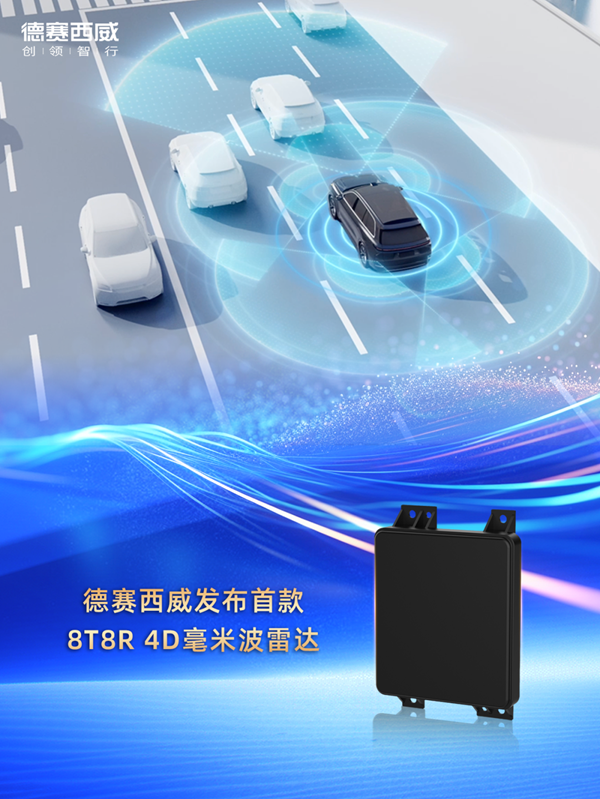
全球首发量产在即|德赛西威发布首款卫星架构 8T8R 4D 毫米波雷达
Zhong Guo Qi Che Bao Wang· 2026-02-06 10:33
Core Insights - The auxiliary driving industry is transitioning from L2+ to L3, with "all-weather, all-scenario, high redundancy" perception capabilities becoming a consensus and core pursuit [1] Industry Overview - By 2025, the penetration rate of millimeter-wave radar in China's passenger vehicles is expected to exceed 50%, making 4D millimeter-wave radar a focal point in market competition [3] - The implementation of new national standards like AEB is highlighting the shortcomings of traditional 3D millimeter-wave radar, while the enhanced perception capabilities of 4D millimeter-wave radar are becoming a key choice for automakers to balance regulatory compliance and user experience [3] Company Developments - Desay SV's 8T8R 4D millimeter-wave radar has been recognized as a global leader, with the first model supporting satellite architecture already secured for deployment with major domestic automakers, aiming for mass production by 2026 [3] - The upgrade to 4D millimeter-wave radar is not just a hardware iteration but a system engineering effort combining "sensors + domain control," achieving significant technological breakthroughs [4] Technological Advancements - The 8T8R radar features a 30% improvement in angular accuracy, 150% increase in point cloud density compared to the 6T8R solution, and enhanced anti-interference capabilities, allowing for stable perception in extreme conditions [4] - The radar can detect objects over 300 meters away, reliably identifying traffic cones at 120 meters and stationary vehicles at 280 meters, meeting industry standard requirements [4] Future Outlook - The 4D millimeter-wave radar supports a satellite architecture that allows direct output of high-fidelity ADC raw data to central domain controllers, reducing hardware costs and power consumption [5] - Over the next three years, 4D millimeter-wave radar is expected to rapidly penetrate the mainstream passenger vehicle market priced around 150,000 yuan [5] - Desay SV has a strong foundation in the millimeter-wave radar field, with over a million units shipped annually during the 3D radar era, and is well-positioned for the rapid rollout of 4D technology [5] Strategic Positioning - Desay SV aims to provide a complete perception solution that is quickly producible, adaptable, and continuously evolving, marking a significant step in the high-level intelligent driving sensor field with the launch of the 8T8R 4D millimeter-wave radar [6]

德赛西威(002920) - 2026年2月5日投资者关系活动记录表
2026-02-06 10:14
Group 1: Market Positioning - The company leverages unique advantages to create products that are superior to competitors, maintaining a leading position in the market [2][3] - The diverse and tiered product matrix, along with flexible cooperation models, covers a vast majority of customer needs, supporting the company's market leadership [3] Group 2: Quality Management - The company has integrated 14 advanced international management systems, including IATF16949 and ISO26262, forming a comprehensive digital management system from R&D to customer service [4] - It is the first enterprise to receive the "National Quality Award" and has won various quality awards, demonstrating its commitment to high-quality product delivery [4] - The company operates a leading laboratory with dual recognition (CNAS and A2LA), covering extensive testing capabilities in electrical, mechanical, environmental reliability, EMC, and failure analysis [4] Group 3: Robotics Domain Control - The company has established strategic partnerships with several renowned robotics firms and launched the AI Cube, an AI computing terminal for robotics [5] - The AI Cube aims for "zero defects" and enhances the durability and reliability of key robotic components, improving their intelligence in complex environments [5] - The company provides technical services for rapid model adaptation, optimization, and computational acceleration, aiding clients in enhancing large model inference speed [5]
从GDP年均6%增速 看惠州经济跃升“密码”
Nan Fang Du Shi Bao· 2026-02-05 23:15
当历史的指针划过"十四五"的刻度,惠州交出了一份令人瞩目的答卷:地区生产总值(GDP)年均增长 6%,位居全省第一。年均增长6%,这对惠州意味着什么? "十四五"时期我国经济年均增长5.4%,广东省的地区生产总值年均增长率为4.7%,惠州的6%已经超越 了全国全省的平均增速了。这不仅仅是一个经济增速的数字,更是一个城市转型升级的生动注脚,一种 发展路径的战略选择。 A 数字背后的前瞻布局 年均6%的增长速度,对惠州而言,首先意味着发展模式的根本性转变。在房地产行业进入下行通道之 前,惠州展现出难得的战略清醒和行动果决,果断切入以工业为主要支撑的发展轨道。这一前瞻性布 局,为惠州经济稳健增长构筑了坚实底座。 "十四五"期间,惠州规上工业增加值年均增长8.7%,同样位居全省第一。这一数据与GDP增速的协同提 升,揭示了增长的内在逻辑:不是依靠短期刺激或泡沫堆积,而是源于实体经济的扎实根基。 企业梯队建设成效显著,超10亿元企业由2020年的97家增至151家,超百亿企业由10家增至16家。高新 技术企业数量翻番,培育了1110家省级专精特新中小企业、69家国家专精特新"小巨人"企业、28家 (次)制造业单项冠军企 ...
AI转型和全球化,项目管理如何助力企业战略破局?
财富FORTUNE· 2026-02-05 13:36
Core Viewpoint - Project management is increasingly recognized as a strategic capability that bridges strategy and execution, emphasizing the importance of delivering value that exceeds all inputs and expenditures [2][12]. Group 1: Importance of Project Management - Only 50% of projects are reported to be successful, highlighting the growing complexity and challenges in project management as businesses undergo digital transformation and agile innovation [2]. - The traditional "iron triangle" of project management (scope, time, and budget) is evolving, necessitating a redefinition of project success based on the value created rather than just adherence to these constraints [9][11]. Group 2: PMI's Role and Market Potential - PMI is recognized as a leading authority in project management, with its certifications, such as PMP, becoming a gold standard in the industry. The demand for project management professionals is projected to reach 30 million globally by 2035, with China's demand expected to double from 11.1 million to 23.3 million [5][6]. - PMI's initiatives in China focus on talent development and the introduction of global standards, particularly in AI and sustainable development, to enhance project management practices [3][14]. Group 3: M.O.R.E. Framework - PMI has introduced the M.O.R.E. framework (Manage perceptions, Own project success, Reassess parameters, Expand perspective) to help redefine project success and shift from a task-driven to a value-driven approach [11][12]. - This framework encourages project professionals to manage stakeholder perceptions and ensure that projects align with strategic objectives, thus enhancing overall project value [11][12]. Group 4: Globalization and Localization Challenges - As Chinese companies expand globally, they face challenges in finding suitable talent and establishing a common communication language. PMI aims to provide a standardized framework to facilitate cross-regional and cross-cultural collaboration [13][14]. - PMI's global standards, including the PMBOK Guide, are recognized by various international organizations, reinforcing their authority in project management and aiding in the localization of training and certification for Chinese enterprises [14]. Group 5: AI and Project Management - The integration of AI into project management is seen as a transformative force, with PMI launching initiatives to help the industry leverage AI for project management and manage AI transformation projects [19][20]. - PMI has developed tools and platforms to support project professionals in utilizing AI, aiming to enhance project success rates and adapt to the rapid pace of technological change [20].
中国汽车 - 智能驾驶座舱加速走向集成-China Autos & Shared Mobility-One box, one dream - Smart-drivingcockpit racing towards integration
2026-02-05 02:22
Summary of Conference Call on China Autos & Shared Mobility Industry Overview - The focus is on the integration of smart-driving and cockpit functionalities within the automotive industry, particularly in China. This integration is expected to accelerate significantly in the next 6-12 months due to advancements in VLA (vision-language-action) models and a pressing need for cost savings [1][2]. Key Insights 1. **Integration of Smart Systems**: The integration of smart cockpit and smart driving systems is anticipated to reach a new level, with penetration rates of approximately 80% for smart cockpits and 60% for smart driving (L2 and above) in China by 2025. This shift is driven by the synergy between these systems, increased AI computing needs, and OEMs' focus on cost savings [2][3]. 2. **Cost Savings from Integration**: Integrating cockpit and driving functions onto a single SoC (System on Chip) could yield cost savings of Rmb2-3k per vehicle by eliminating the need for separate hardware components. This integration is expected to make advanced features accessible in vehicles priced below Rmb150k [10][11]. 3. **Technological Advancements**: The automotive industry is witnessing rapid technological upgrades, with chip processes advancing from 7nm to 5nm and below. This is crucial for meeting the higher computing power demands of L3 autonomous driving systems, which require onboard computing power ranging from 700 to 2250 TOPS [4]. 4. **Market Dynamics**: Companies like Horizon Robotics are positioned to benefit from this trend, provided they can compete effectively with established players like Nvidia in the SoC market. However, this integration poses risks for tier-one DCU makers, as it may lead to a decrease in the value content of their products [11][16]. Additional Considerations - **Supplier Landscape**: Key suppliers and OEMs adopting integrated smart cockpit and driving solutions are highlighted, indicating a shift in the competitive landscape within the industry [11]. - **Risks**: Potential risks include slower-than-expected adoption of ADAS/AD technologies, supply chain disruptions, and successful in-house hardware design initiatives by OEMs [18]. Conclusion The automotive industry in China is on the brink of significant transformation with the integration of smart-driving and cockpit functionalities. This shift is driven by technological advancements, cost-saving measures, and changing market dynamics, presenting both opportunities and risks for stakeholders involved.


特斯拉20260203
2026-02-04 02:27
赵旭杨 开源证券汽车分析师: 好的,各位领导晚上好。我是开源证券汽车组的赵旭阳。今天感谢大家来参加我们今天的 智驾系列的第九期,关于特斯拉的一些智驾的一些信息的一些更新。以及就是近期那个, 特斯拉,就是美国的这个,高速公路安全管理局,其实也公布了一些智驾的数据。就是尤 其是这个 Robot Taxi 这边吧,一些这个,关于一些事故的一些数据的统计。这个之前其 实有一个这个比较大的一个新闻,然后大家可能觉得这个 Robot Taxi 的这个安全性可能 是产生了一些质疑。 然后这块我们也把这个数据下载下来,然后进行了一些这个分析。由于这个数据本身是包 含所有北美那边的这个 robot taxi 的车辆的,所以其实我们也可以整体性地观察出来的一 些,观察出来一些这个整体行业的一些这个情况。首先就是那个特斯拉的这个财报,财报 里边的话,其实我们觉得对于这个对于这个,我对这个少了一个环节,就是我们先还是把 我们的这个整体的支架的观点,简单给大家。汇报一下。我觉得,就是说整体智驾的这个 热度,我觉得这段这段时间是偏向于比较低位的一个状态的。 这个原因,我觉得主要还是说近期的这个智驾整体的这个催化呀,整体来说是比较小的。 ...

行业深度 | RoboX:产业奇点已至 规模化应用加速【国联民生汽车 崔琰团队】
汽车琰究· 2026-02-03 16:03
Core Insights - The RoboX industry is approaching a commercialization inflection point, driven by strong policy support, increasing demand for cost-effective and safe autonomous driving solutions, and significant reductions in core component costs [2][6][11]. Group 1: RoboX Overview - RoboX encompasses various forms of autonomous driving applications, including Robotaxi, Robovan, and Robotruck, designed to adapt to different transportation scenarios through modular design [8]. - The industry is experiencing rapid advancements in technology, with the penetration rate of L2 and above autonomous features in passenger vehicles expected to exceed 90% by 2030, significantly driving down costs for key components like LiDAR and computing chips [9][11]. Group 2: Robotaxi Insights - Robotaxi is projected to achieve an operational cost of $0.2 per kilometer by 2027, a 50% reduction compared to traditional ride-sharing platforms, primarily due to the remote safety operator model and economies of scale [3][17]. - The global Robotaxi market is expected to reach a valuation of $352.6 billion by 2035, with the Chinese market anticipated to grow from $200 million in 2025 to $179.4 billion by 2035, indicating strong growth potential [23][28]. Group 3: Robovan Insights - The demand for Robovan is driven by labor shortages and high costs in last-mile delivery, with its capabilities making it a key solution across e-commerce, retail, and food delivery sectors [4]. - The cost of Robovan is expected to drop significantly, from 500,000-600,000 yuan to around 20,000 yuan, due to economies of scale and increased penetration of L2 and above features in passenger vehicles [4][11]. Group 4: Robotruck Insights - Robotruck applications are expanding from closed environments to long-haul logistics, with a market potential reaching hundreds of billions, focusing on stable freight demand and high operational value [5]. - The adoption of "virtual drivers" in Robotrucks is expected to significantly reduce the operating costs of electric trucks, enhancing their commercial viability [5]. Group 5: Policy Support - Since 2020, the Chinese government has implemented numerous policies to support the development of intelligent connected vehicles, establishing a robust regulatory framework for the industry [11][13]. - By 2025, 17 national-level testing demonstration zones have been established, with over 32,000 kilometers of testing roads opened, facilitating the transition from technology validation to commercial operation [11][13]. Group 6: Investment Recommendations - Companies involved in autonomous driving solutions and operations are expected to benefit directly from the commercialization of RoboX, with a projected rapid increase in penetration rates between 2026 and 2027, unlocking a market potential of hundreds of billions [6][28]. - Recommended companies include WeRide, Cao Cao Mobility, and XPeng Motors, with a focus on intelligent component manufacturers like Horizon Robotics and Bertelson [6].


德赛西威2月2日获融资买入1.01亿元,融资余额17.28亿元
Xin Lang Cai Jing· 2026-02-03 01:25
Group 1 - The core viewpoint of the news is that Desay SV Automotive experienced a decline in stock price and trading volume on February 2, with significant financing activities indicating high levels of market interest and potential volatility [1] Group 2 - As of February 2, Desay SV's stock price fell by 1.37%, with a trading volume of 890 million yuan. The financing buy-in amount was 101 million yuan, while the financing repayment was 110 million yuan, resulting in a net financing buy of -9.4961 million yuan [1] - The total margin balance for Desay SV as of February 2 was 1.731 billion yuan, with the financing balance of 1.728 billion yuan accounting for 2.58% of the circulating market value, indicating a high level compared to the past year [1] - On the short-selling side, Desay SV had 4,100 shares repaid and 2,600 shares sold on February 2, with a selling amount of 313,600 yuan at the closing price. The short-selling balance was 282.64 million yuan, also indicating a high level compared to the past year [1] Group 3 - As of September 30, the number of shareholders for Desay SV was 56,500, a decrease of 4.24% from the previous period, while the average circulating shares per person increased by 4.43% to 9,789 shares [2] - For the period from January to September 2025, Desay SV achieved operating revenue of 22.337 billion yuan, a year-on-year increase of 17.72%, and a net profit attributable to shareholders of 1.788 billion yuan, up 27.08% year-on-year [2] - Desay SV has distributed a total of 2.237 billion yuan in dividends since its A-share listing, with 1.438 billion yuan distributed over the past three years [2] Group 4 - As of September 30, 2025, the sixth largest circulating shareholder of Desay SV was Hong Kong Central Clearing Limited, holding 9.3147 million shares, an increase of 1.502 million shares from the previous period. The tenth largest shareholder was Huatai-PB CSI 300 ETF, holding 4.8369 million shares, a decrease of 238,800 shares from the previous period [2]
舜宇光学:25E盈利超预期,需求波动不改光学升级主线-20260203
海通国际· 2026-02-03 00:25
Investment Rating - The report maintains an "Outperform" rating for Sunny Optical Technology [2][10][17] Core Insights - Sunny Optical is expected to achieve attributable net profit of RMB 45.89–47.24 billion in 2025, representing a year-on-year increase of 70% to 75%, significantly above Bloomberg consensus of RMB 35.39 billion. This upside is primarily driven by a one-off investment gain of approximately RMB 9.19 billion from an equity transfer for a stake in Goertek Optics. Excluding this non-recurring item, the core attributable net profit is estimated to be RMB 36.7–38.05 billion, supported by the ongoing premiumization of smartphone camera specifications [3][13] - The company continues to benefit from the upgrade of camera specifications in flagship and mid-to-high-end smartphones, which is expected to enhance both average selling price (ASP) and gross margin for handset lenses and camera modules [4][14] Summary by Relevant Sections Handsets - Despite ongoing headwinds from rising memory costs, the trend of optical upgrades remains intact. The company is well-positioned to benefit from the adoption of higher-value products such as variable aperture and periscope cameras, which will drive ASP and margin expansion [4][14] Automotive - The adoption of intelligent driving technologies is expected to significantly boost the company's automotive lens and module businesses. The average number of cameras per vehicle is projected to increase, with high-end vehicles already equipped with around 12 cameras [5][15] XR & IoT - The company maintains its global leadership in imaging modules for smart glasses, with strong growth in revenue from handheld imaging devices. The rapid expansion of AI and AR glasses is anticipated to be a key growth driver in the coming years [6][16] Valuation - The estimated EPS for 2025-2027 is revised to RMB 4.23, 3.86, and 4.19 respectively. Based on a P/E ratio of 19.6x for 2026, the target price is set at HKD 85.24 [6][17]
舜宇光学科技(02382):25E盈利超预期,需求波动不改光学升级主线
Haitong Securities International· 2026-02-02 23:30
Investment Rating - The report maintains an "Outperform" rating for Sunny Optical Technology [2][10][17] Core Insights - Sunny Optical is expected to achieve attributable net profit of RMB 45.89–47.24 billion in 2025, representing a year-on-year increase of 70% to 75%, significantly above Bloomberg consensus of RMB 35.39 billion. This upside is primarily driven by a one-off investment gain of approximately RMB 9.19 billion from an equity transfer for a stake in Goertek Optics. Excluding this non-recurring item, the core attributable net profit is estimated to be RMB 36.7–38.05 billion, supported by the ongoing premiumization of smartphone camera specifications [3][13] - The company continues to benefit from the upgrade of camera specifications in flagship and mid-to-high-end smartphones, which is expected to drive the average selling price (ASP) and gross margin for handset lenses and camera modules [4][14] Summary by Relevant Sections Handsets - Despite ongoing cost pressures from rising memory prices, the trend towards optical upgrades in smartphones remains intact. The company is well-positioned to benefit from the adoption of higher-value products such as variable aperture and periscope cameras, which will drive ASP and margin expansion [4][14] Automotive - The adoption of intelligent driving technologies is expected to significantly boost the company's automotive lens and module businesses. The average number of cameras per vehicle is projected to increase, with high-end vehicles already equipped with around 12 cameras. This trend is anticipated to accelerate growth in the automotive segment [5][15] XR & IoT - The company maintains its leading market share in imaging modules for smart glasses, with strong growth in revenue from handheld imaging devices. The rapid expansion of AI and AR glasses is expected to become a key growth driver in the coming years [6][16] Valuation - The estimated EPS for 2025-2027 is revised to RMB 4.23, 3.86, and 4.19 respectively. Based on a P/E ratio of 19.6x for 2026, the target price is set at HKD 85.24, maintaining the "Outperform" rating [6][17]