
三生制药

Search documents
方正证券:创新药出海已成趋势 新技术开发引领未来
Zhi Tong Cai Jing· 2025-11-26 02:29
Group 1: Core Insights - The current wave of innovative drugs is driven by China's participation in new technologies, with advancements in ADC, bispecific antibodies, second-generation IO, and GLP-1 [1] - The global pharmaceutical transaction volume has steadily increased, with total transaction amounts rising from $56.9 billion to $187.4 billion over the past decade, while China's transaction amounts surged from $3.1 billion to $57.1 billion [1] - By 2024, China's transaction volume is expected to account for approximately 30% of global pharmaceutical transactions [1] Group 2: Sector Analysis - In oncology, the combination of IO and ADC therapies remains strong, with significant transactions in the PD-1 bispecific antibody space; the sales of Pembrolizumab are projected to reach $29.482 billion in 2024 [2] - The autoimmune disease sector is witnessing a shift as older drugs face patent expirations, with new opportunities emerging in Th2 and Th17 pathways; Dupilumab is expected to lead with $14.1 billion in sales in 2024 [2] - The cardiovascular and metabolic disease market continues to grow, with GLP-1 receptor agonists projected to exceed $50 billion in global sales in 2024 [3] Group 3: Future Technologies - New technologies such as next-generation ADCs, TCE therapies, universal/in vivo CART technologies, gene therapy, and small nucleic acid technologies are anticipated to lead future disease treatments [4]

创新药集体大涨!利好频出,高弹性港股通创新药ETF(520880)放量涨超3%
Mei Ri Jing Ji Xin Wen· 2025-11-26 02:18
Group 1 - The Hong Kong innovative drug sector has rebounded strongly, with leading stocks like Heng Rui Pharmaceutical and Sanofi both rising over 4% [1] - The Hong Kong Stock Connect innovative drug ETF (520880) has over 70% of its holdings in leading innovative drug stocks, showing a rise of over 3% in early trading [1] - Significant positive news for major innovative drug companies includes Sanofi's plan to spin off its minoxidil brand for a listing on the Hong Kong Stock Exchange and the approval of clinical trial applications for ActRIIA/B antibody JMT206 by Shiyao Group [1] Group 2 - The Hong Kong innovative drug sector has undergone sufficient adjustments since September and may now be in a cost-effective allocation zone [2] - The Hong Kong Stock Connect innovative drug ETF (520880) and its linked fund (025221) passively track the Hang Seng Hong Kong Stock Connect Innovative Drug Select Index, which exclusively invests in innovative drug R&D companies [2] - As of the end of September, the index has shown a cumulative increase of 108.14% this year, outperforming other innovative drug indices [2]
三生制药飙升逾6%
Xin Lang Cai Jing· 2025-11-26 02:12
Core Viewpoint - The Hong Kong innovative drug sector is experiencing significant growth, with leading stocks such as Sangfor and CSPC Pharmaceutical rising over 6% and 8% respectively, driven by positive market sentiment and key developments in the industry [1][2]. Group 1: Market Performance - The Hong Kong innovative drug ETF (520880) opened high and increased by over 3%, with more than 70% of its portfolio invested in leading innovative drug stocks [1]. - Sangfor Pharmaceutical and CSPC Pharmaceutical both saw their stock prices increase significantly, indicating strong market performance in the innovative drug sector [1][2]. Group 2: Industry Developments - Sangfor Pharmaceutical plans to spin off its minoxidil brand, Mandi International, for a listing on the Hong Kong Stock Exchange [1]. - CSPC Pharmaceutical received approval for clinical trials of its ActRIIA/B antibody JMT206 injection, aimed at treating obesity [1]. Group 3: ETF Insights - The fund manager of the Hong Kong innovative drug ETF highlighted that the innovative drug sector is seeing continuous catalysts, with significant business development transactions exceeding $1 billion this year [2]. - The ETF is positioned to benefit from upcoming industry conferences and the expected release of innovative drug insurance negotiations results in December [2]. - The index tracked by the ETF has a high concentration of leading stocks, with the top ten holdings accounting for over 71% of the index weight, providing a strong representation of the innovative drug sector [3].

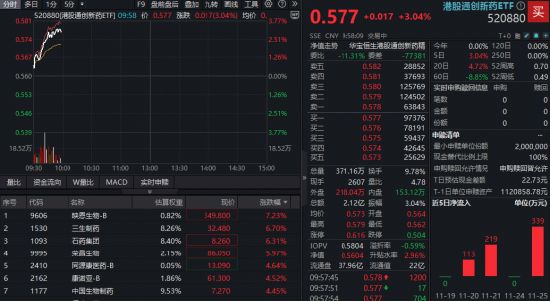
三生制药飙升逾6%,拟分拆“防脱神药”蔓迪赴港上市!高弹性港股通创新药ETF(520880)放量涨超3%
Xin Lang Ji Jin· 2025-11-26 02:07
Core Viewpoint - The Hong Kong innovative drug sector is experiencing significant growth, with leading stocks such as 3SBio and CSPC Pharmaceutical rising over 6% and 8% respectively, driven by positive news and developments in the industry [1][2][3]. Group 1: Market Performance - The Hong Kong innovative drug ETF (520880) has over 70% of its portfolio invested in leading innovative drug stocks, showing a strong upward trend with a rise of over 3% in early trading [2][3]. - Major stocks in the innovative drug sector, including 3SBio and CSPC Pharmaceutical, have shown substantial gains, indicating a bullish sentiment in the market [1][2]. Group 2: Industry Developments - 3SBio plans to spin off its Minoxidil brand, Mandi International, for a listing on the Hong Kong Stock Exchange, which is expected to enhance its market position [1]. - CSPC Pharmaceutical has received approval for clinical trials of its ActRIIA/B antibody JMT206 injection for obesity treatment, marking a significant advancement in its product pipeline [1]. Group 3: ETF Insights - The Hong Kong innovative drug ETF (520880) is the largest in its category, with a total scale of 2.12 billion HKD and an average daily trading volume of 464 million HKD since its inception [4]. - The ETF's index, the Hang Seng Hong Kong Stock Connect Innovative Drug Select Index, has a high concentration of leading stocks, with the top ten holdings accounting for over 71% of the total weight, indicating a strong focus on major players in the innovative drug sector [4][3]. Group 4: Future Outlook - The innovative drug sector is expected to see continued positive catalysts, with significant data releases and active business development transactions anticipated in November and December [3]. - Upcoming industry conferences and the expected release of the first version of the commercial insurance innovative drug directory are likely to further boost market sentiment [3].
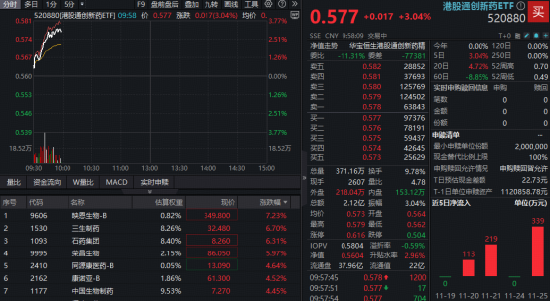
港股医药板块再度走强,港股创新药ETF(159567)早盘涨超3%
Mei Ri Jing Ji Xin Wen· 2025-11-26 02:03
Core Viewpoint - The Hong Kong pharmaceutical sector is experiencing a strong rally, driven by increased demand for flu-related medications and the growth of innovative domestic drugs in international markets [1] Group 1: Market Performance - The Hong Kong pharmaceutical sector saw significant gains, with companies like InnoCare Pharma, Rongchang Bio, CSPC Pharmaceutical, and 3SBio all rising over 6% [1] - The Hong Kong Innovative Drug ETF (159567) increased by over 3% as of 9:51 AM, with a trading volume exceeding 600 million yuan [1] - As of November 25, the ETF has recorded a net inflow of 903 million yuan for the month [1] Group 2: Demand Trends - There is a notable increase in demand for flu medications on the Alibaba Health platform, with a more than 500% week-on-week growth in the number of buyers for antiviral flu drugs during the recent two weeks (November 10-23) [1] Group 3: Industry Outlook - Institutions believe that more domestic innovative drugs are achieving value upgrades through international expansion, with overseas licensing transaction amounts reaching new highs, providing new momentum for sector growth [1] - The long-term positive trend in the innovative drug industry is expected to continue, extending from performance realization to business development in international markets [1]
新加坡AISG计划放弃Meta转向阿里千问,港股科技ETF(159751)涨超1.1%
Sou Hu Cai Jing· 2025-11-26 02:03
Group 1 - The core viewpoint of the news highlights a positive market sentiment driven by favorable factors such as the Federal Reserve's dovish stance and a call between the US and Chinese leaders, leading to a collective rise in major indices [1] - The AI industry chain is a focal point, with hardware sectors like Google's OCS concept and Meta's potential multi-billion dollar procurement of Google's TPU driving significant gains in related stocks [1] - The application side sees a shift in sentiment with Singapore's AISG moving away from Meta towards Alibaba's Qianwen, further boosting AI applications and leading to new highs in core stocks, which also positively impacts gaming stocks [1] Group 2 - Dongwu Securities notes a reduction in short-term risk factors for the Hong Kong stock market, suggesting that the current position is attractive for medium to long-term investment [2] - The expectation of a potential interest rate cut by the Federal Reserve in December could support a rebound in the Hong Kong market [2] - The upcoming Central Economic Work Conference in December may refocus market attention on policy, which has not yet been fully priced in [3] - The narrative around the AI technology bubble in the US has weakened, leading to a significant pullback in Hong Kong tech stocks, which now present an attractive investment opportunity [4] Group 3 - The Hong Kong Technology ETF closely tracks the CSI Hong Kong Stock Connect Technology Index, which selects 50 large-cap, high R&D investment, and high revenue growth tech companies to reflect the overall performance of tech leaders in the Hong Kong Stock Connect [5] - As of October 31, 2025, the top ten weighted stocks in the CSI Hong Kong Stock Connect Technology Index account for 66.81% of the index, including major players like Alibaba, Tencent, and BYD [5]



港股医药生物板块走强 石药集团涨超6%
Xin Lang Cai Jing· 2025-11-26 02:00
港股医药生物板块走强,荣昌生物、石药集团、三生制药涨超6%,复宏汉霖、基石药业、中国生物制 药涨幅居前。 ...
拟分拆上市 德镁医药面临三大挑战
Xin Lang Cai Jing· 2025-11-25 20:05
Core Viewpoint - 康哲药业's subsidiary, 德镁医药, has submitted a listing application to the Hong Kong Stock Exchange, aiming for a spin-off listing without financing, reflecting a trend of pharmaceutical companies pursuing independent growth [1][6] Company Overview - 德镁医药, established in 2020, has been operating as an independent unit since 2021, focusing on skin health and ranking first among Chinese innovative pharmaceutical companies in skin prescription drug revenue in 2024 [2] - The skin disease treatment and care market in China is projected to reach a scale of 899 billion yuan in 2024, with a compound annual growth rate of 10.4% from 2024 to 2035 [2] Financial Performance - 德镁医药's revenue from 2022 to the first half of 2025 is reported as follows: 384 million yuan, 473 million yuan, 618 million yuan, and 498 million yuan, respectively, while the company has not yet achieved profitability, with net losses of 55.17 million yuan, 4.70 million yuan, 106 million yuan, and 31.08 million yuan during the same period [2][5] - The revenue structure is primarily composed of skin prescription drugs and dermatological skincare products, with prescription drugs accounting for nearly 90% of total revenue [2] Product Portfolio - The main products include益路取 (替瑞奇珠单抗注射液), 喜辽妥 (多磺酸粘多糖乳膏), and 安束喜 (聚多卡醇注射液), along with four candidates in clinical stages, targeting diseases like psoriasis and vitiligo [3] - The candidate product, 芦可替尼乳膏, is expected to be a new growth point, with its new drug application accepted by the National Medical Products Administration in September 2024 [3] Challenges Ahead - 德镁医药 faces challenges in original research capabilities, as its main products are primarily licensed or acquired, necessitating upfront licensing fees [4] - The company has incurred high sales and marketing expenses, attributing its losses to costs associated with promoting newly acquired or launched products [4][5] - The transition to an independent entity requires enhancing operational capabilities, as evidenced by the significant reduction in procurement from 康哲药业 over the years [5] Industry Context - The trend of pharmaceutical companies pursuing spin-off listings is gaining momentum, with several companies, including 三生制药 and 复星医药, also planning similar moves [6] - The rationale for these spin-offs includes expanding financing channels, accelerating internationalization, and enabling strategic transformation [6]
解密脱发药公司蔓迪IPO生意经:销售费用是研发的6倍
Hua Er Jie Jian Wen· 2025-11-25 17:45
Core Viewpoint - The investment made by the company in 2015 to acquire Mandi International has yielded nearly tenfold returns, with Mandi's valuation reaching HKD 58 billion in November 2025, compared to the original acquisition price of HKD 5.28 billion [1][24]. Group 1: Investment and Valuation - The acquisition of Mandi International in 2015 for HKD 5.28 billion has resulted in a valuation increase to HKD 58 billion by November 2025, representing a nearly tenfold increase [1][24]. - Mandi's revenue from its core product, Minoxidil solution, has surpassed HKD 1 billion, with projected revenues of HKD 14.55 billion and net profits of HKD 3.9 billion for 2024 [2]. Group 2: Market Position and Product Strategy - Mandi holds a 53.3% market share in the Minoxidil solution segment, which is a leading treatment for androgenetic alopecia [4]. - The company has emphasized marketing, with sales expenses projected to be six times that of R&D expenses in 2024 [2][8]. - Mandi's 5% Minoxidil solution is expected to generate approximately HKD 9.91 billion in revenue for 2024, accounting for nearly 70% of total revenue [5]. Group 3: Challenges and Future Prospects - Despite strong revenue, Mandi faces challenges as the growth of its main product, Minoxidil solution, has begun to decline, with projected revenue drops of 10% in 2024 and over 25% in the first half of 2025 [14]. - The company is actively seeking to diversify its product offerings, including new products for skin and weight management, with plans to submit applications for new drugs by 2027 [16][17]. - The introduction of a 5% Minoxidil foam product has shown promising growth, generating HKD 2.83 billion in the first half of 2025, indicating potential for continued revenue growth [19].
药闻 | 2025中国创新药“出海潮”透视
Xin Hua Cai Jing· 2025-11-25 14:46
Core Insights - Since 2025, China's innovative pharmaceuticals have experienced a "simultaneous leap in scale and quality" driven by policy benefits and industry accumulation, with total outbound licensing exceeding $90 billion by the end of October, nearly doubling from $51.9 billion in 2024 [1] - The third quarter saw a significant increase in the "value" of outbound transactions, with notable collaborations such as the global strategic partnership between Hengrui Medicine and GSK, involving 12 innovative drugs and potential milestone payments of up to $12 billion [2][3] - The overall trend indicates three structural changes in China's innovative pharmaceuticals' outbound efforts: an increase in high-value transactions, diversification of technology areas, and enhanced contributions from emerging markets [4] Group 1: Market Performance - The total amount of outbound licensing has surpassed $90 billion, indicating a robust growth trajectory [1] - Hengrui Medicine's collaboration with GSK includes a $500 million upfront payment and potential milestone payments of $12 billion, showcasing the shift from traditional licensing to collaborative development [2] - BeiGene's global sales of its core product, Zebrutinib, reached 7.423 billion yuan, marking a 51% year-on-year increase, with the U.S. market contributing significantly [2][3] Group 2: Structural Changes - High-value transactions are becoming mainstream, with large upfront payments and high-potential milestone clauses [4] - Collaborations are diversifying beyond oncology to include areas like autoimmune diseases and rare diseases [4] - There is a rising trend of local partnerships in countries along the Belt and Road Initiative, which helps reduce costs and expedite market entry [4] Group 3: Challenges and Opportunities - Despite the impressive growth, there are underlying issues such as insufficient internal capabilities and a lack of robust ecological support, which hinder the industry's collective advancement [5][6] - The phenomenon of "selling seedlings" reflects the financial pressures faced by many companies, leading to a reliance on licensing rather than developing their own capabilities [6][7] - The report suggests that targeting Belt and Road countries could provide a strategic opportunity for mid-sized and smaller companies to meet local demand for affordable innovative drugs [8][9] Group 4: Future Directions - The report emphasizes that Chinese pharmaceutical companies should not only focus on drug exports but also on promoting a comprehensive "going out" strategy that includes technology and supply chain integration [9] - The transition from merely "product output" to "technology output" represents a significant evolution in China's pharmaceutical industry, enhancing its global competitiveness [9]


