
小米汽车

Search documents
高阶智驾免费风潮,汽车业未来靠什么挣钱
3 6 Ke· 2025-08-06 00:25
Group 1 - The automotive industry is facing challenges in monetizing software subscription models, with many companies unable to provide a clear timeline for profitability through this approach [1][2][3] - The emergence of a "free alliance" among domestic automakers, offering advanced driver assistance systems (ADAS) as standard features, has raised concerns about the sustainability of the software subscription model [1][8] - Bosch's call for not promoting high-level intelligent driving systems for free highlights the potential risks to the future profitability of the automotive sector [1][7] Group 2 - Global automakers initially viewed software subscriptions as a key revenue model, but the trend towards free offerings in China has led to a reevaluation of this strategy [2][5] - Companies like Tesla and Huawei remain committed to charging for software, with Tesla's Full Self-Driving (FSD) priced at 64,000 yuan, indicating a willingness to pay for advanced technology [2][13] - The competitive landscape has shifted, with many Chinese automakers adopting a model of embedding hardware and offering software for free, aiming to increase usage and data collection [9][10] Group 3 - The feasibility of subscription models is questioned due to consumer expectations for free access to intelligent driving features, making it difficult for companies to charge for software [3][12] - The hardware subscription model has seen limited success, with luxury brands experimenting but facing backlash from consumers who feel they should not pay extra for features already included in the vehicle [4][5] - The potential for a successful subscription model may depend on the development of higher-level autonomous driving technologies, which could change consumer willingness to pay [12][13] Group 4 - The automotive industry is experiencing a shift towards standardizing high-level intelligent driving systems, with many new models offering these features at no additional cost [8][9] - Companies are exploring various pricing strategies, including limited-time free access and one-time buyouts, to encourage adoption of intelligent driving technologies [9][10] - The long-term viability of subscription models remains uncertain, with industry experts suggesting that only a few companies may successfully implement them due to ongoing price competition [12][14]



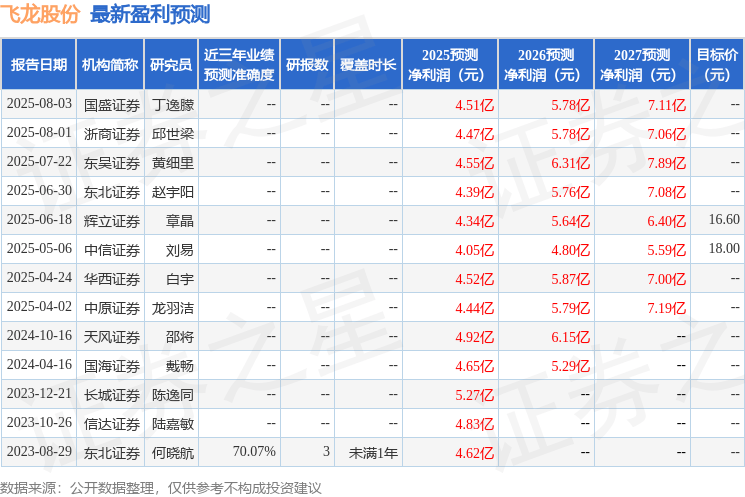
飞龙股份:8月5日接受机构调研,浙商大制造、易方达基金参与
Sou Hu Cai Jing· 2025-08-05 13:41
Core Viewpoint - The company anticipates improved revenue in the second half of 2025 driven by new overseas projects, increased orders for electric vehicle integration modules, and growth in liquid cooling products [2]. Group 1: Business Outlook - The company expects revenue to improve in the second half of 2025 due to three main drivers: gradual ramp-up of overseas new projects, growth in orders for electric vehicle integration modules, and increased sales of liquid cooling products [2]. - The company is not considering additional investments in automotive engine thermal management products domestically, aside from its subsidiary in Thailand [3]. Group 2: Product and Client Information - The company has established connections with over 130 major clients for its electronic pump series, including Chery, Li Auto, and others [4]. - The thermal management integrated module's value is significantly higher than traditional single-component products, but specific values vary based on product structure [5]. Group 3: Liquid Cooling Developments - A new subsidiary, Anhui Hangyi Technology Co., has been established to focus on non-automotive liquid cooling pump development for data centers, renewable energy storage, and charging stations [6]. - The company is actively expanding its overseas server liquid cooling market through clients in Taiwan while maintaining a strong domestic market presence [6]. Group 4: Profitability and Competitive Advantages - The company implements a dual-line penetration strategy in the automotive and industrial sectors, optimizing operations to enhance profitability [7]. - Key competitive advantages in the liquid cooling sector include a decade of experience, a broad client base of over 80 companies, and diverse application scenarios across various industries [8][9]. Group 5: Financial Performance - For the first half of 2025, the company reported a main revenue of 2.162 billion yuan, a year-on-year decrease of 8.67%, while net profit increased by 14.49% to 210 million yuan [10]. - The company’s gross margin stands at 25.52%, with a debt ratio of 38.14% [10].


汽车行业周报(25 年第27 周):行业进入中报业绩期,建议关注2025世界机器人大会-20250805
Guoxin Securities· 2025-08-05 10:01
Investment Rating - The automotive industry is rated as "Outperform" [4][5] Core Views - The industry is entering the mid-year performance reporting period, with a focus on the 2025 World Robot Conference. The July car market is expected to grow primarily due to the "trade-in and scrapping" policies, with retail sales of narrow passenger cars projected at approximately 1.85 million units, a year-on-year increase of 7.6% [1][3] - The long-term outlook emphasizes the rise of domestic brands and opportunities in incremental components driven by electric and intelligent trends. In the short term, the strong new product cycle of Huawei and the first year of the Xiaomi automotive industry chain are highlighted [3][12] Monthly Production and Sales Data - In July, the narrow passenger car retail market is expected to reach around 1.85 million units, with a year-on-year growth of 7.6% and a month-on-month decline of 11.2%. New energy vehicle retail is estimated at about 1.01 million units, with a penetration rate expected to rise to 54.6% [1] - Weekly data shows that from July 1 to 27, retail sales of passenger cars reached 1.445 million units, a year-on-year increase of 9% but a month-on-month decline of 19% [1] Weekly Market Performance - For the week of July 28 to August 1, the CS automotive index fell by 2.26%, with the CS passenger vehicle index down by 2.73%. The CS electric vehicle index decreased by 5.01%, while the overall Shanghai Composite Index fell by 1.38% [2] Key Company Earnings Forecast and Investment Ratings - Key companies such as Leap Motor, Geely, and JAC are rated as "Outperform" with respective earnings per share (EPS) forecasts for 2025 and 2026 indicating growth potential [4] - Leap Motor (9863.HK) is expected to have an EPS of -0.05 in 2025, while Geely (0175.HK) is projected to have an EPS of 1.36 [4] Investment Recommendations - The report recommends focusing on domestic brands and the opportunities in incremental components, particularly in the context of electric and intelligent vehicles. Specific recommendations include: - Vehicle manufacturers: Leap Motor, JAC, Geely - Intelligent technology: Kobot, Huayang Group, Junsheng Electronics - Robotics: Top Group, Sanhua Intelligent Control, Shuanghuan Transmission - Domestic alternatives: Xingyu Co., Fuyao Glass, Jifeng Co., New Spring Co., Horizon Robotics-W [3][12][24] Industry Long-term Outlook - The Chinese automotive industry is transitioning from a growth phase to a mature phase, with a projected annual compound growth rate of 2% over the next 20 years. The report anticipates that new energy vehicle sales will continue to grow significantly, with projections of 1.55 million units in 2025, representing a year-on-year increase of over 25% [13][24]

交银国际:7月传统淡季下新能源车市温和增长 预计8月环比改善
智通财经网· 2025-08-05 07:35
Core Insights - July saw a moderate growth in the new energy vehicle (NEV) market despite being a traditional off-peak season for passenger car sales, with delivery volume growth slowing down year-on-year [2][3] - The overall delivery volume of NEVs in July showed a year-on-year increase of 11.2% but a month-on-month decrease of 6.2% among 11 car manufacturers [2][3] - The upcoming months are expected to see improved sales as multiple new models are set to launch, coinciding with the traditional peak sales season in September and October [6] Company Summaries - **BYD**: In July, BYD sold 341,030 passenger vehicles, a slight year-on-year increase but a month-on-month decrease of 9.7%. Exports reached 80,178 units, a significant year-on-year increase of 159.5% [2][3] - **Xiaomi Auto**: Achieved over 30,000 deliveries in July, marking a new monthly delivery record [2] - **Horizon Smart Mobility**: Delivered 47,752 units in July, an 8.3% increase year-on-year, but a 9.5% decrease month-on-month [3] - **Xpeng Motors**: Delivered 36,717 units in July, with year-on-year and month-on-month growth of 229.4% and 6.1%, respectively, setting a new monthly delivery record [3] - **Li Auto**: Delivered 30,731 units in July, with year-on-year and month-on-month declines of 39.7% and 15.3% [3] - **NIO**: Delivered 21,017 units in July, with a year-on-year increase of 2.5% but a month-on-month decrease of 15.7% [4] - **Leap Motor**: Achieved 50,129 deliveries in July, marking a year-on-year increase of 127% and a month-on-month increase of 4% [4] - **Avita**: Delivered 10,062 units in July, with a year-on-year increase of 177.6% but a slight month-on-month decrease of 0.9% [5] Market Outlook - The market is expected to improve in August as several new models are set to launch, including Li Auto's i6 and new versions of Xpeng's P7 and Horizon's R7 and S7 [6] - The industry remains optimistic about BYD's smart driving and export capabilities, as well as Xpeng's new model launches contributing to sales and profit margin improvements [6]


7月新势力销量分析:呈显著分化趋势 尾部品牌压力加剧
Zhong Guo Zhi Liang Xin Wen Wang· 2025-08-05 07:02
Industry Overview - In July, the new energy vehicle market showed a significant performance boost due to the "old-for-new" policy and the summer consumption season, with many new car manufacturers reporting impressive sales figures [1] - The monthly sales data revealed a trend of differentiation, with leading companies achieving record high sales while smaller brands faced increased survival pressure [1] Company Performance - Leap Motor achieved a remarkable sales milestone in July, with monthly sales surpassing 50,000 units at 50,129, representing a year-on-year growth of over 126% [3] - Hongmeng Zhixing maintained strong sales momentum with total sales reaching 47,752 units, driven primarily by the Wanjie series, which contributed 40,753 units [5] - Xiaopeng Motors set a new monthly delivery record with 36,717 units sold, marking a year-on-year increase of 229% [7] - Li Auto fell to fourth place with 30,731 units delivered in July, a year-on-year decline of approximately 40% [9] - Xiaomi Auto's monthly delivery exceeded 30,000 units for the first time, marking a new high for the brand [11] - Deep Blue Auto delivered 27,169 units, achieving a year-on-year growth of 62% [13] - NIO delivered 21,017 vehicles in July, with expectations for increased sales in August following the launch of the L90 model [15] - Lantu Auto reported 12,135 units delivered, marking six consecutive months of positive growth [17] - Avita's sales reached 10,062 units, showing a year-on-year increase of 178% [17] - Zhiji Auto struggled with sales of 7,027 units, failing to break the 10,000 mark [17] Market Dynamics - The market is characterized by a "stronger getting stronger" trend, with Leap Motor leading in value-for-money offerings, Xiaopeng Motors maintaining a top-three position, and Xiaomi Auto launching successful new models [17] - The competitive landscape is expected to intensify in the next five months, with companies planning to introduce new models and technologies [17]
汽车行业周报(25年第27周):行业进入中报业绩期,建议关注2025世界机器人大会-20250805
Guoxin Securities· 2025-08-05 07:00
Investment Rating - The automotive industry is rated as "Outperform the Market" [1][5][4] Core Viewpoints - The industry is entering the mid-year performance period, with a focus on the 2025 World Robot Conference. The July car market is expected to grow primarily due to the "trade-in and scrapping" policies, with an estimated retail market of 1.85 million narrow passenger cars, a year-on-year increase of 7.6% [1][3] - The long-term outlook emphasizes the rise of domestic brands and opportunities in incremental components driven by electric and intelligent trends. In the short term, the strong new product cycle of Huawei and the first year of the Xiaomi automotive industry chain are highlighted [3][12] - The report suggests that under the geopolitical backdrop, the automotive sector as a domestic consumption product is likely to see increased stimulus policies, favoring passenger cars and domestically replaced components [3][12] Monthly Production and Sales Data - In July, the narrow passenger car retail market is projected to be around 1.85 million units, with a year-on-year growth of 7.6% and a month-on-month decline of 11.2%. New energy vehicle retail is expected to be approximately 1.01 million units, with a penetration rate of 54.6% [1][22] - Weekly data indicates that from July 1 to 27, the national passenger car retail reached 1.445 million units, a year-on-year increase of 9% but a month-on-month decline of 19% [1][2] Weekly Market Performance - For the week of July 28 to August 1, the CS automotive index fell by 2.26%, with the CS passenger car index down by 2.73%. The CS electric vehicle sector saw a decline of 5.01% [2][3] - The CS automotive sector outperformed the CSI 300 index by 0.08 percentage points but underperformed the Shanghai Composite Index by 0.88 percentage points, with a year-to-date increase of 10.97% [2][3] Key Company Earnings Forecast and Investment Ratings - Key companies such as Leap Motor, Geely, and JAC are rated as "Outperform the Market" with varying earnings per share (EPS) forecasts for 2025 and 2026 [4][5] - Leap Motor is expected to have an EPS of -0.05 in 2025, while Geely is projected to have an EPS of 1.36 [4][5] Investment Recommendations - The report recommends focusing on the rise of domestic brands and opportunities in incremental components, particularly in electric and intelligent sectors. Specific recommendations include: - Vehicle manufacturers: Leap Motor, JAC, Geely - Intelligent technology: Kobot, Huayang Group, Junsheng Electronics - Robotics: Top Group, Sanhua Intelligent Control, Shuanghuan Transmission - Domestic replacements: Xingyu Co., Fuyao Glass, Jifeng Co., New Spring Co., Horizon Robotics [3][12][24]




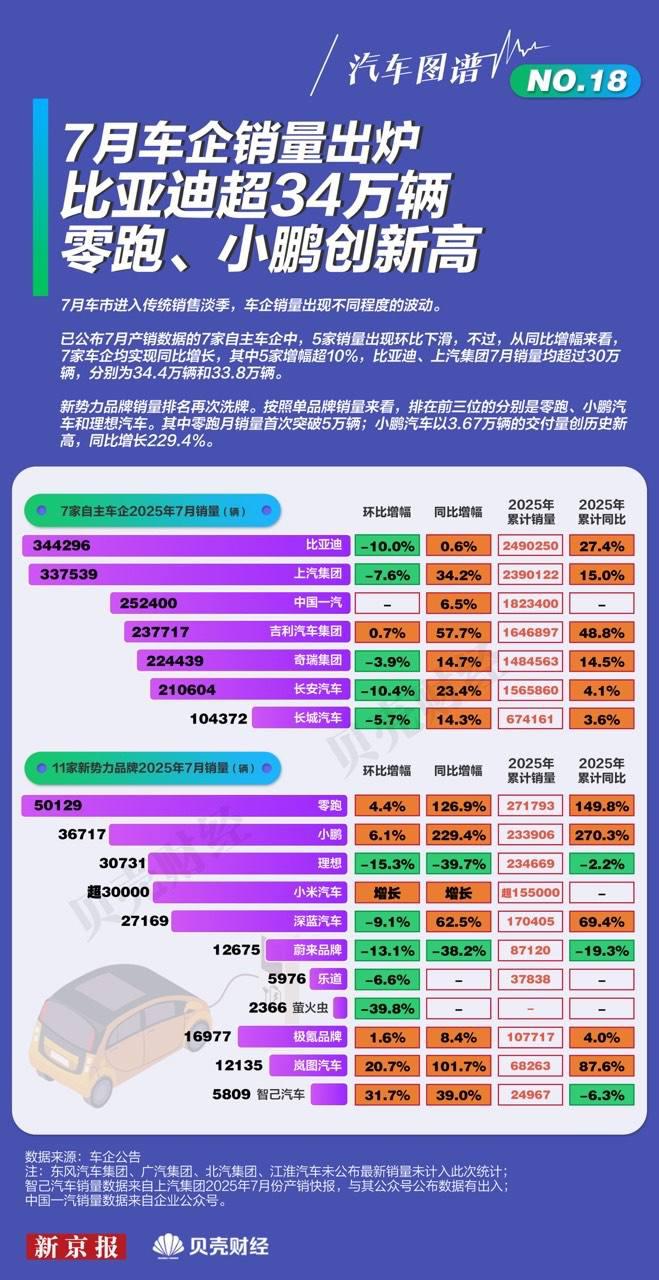
7月销量比亚迪超34万辆,零跑、小鹏创新高
Xin Jing Bao· 2025-08-05 00:13
7月车市进入传统销售淡季,车企销量出现不同程度波动。 已公布7月产销数据的7家自主车企中,5家销量出现环比下滑,不过,从同比增幅来看,7家车企均实现 同比增长,其中5家增幅超10%,比亚迪(002594)、上汽集团(600104)7月销量均超过30万辆,分别 为34.4万辆和33.8万辆。 新势力品牌销量排名再次洗牌。按单品牌销量来看,排在前三位的分别是零跑、小鹏汽车和理想汽车。 其中零跑月销量首次突破5万辆;小鹏汽车以3.67万辆的交付量创历史新高,同比增长229.4%。 | 超30000 | | 小米汽车 | 增长 | 增长 | 1155000 | | | --- | --- | --- | --- | --- | --- | --- | | 27169 | | 深蓝汽车 | -9.1% | 62.5% | 170405 | 69.4% | | 12675 | | 商来品牌 | -13.1% | -38.2% | 87120 | -19.3% | | 5976 乐道 | | | -6.6% | - | 37838 | - | | 2366 萤火虫 | | | -39.8% | - | | 1 | | 16 ...

7月造车新势力零跑领跑
Bei Jing Ri Bao Ke Hu Duan· 2025-08-04 22:24
Core Insights - The new energy vehicle market is experiencing significant changes in sales rankings among emerging car manufacturers, with Leap Motor achieving the highest sales in July, surpassing 50,000 units for the first time [1] - Hongmeng Zhixing follows closely with over 47,000 units sold, while XPeng Motors ranks third with over 36,000 units [1] - Li Auto, which has consistently ranked among the top sellers in recent years, has notably dropped out of the top three in July [1] Group 1: Sales Performance - Leap Motor's sales reached 50,129 units in July, marking a 126% year-on-year increase and setting a new monthly delivery record [1] - Hongmeng Zhixing's total sales for July amounted to 47,752 units, driven by strong performance from the AITO brand, which sold over 40,000 units [1] - XPeng Motors, Li Auto, and Xiaomi Motors each surpassed 30,000 units in July, while NIO maintained sales above 20,000 units [1] Group 2: Market Strategies - Leap Motor's success is attributed to its competitive pricing strategy, which has allowed it to capture a significant market share [1] - NIO has implemented cost-cutting measures and efficiency improvements in response to substantial losses and sluggish sales growth [1] - The upcoming launch of the new model from the collaboration between Huawei and SAIC, targeting the 150,000 yuan market, is expected to boost sales for Hongmeng Zhixing [1]
【新能源】2025年7月新能源乘用车厂商批发销量快讯
乘联分会· 2025-08-04 09:20
Core Viewpoint - The article discusses the strong performance of the new energy vehicle (NEV) market in July 2025, highlighting the impact of government subsidies and the shift from price competition to value competition among manufacturers [1][2]. Group 1: Market Performance - July 2025 is expected to have 23 working days, leading to stable production and sales in the NEV market despite some manufacturers taking summer breaks [1]. - The wholesale sales of NEVs in June increased by 25% year-on-year, with a notable decrease in channel inventory [1]. - The estimated wholesale sales of NEVs in July are projected to reach 1.18 million units, representing a 25% year-on-year growth but a 4% month-on-month decline [2][5]. Group 2: Government Policies and Industry Response - The government's "two new" policy subsidies have significantly boosted market activity, with many regions fully utilizing their initial subsidy funds [1]. - The Ministry of Industry and Information Technology is working to regulate competition in the NEV sector, aiming to curb malicious price cuts and promote a focus on technological upgrades and service quality [1]. - Manufacturers are responding to these regulatory changes by adjusting their competitive strategies, resulting in stable promotional activities in the market [1]. Group 3: Manufacturer Performance - Several manufacturers, including Leap Motor, Xiaopeng Motors, and Xiaomi Motors, achieved record high wholesale sales in July, contributing to a robust overall performance in the NEV market [2]. - Data indicates that manufacturers with wholesale sales exceeding 10,000 units accounted for 91.7% of the total NEV sales in June [2]. - The cumulative wholesale sales from January to July 2025 reached 7.63 million units, marking a 35% year-on-year increase [2].
7月新势力格局生变 零跑月销首破5万辆
Bei Jing Ri Bao Ke Hu Duan· 2025-08-04 09:02
Group 1: Sales Performance of New Energy Vehicle Companies - Leap Motor achieved a record monthly delivery of 50,129 vehicles in July, marking a 126% year-on-year increase and securing the top position in sales [1] - Huawei's AITO brand, with a total sales of 47,752 vehicles in July, ranked second, although it experienced a decline in sales compared to the previous month [1] - Xiaopeng Motors delivered 36,717 vehicles in July, representing a 229% year-on-year increase and a 6% month-on-month increase, setting a new monthly delivery record [2] Group 2: Challenges and Strategies of Other New Energy Vehicle Companies - Li Auto's sales fell to 30,731 vehicles in July, with both year-on-year and month-on-month declines, indicating a need for more competitive pricing strategies [2] - NIO maintained sales above 20,000 units in July, reaching 21,017 vehicles, but faced scrutiny due to significant losses and slow growth [2] - Xiaomi's sales exceeded 30,000 units in July, with a focus on increasing production capacity to meet demand [2] Group 3: Performance of Traditional Automakers' New Brands - Changan's Deep Blue brand delivered over 27,000 vehicles in July, while GAC's Aion brand surpassed 26,000 vehicles [3] - Several brands, including Geely's Zeekr and Dongfeng's Lantu, reported sales in the range of 10,000 to 17,000 vehicles [3]