
阿里

Search documents
研判2025!全球及中国硅光芯片行业运行现状、市场规模及竞争格局分析:行业规模不断壮大,国内企业加速布局[图]
Chan Ye Xin Xi Wang· 2025-05-02 02:26
内容概要:硅光芯片,顾名思义,是指在硅衬底上利用微纳加工技术构建光子器件和电子器件,实现光 信号的产生、调制、传输、检测和处理等功能的集成光子芯片。其核心理念是将光子器件集成到成熟的 硅基CMOS工艺平台上,充分利用硅材料的光学特性和CMOS工艺的低成本、高集成度优势。硅光芯片 结合了集成电路技术的超大规模、超高精度制造的特性和光子技术超高速率、超低功耗的优势。经过20 余年的快速发展,得益于大容量数据通信场景的日益增加以及新需求、新应用的出现,硅光芯片技术研 究已逐渐从学术研究驱动转变为市场需求驱动,2024年全球硅光芯片市场规模接近1.5亿美元。未来, 硅光芯片仍具备广阔发展前景,市场规模将进一步壮大,应用领域也不断拓展。硅光芯片凭借其独特的 优势,在多个领域展现出巨大的应用潜力,并有望替代现有技术方案,成为未来信息技术发展的关键支 撑。硅光最主要、最直接的应用场景是数据中心。此外,硅光芯片在电信、光学激光雷达、量子科技等 领域也有广阔的发展前景。从企业布局来看,目前,国际公司在技术和市场上拥有领先优势。英特尔占 据市场主导地位,思科作为市场领导者也在通过收购Lightwire、Luxtera及Acaci ...


AI中厂夹缝求生
3 6 Ke· 2025-04-30 07:37
Core Insights - Kunlun Wanwei has made significant progress in commercializing its AI products, particularly in AGI and AIGC, with notable revenue achievements in AI social and music sectors [1][3][7] - The company has faced challenges in maintaining a stable narrative and profitability amidst fluctuating stock performance and market skepticism [2][16] - Kunlun Wanwei's strategy focuses on optimizing model costs and leveraging AI applications to drive revenue, while also navigating a competitive landscape dominated by larger firms [10][11][12] Financial Performance - In 2024, Kunlun Wanwei reported a net loss of 1.6 billion yuan, a significant decline from a profit of 660 million yuan in 2023, marking a new low in its ten-year history [16] - The company’s annual recurring revenue (ARR) for AI social reached approximately 12 million USD, with a peak monthly revenue of over 1 million USD [1][7] - R&D expenses reached 1.54 billion yuan, reflecting the company's commitment to maintaining its competitive edge in AI [16] Product Development - The company has developed various AI models, including the TianGong AI assistant, which has achieved a peak monthly active user count of over 10 million [4][11] - Kunlun Wanwei's music generation model, Mureka, has been recognized for its competitive edge in the AI music space, outperforming notable competitors [15] - The launch of the SkyReels platform integrates video and 3D models for automated content creation, showcasing the company's innovation in AI applications [5] Market Positioning - Kunlun Wanwei positions itself uniquely in the AI landscape, focusing on product development rather than competing directly with larger firms that have more resources [9][12] - The company aims to capture opportunities in the AI sector, which is viewed as a blue ocean market with potential for disruption across various industries [12][17] - Despite the challenges, Kunlun Wanwei remains optimistic about achieving profitability in its AI model business by 2027 [17]


上汽业绩企稳背后的关键词:换挡、整合、协同
Jing Ji Guan Cha Wang· 2025-04-30 03:46
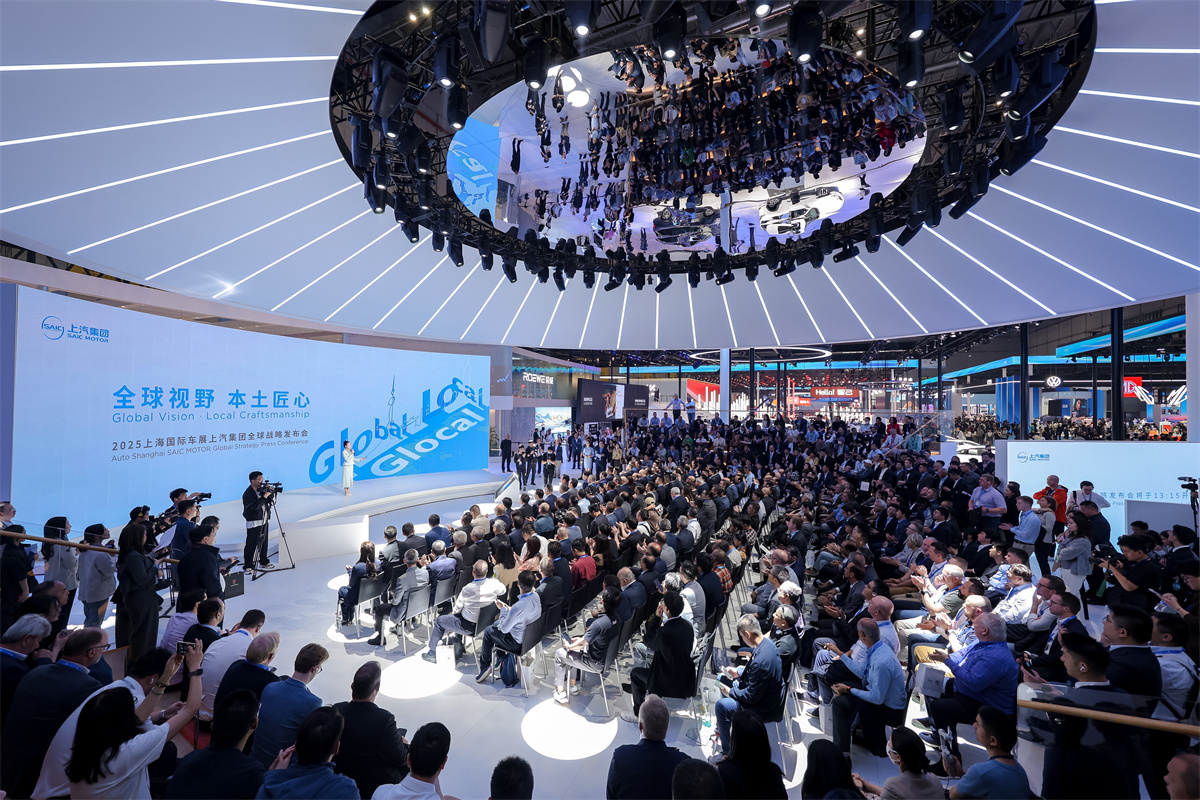
Core Insights - SAIC Motor Corporation reported a significant recovery in its operating performance in Q1 2025, with total vehicle sales reaching 945,000 units, a year-on-year increase of 13.3%, and total revenue of 140.86 billion yuan, with a net profit attributable to shareholders of 3.02 billion yuan, up 11.4% year-on-year [1][2] - The company achieved a remarkable milestone by delivering 1.368 million new energy vehicles and 1.082 million vehicles in overseas markets in 2024, making it the only Chinese automotive group to sell over one million units in both new energy and overseas markets for three consecutive years [1][3] Sales Recovery: Dual Engines of Self-owned and New Energy - The rebound in sales is attributed to the company's deep reform efforts and internal business integration, which have allowed it to seize market opportunities effectively [2][6] - In Q1 2025, the sales of SAIC's self-owned brands, including SAIC Passenger Cars, SAIC Maxus, and SAIC-GM-Wuling, contributed significantly to overall growth, with SAIC Passenger Cars selling 163,000 units (up 0.77%), SAIC Maxus 51,800 units (up 7.57%), and SAIC-GM-Wuling 353,000 units (up 57.58%) [2][8] - The new energy vehicle segment also saw substantial growth, with sales reaching 272,900 units in Q1 2025, a year-on-year increase of 29.89%, significantly outpacing the overall market growth [2][3] Market Trends and Strategic Initiatives - The rise of self-owned brands and new energy vehicles aligns with broader trends in the Chinese automotive market, where self-owned brands captured 62.7% of the domestic retail market share in March 2025, up 7.7 percentage points year-on-year, and new energy vehicles achieved a retail penetration rate of 51.1%, up 8.7 percentage points [3][5] - SAIC's overseas strategy, termed "Glocal Strategy," aims to create a localized ecosystem while expanding globally, shifting focus from mere scale expansion to value creation [5][15] Internal Reforms and Brand Revitalization - The company's internal restructuring has led to the integration of core self-owned businesses, enhancing resource concentration and operational efficiency [8][6] - SAIC is focusing on brand rejuvenation across its self-owned brands, including the high-end, intelligent IM brand, the youthful MG brand, and the locally-focused Roewe brand, each targeting different market segments [9][10] Collaborative Growth and Cross-industry Partnerships - SAIC is leveraging collaborative synergies with established partners like Volkswagen and General Motors, as well as tech companies like Huawei and OPPO, to enhance its technological capabilities and market offerings [10][13] - The company plans to launch multiple new models tailored for the Chinese market through its joint ventures, including 18 new models from SAIC Volkswagen by 2030 [12][15] Conclusion - Through internal reforms, a robust technological foundation, and strategic partnerships, SAIC is solidifying its leadership position in the domestic market while paving the way for future global expansion [15]

AIDC系列报告:电源产业乘风而起
Xinda Securities· 2025-04-29 08:40
Investment Rating - The report maintains a "Positive" investment rating for the power supply industry [4] Core Viewpoints - The rapid development of artificial intelligence (AI) is driving the demand for intelligent computing data centers (AIDC), which are expected to enhance the efficiency of computing resources and provide a solid foundation for the digital economy [9][11] - The power supply architecture is anticipated to evolve from UPS to HVDC, with a focus on improving power supply efficiency and reliability [4][66] - The market for AI servers and power supplies is expected to see significant growth, driven by increasing power density and the need for high-performance computing [41][56] Summary by Sections 1. AI Trends and Power Supply Demand - The construction of intelligent computing centers is expected to accelerate due to the AI wave, with a focus on enhancing computing power and efficiency [9] - The power supply infrastructure is likely to undergo iterative upgrades to meet the growing demands of data centers [19] 2. AI Server Power Supply Upgrades - The global AI market reached approximately 1,187.9 billion yuan in 2023, with expectations of a compound annual growth rate exceeding 35% from 2023 to 2030 [41] - AI server power supply performance is expected to improve, leading to increased value and demand for high-power solutions [41][56] - The transition from UPS to HVDC systems is anticipated to enhance efficiency and reliability in data centers [66][82] 3. Investment Recommendations - The report suggests focusing on several areas within the power supply sector, including: 1. Increased power density in server power supplies, with recommendations to monitor companies like Megmeet and EATON [4] 2. The shift from UPS to HVDC systems, with a focus on companies such as Zhongheng Electric and Hezhong Electric [4] 3. Backup power solutions, particularly BBU and diesel generators, with recommendations to observe companies like Yiwei Lithium Energy and KOTAI Power [4]


电力设备与新能源行业深度报告:AIDC系列报告:电源产业乘风而起
Xinda Securities· 2025-04-29 08:23
Investment Rating - The report maintains a "Positive" investment rating for the power supply industry [4]. Core Viewpoints - The rapid development of artificial intelligence (AI) is driving the demand for intelligent computing data centers (AIDC), which require enhanced power supply and distribution infrastructure [4][9]. - The performance of AI chips is significantly improving, leading to an expected increase in both volume and price for server power supplies [4]. - The power supply architecture is anticipated to evolve from UPS to HVDC systems, enhancing efficiency and reliability [4]. - Investment suggestions include focusing on companies involved in server power supply, HVDC technology, and backup power solutions [4]. Summary by Sections 1. AI Trends and Power Supply Demand - The construction of intelligent computing centers is expected to accelerate due to the AI wave, enhancing the efficiency of data centers [9]. - The power supply infrastructure is likely to undergo iterative upgrades to meet the growing demands of AI applications [19]. 2. AI Server Power Supply Upgrades - The global AI market reached approximately 1,187.9 billion yuan in 2023, with a projected compound annual growth rate (CAGR) of over 35% until 2030 [41]. - AI server power supply performance is expected to improve, leading to increased demand for high-power solutions [41][56]. - The transition from UPS to HVDC systems is anticipated to enhance efficiency and reliability in data centers [66][82]. 3. Investment Recommendations - Companies to watch include: 1. Server power supply manufacturers like Megmeet and Euron. 2. HVDC technology providers such as Zhongheng Electric and Hewei Electric. 3. Backup power solution providers like Yiwei Lithium Energy and Weilan Lithium Core [4].
新质生产力重塑科技服务业:从基础配套到价值中枢进化
2 1 Shi Ji Jing Ji Bao Dao· 2025-04-24 05:27
Core Insights - Chinese technology companies are proactively addressing the pressures from US tariff policies through strategies such as technological innovation, ecosystem expansion, and supply chain restructuring [1][6][12] - The technology service industry in China is undergoing a transformation from being a passive follower to an active leader in the global tech landscape [1][12] - The trade war has not hindered the growth of Chinese tech firms; instead, it has accelerated the development of supply chain resilience, technological substitution, and market diversification [1][6][12] Group 1: Evolution of Technology Service Industry - The technology service industry has shifted from being seen as a "supporting role" to becoming a central value driver in the industrial chain, even setting technology standards in certain fields [2][5] - Companies like Luxshare Precision (002475) have transitioned from assembly to core technology development, exemplifying this shift [2][4] - The "ecological empowerment" model is becoming mainstream, with platforms like Alibaba and Didi offering modular solutions for small and medium enterprises to expand internationally [3][4] Group 2: Strategies for Overcoming Trade Pressures - Supply chain resilience is being built through a "China +1" strategy, with companies like Industrial Fulian (601138) and Xinwangda (300207) establishing factories in other countries to mitigate risks [7][8] - Technological substitution is accelerating, with companies like Taijing Technology increasing their global market share in critical components, demonstrating the push for domestic alternatives [9] - Market diversification is evident as companies target emerging markets in Latin America, the Middle East, and Southeast Asia to reduce reliance on uncertain Western markets [10][11] Group 3: Policy and Market Synergy - The rise of the technology service industry is supported by policy initiatives that encourage platform and ecosystem development, such as Beijing's "14 measures for the technology service industry" [12] - Financial support mechanisms, including tax reductions and capital market access, are facilitating innovation and reducing research costs for tech firms [12] - The ongoing transformation indicates that the trade war has not only failed to cripple Chinese tech companies but has also propelled them towards becoming central players in the global tech competition [12][13]
特锐德(300001):充电网业务快速增长,电力设备盈利能力显著提升
Guoxin Securities· 2025-04-24 05:17
Investment Rating - The investment rating for the company is "Outperform the Market" [4][6][16] Core Views - The company is expected to achieve a net profit attributable to shareholders of 917 million yuan in 2024, representing a year-on-year increase of 87%. The revenue is projected to be 15.374 billion yuan, up 21% year-on-year, with a gross margin of 25.92% and a net margin of 6.11% [1][8][12] - The electric vehicle charging network business is experiencing rapid growth, with revenue of 4.890 billion yuan in 2024, an increase of 18% year-on-year, and a net profit of 208 million yuan, up 72% year-on-year. The company has established over 290 joint ventures and partnerships with more than 70 automotive manufacturers [2][13][14] - The power equipment business is also showing robust growth, with revenue of 10.485 billion yuan in 2024, a 22% increase year-on-year, and a net profit of 709 million yuan, up 91% year-on-year. The company has secured significant contracts in both domestic and international markets, particularly in the renewable energy sector [3][15][16] Summary by Sections Financial Performance - In 2024, the company is projected to achieve total revenue of 15.374 billion yuan, with a year-on-year growth of 21%. The net profit attributable to shareholders is expected to be 917 million yuan, reflecting an 87% increase. The company’s gross margin is forecasted at 25.92%, with a net margin of 6.11% [1][8][12] - For Q4 2024, the company anticipates revenue of 6.477 billion yuan, a quarter-on-quarter increase of 83%, and a net profit of 470 million yuan, up 86% quarter-on-quarter [1][8] Electric Vehicle Charging Network - The electric vehicle charging network business is projected to generate revenue of 4.890 billion yuan in 2024, an 18% increase year-on-year, with a net profit of 208 million yuan, up 72% year-on-year. The company’s charging volume is expected to exceed 13 billion kWh, a 40% increase year-on-year, and it will operate 709,000 public charging piles by the end of 2024 [2][13][14] Power Equipment Business - The power equipment segment is expected to achieve revenue of 10.485 billion yuan in 2024, a 22% increase year-on-year, with a net profit of 709 million yuan, reflecting a 91% increase year-on-year. The company has made significant inroads in the renewable energy sector, with a contract value growth of over 70% in 2024 [3][15][16] - The company is also expanding its international presence, with overseas contracts reaching 800 million yuan in 2024, a 132% increase year-on-year [3][15]

【产业互联网周报】 ADM回应关闭中国贸易业务传闻;天津:到2027年人工智能基础核心企业营收突破1000亿元;OpenAI布局社交网络;工信部:中国已...
Tai Mei Ti A P P· 2025-04-21 01:46
Domestic News - Huqin Technology responded to NVIDIA's H20 trade restrictions, stating that the company has made sufficient preparations for uncertainties and that business operations are proceeding normally [2] - WeChat Pay partnered with international payment giant Stripe to accelerate internationalization, enabling businesses in 20 countries to seamlessly integrate WeChat Pay for online and offline transactions [3] - The National Supercomputing Internet Platform launched a long-text multimodal model to assist in AI agent development [4] - Keling AI released version 2.0 of its base model, allowing the generation of videos using "text + images + videos," significantly enhancing its capabilities [5] - Xiaogoods City signed a strategic cooperation agreement with Alibaba Cloud to build a digital trade system integrating AI and cloud computing [7] - Zhixiang Future announced the open-source of its image generation model HiDream-I1, which has achieved top rankings in image quality and semantic understanding [8] - Yuanfudao Group launched "Xiaoyuan AI," an intelligent teaching solution based on its self-developed models [9] - Shanghai Metro officially opened 5G public signals across its entire network, covering 21 lines and 896 kilometers [10] - Alipay launched the first domestic "Payment MCP Server," allowing AI developers to integrate payment services using natural language [11] - ByteDance's Seedream 3.0 model has matched the performance of the leading image generation model GPT-4o, entering the global top tier [12] Corporate Developments - ADM responded to rumors of closing its trade business in China, clarifying that adjustments only affect a small part of its operations [13] - China General Nuclear Power Corporation established a new manufacturing technology company focusing on smart robotics [15] - Tencent Cloud announced the establishment of a new availability zone in Osaka, Japan, expanding its global service network [21] - Figma submitted documents for a potential IPO to the U.S. SEC, with details on share quantity and pricing yet to be determined [28] - Hugging Face acquired Pollen Robotics to enter the physical robotics sector, marking its largest personnel acquisition to date [30] - JD Cloud Computing increased its registered capital by 60% to 800 million RMB [31] - Dongyi Technology completed over 100 million RMB in angel financing to advance its humanoid robot technology [32] Policies & Trends - Xi Jinping emphasized the need for China and Malaysia to deepen cooperation in AI, digital economy, and green economy [33] - Nanjing announced that all primary and secondary schools will offer AI courses by 2025 [34] - The Ministry of Education and nine other departments released opinions to accelerate digitalization in education, including promoting international cooperation [36] - Tianjin aims for AI core enterprises to achieve over 100 billion RMB in revenue by 2027 [39] - Shanghai Xuhui District launched six AI governance scenarios, collaborating with ten companies to enhance urban management [40] - The Ministry of Industry and Information Technology (MIIT) announced plans to promote the integration of AI and industrial internet [46] - MIIT reported that as of March 2023, China has built and opened 4.395 million 5G base stations [49]

英伟达H20被限购?中国芯圈自研突围丨芯片战场
2 1 Shi Ji Jing Ji Bao Dao· 2025-04-16 11:24
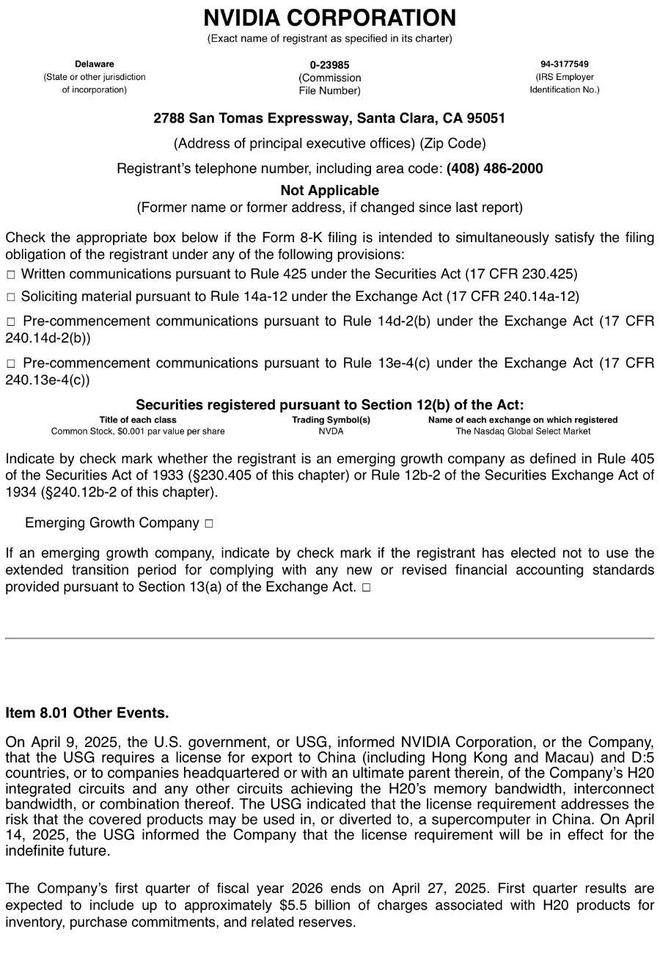
21世纪经济报道记者倪雨晴 深圳报道美国继续收紧AI芯片的出口管制。 据上海证券报报道,当地时间4月15日,英伟达披露,其"特供"中国市场的AI芯片H20已经被美国政府 列入出口管制,需要申请许可证方可出口。英伟达在文件中表示,美国政府已于当地时间4月9日通知英 伟达,要求其向中国(包括香港和澳门)和D:5国家组,或总部或最终母公司位于该地区的企业,出口 H20人工智能加速器和实现H20存储带宽、互连带宽或其组合的任何集成电路都需要获得许可证。英伟 达表示,鉴于H20相关库存及订单等,公司将在2026财年第一季度(截至2025年4月27日)计提约55亿 美元。 IVIDIA CORPORATIC Exact name of registrant as specified Delaware (State or other jurisdiction of incorporation) ammicciar 94-3177549 (IRS Emolover Identification No.) 2788 San Tomas Expressway, Santa Clara, CA 95051 (Address of ...

RISC-V架构解析及国产影响梳理
2025-04-15 14:30
Summary of Conference Call Industry and Company Involved - The conference call primarily discusses the RISC-V architecture and its comparison with X86 and ARM architectures in the semiconductor industry, focusing on the domestic market in China. Core Points and Arguments 1. **Overview of Chip Architectures**: - The three main chip architectures discussed are X86, ARM, and RISC-V. X86 has been dominant in PCs and servers for over two decades, while ARM is prevalent in mobile devices. RISC-V is emerging as an open-source alternative [1][2][3]. 2. **X86 Architecture**: - X86 is a closed architecture, limiting competition as only a few companies can produce compatible chips. It is primarily used in PCs and servers [2]. 3. **ARM Architecture**: - ARM is also a closed architecture, widely used in mobile devices. It has a mature ecosystem with extensive development tools, but it charges licensing fees based on chip sales [2][3][11]. 4. **RISC-V Architecture**: - RISC-V is an open-source architecture that allows for customization without licensing fees. It is gaining traction in various applications, including edge computing and AI [3][4][5]. 5. **Market Growth and Adoption**: - RISC-V has seen rapid growth, with a modular design that allows flexibility in instruction sets. It is being adopted in high-performance computing and edge AI applications, with a 30% reduction in power consumption compared to competitors [4][7][8]. 6. **Challenges for RISC-V**: - Despite its advantages, RISC-V faces challenges such as a less mature ecosystem and performance gaps compared to X86 and ARM. It is currently more suited for mid to low-power applications [6][9][10]. 7. **Cost Advantages**: - RISC-V can significantly reduce costs (60%-70%) by eliminating licensing fees, making it an attractive option for manufacturers [19]. 8. **Key Players in the RISC-V Ecosystem**: - Major players include Alibaba's T-head (Pingtouge), which is a leader in RISC-V development, and other companies like Westone Technology and various automotive electronics firms [12][13][27]. 9. **Government Support and Industry Standards**: - There is a push from the Chinese government to support RISC-V through policies and industry standards, aiming to create a unified ecosystem and reduce reliance on foreign technologies [25][26][38]. 10. **Future Prospects**: - The RISC-V architecture is expected to penetrate various sectors, including consumer electronics, automotive, and IoT, as it fills gaps left by ARM and X86 in specific applications [27][28]. Other Important but Possibly Overlooked Content 1. **Ecosystem Development**: - The development of tools and support for RISC-V is ongoing, with companies creating platforms to facilitate development and integration [24][32]. 2. **Compatibility and Customization**: - RISC-V allows for custom instruction sets, which can lead to fragmentation in software compatibility, but it also enables innovation and tailored solutions for specific applications [33][34]. 3. **Investment and Collaboration**: - Companies are investing in RISC-V technology and collaborating to enhance the ecosystem, which is crucial for its long-term success [36][41]. 4. **Market Dynamics**: - The competitive landscape is shifting as traditional players like Intel and AMD explore RISC-V, indicating a potential shift in market dynamics and strategies [20][21]. 5. **Technical Challenges**: - RISC-V still needs to overcome technical challenges related to performance and ecosystem maturity to compete effectively with established architectures [10][39]. This summary encapsulates the key discussions and insights from the conference call regarding the RISC-V architecture and its implications for the semiconductor industry.