
华泰证券

Search documents
2025中国企业ESG“金责奖”最佳责任进取奖揭晓
Xin Lang Cai Jing· 2026-01-15 07:31
Core Viewpoint - The 2025 China Enterprise ESG "Golden Responsibility Award" aims to recognize companies that have made significant contributions to ESG (Environmental, Social, and Governance) practices, with over 5,000 enterprises participating in the evaluation process [1][4]. Group 1: ESG Award Overview - The award was launched in November 2025 by Sina Finance ESG Rating Center, focusing on promoting sustainable development and responsible investment [1][4]. - The award emphasizes the importance of responsibility in ESG practices, symbolizing that responsibility is as valuable as gold [1][4]. - The evaluation process included comprehensive performance assessments, professional scoring, and online voting, culminating in the announcement of the award winners after three months of competition [1][4]. Group 2: Award Winners - The "Best Responsibility Initiative Award" was awarded to ten companies, including: - Fenghuo Communication - Wens Foodstuff Group - Haitian Flavoring and Food - Aier Eye Hospital - Yunnan Baiyao - Anker Innovation - Jinfa Technology - Huatai Securities - Seres - Hainengda [2][5]. - The award committee congratulated the winners and expressed hope that these companies will lead by example in enhancing their ESG capabilities and contribute to China's high-quality development [2][5]. Group 3: ESG Rating Center Introduction - The Sina Finance ESG Rating Center is the first Chinese platform dedicated to ESG information and ratings, promoting sustainable development and responsible investment [3][6]. - The center aims to establish ESG evaluation standards suitable for China's characteristics and enhance corporate ratings [3][6]. - It also publishes multiple ESG innovation indices to provide investors with more options regarding corporate ESG performance [3][6].






中国股票策略・“慢牛” 指南:背景、动因、挑战与展望-China Equity Strategy _Guide to the ‘slow bull‘ (part 1)_ Background, reasons, challenges and outlook
2026-01-15 06:33
Summary of Key Points from the Conference Call Industry Overview - The focus is on the **A-share market in China**, which has been underperforming compared to global indices since 2010, with a widening gap since 2020. The A-share market's long-term trend does not align with China's economic growth, indicating structural challenges within the capital markets [2][10][11]. Core Insights and Arguments 1. **Structural Challenges**: - The A-share market has historically been financing-oriented, neglecting investor returns. State-Owned Enterprises (SOEs) dominate the market but trade at a significant valuation discount compared to non-SOEs. Additionally, equities represent a small portion of household wealth, leading to an elevated equity risk premium [2][13][20]. 2. **Need for a 'Slow Bull' Market**: - A 'slow bull' market is deemed essential for transitioning the stock market into a primary wealth reservoir, potentially replacing the property market. This shift could support the 'common prosperity' initiative and enhance confidence in non-SOE sectors [3][62][70]. 3. **Reforms Underway**: - Current reforms aim to improve investor returns through increased dividend payments, share buybacks, and better information disclosures. These reforms are expected to attract long-term capital and enhance market liquidity [4][46]. 4. **Earnings Growth Projections**: - The A-share market is projected to see earnings growth accelerate from 6% YoY in 2025 to 8% in 2026, driven by supportive policies and a recovering economy. This growth is expected to be supported by a decline in the risk-free rate and increased household savings allocation into equities [5][61]. Additional Important Insights 1. **Valuation Discrepancies**: - SOEs, which make up about 45% of the A-share market cap, trade at half the price-to-earnings (PE) and price-to-book (PB) multiples of non-SOEs. This valuation gap is attributed to sector distribution, operating efficiency, and negative investor perceptions [21][22][37]. 2. **Household Asset Allocation**: - Households in China allocate only about 15% of their assets to equities, reflecting low expectations for stable returns. This is compounded by a preference for fixed income assets, which has been reinforced by high real interest rates [48][53][56]. 3. **Impact of Property Market Downturn**: - The ongoing downturn in the property market has negatively affected household wealth and confidence, leading to a higher equity risk premium in the A-share market compared to historical averages [52][64]. 4. **Government Fiscal Pressure**: - Local governments are facing fiscal pressure due to declining land sales revenue, prompting discussions on an equity-based fiscal model to generate additional revenue through state-owned capital operations [85][86]. 5. **Investor Composition**: - The state holds a significant portion of the A-share market, with estimates suggesting that state-related entities account for at least Rmb33 trillion, nearly a third of the total market cap [71][75]. Conclusion - The A-share market is at a critical juncture, with ongoing reforms and a potential shift towards a 'slow bull' market that could enhance investor confidence and align market performance with economic growth. The structural challenges, particularly regarding SOE valuations and household asset allocation, remain significant hurdles to overcome for sustainable market development [2][3][4][5][21][22].
券商首位首席科学家辞职,年薪超200万,3年涨薪近80万
2 1 Shi Ji Jing Ji Bao Dao· 2026-01-15 06:16
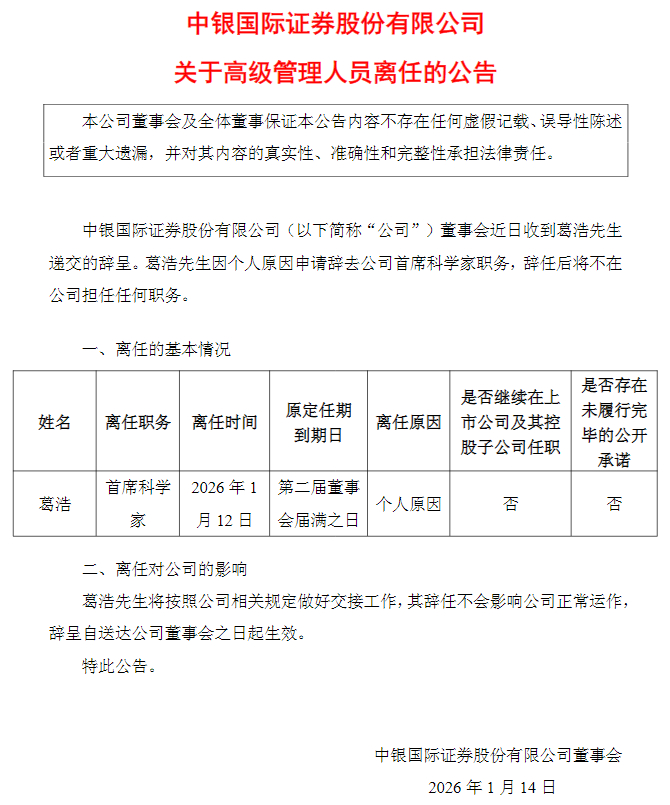
Core Viewpoint - The resignation of Ge Hao, the former Chief Scientist of Zhongyin Securities, raises questions about the company's digital transformation effectiveness and future financial technology strategy following the departure of a key technical leader [2][17]. Group 1: Resignation Details - Ge Hao submitted his resignation for personal reasons, effective January 12, 2026, which is earlier than his originally scheduled term [1]. - Zhongyin Securities confirmed that Ge Hao's departure will not affect the company's normal operations and that he will complete the handover according to company regulations [1]. Group 2: Background of Ge Hao - Ge Hao, born in October 1976, holds a master's degree in software engineering from Peking University and has extensive experience in technology roles at Baidu before joining Zhongyin Securities [5]. - He was appointed as Chief Scientist in March 2020, a position that was the first of its kind in the securities industry, aimed at driving technological innovation and creating new business opportunities [5][6]. Group 3: Compensation and Performance - Ge Hao's annual salary increased significantly during his tenure, reaching 2.0182 million yuan in 2024, making him the highest-paid executive at Zhongyin Securities [7]. - His salary growth from 1.2315 million yuan in 2022 to 2.0182 million yuan in 2024 reflects the company's commitment to investing in technology leadership [7]. Group 4: Digital Transformation Strategy - Zhongyin Securities has emphasized its digital transformation strategy, which includes a focus on wealth management, comprehensive risk management, and digital office reforms [11]. - The company has consistently invested over 6% of its annual revenue in information technology from 2019 to 2024, with a total IT investment of 2.13 billion yuan in 2024 [12][14]. Group 5: Industry Context and Challenges - The resignation of Ge Hao highlights the challenges faced by Zhongyin Securities in maintaining its digital transformation momentum and filling the technical talent gap [17]. - The company is under pressure to balance its technology investments with effective outcomes, especially as it seeks to differentiate itself in the competitive financial technology landscape [15][17].


多只宽基ETF成交量放大 有色金属相关ETF领涨
Xin Lang Cai Jing· 2026-01-15 05:04
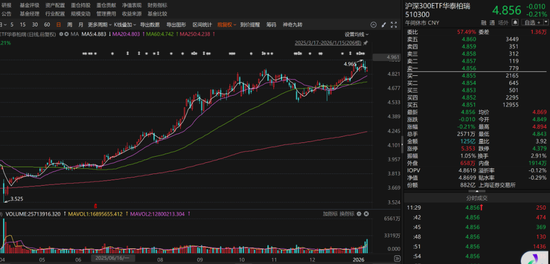
Group 1: ETF Market Performance - On January 15, multiple broad-based ETFs saw a significant increase in trading volume, with the Huatai-PB CSI 300 ETF achieving a half-day trading volume of 12.5 billion yuan, surpassing the highest daily trading volume since April 9, 2025 [1][11] - The Huatai-PB CSI 300 ETF experienced a slight decline of 0.21%, but its trading volume exceeded the previous day's total of 10.5 billion yuan [1][11] - Other ETFs, such as the Huatai-PB CSI A500 ETF and the Huaxia CSI A500 ETF, also reported substantial trading volumes of 12.6 billion yuan and 12.3 billion yuan, respectively, indicating a strong market interest [3][11] Group 2: Sector Performance - The performance of ETFs related to non-ferrous metals and batteries led the market on January 15, with the Southern Non-Ferrous Metals ETF rising by 2.75%, the GF Rare Metals ETF increasing by 2.45%, and the ICBC Credit Suisse Lithium Battery ETF up by 2.42% [6][13] - Analysts from Huatai Securities noted that the recent rise in resource prices is driven by multiple factors, including global monetary easing and increased demand for copper, silver, and rare metals due to AI data centers [13][14] Group 3: Investment Insights - The managers of the Ping An Resource Selected Mixed Fund highlighted a significant structural market for resource products in 2025, with precious metals and industrial metals like copper leading the gains [15] - They emphasized the importance of focusing on key sub-industry investment opportunities in 2026, particularly in industrial metals such as copper and aluminum, as well as in new energy metals like lithium and rare earths [15][16] - The long-term investment value of precious metals, particularly gold and silver, was also underscored, with gold being a core asset for risk diversification [16][17]
开源证券:两融杠杆上限调降对券商影响有限 看好板块行情
智通财经网· 2026-01-15 03:44
两融规模仍有提升空间,测算2025年两融净收入贡献券商营收约10% 截至1月13日,全市场融资规模2.67万亿,占股市流通市值比重2.58%,高于2021年7月高点的2.51%,低 于2015年7月高点4.72%,当下整体融资业务规模并不过高。该行以2025年数据测算,券商两融业务利 息净收入占券商营收比重在10%左右。 看好券商ROE持续提升,市场对券商业绩增长持续性和资金端压制有预期差 三条主线:国际业务优秀且低估值的头部券商华泰证券、国泰海通、中金公司H和中信证券;大财富管 理优势突出的广发证券、东方证券H;零售优势突出、受益于海南跨境资管试点的国信证券。受益标的 同花顺。 智通财经APP获悉,开源证券发布研报称,经中国证监会批准,沪深北交易所发布通知,将投资者融资 买入证券时的融资保证金最低比例从80%提高至100%。继续看好券商板块机会,券商业绩增长持续性 和资金端压制影响两方面存在预期差,券商板块滞涨明显,继续看好居民存款迁移、股市机制重建下券 商大财富管理、投行和机构业务的持续增长。 开源证券主要观点如下: 事件 1月14日,经中国证监会批准,沪深北交易所发布通知调整融资保证金比例,将投资者融资 ...
两融余额站上2.6万亿,券商额度告急监管出手降温
Huan Qiu Wang· 2026-01-15 03:30
Core Viewpoint - The continuous increase in margin financing and securities lending (two-in-one) balance in the Shanghai and Shenzhen markets has reached a historical high, prompting regulatory adjustments to prevent overheating in the market [1][3]. Group 1: Market Performance - The two-in-one balance has remained above 2.6 trillion yuan for six consecutive trading days, marking a new historical peak [1]. - The market has seen a significant increase in trading volume, with transaction amounts exceeding 3.5 trillion yuan for three consecutive days at the beginning of 2026 [1]. - The number of new accounts opened in the two-in-one market reached 1.542 million in 2025, a substantial increase of 52.9% compared to 2024, continuing a three-year growth trend [1]. Group 2: Regulatory Adjustments - On January 14, the Shanghai and Shenzhen Stock Exchanges announced an increase in the minimum margin ratio for new financing contracts from 80% to 100%, signaling a regulatory intent to guide the market towards a "slow bull" rather than a "crazy bull" [1][3]. - This adjustment is the first reversal since the margin ratio was lowered from 100% to 80% in August 2023 to stimulate market activity [3]. Group 3: Brokerages and Risk Management - Some large and medium-sized brokerages are experiencing a shortage of two-in-one quotas, attributed to the rapid growth of financing scale outpacing the speed of net capital replenishment [1]. - The tightening of quotas may also reflect brokerages' risk control strategies, aiming to manage the release of quotas in line with regulatory efforts to cool the market [1][3]. - Analysts believe that the current leverage risk is manageable, with the proportion of two-in-one balances to the circulating market value remaining stable at 2.59%, significantly lower than the levels seen in 2015 [3][4].
独家洞察 | 美国通胀「降温」,但尚不足以支撑降息
慧甚FactSet· 2026-01-15 02:13
Core Insights - The article discusses the continued decline in U.S. inflation levels, with the core Consumer Price Index (CPI) reaching a low not seen since March 2021, indicating a more controllable inflation environment [2][4]. Inflation Data Analysis - In December, the U.S. CPI rose by 0.3% month-on-month and 2.7% year-on-year, consistent with November figures and market expectations [2]. - The core CPI, excluding food and energy, increased by 0.2% month-on-month and maintained a year-on-year growth rate of 2.6%, the lowest since March 2021 [2]. - Certain categories like clothing and entertainment rebounded in December after a weak November, while new and used car prices continued to decline, affecting core goods inflation [4]. Federal Reserve Policy Outlook - The easing inflation data has reignited discussions about a potential shift in Federal Reserve policy, with some investors speculating on an early signal for easing [4]. - However, inflation remaining above the 2% target and a resilient labor market suggest the Fed is likely to maintain a cautious stance to avoid premature policy loosening [4]. - Market expectations for a rate cut at the January meeting are low, with only a 1.7% probability for a 25 basis point cut, indicating a prevailing expectation to keep rates unchanged [4]. Future Projections - Huatai Securities maintains the view that the Fed will delay rate cuts until at least May, citing factors like data collection delays and limited upward pressure from tariffs [5]. - The forecast for the core CPI has been adjusted down by 0.3 percentage points to 3% for 2026, reflecting a more tempered outlook on inflation [5]. - The Fed's short-term lack of urgency to cut rates is attributed to a resilient job market and inflation not yet reaching the 2% target [5]. Political and Institutional Concerns - Federal Reserve Chairman Jerome Powell faces legal challenges that could complicate the monetary policy environment, with concerns about the independence of the Fed being raised [6]. - A collective statement from former Fed chairs and Treasury secretaries opposes criminal investigations into the Fed's leadership, emphasizing the importance of central bank independence [6][7]. - The potential for political interference in monetary policy raises concerns about inflation expectations and the Fed's ability to maintain a tight policy stance [6][7].
华泰证券1月14日获融资买入4.36亿元,融资余额61.33亿元
Xin Lang Cai Jing· 2026-01-15 01:20
Group 1 - On January 14, Huatai Securities experienced a decline of 1.79% with a trading volume of 3.362 billion yuan, and the net financing buy was -31.39 million yuan [1] - As of January 14, the total margin trading balance of Huatai Securities was 6.148 billion yuan, with a financing balance of 6.133 billion yuan, accounting for 3.55% of the circulating market value, which is below the 10% percentile level over the past year [1] - The company repaid 95,800 shares of securities lending and sold 97,900 shares on January 14, with a selling amount of 2.3153 million yuan, while the securities lending balance was 15.382 million yuan, exceeding the 90% percentile level over the past year [1] Group 2 - As of September 30, Huatai Securities had 195,500 shareholders, a decrease of 6.96% from the previous period, with an average of 38,566 circulating shares per person, an increase of 7.62% [2] - For the period from January to September 2025, Huatai Securities reported an operating income of 27.129 billion yuan, a year-on-year decrease of 13.67%, while the net profit attributable to shareholders increased by 1.69% to 12.733 billion yuan [2] - The company has distributed a total of 42.893 billion yuan in dividends since its A-share listing, with 13.994 billion yuan distributed in the last three years [3] Group 3 - As of September 30, 2025, the largest circulating shareholder of Huatai Securities was Hong Kong Central Clearing Limited, holding 442 million shares, a decrease of 108 million shares from the previous period [3] - China Securities Finance Corporation remained the seventh largest circulating shareholder with 153 million shares, unchanged from the previous period [3] - The Guotai CSI All-Share Securities Company ETF (512880) entered as a new shareholder, holding 131 million shares [3]

华泰证券:超预期创新药BD带动医药板块共振
Di Yi Cai Jing· 2026-01-15 00:20
Group 1 - The core viewpoint of the article is that the Hong Kong innovative drug sector has seen a significant recovery in liquidity since the beginning of 2026, leading to a positive market outlook [1] - The report highlights that the upcoming JPM Healthcare Conference is expected to further boost the Chinese biopharmaceutical (BD) transactions, which have already shown substantial growth compared to the same period last year [1] - Huatai Securities anticipates that the liquidity recovery at the start of the year will trigger a clear beta rally in innovative drugs, with expectations of breaking previous highs [1] Group 2 - The external demand-driven Contract Research Organization (CXO) sector is expected to continue exceeding performance expectations due to the demand for new molecules, potentially resonating with the innovative drug sector [1]
有色金属主题基金成机构“新宠”
Shang Hai Zheng Quan Bao· 2026-01-14 17:47
Core Viewpoint - The non-ferrous metal sector is becoming a focal point for institutional investment, with a significant increase in the number of themed funds and net subscriptions for ETFs in this category over the past year [1][2]. Group 1: Fund Activity - In the past week, seven non-ferrous metal themed funds have been reported, with several more in the pipeline for issuance [1]. - Over the past year, non-ferrous metal themed ETFs (excluding gold) have seen net subscriptions exceeding 51 billion yuan, with 15 ETFs currently having a total scale of nearly 80 billion yuan [1][2]. - As of January 1, 2025, the total scale of non-ferrous metal themed ETFs was approximately 8.08 billion yuan, which increased to 78.81 billion yuan by January 13, 2026 [2]. Group 2: Index Characteristics - There are multiple non-ferrous metal themed indices, each with different focuses, requiring investors to carefully select ETFs based on their characteristics [1]. - The CSI Shenwan Non-Ferrous Metal Index selects 50 listed companies from the non-ferrous metal and non-metal materials sectors [1]. - The CSI Industrial Non-Ferrous Metal Index focuses on 30 larger market cap companies involved in copper, aluminum, lead-zinc, and rare metals [1]. - The CSI Non-Ferrous Metal Mining Index selects 40 companies with non-ferrous metal mineral resource reserves [1]. Group 3: Market Trends and Drivers - The recent surge in the non-ferrous metal sector is attributed to various factors, including global monetary easing and increased demand from AI data centers for copper, silver, and rare metals [2]. - Supply constraints and regional imbalances in supply and demand, along with frequent mining accidents, contribute to uncertainties in the supply side [2]. - Long-term macroeconomic logic for non-ferrous metals remains intact, with a strategy of accumulating during market adjustments recommended [2]. Group 4: Future Outlook - The current demand for non-ferrous metals is driven by emerging fields such as AI computing and robotics, which have a higher price acceptance for commodities than previously expected [3]. - Despite the strong performance of the non-ferrous sector in 2025, expectations should be moderated for 2026, although the long-term resource cycle is still ongoing [3].