
中国海外发展

Search documents
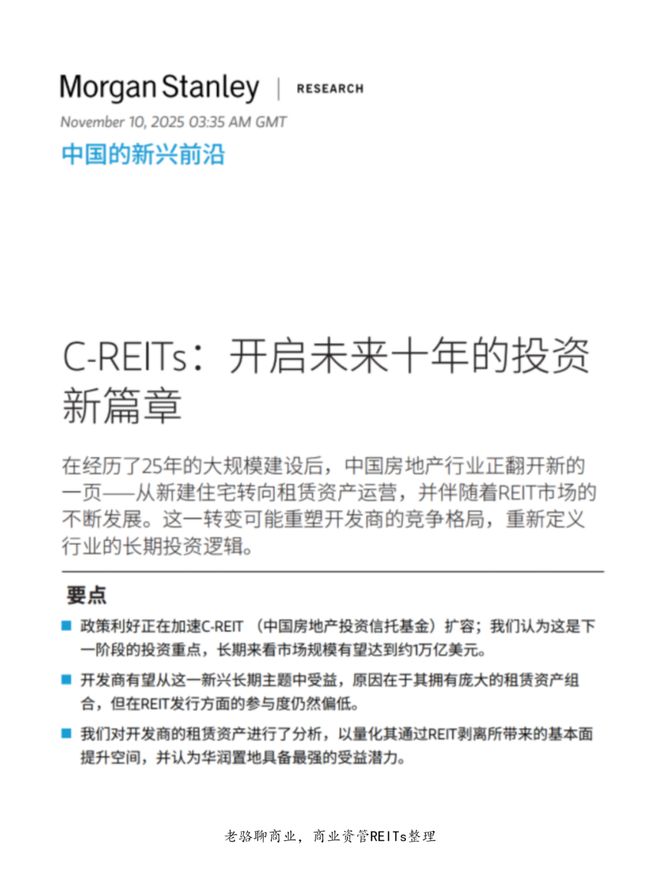
C-REITs:开启未来十年的投资新篇章
Xin Lang Cai Jing· 2025-11-19 04:31
Core Insights - The Chinese real estate industry is transitioning from new residential construction to rental asset operations, alongside the development of the REIT market, which may reshape the competitive landscape for developers and redefine long-term investment logic [1][3]. Group 1: C-REIT Expansion - Policy incentives are accelerating the expansion of C-REITs (China Real Estate Investment Trusts), with the market size expected to reach approximately $1 trillion in the long term [2][4]. - Developers are likely to benefit from this emerging long-term theme due to their large rental asset portfolios, although their participation in REIT issuance remains low [2][4]. - The analysis of developers' rental assets indicates that China Resources Land has the strongest potential for benefit from REIT spin-offs [2][4]. Group 2: Market Dynamics - Since Q3 2025, favorable policies have accelerated the issuance of domestic REITs, expanding the asset range and issuer backgrounds [6]. - C-REITs are expected to become an important asset class over the next 10 to 20 years due to their stable returns and low correlation with the stock market [6]. - The limited trading volume of C-REITs suggests that listed developers are a good entry point into this rapidly expanding theme [6]. Group 3: Key Beneficiaries - In-depth analysis shows that China Resources Land (1109.HK) has the highest short-term benefit potential, followed by New World Development (601155.SS) and Longfor Group (0960.HK) due to their large shopping center portfolios [7]. - Other companies with rich non-retail rental assets, such as China Overseas Land (0688.HK), China Merchants Shekou (001979.SZ), Vanke (2202.HK), and Poly Developments (600048.SS), may also benefit in the medium term as the REIT coverage expands [7]. Group 4: C-REIT Development History - The development of C-REITs over the past 25 years can be divided into four phases: initial preparation, gradual development, accelerated promotion, and full-speed phase [9]. - The regulatory framework for C-REITs was first proposed in the early 2000s, with significant progress made since the first public REIT was listed in mid-2021 [8][9]. Group 5: Current Market Status - As of September 2025, there are 75 publicly listed C-REITs with a cumulative issuance scale of approximately RMB 200 billion and a market value of about RMB 220 billion [10]. - Despite significant growth since the first public REITs were listed, C-REITs currently account for only 0.15% of the total market value of China's stock market [10]. Group 6: Future Potential - The potential market size for C-REITs is estimated to reach $1 trillion, which is 32 times the current market value of approximately $31 billion [15][16]. - The estimated value of commercial properties completed since 2000 is around $4.9 trillion, indicating a significant opportunity for C-REITs to capture a larger market share [14][15].




申万宏源证券晨会报告-20251119
Shenwan Hongyuan Securities· 2025-11-19 00:45
Group 1: Computer Industry Investment Strategy - The year 2025 marks the beginning of domestic computing power industrialization, with significant advancements in domestic AI chips and server architecture, enhancing overall computing performance [10] - The gap between Chinese and American large models is narrowing, with expectations of further convergence and potential surpassing in certain areas by 2026 [10] - The software industry is entering an optimal layout window as AI revenue for many companies exceeds 10%, indicating a technological revolution [10] - Investment focus areas include Deep Research, AI programming, multi-modal applications, and industry-specific agents [10] Group 2: Real Estate Industry Investment Strategy - The real estate market is expected to structurally bottom out, with five major opportunities identified, including stabilization of residents' balance sheets and improved housing affordability [12][18] - The policy direction will focus on stabilizing demand and promoting high-quality development, which will benefit real estate companies [18] - Predictions for 2025-2026 include a decline in sales volume and prices, but core cities are expected to stabilize sooner due to healthier supply-demand relationships [18] Group 3: Pharmaceutical Industry Investment Strategy - Chinese pharmaceutical companies are increasingly leading global multi-center clinical trials, with a growing number of new drugs successfully commercialized overseas [15] - The shift from "fast following" to "innovation leading" in drug development positions Chinese companies to redefine the global pharmaceutical landscape [15] - Investment directions include biotech transitioning to biopharma and the revaluation of traditional pharmaceutical companies during their innovation transformation [15]
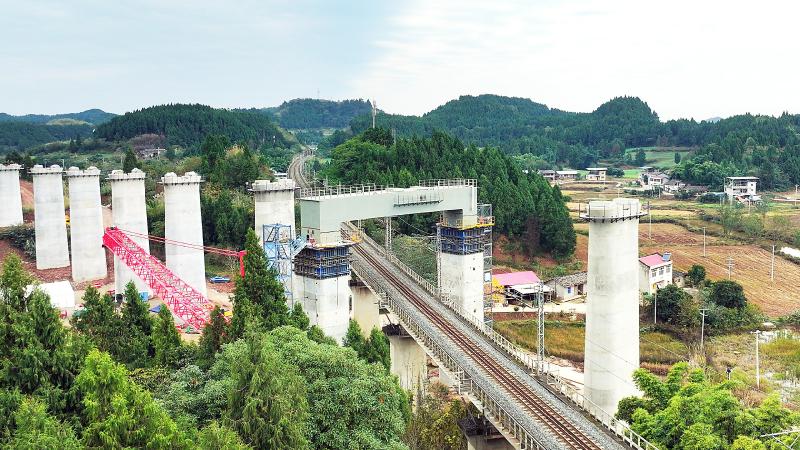
成达万高铁上跨沪蓉铁路支线 150度转身 170吨钢盖梁就位
Si Chuan Ri Bao· 2025-11-19 00:39
Group 1 - The successful installation of a 170-ton steel cover beam at the Chengdu-Dazhou-Wanzhou high-speed railway marks a key milestone in the construction of the De Gong Village Super Bridge [2] - The De Gong Village Super Bridge spans approximately 3,876 meters and is located in Suining City, Sichuan Province [2] - The construction faced multiple challenges, including coordination difficulties with existing operational lines and high risks associated with cross-operation [2] Group 2 - The Chengdu-Dazhou-Wanzhou high-speed railway is an important part of China's "eight vertical and eight horizontal" high-speed rail network, with a total length of 477 kilometers and a design speed of 350 kilometers per hour [3] - Once completed, the travel time from Chengdu to Wanzhou will be reduced to under 2 hours, significantly contributing to the economic development of the Chengdu-Chongqing economic circle and the Yangtze River economic belt [3]
起始价超84亿元!北京海淀上地0702地块“转正”挂牌
Xin Jing Bao· 2025-11-18 13:07
Core Viewpoint - The Beijing Haidian District has officially listed the Shangdi 0702 land parcel for auction, with a starting price of 8.422 billion yuan, expected to attract intense bidding due to its prime location and development potential [1][2]. Group 1: Land Parcel Details - The Shangdi 0702 land parcel consists of three sub-parcels, totaling 77,100 square meters, with a planned construction area of 225,400 square meters [1]. - The sub-parcels include residential land with a scale of 22,000 square meters and a floor area ratio of 2.2, and multi-functional land with a scale of 34,800 square meters and a floor area ratio of 3.8 [1]. Group 2: Development Requirements - The land transfer documents stipulate that the project must comply with high-quality residential construction guidelines and policies, emphasizing the use of durable materials and aesthetic integration with the urban landscape [2]. - The residential buildings must feature simple, practical, and beautiful facades, ensuring safety and rational construction [2]. Group 3: Market Context - The Shangdi 0702 land parcel is strategically located between the fifth and sixth ring roads, near key transportation links and established commercial facilities, indicating a mature living environment [2]. - The competitive landscape includes several high-end projects in the northern Haidian area, such as HeYue YuMing and HeYue WangYun, which have already entered the market with a sales guidance price of 105,000 yuan per square meter [2].
地产10月观察及数据点评:基数扰动,延续去库存
Haitong Securities International· 2025-11-17 06:35
Investment Rating - The report maintains a preference for high-quality companies in the real estate sector, specifically recommending: 1) Development: A-Shares - China Vanke, Poly Developments, China Merchants Shekou, Gemdale; H-Shares - China Overseas Land & Investment; 2) Residential: Longfor Group; 3) Property Management: Onewo, China Resources Mixc Lifestyle Services, China Overseas Property, Poly Property Services, China Merchants Property; 4) Cultural Tourism: Shenzhen Overseas Chinese Town [63][70]. Core Insights - October data showed a significant decline due to high base effects, expected to continue until year-end. Both investment and demand sides exhibited accelerated declines, with development investment year-on-year growth at -23.2% and new construction area at -29.3%. Sales amount and area decreased by -25.1% and -19.6% respectively [63][71]. - The base effect is anticipated to narrow the year-on-year decline in 2026, but it cannot be linearly extrapolated for long-term industry judgments. Continuous tracking of industry trends and high inventory levels is necessary [64][72]. - The current inventory reduction trend persists, with a rapid decline in completed areas indicating a decrease in unsold projects. The proportion of unsold units in construction is rising, suggesting that the industry faces significant challenges in inventory reduction [64][73]. Summary by Sections 1. Investment Decline and Sales - In the first ten months of 2025, real estate development investment decreased by 14.7% year-on-year, with a notable decline in new construction area by 19.8% [6][10]. - Sales figures also reflected a downturn, with total sales area down by 6.8% and sales amount down by 9.6% compared to the same period in 2024 [27][8]. 2. Funding Sources - Total funding sources for real estate reached 7.89 trillion yuan, a decrease of 9.7% year-on-year. Domestic loans accounted for 15.42% of funding sources, with a decline of 1.8% year-on-year [47][49]. 3. Inventory and Sales Ratios - As of October 2025, the nationwide unsold housing area was 7.56 billion square meters, with a sales-to-completion ratio of 2.06, indicating ongoing inventory challenges [39][44]. 4. Market Outlook - The report suggests that while short-term new projects may drive sales, long-term inventory issues remain due to high debt levels among developers. The market is currently treating new and old projects separately, which may be feasible in the short term but poses long-term pressures [64][73].
房地产行业2026年投资策略:潮平待风起,扬帆更远航
Shenwan Hongyuan Securities· 2025-11-17 04:13
Group 1 - The core viewpoint of the report indicates that the stabilization of the residential balance sheet suggests a potential bottoming out in the real estate market, but the speed of improvement will determine the duration of this bottoming process [3][4] - The report highlights that since 2021, China's housing prices have cumulatively declined by 37%, which is longer than the average decline of 34% over 6.1 years in 42 countries, indicating that while the price drop is significant, the adjustment period in China is still relatively short [22][7] - The report identifies five major opportunities in the industry, including the stabilization of the residential asset-liability ratio, a decrease in the housing price-to-income ratio, improving rental yields, a bullish stock market potentially boosting wealth effects, and a deep clearing of supply-side issues [3][4] Group 2 - The industry outlook predicts a structural bottoming out, with opportunities arising for quality housing and commercial real estate, driven by policies focusing on demand recovery and high-quality development [3][4] - The report anticipates that the core cities will stabilize sooner due to healthier supply-demand relationships, with a forecast for sales volume and price declines to narrow in 2025-2026 [3][4] - The report maintains a "positive" rating for the real estate sector, recommending specific companies in the quality housing and commercial real estate segments, as well as undervalued firms and property management companies [3][4]





中国房地产月度追踪_新开工面积降至本轮下行周期以来(1-2 月除外)的月度最低水平-China Property Monthly Tracker_ New starts plunged to the lowest monthly level (excl Jan_Feb) since this downturn
2025-11-16 15:36
Summary of China Property Monthly Tracker Industry Overview - The report focuses on the **Chinese property market**, highlighting significant declines in new property starts, sales, and construction activities, indicating a downturn in the sector. Key Points Market Performance - **New starts** in October 2025 fell to the lowest monthly level (excluding January and February) since the current downturn began [2][9] - **Primary sales** volume and value declined by **19%** and **24%** year-over-year (YoY), respectively, while construction activities (completion and new starts) plunged nearly **30%** YoY [2][9] - **Secondary sales volume** also fell short of expectations, contributing to a broader weakening in market sentiment and income expectations [2][9] Price Trends - The **average selling price (ASP)** for properties continued to decline, with primary ASPs down **0.5%** month-over-month (MoM) and secondary ASPs down **0.7%** MoM in October [9][31] - The **ASP** in tier-1 cities showed a **0.3%** decline for primary and **0.9%** for secondary markets, indicating a divergence in pricing trends [9][31] Future Expectations - For November 2025, expectations include: 1. Continued price weakness, especially in secondary ASPs across all cities [3][11] 2. An expansion in the YoY decline for primary transaction volume and value, with new starts remaining weak [3][11] 3. A narrowing trend in secondary transaction volume YoY, but still recording substantial declines [3][11] 4. A further decline in land sales volume and a potential negative YoY change in land sales value [3][11] Developer Insights - Developers' land acquisition profitability improved slightly month-over-month in October, with land acquisition spending averaging **28%** of contract sales, down from **54%** in September [2][10] - The report notes that developers are likely to be less aggressive in land banking for the remainder of the year, having largely met their full-year land replenishment plans [18][10] Government Policies and Market Sentiment - The report highlights ongoing discussions regarding the removal of housing purchase restrictions in core districts of tier-1 cities, which could positively impact home purchases [4][10] - There is a noted deterioration in the demand-side strength score, which dropped to **37 out of 100**, indicating a challenging environment for home purchases and secondary market performance [53][55] Construction and Investment Trends - Construction activities are expected to see a high single-digit percentage decline YoY for completions and a **30-40%** decline for new starts in November [17][11] - Developers are expected to focus on smaller projects with better ASP visibility and easier product positioning, rather than larger land parcels requiring phased development [18][10] Financial Metrics - The report provides a detailed summary of key market indicators, including: - **GFA sold**: **61 million sqm** in October, down **18.8%** YoY - **Property sales**: **Rmb 0.6 trillion**, down **24.3%** YoY - **ASP**: **Rmb 9,723/sqm**, down **6.8%** YoY - **New starts**: **37 million sqm**, down **29.5%** YoY - **Completions**: **37 million sqm**, down **28.2%** YoY [20][29] Conclusion - The Chinese property market is experiencing significant challenges, with declining sales, construction activities, and prices. The outlook for November remains cautious, with expectations of continued weakness in both primary and secondary markets. Developers are adjusting their strategies in response to market conditions, and government policies may play a crucial role in shaping future demand.
房地产行业点评报告:高基数下销售数据承压,开竣工面积降幅扩大
KAIYUAN SECURITIES· 2025-11-16 13:14
Investment Rating - The industry investment rating is "Positive" (maintained) [1] Core Viewpoints - The report highlights a significant decline in monthly sales data across various city tiers, indicating that all levels of cities have entered a downward trend [5][14] - The report anticipates continued pressure on new construction and completion data for the year, with a notable decrease in both metrics [6][19] - There is an ongoing decline in development investment, which is expected to impact the willingness to start new projects [7][23] - The pressure on real estate companies' cash flow is increasing, with a notable drop in funds available to developers [8][27] - The report suggests a cautious outlook for the market, with expectations of low sales continuing into the fourth quarter [8][34] Summary by Sections Monthly Sales Data - From January to October 2025, the national sales area of commercial housing was 720 million square meters, down 6.8% year-on-year, with residential sales area down 7.0% [5][14] - In October 2025, the sales area and amount of commercial housing decreased by 19.6% and 24.3% year-on-year, respectively [5][14] Construction Data - New construction area from January to October 2025 was 491 million square meters, down 19.8% year-on-year, with residential new construction down 19.3% [6][19] - Completion area during the same period was 349 million square meters, down 16.9% year-on-year [6][19] Development Investment - Real estate development investment from January to October 2025 was 7.36 trillion yuan, down 14.7% year-on-year, with residential investment down 13.8% [7][23] - The report indicates that the decline in investment is expected to continue due to weak sales recovery [7][23] Funding for Developers - Funds available to real estate developers totaled 7.89 trillion yuan from January to October 2025, down 9.7% year-on-year [8][27] - The report notes that all funding sources, including domestic loans and personal mortgage loans, have seen increased year-on-year declines [8][31] Investment Recommendations - The report recommends focusing on developers with strong fundamentals and those that can cater to improving customer needs, such as Greentown China and China Overseas Development [8][34] - It also suggests companies benefiting from both residential and commercial real estate recovery, like China Resources Land and Longfor Group [8][34]
房地产开发2025W46:本周新房成交同比-34.6%,10月房价延续调整
GOLDEN SUN SECURITIES· 2025-11-16 07:10
Investment Rating - The report maintains an "Overweight" rating for the real estate industry [4][6]. Core Insights - The report emphasizes that the current policy environment is being driven by fundamental pressures, suggesting that the policy response may exceed the levels seen in 2008 and 2014 [4]. - Real estate is identified as an early-cycle indicator, serving as a barometer for economic trends, making it a strategic investment focus [4]. - The competitive landscape within the industry is improving, with leading state-owned enterprises and select mixed-ownership and private firms expected to benefit more in the future [4]. - The report continues to support investment in first-tier cities and two-thirds of second-tier cities, indicating that this combination has historically performed better during sales rebounds [4]. - Supply-side policies, including land storage and management of idle land, are highlighted as critical areas to monitor, with first and second-tier cities likely to benefit more from these changes [4]. Summary by Sections New Housing Market - In the week, new housing transaction area in 30 cities was 1.59 million square meters, showing a week-on-week increase of 17.4% but a year-on-year decrease of 34.6% [2]. - The new housing transaction area for first-tier cities was 432,000 square meters, up 12.6% week-on-week but down 42.5% year-on-year [2]. - Second-tier cities recorded a transaction area of 881,000 square meters, up 24.7% week-on-week and down 23.4% year-on-year [2]. - Third-tier cities had a transaction area of 276,000 square meters, up 4.9% week-on-week but down 47.7% year-on-year [2]. Second-Hand Housing Market - The total transaction area for second-hand housing in 14 sample cities was 2.003 million square meters, reflecting a week-on-week growth of 4.7% but a year-on-year decline of 17.0% [2]. - First-tier cities accounted for 856,000 square meters in second-hand transactions, up 8.7% week-on-week [2]. - Second-tier cities had a transaction area of 873,000 square meters, up 1.4% week-on-week [2]. - Third-tier cities recorded 273,000 square meters, up 3.7% week-on-week [2]. Credit Bonds - In the week of November 10-16, four credit bonds were issued by real estate companies, a decrease of eight from the previous week, with a total issuance of 3.62 billion yuan, down 6.63 billion yuan [3]. - The total repayment amount was 10.829 billion yuan, an increase of 4.359 billion yuan, resulting in a net financing amount of -7.209 billion yuan, down 10.989 billion yuan [3]. Market Performance - The report notes that the Shenwan Real Estate Index had a cumulative change of 2.7%, outperforming the CSI 300 Index by 3.78 percentage points, ranking 7th among 31 Shenwan primary industries [14]. - A total of 84 stocks in the real estate sector rose, while 30 stocks fell, with the top five gainers being Qianjing Garden, China Wuyi, Huaxia Happiness, Guancheng Datong, and Rongsheng Development, with gains of 61.0%, 30.0%, 26.3%, 21.6%, and 18.2% respectively [14].


房地产1-10月月报:投资低位进一步走弱,销售量价降幅均扩大-20251115
Shenwan Hongyuan Securities· 2025-11-15 11:14
Investment Rating - The report maintains a "Positive" rating for the real estate sector, indicating a cautious optimism despite current challenges [2][3]. Core Insights - The investment side of the real estate sector continues to weaken, with significant declines in new construction and completion rates. For the period from January to October 2025, total real estate investment decreased by 14.7% year-on-year, with new construction down by 19.8% and completions down by 16.9% [1][20]. - The sales side shows a broader decline in sales volume and price. From January to October 2025, the sales area decreased by 6.8% year-on-year, with a more pronounced drop of 18.8% in October alone. The sales amount also fell by 9.6% year-on-year, with a 24.3% decline in October [2][33]. - Funding sources for real estate development are tightening, with total funding down by 9.7% year-on-year. In October, funding sources saw a significant drop of 21.9% compared to the previous month [35]. Investment Analysis - The report suggests that the real estate sector is still in a bottoming phase, with core cities expected to stabilize sooner. Two major opportunities are highlighted: the potential shift of real estate companies towards manufacturing and the favorable conditions for quality commercial enterprises during a monetary easing cycle [2][3]. - Adjustments to the 2025 forecasts include a projected investment decline of 14.2% (previously 11.0%), new construction down by 18.0% (previously 15.1%), and completions down by 17.7% (previously 20.0%) [20][34].