舜宇光学科技

Search documents
舜宇光学科技:光学业务增长强劲
Xin Lang Cai Jing· 2025-09-28 14:20
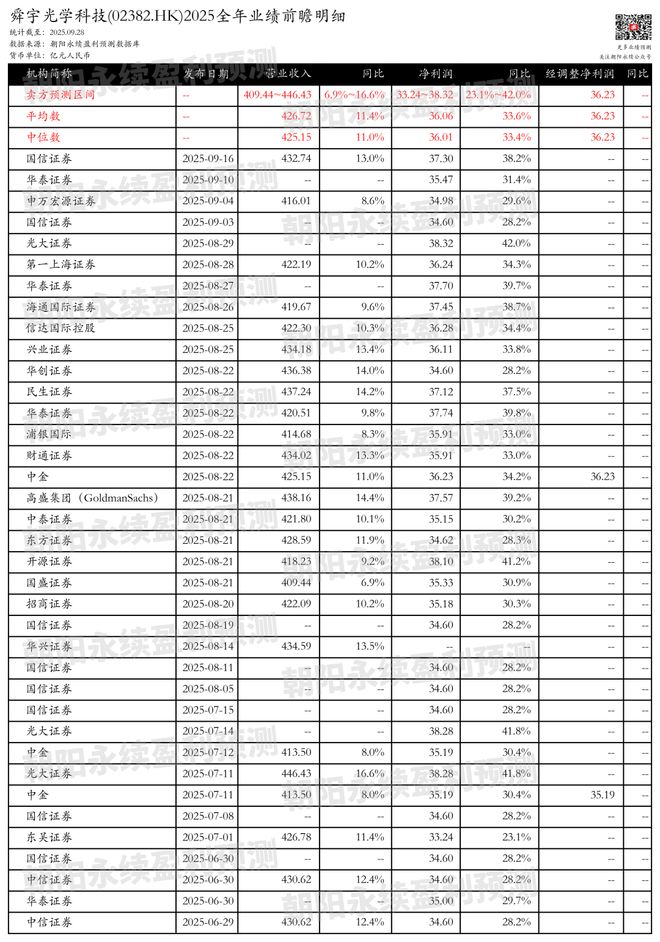
Core Viewpoint - Sunny Optical Technology is expected to achieve a revenue of 40.944 to 44.643 billion RMB for the fiscal year, representing a year-on-year growth of 6.9% to 16.6%, with a net profit forecast of 3.324 to 3.832 billion RMB, indicating a growth of 23.1% to 42.0% [1][2] Financial Performance - The company is projected to report an adjusted net profit of 3.623 billion RMB [1] - The average revenue forecast from various institutions is approximately 42.672 billion RMB, with a median of 42.515 billion RMB [2] - The company achieved a revenue of 19.7 billion RMB in the first half of 2025, aligning with market expectations, and a net profit of 1.65 billion RMB, reflecting a year-on-year increase of 52.6% [3][4] Business Segments - **Mobile Business**: Despite a decline in shipment volume, revenue increased by 1.7%, with a gross margin guidance raised to 25-30%. Revenue growth for 2025 is expected to be between 5-10% due to the adoption of high-end lens modules and advanced optical technologies [4][5] - **Automotive Business**: Revenue from vehicle optics grew by approximately 18%, with the LiDAR business expected to become a future revenue pillar, having secured projects exceeding 1.5 billion RMB [4][5] - **XR and IoT Business**: The XR segment saw a year-on-year growth of 21%, with rapid expansion in smart glasses and AI service robots, anticipating robot business revenue to reach 2 billion RMB [4][5]

组合辅助驾驶迎来强监管新阶段,从L2规范向L3前瞻:——汽车行业专题研究
Guohai Securities· 2025-09-28 14:01
Investment Rating - The report maintains a "Recommended" rating for the automotive auxiliary driving industry [1]. Core Insights - The report analyzes the recent policies aimed at stabilizing growth and enhancing safety in the automotive industry, particularly focusing on the transition from L2 to L3 autonomous driving standards [4][5]. - The automotive industry is entering a new phase characterized by strong regulatory measures and a focus on safety and growth, with specific targets set for vehicle sales and the promotion of intelligent connected vehicles [10][12]. - The implementation of the "Safety Requirements for Intelligent Connected Vehicle Combination Driving Assistance Systems" standard marks a significant step towards the standardization and regulation of L2/L2+ auxiliary driving systems [16][18]. Summary by Sections 1. Automotive Industry New Policies - The "Automotive Industry Stabilization and Growth Work Plan (2025-2026)" aims to address complex economic conditions and set targets for 2025, including approximately 32.3 million total vehicle sales and 15.5 million new energy vehicle sales, reflecting a growth of about 3% and 20% respectively [10][12]. - The plan emphasizes expanding domestic consumption, improving supply quality, optimizing the industry environment, and enhancing international cooperation [15][16]. 2. Smart Driving Policy Overview - National policies focus on guiding and regulating the development of intelligent driving, establishing a comprehensive regulatory framework that includes safety standards and ethical guidelines [27][28]. - Local policies emphasize pilot projects and differentiated exploration, with cities like Guangzhou and Beijing implementing unique strategies to promote smart driving technologies [31][32]. 3. Accelerating Standardization in the Industry - The report outlines a three-phase path for the implementation of standards, with the formal approval of L3 autonomous driving expected post-2026 [5][42]. - Investment opportunities are identified in compliance-driven market demands and technological upgrades, particularly in areas such as driver monitoring systems, data recording systems, and core components like domain controllers and automotive-grade chips [5][42]. 4. Investment Opportunities - The report suggests focusing on companies with strong R&D capabilities and compliance with safety requirements, including leading automotive manufacturers and intelligent driving solution providers [5][46]. - The implementation of the new standards is expected to create a clear safety baseline and enhance market confidence in higher-level autonomous driving systems [44][49].




30年前中国企业有多野?四大行业的同年觉醒,如今命运天差地别
Sou Hu Cai Jing· 2025-09-27 08:37
Core Insights - The article reflects on the transformative changes in China's business landscape from 1995 to 2025, highlighting the rise of new industries like electric vehicles and AI robots while contrasting them with the struggles of traditional businesses [2][26]. Traditional Business Decline - In 1995, Asia Mall in Zhengzhou represented a shift in retail with its "customer is king" philosophy, but it faced underlying crises that led to its eventual downfall [4][6]. - The ambitious expansion plan of Asia Mall, which aimed for 500 million in sales and numerous stores, ultimately resulted in significant debt and is seen as a cautionary tale of aggressive expansion without solid foundations [6][9]. Automotive Industry Emergence - The motorcycle industry in 1995 saw significant players like Jialing Motorcycle, while BYD, founded by Wang Chuanfu, innovated in battery production, setting the stage for future developments in electric vehicles [11][13]. - The introduction of models like the Santana 2000 and the CR-V marked pivotal moments in the Chinese automotive market, influencing consumer perceptions and driving growth in the SUV segment [13]. Internet Industry Dawn - The establishment of the first private educational institution in Beijing by Zhang Shuxin in 1995 marked the beginning of China's internet movement, despite early struggles to find a viable business model [15][19]. - The failures of early internet ventures like Yinghaiwei paved the way for later successes, as companies like Sina and Sohu emerged with more practical approaches to online services [19]. Semiconductor Industry Breakthrough - A visit to Samsung's semiconductor factory in 1995 catalyzed China's realization of its technological lag, leading to the launch of the "909 Project" aimed at establishing a domestic semiconductor industry [21][24]. - The "909 Project" laid the groundwork for future advancements in chip technology, emphasizing a model of government guidance combined with market operations [24]. Conclusion - The contrasting narratives of failure and success in 1995 illustrate the complexities of China's economic transformation, with lessons learned shaping the future of various industries [26][28].

履职八月遭免职?网传舜宇光学科技子公司总经理张超君遭免职,内部公告外泄
Xin Lang Zheng Quan· 2025-09-25 10:47
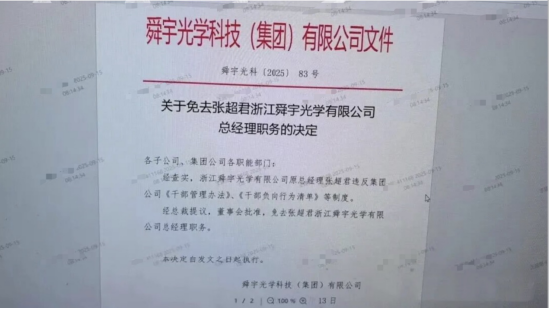
Core Viewpoint - The internal announcement from Sunny Optical Technology (Group) Co., Ltd. regarding the dismissal of Zhang Chaojun, General Manager of Zhejiang Sunny Optical, has sparked significant market and public attention due to its leak and the circumstances surrounding it [1][11]. Group 1: Dismissal Details - Zhang Chaojun has been dismissed from his position due to violations of the company's management regulations and negative behavior list, as approved by the board of directors [5][9]. - Zhang, aged 55, had been with the company for over 30 years, having joined in 1993 and held various positions before becoming General Manager in January 2025 [6][9]. - The specific reasons for his dismissal have not been disclosed, leading to speculation and discussions in the public domain [11][13]. Group 2: Information Leak and Company Response - The leaked internal announcement included identifiable employee watermarks, raising concerns about information security within the company [1][12]. - The company has acknowledged the leak and emphasized the importance of adhering to information security protocols, stating that it will enhance control and impose stricter penalties for violations [12]. - Sunny Optical Technology, with a market capitalization exceeding HKD 95 billion, is facing dual challenges: the unexpected dismissal of a senior manager and the exposure of its information security vulnerabilities [12].
阿里、小米等芯片开发进程加速,重仓的港股通科技ETF(159262)盘中最高涨超2%,连续12日“吸金”规模突破50亿元
Xin Lang Cai Jing· 2025-09-25 06:09
Group 1 - The Nasdaq Golden Dragon China Index saw significant gains, with notable increases in companies such as GDS Holdings up 16.6%, Daqo New Energy up 12.6%, and Alibaba maintaining around a 10% increase [1] - The Hang Seng Tech Index rose over 2%, led by Hua Hong Semiconductor and followed by SMIC and Alibaba [1] - Xiaomi officially announced the global launch of its 17 series featuring the fifth-generation Snapdragon 8 processor, which boasts a peak frequency of 4.6GHz and significant power efficiency improvements [1] Group 2 - Zhongtai Securities indicated that the Hong Kong stock market is expected to continue its structural rise, supported by the US-China summit and improved sentiment in the A-share market, with a focus on the technology sector driven by AI demand [2] - The Hong Kong Stock Connect Technology ETF (159262) rose 1.65%, with component stocks like Hua Hong Semiconductor and Xiaomi Group showing strong performance [2] - The Hang Seng Stock Connect Technology Index excludes sectors like pharmaceuticals and automobiles, focusing on TMT industries, with major weights in AI leaders such as Alibaba, Tencent, and Xiaomi [2] Group 3 - As of September 24, 2025, the Hong Kong Stock Connect Technology ETF reached a record size of 5.034 billion yuan, marking the highest since its inception [3] - The ETF has seen continuous net inflows over the past 12 days, with a peak single-day inflow of 325 million yuan, totaling 785 million yuan in net inflows [3] Group 4 - The Hong Kong Stock Connect Technology ETF represents a shift from "Internet" to "AI+" within the hard technology sector [4]


全球与中国倒置荧光显微镜市场现状及未来发展趋势-2025版
QYResearch· 2025-09-25 03:50
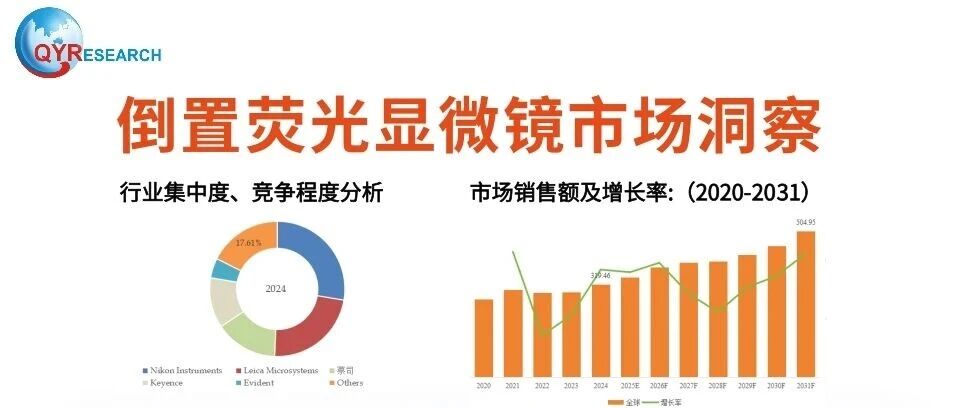
Core Viewpoint - The inverted fluorescence microscope industry is experiencing rapid development characterized by simultaneous technological upgrades and market expansion, with a projected global market sales of $319 million in 2024 and $505 million by 2031, reflecting a CAGR of 6.54% from 2025 to 2031 [2][7]. Industry Current Status - The current market is driven by technological innovations such as super-resolution technology, AI algorithms for automatic focusing and image analysis, and multi-modal imaging techniques that enhance dynamic observation of cells [2]. - The primary application areas are biomedical research, focusing on live cell observation, drug screening, and cancer mechanism studies, while the demand in materials science and industrial testing is declining due to a shift towards biomedical applications [2]. - The competitive landscape is dominated by international giants like Evident, Zeiss, Nikon, and Leica, but domestic brands are gaining market share due to policy support and cost advantages [2][10]. Industry Challenges - The industry faces challenges such as reliance on imported high-end optical components, lagging domestic super-resolution technology, and high pricing of advanced equipment, which restricts procurement by small and medium-sized institutions [3]. Development Trends - The development trends focus on five core areas: super-resolution imaging, intelligence and automation, multi-modal integration, domestic technology upgrades, and expansion of application scenarios [4]. - Super-resolution imaging is pushing the resolution to the nanoscale, enabling high-precision observation of cellular dynamics and molecular interactions [4]. - The integration of AI technology enhances automation in tasks like sample recognition and image analysis, significantly improving experimental efficiency [4]. - Domestic technology is advancing, with companies narrowing the gap with international brands and increasing market share through policy support [4]. Global Market Overview - The global inverted fluorescence microscope market is projected to reach $319 million in 2024, with China accounting for approximately 20% of the market share [7]. - North America is the largest consumer market, expected to maintain a leading position with a market share of 36.8% in 2024, followed by Europe and China [7]. - In terms of production, China and Japan are significant regions, each holding around 33.9% and 33.0% of the market share in 2024, respectively [7]. Product and Application Insights - The three-microscope type is expected to dominate the market, with a projected share of 79.6% by 2031 [8]. - Hospitals are anticipated to hold a market share of approximately 43.5% in 2024, with a CAGR of about 7.27% in the coming years [8]. - Major global manufacturers include Evident, Leica Microsystems, Nikon Instruments, and others, with the top tier holding around 82.39% of the market share [8]. Policy Analysis - China's policies are strongly driving domestic substitution and technological breakthroughs, with significant funding and tax incentives to support the development of biomedical imaging equipment [12]. - The "14th Five-Year Plan" emphasizes high-end scientific instruments as a strategic industry, aiming for a domestic production rate of over 60% by 2025 [12]. - Internationally, the industry faces challenges from regulatory barriers and trade protectionism, impacting market entry and competition [12][13].
每日投资策略:恒指低开高走,港股收涨 359 点-20250925
Guodu Securities Hongkong· 2025-09-25 03:22
Group 1: Market Overview - The Hang Seng Index opened lower but closed up by 359 points or 1.37%, ending at 26,518 points, recovering above the 10-day moving average [3] - The market saw a total turnover of 288.77 billion, marking three consecutive days below 300 billion, with a net inflow of 13.704 billion from northbound trading [3] - Among 88 blue-chip stocks, 49 rose while 36 fell, with notable gainers including Xinyi Solar up 4.9% and Galaxy Entertainment up 2.2% [4] Group 2: Company Developments - Chow Tai Fook reported a net profit of 2.162 billion, a year-on-year increase of 3.73%, with total revenue of 24.285 billion, down 8.09% [12] - Alibaba Cloud announced plans to establish data centers in Brazil, France, and the Netherlands, with further expansions planned in Mexico, Japan, South Korea, Malaysia, and Dubai [13] - Baidu's A-share issuance plan has been approved by the Shanghai Stock Exchange, aiming to raise funds for early drug research and development projects [14] Group 3: Industry Trends - The Chinese Ministry of Commerce issued 13 policy measures to support service exports, including optimizing tax procedures and enhancing cross-border financial management [10] - The Ministry of Commerce and other departments released guidelines to promote digital consumption, encouraging the development of new business models like live-streaming e-commerce [9] - Gaode, a subsidiary of Alibaba, announced a waiver of annual fees for all restaurant merchants, resulting in a 6.31-fold increase in new merchant registrations in a single day [15]

突破關鍵阻力!舜宇光學輪證策略全解析
Ge Long Hui· 2025-09-24 11:43
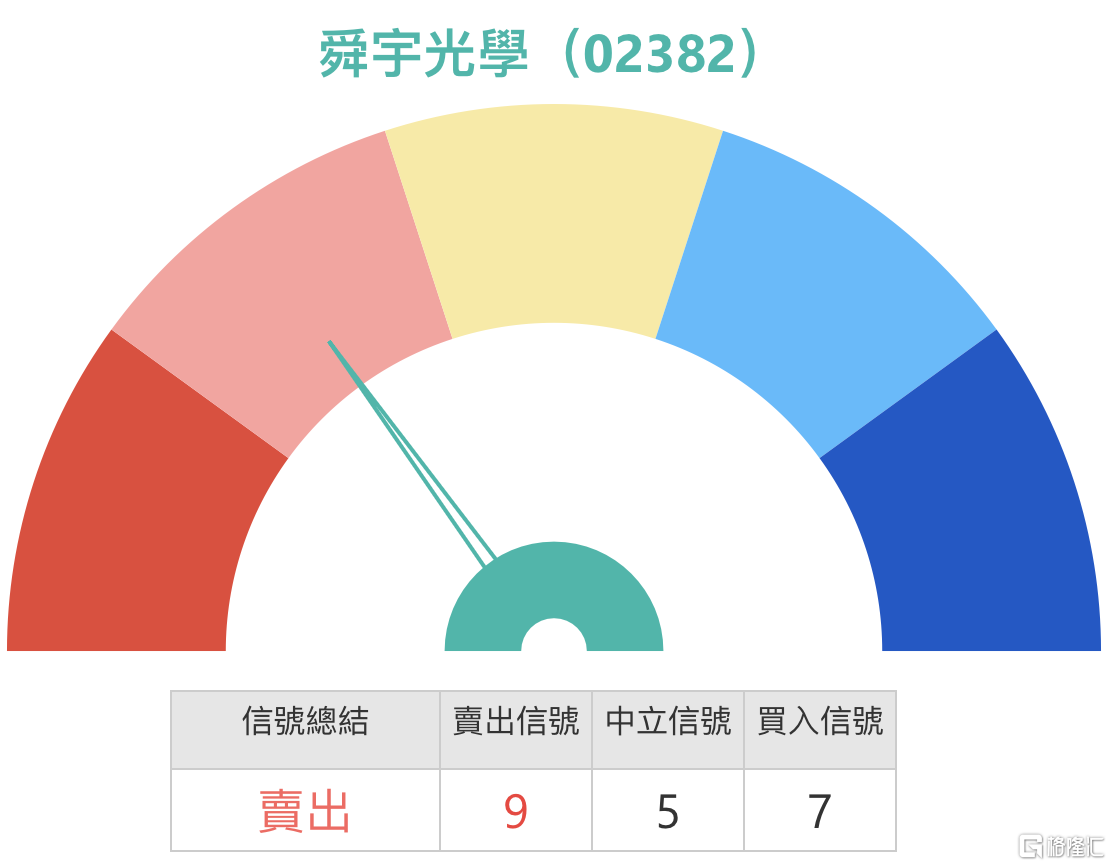
Group 1 - The stock price of Sunny Optical Technology (02382) reached a high of 88.35 HKD, successfully breaking through key resistance levels at 81.79 HKD (10-day moving average) and 80.87 HKD (30-day moving average), indicating a bullish trend [1] - The Relative Strength Index (RSI) is at 61, suggesting it is not yet in the overbought territory, while other indicators like the stochastic oscillator and MACD are signaling buy opportunities [1] - The stock has shown significant volatility with a 5-day price fluctuation of 9.8%, presenting both opportunities and risks for short-term traders [2] Group 2 - Recent market performance of related products has been strong, with UBS warrants (64956) surging 40% in two days due to a 6.29% increase in the underlying stock, indicating investor optimism in the optical sector [4] - Current resistance levels for Sunny Optical are at 92.4 HKD and 93.9 HKD, while support is seen at 81 HKD, with potential downside to 79.2 HKD if the support is breached [2] - Investors are advised to consider various warrant strategies, with UBS call warrants (15320) offering a leverage of 5.6 times and a strike price of 95.93 HKD, suitable for those expecting further price increases [4][6]
贝莱德在舜宇光学科技的持股比例于9月18日从4.61%升至5.13%

Mei Ri Jing Ji Xin Wen· 2025-09-24 09:11
Group 1 - BlackRock's stake in Sunny Optical Technology increased from 4.61% to 5.13% as of September 18 [1]
部分苹果概念股尾盘走高 iPhone 17标准款热度传导至产业链 果链有望受益OpenAI硬件布局
Zhi Tong Cai Jing· 2025-09-24 07:30
Group 1 - Apple concept stocks saw gains in late trading, with notable increases in shares of companies such as Q Technology (up 5.16% to HKD 16.11), Lens Technology (up 4.12% to HKD 30.34), and Sunny Optical (up 1.36% to HKD 86) [1] - Reports indicate that the iPhone 17 standard and Pro Max models are receiving strong demand, with some delivery times extending beyond the pre-order period, suggesting higher-than-expected interest in the standard iPhone 17 [1] - JPMorgan has raised its shipment and profit forecasts for Apple over the next two years, adjusting its target price for Apple to USD 280 based on early signs that the new models may perform better than previously anticipated [1] Group 2 - OpenAI has reportedly signed agreements with Luxshare Precision and other companies to develop a consumer-grade device, indicating collaboration with the domestic supply chain [1] - Analysts from Jefferies noted that OpenAI is also in discussions with Lens Technology and AAC Technologies regarding component supply, highlighting the strategic choice to partner with Apple’s supply chain companies [1] - The collaboration with OpenAI is expected to provide new growth momentum for existing Apple supply chain companies, given that key members of OpenAI's device team have backgrounds at Apple [1]