
古茗

Search documents
“微利时代”下,餐饮品牌如何破局?
Hu Xiu· 2025-09-26 03:38
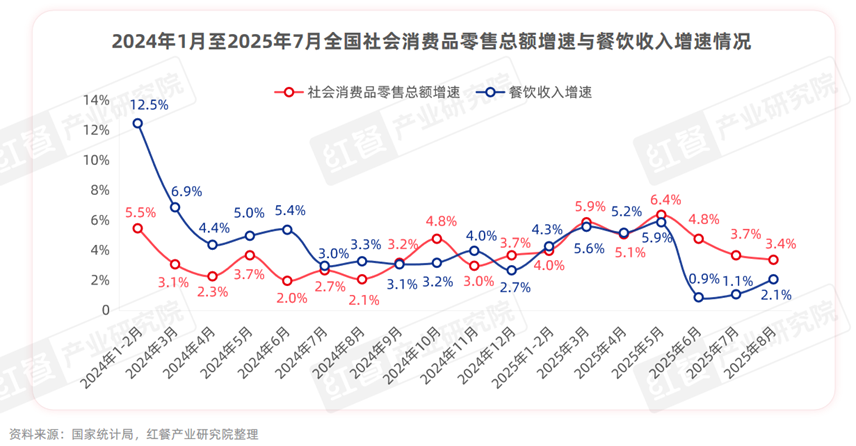
Core Insights - The Chinese catering industry is experiencing a slowdown in growth, with a significant decline in revenue growth rates and a shift in consumer spending habits [2][16][18] - The industry is undergoing a transformation characterized by increased chain operations, innovative marketing strategies, and a focus on product differentiation [5][24][35] Market Overview - National catering revenue from January to August 2025 reached 3.6 trillion yuan, with a year-on-year growth of 3.6%, down 3 percentage points from the same period in 2024 [2] - The number of catering outlets in China exceeded 7.6 million by August 2025, a decrease of 1.9% compared to 2024 [3] Chain Operations - The chain rate in the catering industry has accelerated, with the overall chain rate increasing from 15% in 2020 to an estimated 25% in 2025 [5][6] - The fast food segment saw a 4 percentage point increase in chain rate from 2023 to 2024, reaching 29% [6] Delivery Market Dynamics - The national food delivery market exceeded 1.27 trillion yuan in 2024, growing by 6.2% year-on-year, and is expected to exceed 1.4 trillion yuan in 2025 [9][10] - Daily food delivery orders peaked at over 200 million by August 2025, doubling from 2024 [10] Consumer Behavior - Consumer spending on dining is becoming more cautious, with a significant drop in the proportion of consumers expecting to increase their dining expenditures in 2025 [16][18] - The average per capita consumption in the catering sector fell to 36.6 yuan by August 2025, a decrease of 7.7% from 2024 [18] Industry Trends - The catering industry is witnessing a "listing wave," with several major brands going public in 2025, although many are facing financial challenges [19][22] - The average lifespan of catering outlets has decreased, with many businesses closing within two years of operation [22] Product Innovation - Brands are focusing on product innovation, with over 5,263 new products launched from January to July 2025 [25][28] - Regional ingredients and flavors are becoming key areas for product development [28][29] Marketing Strategies - Short drama marketing is emerging as a new trend, with many brands producing series to engage consumers [35] - User-generated content (UGC) marketing is gaining popularity, with brands launching interactive campaigns to enhance consumer engagement [37] Digital Transformation - The catering industry is increasingly adopting digital and AI technologies to enhance operational efficiency and customer engagement [38][41] - Brands are implementing digital systems for supply chain management and customer relationship management [39][42] International Expansion - Chinese catering brands are exploring overseas markets, with over 30 brands opening their first international locations since 2024 [43] - However, many brands are adopting a more cautious approach to international expansion in 2025 [45][46] Segment Highlights - The "small stir-fry" segment is gaining popularity, particularly in Jiangxi cuisine, with significant social media engagement [52] - The hot pot market is experiencing a decline in outlet numbers and average spending, while smaller hot pot formats are thriving [55][58] - The fast food segment is growing steadily, driven by consumer demand for value [61] - The ready-to-drink beverage market is stabilizing, with tea drinks entering an adjustment phase while coffee drinks continue to grow [64][67]

茶饮企业加入咖啡价格战 咖啡企业奶茶化 9块9或成生死线
Nan Fang Du Shi Bao· 2025-09-25 14:10
Core Viewpoint - The Chinese coffee market is undergoing a significant "value deconstruction," with prices being driven down to as low as 4.9 yuan, transforming coffee from a luxury item into an accessible consumer good [1][6][28] Group 1: Market Dynamics - Luckin Coffee and Kudi initiated a price war by normalizing the 9.9 yuan coffee price, which has now been further undercut by tea brands like Cha Bai Dao and Gu Ming, bringing prices down to 6.9 yuan and 4.9 yuan [1][3][6] - The coffee market is expanding under the influence of low prices, leading to a bifurcation between affordable and premium offerings [1][7] - The shift in consumer behavior has moved from "going out for coffee" to "picking up coffee on the way," indicating a change in consumption scenarios [6][28] Group 2: Competitive Landscape - Tea brands are entering the coffee market, leveraging their existing customer base and aiming for increased sales, with Gu Ming reporting a 10% average sales increase after introducing coffee [3][5] - The ongoing "subsidy war" in the delivery sector is further driving down prices, making coffee more appealing to consumers who are already purchasing tea [5][28] Group 3: Profitability Concerns - The price war raises questions about profitability, as the cost of quality coffee beans often exceeds the selling price, leading to concerns about how companies can sustain profits [10][14] - Kudi's coffee cost structure indicates that selling coffee at 9.9 yuan may not cover costs unless sales volumes are sufficiently high, suggesting a reliance on scale for profitability [11][14] - Despite the price pressures, major brands like Luckin and Kudi continue to report significant revenues, although their profit margins are under strain due to aggressive pricing strategies [27][28] Group 4: Future Trends - The coffee market is likely to see a split between low-cost, high-frequency consumption brands and premium, experience-focused independent cafes [28][29] - Consumer perceptions are also diverging, with some viewing coffee as a daily necessity while others still value the premium experience associated with high-end coffee [29]

中信证券:8月现制饮品景气边际放缓 头部有望享受行业长周期增长红利
Zhi Tong Cai Jing· 2025-09-25 01:49
Core Viewpoint - The current high demand for ready-to-drink beverages driven by delivery subsidies is leading to industry supply expansion, but concerns are rising about brand same-store performance under high base conditions by 2026 [1] Group 1: Market Overview - The overall supply growth rate is slowing down, with the total number of milk tea stores in China reaching 518,000 as of August 2025, a month-on-month increase of 2,000, and coffee stores totaling 190,000, a month-on-month increase of 4,000 [1] - The marginal reduction in delivery subsidies since July has led to a simultaneous slowdown in the store expansion speed of major brands [1] Group 2: Store Opening Trends - There is significant differentiation in store openings within the tea beverage segment, with leading brands in the mid-to-high-end market, such as Gu Ming and Ba Wang Tea Ji, maintaining a competitive edge, while low-end brand Mi Xue Bing Cheng has slowed its opening pace to protect existing store sales [2] - In the coffee segment, industry penetration is rapidly increasing, with brands like Luckin, Kudi, and Lucky Coffee expanding quickly, while Starbucks maintains a slow growth rate in store numbers [2] Group 3: Store Efficiency - The growth rate of store efficiency for leading brands is under pressure due to the reduction of third-party delivery subsidies, with August store efficiency growth for brands in the mid-price range (10-20 yuan) generally falling within the 10%-20% year-on-year growth range, although there is some internal differentiation [3] - High-end brands have limited participation in subsidy activities, which may affect their store efficiency differently [3]

4元1杯的雪王柠檬水断货,其他茶饮凭啥躲过一劫?
3 6 Ke· 2025-09-24 04:09
Core Viewpoint - The recent shortage of lemon water at Mixue Ice City highlights significant risks within the industry, primarily due to rising lemon prices and supply chain vulnerabilities [1][5][11]. Group 1: Supply Chain and Pricing Issues - The average wholesale price of lemons in China has nearly doubled compared to the same period last year, reaching 15 RMB per kilogram as of September 17, 2025 [3]. - Mixue Ice City sells over 1 billion cups of its lemon water annually, generating approximately 4 billion RMB in sales, which constitutes 13% of the company's revenue for the first half of 2025 [5]. - The company has invested in its supply chain by controlling over 50% of high-quality fresh fruit resources in key lemon-producing areas, but this concentration has amplified risks when faced with climate disasters and global supply chain disruptions [8][11]. Group 2: Climate Impact and Global Supply Chain - Major lemon-producing regions in China, particularly Sichuan and Chongqing, have faced severe droughts and high temperatures, leading to expected reductions in lemon supply by 50-60% [8]. - Global supply chain issues, including adverse weather in other lemon-producing countries, are projected to decrease global lemon supply by 6% [8][10]. Group 3: Competitive Landscape and Risk Management - Other tea brands have successfully mitigated the lemon crisis by diversifying their sourcing strategies and using alternative lemon varieties that are less affected by climate issues [15]. - Brands like Starbucks and CoCo utilize a global sourcing model to minimize risks associated with local supply disruptions, while Mixue's low-price strategy has constrained its ability to pass on rising costs to consumers [15][19]. - The crisis underscores the vulnerability of Mixue's concentrated capital model, contrasting with competitors who have adopted more resilient supply chain strategies [20].

4元1杯的雪王柠檬水断货,其他茶饮凭啥躲过一劫?
首席商业评论· 2025-09-24 03:50
Core Viewpoint - The recent shortage of lemon water at Mixue Ice City highlights significant risks within the industry, particularly related to supply chain vulnerabilities and reliance on single-source raw materials [2][6][21]. Group 1: Supply Chain Issues - Multiple stores of Mixue Ice City have reported unavailability of lemon water, with staff confirming that the product is out of stock and expected to remain so for several days [2]. - The shortage is attributed to a sharp increase in lemon prices, with the average wholesale price reaching 15 RMB per kilogram, nearly doubling compared to the same period last year [4]. - Mixue Ice City has a significant dependency on lemons from specific regions, with over 70% of its supply sourced from Sichuan and Chongqing, making it vulnerable to climate-related disruptions [12]. Group 2: Financial Impact - The ice-fresh lemon water is a key product for Mixue Ice City, with annual sales exceeding 1 billion cups, translating to a revenue of approximately 4 billion RMB, which constitutes 13% of the company's total revenue of 14.87 billion RMB for the first half of 2025 [6][9]. - The company's low-price strategy, exemplified by the 4 RMB price point for lemon water, has pressured its supply chain, making it difficult to absorb rising costs when supply shortages occur [14][20]. Group 3: Competitive Landscape - Other tea brands have managed to avoid similar shortages by diversifying their supply sources and utilizing different lemon varieties that are less susceptible to climate impacts [16]. - Brands like Heytea and Starbucks employ global sourcing strategies and local processing to mitigate risks associated with supply chain disruptions [18]. - The contrasting business models and capital structures of competitors allow them to maintain higher profit margins, enabling them to better manage cost increases compared to Mixue Ice City, which has a lower gross profit margin of 31.6% [20]. Group 4: Broader Industry Implications - The lemon crisis reflects a broader conflict between capital concentration and diverse consumer demands, revealing the fragility of Mixue Ice City's single-capital model [21]. - The future of the tea beverage industry may shift from mere store expansion to a focus on controlling the entire supply chain, including cultivation and processing [21].

中信证券:积极关注海外市场可能增长的现制饮品品牌
Xin Lang Cai Jing· 2025-09-24 00:37
Core Insights - The beverage industry in August experienced a slowdown in expansion due to the reduction of subsidies from third-party delivery platforms [1] - There is a significant differentiation in the opening of tea shops, with brands like Gu Ming and Ba Wang Cha Ji leading, while Mi Xue Bing Cheng has noticeably slowed down [1] - Coffee penetration continues to rise, with Luckin, Kudi, and Xingyun Coffee opening stores rapidly, while Starbucks maintains a slow growth in store numbers [1] - The performance of leading brands in terms of store efficiency has generally slowed down, with mid-range price brands (10-20 yuan) showing a year-on-year growth rate in store efficiency between 10% and 20%, but with internal differentiation [1] - Concerns among some investors regarding the industry's performance next year due to high base effects are noted, but the company believes that leading brands with product innovation and offline traffic capabilities are likely to navigate through the cycle successfully, while also paying attention to potentially growing brands in overseas markets [1]
部分茶饮股逆市上扬 古茗涨超4% 蜜雪集团涨超3%
Zhi Tong Cai Jing· 2025-09-23 03:35
Core Viewpoint - The tea beverage industry is experiencing a resurgence after a brief slowdown, with leading brands like Mixue and Guming showing significant revenue growth in the first half of the year [1] Industry Summary - The tea beverage sector has seen a recovery in growth after a 24-year period of slowdown, with a notable increase in revenue for top brands [1] - The revenue growth for leading brands such as Mixue and Guming reached approximately 40% year-on-year in the first half of the year [1] - The launch of major brands in early 2025 is expected to enhance the overall penetration rate of the tea beverage industry and increase foot traffic to stores [1] - The ongoing competition in the delivery sector has positioned tea beverages as a key subsidized category, further boosting sales per store [1] Company Summary - Guming (01364) shares rose by 4.55%, trading at 22.06 HKD [1] - Mixue Group (02097) shares increased by 3.52%, trading at 405.4 HKD [1] - Shanghai Auntie (02589) shares grew by 1.3%, trading at 124.8 HKD [1] - Cha Baidao (02555) shares saw a slight increase of 0.24%, trading at 8.34 HKD [1] - The strong performance of brands is attributed to the excellent single-store model of franchise outlets, indicating a robust future potential for these brands [1]
港股异动 | 部分茶饮股逆市上扬 古茗(01364)涨超4% 蜜雪集团(02097)涨超3%
智通财经网· 2025-09-23 03:32
Core Viewpoint - The tea beverage industry is experiencing a resurgence after a brief slowdown, with leading brands showing significant revenue growth in the first half of the year [1] Industry Summary - The tea beverage sector has seen a recovery after a 24-year period of slowed growth, with major brands like Mixue and Gu Ming reporting approximately 40% year-on-year revenue growth in the first half of the year [1] - The launch of major tea brands in early 2025 is expected to enhance overall market penetration and increase foot traffic to stores [1] - The ongoing competition in the delivery market has positioned tea beverages as a key subsidized category, further boosting sales per store [1] Company Summary - Gu Ming (01364) shares rose by 4.55% to HKD 22.06, while Mixue Group (02097) increased by 3.52% to HKD 405.4, and Hu Shang A Yi (02589) saw a 1.3% rise to HKD 124.8 [1] - The strong performance of brands is attributed to the effective single-store model of franchise outlets, indicating that future brand momentum will heavily rely on this model [1]
开源晨会-20250922
KAIYUAN SECURITIES· 2025-09-22 14:59
Macro Economic Overview - The "14th Five-Year Plan" emphasizes the use of more proactive fiscal policies to support employment and foreign trade, and to improve people's livelihoods [3][4] - Recent policies focus on industrial internet applications and the development of new energy sectors, indicating a shift towards digitalization and innovation [3][4] Fixed Income Market - As of August 2025, the total bond custody amount reached 174.54 trillion yuan, with a net increase of 15,060.06 million yuan, indicating a slight decrease in growth compared to previous months [9][10] - The leverage ratio in the bond market slightly increased to 106.88%, reflecting a cautious optimism in the market [13][14] Pharmaceutical Industry - The pharmaceutical sector is entering a new growth phase driven by innovation and optimization of centralized procurement, with major companies like Heng Rui Pharmaceutical and China Biologic Products showing robust revenue growth [17][18] - The recent adjustments in the national medical insurance directory are expected to benefit innovative drugs, leading to potential rapid growth for companies involved [18][19] Non-Bank Financial Sector - The performance of non-bank financial companies is primarily driven by property and equity investments, with significant contributions from the property insurance sector [21][22] - The net profit growth of listed insurance companies improved in the first half of 2025, largely due to the profitability of property insurance [21][24] Agricultural Sector - The price of white feather chicken increased due to supply disruptions and rising demand, with the average selling price reaching 7.17 yuan/kg in August 2025 [30][31] - The egg market faces pressure from high production capacity, limiting the potential for price increases despite some upward movement in prices [32][33] Machinery Industry - The valuation of global robotics companies is being redefined, with Figure's recent funding round valuing the company at 39 billion USD, indicating a bullish outlook for the robotics sector [37][38] - Key components in robotics are expected to see significant valuation increases, with potential PE ratios reaching 200 times as the industry matures [38][39] Consumer Services Sector - The upcoming National Day holiday is expected to boost travel bookings, with a steady increase in pre-booking trends observed [42][45] - The tea and coffee sector continues to show strong performance, with leading brands expanding their market presence despite some overall industry slowdowns [43][45] Real Estate and Construction - China Overseas Property is experiencing growth in both scale and profitability, with projected net profits increasing from 16.1 billion yuan in 2025 to 19.6 billion yuan by 2027 [47][48] - The company is focusing on high-quality expansion and has seen a significant increase in managed area and new contract signings [49][50] Electronics Industry - The domestic high-power server power supply market is growing, with companies like Oulu Tong positioned as leaders in this space, benefiting from the rise of AI applications [51][52] - The demand for higher power server supplies is expected to increase, with new products in development to meet the needs of advanced AI servers [53]





国金证券:餐饮行业步入复苏阶段 供给侧调改驱动利润上行
Zhi Tong Cai Jing· 2025-09-22 06:17
Core Viewpoint - The restaurant industry is experiencing a recovery characterized by "overall pressure and internal differentiation," with significant variations in same-store performance and a shift from low-base recovery logic to genuine supply-side adjustments since 2025 [1][2]. Group 1: Industry Performance - The restaurant industry's revenue showed signs of pressure and differentiation in H1 2025, with fluctuations in year-on-year growth rates for social retail dining and above-limit dining since 2025, including negative growth in July for above-limit dining [1]. - The national restaurant industry prosperity index was 104.1 in June 2025, slightly down by 0.1% from May, indicating slight volatility despite strong demand in specific scenarios like graduation banquets and summer night markets [1][2]. - The performance of same-store sales varied significantly, with resilient performance in cost-effective categories like tea drinks and fast food, while high-ticket hot pot categories faced notable pressure [1][2]. Group 2: Company Strategies - Leading brands are focusing on cost reduction and efficiency improvement, adapting store types to local markets, and prioritizing profit over revenue growth [2][3]. - Companies with supply chain advantages or refined operational capabilities, such as Yum China and Gu Ming, are showing stable profitability, with some brands like Gu Ming achieving a net profit increase of 121.5% year-on-year [2]. Group 3: Expansion and Profitability - The profitability of individual stores is crucial for supporting expansion, with the logic of opening new stores being based on whether the combined profits of new and existing stores exceed previous profits [3]. - Successful examples include Xiao Cai Yuan, which achieved a net increase of 55 stores in H1 2025 with a profit margin of 23.8%, demonstrating a positive cycle of store expansion and profit growth [3]. Group 4: Investment Recommendations - The industry outlook remains positive for cost-effective dining segments, with a recommendation to focus on leading companies like Xiao Cai Yuan, which is expected to accelerate store openings and achieve positive same-store growth in the current market environment [4].
