藏格矿业

Search documents
协鑫能源科技股份有限公司 关于对控股子公司提供担保的进展公告
Zhong Guo Zheng Quan Bao - Zhong Zheng Wang· 2025-11-22 02:09
Summary of Key Points Core Viewpoint - The company has approved a significant external guarantee limit for the year 2025, amounting to 33.669 billion RMB, to support its subsidiaries in obtaining financing and conducting daily operations [2][3]. Group 1: External Guarantee Overview - The board of directors approved a maximum external guarantee amount of 33.669 billion RMB for 2025, which includes various forms of guarantees such as guarantees, asset pledges, and collateral [2]. - The guarantee limit for subsidiaries within the consolidated financial statements is set at 32.901 billion RMB, with specific limits for subsidiaries based on their debt-to-asset ratios [2]. - The company can provide counter-guarantees for third-party institutions if they are involved in providing guarantees for the company's subsidiaries [2]. Group 2: Authorization and Implementation - The authorization for the external guarantee limit is valid for twelve months from the date of approval by the 2024 annual general meeting [3]. - The management is authorized to organize and implement the guarantees, sign relevant contracts, and adjust the guarantee limits as necessary within legal boundaries [3]. Group 3: Progress of External Guarantees - On November 17, 2025, the company signed a maximum guarantee contract with Zhejiang Guojin Financing Leasing Co., Ltd., providing a guarantee for financing lease business up to 200 million RMB [4]. - As of the announcement date, the actual guarantee amount under this contract is 0 RMB [6]. - On November 6, 2025, a guarantee contract was signed with Bank of China Guangzhou Development Zone Branch for a credit limit of 185 million RMB, with an actual guarantee amount of 118.3012 million RMB as of the announcement date [6][7]. - On November 21, 2025, a guarantee contract was signed with Xiamen International Bank Shanghai Branch for a credit limit of 62.5 million RMB, with an actual guarantee amount of 0 RMB as of the announcement date [8]. Group 4: Cumulative Guarantee Status - As of the announcement date, the company has not experienced any overdue guarantees, litigation related to guarantees, or losses due to guarantee-related judgments [8].

藏格矿业(000408)2025年三季报点评:巨龙延续亮眼盈利 钾肥价格上涨提振业绩
Xin Lang Cai Jing· 2025-11-22 00:30
Core Viewpoint - The company reported a significant decline in revenue and net profit for Q3 2025, with a revenue of 723 million and a net profit of 951 million, reflecting a quarter-on-quarter decrease of 35.76% and 9.72% respectively [1] Group 1: Copper Segment - The copper segment, particularly the performance of the subsidiary "Julong," remains strong, contributing an investment income of 686 million, which is a 5% increase quarter-on-quarter [2] - In Q3, copper and molybdenum prices increased, with copper production and sales reaching 49,700 tons [2] - The second phase of the Julong project has successfully completed trial operations, ensuring smooth production for the upcoming phase [2] Group 2: Lithium Segment - The lithium segment faced significant challenges due to production halts caused by mining permit issues, leading to a sharp decline in lithium production and sales [3] - In Q3, lithium salt production and sales were 851 tons and 330 tons respectively, with an average selling price of 65,100 per ton (including tax) and a production cost of 34,200 per ton, reflecting a nearly 0.5 million decrease quarter-on-quarter [3] - The company resumed production on October 11, with adjusted annual production and sales plans set at 8,510 tons, expecting Q4 sales to rebound [3] Group 3: Potash Segment - The potash segment continued to optimize costs, contributing approximately 356 million to net profit in Q3 [3] - Potash production and sales were 216,400 tons and 247,900 tons respectively, with an average selling price of 3,196 per ton (including tax), showing a 9% increase quarter-on-quarter [3] - The sales cost was 942 per ton, with a slight decrease quarter-on-quarter, indicating ongoing improvements in the cost structure [3] Group 4: Future Outlook - The company anticipates continued growth potential in its three main business segments: copper, lithium, and potash [4] - The second phase of the Julong project is expected to double production capacity by the end of 2025, with plans for a third phase that could reach a copper production capacity of 600,000 tons [4] - The collaborative development of lithium resources in Tibet is progressing, with the "Mami Cuo" project expected to significantly contribute to future growth [4] - The company is also expanding its overseas potash resource portfolio, currently holding approximately 984 million tons of potassium chloride resources in Laos [4]
大鹏工业上市首日涨12倍刷新纪录 北交所新股市场量价齐升
Zheng Quan Shi Bao· 2025-11-21 16:34
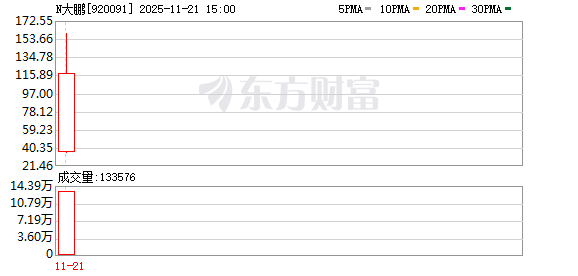
Core Insights - The recent debut of Dapeng Industrial on the Beijing Stock Exchange (BSE) saw an unprecedented surge, with an intraday high increase of over 16 times and a closing increase of 12.11 times, setting a new record for first-day gains of new stocks on the BSE [1][2] - The BSE new stock market is experiencing a significant uptick, driven by a surge in specialized and innovative enterprises going public, attracting substantial investment interest [1][4] - The pace of IPO approvals on the BSE has accelerated, with three companies passing the review on the same day, indicating a robust supply of new listings [4][6] Company Highlights - Dapeng Industrial is a leading manufacturer of specialized intelligent equipment for industrial precision cleaning, primarily serving the automotive sector, including major clients like BYD, Changan, and Geely [2][5] - The company has received multiple accolades, including being recognized as a national-level "specialized, refined, and innovative" enterprise and a "green factory" by the Ministry of Industry and Information Technology [2] - Other companies recently approved for IPO include Aide Technology, specializing in orthopedic medical devices, Tongling Technology, focusing on automotive interior parts, and Jingqiang Technology, a supplier of electromagnetic wire [5][6] Market Trends - The average first-day gain for new stocks on the BSE has been impressive, with six stocks surpassing a 500% increase, indicating a strong market appetite for new listings [3][4] - Analysts predict a normalization of IPO issuance, estimating around 40 new stocks to be launched by the end of the year, with a focus on high-quality growth companies [1][7] - The current market environment is characterized by a high-quality expansion phase, with a concentration on technology and advanced manufacturing sectors [8]

“变革破局 共生共赢——2025中国新能源产业高质量发展论坛”成功召开
Zhong Guo Jing Ying Bao· 2025-11-21 14:38
Core Insights - The Chinese renewable energy industry is transitioning from "scale expansion" to "quality improvement," emphasizing technological innovation, green development, and international cooperation as key drivers for future growth [1][2]. Industry Trends - The current cyclical adjustment in the renewable energy sector is seen as a necessary process for high-quality development, marking a shift from explosive growth to maturity [2]. - The photovoltaic industry exemplifies the challenges faced, particularly regarding the protection of innovation and intellectual property, which is crucial for long-term development [3]. - The low entry barriers and inadequate product value assessment in the photovoltaic sector have led to severe homogenization and price competition [3]. Technological Innovation - Technological innovation is identified as a critical tool for overcoming industry challenges, with a focus on integrating energy storage and new power systems to enhance competitiveness [4]. - The fuel cell vehicle market is expected to narrow the cost gap with traditional fuel vehicles through technological advancements and policy support, aiming for a 15% market penetration by mid-2025 [5]. - Smart manufacturing technologies are injecting new transformative power into the renewable energy sector, with advancements in robotics enhancing operational efficiency [6]. ESG Practices - ESG (Environmental, Social, and Governance) factors are becoming central to high-quality development in the renewable energy industry, with companies seeking to balance long-term sustainability goals with operational objectives [7][8]. - The importance of a comprehensive understanding of ESG issues is emphasized for better engagement with international clients, particularly in supply chain management [9]. Global Strategy - Companies are encouraged to rethink their international strategies, focusing on their unique strengths and avoiding overcrowded markets [10]. - The majority of global photovoltaic components are produced in China, which continues to leverage its technological and cost advantages to meet global energy transition demands [11].

热点追踪周报:由创新高个股看市场投资热点(第 220 期)-20251121
Guoxin Securities· 2025-11-21 12:41
- The report introduces a quantitative model named "250-day new high distance" to track market trends and identify hot spots. The model is based on momentum and trend-following strategies, emphasizing stocks that consistently hit new highs. The calculation formula is: $ 250\text{-day new high distance} = 1 - \frac{Close_{t}}{ts\_max(Close, 250)} $ where $ Close_{t} $ represents the latest closing price, and $ ts\_max(Close, 250) $ is the maximum closing price over the past 250 trading days. If the latest closing price reaches a new high, the distance equals 0; otherwise, it is a positive value indicating the degree of fallback [11][12][13] - The report evaluates the model positively, citing its ability to capture market leaders and trends effectively. It references studies by George (2004), William O'Neil, and Mark Minervini, which highlight the importance of tracking stocks near their 52-week highs for superior returns [11][18] - The report provides backtesting results for the "250-day new high distance" model across major indices as of November 21, 2025. The distances are: - Shanghai Composite Index: 4.83% - Shenzhen Component Index: 8.65% - CSI 300: 6.20% - CSI 500: 9.69% - CSI 1000: 7.59% - CSI 2000: 7.40% - ChiNext Index: 12.16% - STAR 50 Index: 16.45% [12][13][32] - The report introduces a factor named "Stable New High Stocks" to identify stocks with smooth price paths and sustained momentum. The factor construction involves: - Analyst attention: At least five buy or overweight ratings in the past three months - Relative strength: Top 20% in 250-day price change - Price stability: Ranking top 50% based on metrics like price displacement ratio and smoothness of 250-day new high distance over the past 120 days - Trend continuation: Ranking top 50 stocks based on the average 250-day new high distance over the past five days [24][27][28] - The report evaluates the "Stable New High Stocks" factor positively, citing research by Turan G Bali et al. (2011) and Da et al. (2012), which demonstrate the superior returns of stocks with smooth momentum paths compared to those with jumpy price movements [24][27] - Backtesting results for the "Stable New High Stocks" factor show 15 selected stocks, including Heertai, Sray New Materials, and Zangge Mining. These stocks are distributed across manufacturing and cyclical sectors, with manufacturing focusing on construction and cyclical sectors on non-ferrous metals [28][31][33]




热点追踪周报:由创新高个股看市场投资热点(第220期)-20251121
Guoxin Securities· 2025-11-21 11:03
Quantitative Models and Construction Methods 1. Model Name: 250-Day New High Distance Model - **Model Construction Idea**: This model tracks the distance of stock prices or indices from their 250-day high to monitor market trends and identify potential market leaders. It is based on the momentum and trend-following strategy, which has been proven effective in various studies[11][18]. - **Model Construction Process**: The 250-day new high distance is calculated as follows: $ 250 \text{-day new high distance} = 1 - \frac{\text{Close}_{t}}{\text{ts\_max(Close, 250)}} $ Where: - $\text{Close}_{t}$ represents the latest closing price - $\text{ts\_max(Close, 250)}$ represents the maximum closing price over the past 250 trading days If the latest closing price reaches a new high, the distance is 0. If the price has fallen from the high, the distance is a positive value, indicating the degree of decline[11]. - **Model Evaluation**: The model effectively identifies market trends and highlights stocks or indices that are leading the market, aligning with the principles of momentum and trend-following strategies[11][18]. 2. Model Name: Stable New High Stock Selection Model - **Model Construction Idea**: This model focuses on selecting stocks that exhibit stable price paths and consistent momentum, as smoother price trajectories are associated with stronger momentum effects[24][27]. - **Model Construction Process**: The selection process involves the following criteria: - **Analyst Attention**: At least 5 buy or overweight ratings in the past 3 months - **Relative Strength**: 250-day price change in the top 20% of the market - **Price Stability**: Stocks are ranked based on: - **Price Path Smoothness**: Ratio of price displacement to the total price path - **Sustainability of New Highs**: Average 250-day new high distance over the past 120 days - **Trend Continuity**: Average 250-day new high distance over the past 5 days The top 50 stocks based on these criteria are selected[24][27]. - **Model Evaluation**: The model emphasizes the importance of smooth price paths and consistent momentum, which are less likely to attract excessive attention and thus yield stronger returns[24][27]. --- Model Backtesting Results 1. 250-Day New High Distance Model - **Indices' 250-Day New High Distance**: - Shanghai Composite Index: 4.83% - Shenzhen Component Index: 8.65% - CSI 300: 6.20% - CSI 500: 9.69% - CSI 1000: 7.59% - CSI 2000: 7.40% - ChiNext Index: 12.16% - STAR 50 Index: 16.45%[12][13][32] 2. Stable New High Stock Selection Model - **Selected Stocks**: 15 stocks were identified, including Heertai, Sray New Materials, and Zangge Mining. - **Sector Distribution**: - Manufacturing: 5 stocks (e.g., construction industry) - Cyclical: 5 stocks (e.g., non-ferrous metals industry)[28][33] --- Quantitative Factors and Construction Methods 1. Factor Name: 250-Day New High Distance - **Factor Construction Idea**: This factor measures the relative distance of a stock's price from its 250-day high, serving as an indicator of momentum and trend strength[11]. - **Factor Construction Process**: The formula is: $ 250 \text{-day new high distance} = 1 - \frac{\text{Close}_{t}}{\text{ts\_max(Close, 250)}} $ Where: - $\text{Close}_{t}$ is the latest closing price - $\text{ts\_max(Close, 250)}$ is the maximum closing price over the past 250 trading days[11]. - **Factor Evaluation**: The factor effectively captures momentum and trend-following characteristics, making it a reliable indicator for identifying market leaders[11]. 2. Factor Name: Price Path Smoothness - **Factor Construction Idea**: This factor evaluates the smoothness of a stock's price trajectory, as smoother paths are associated with stronger momentum effects[24]. - **Factor Construction Process**: - Calculate the ratio of price displacement to the total price path over a specified period - Rank stocks based on this ratio and select the top performers[24]. - **Factor Evaluation**: The factor highlights stocks with stable momentum, which are less likely to attract excessive attention and thus yield stronger returns[24]. --- Factor Backtesting Results 1. 250-Day New High Distance Factor - **Indices' 250-Day New High Distance**: - Shanghai Composite Index: 4.83% - Shenzhen Component Index: 8.65% - CSI 300: 6.20% - CSI 500: 9.69% - CSI 1000: 7.59% - CSI 2000: 7.40% - ChiNext Index: 12.16% - STAR 50 Index: 16.45%[12][13][32] 2. Price Path Smoothness Factor - **Selected Stocks**: 15 stocks were identified, including Heertai, Sray New Materials, and Zangge Mining. - **Sector Distribution**: - Manufacturing: 5 stocks (e.g., construction industry) - Cyclical: 5 stocks (e.g., non-ferrous metals industry)[28][33]


由创新高个股看市场投资热点
量化藏经阁· 2025-11-21 09:18
Group 1 - The report tracks stocks, industries, and sectors that are reaching new highs, indicating market trends and hotspots [1][4][24] - As of November 21, 2025, the distance to the 250-day new high for major indices is as follows: Shanghai Composite Index 4.83%, Shenzhen Component Index 8.65%, CSI 300 6.20%, CSI 500 9.69%, CSI 1000 7.59%, CSI 2000 7.40%, ChiNext Index 12.16%, and STAR 50 Index 16.45% [5][24] - Among the CITIC primary industry indices, the sectors closest to their 250-day new highs include petroleum and petrochemicals, textiles and apparel, basic chemicals, home appliances, and steel [8][24] Group 2 - A total of 1,127 stocks reached a 250-day new high in the past 20 trading days, with the highest number of new highs in the basic chemicals, machinery, and power equipment and new energy sectors [2][13][24] - The highest proportion of new high stocks is found in the textiles and apparel, coal, and non-ferrous metals sectors, with respective proportions of 41.41%, 38.89%, and 38.71% [13][24] - The cyclical and manufacturing sectors had the most new high stocks this week, with 364 and 315 stocks respectively [15][24] Group 3 - The report identifies 15 stocks that have shown stable new highs, including Heertai, Sry New Materials, and Cangge Mining, with the manufacturing and cyclical sectors contributing the most stocks [3][20][25] - The construction industry had the highest number of new highs within the manufacturing sector, while the non-ferrous metals industry led in the cyclical sector [20][25]

宏观宽松预期叠加不确定性增强,有色行业整体表现亮眼 | 投研报告
Zhong Guo Neng Yuan Wang· 2025-11-21 03:02
Core Viewpoint - The report indicates a mixed outlook for the metals industry, with price fluctuations influenced by macroeconomic factors, supply disruptions, and changing monetary policies, particularly regarding interest rates [2][4][6]. Group 1: Lithium Prices - In the first three quarters of 2025, the average price of domestic battery-grade lithium carbonate (99.5% purity) and lithium hydroxide (56.5% purity) was 71,339.89 CNY/ton and 67,844.81 CNY/ton, respectively, representing year-on-year declines of 25.17% and 21.47% compared to the same period in 2024 [1][5]. - The price decline for lithium products has slowed in the first half of 2025, with a rebound observed in the third quarter, suggesting a potential turning point [5]. Group 2: Precious Metals - Precious metal prices have been supported by expectations of interest rate cuts, with gold prices experiencing a significant upward trend in the third quarter of 2025 [3][6]. - The overall labor market remains balanced despite a decline in non-farm employment, indicating potential economic weakness and rising inflation concerns, which further support precious metal prices [3]. Group 3: Industrial Metals - The third quarter of 2025 saw increased expectations for interest rate cuts, which provided support for industrial metal prices, particularly copper, amid supply disruptions from incidents like the Grasberg copper mine accident in Indonesia [4][6]. - The average price of LME copper in the first three quarters was 9,561.07 USD/ton, up 4.71% from 9,131.16 USD/ton in the same period of 2024, while LME aluminum prices rose by 8.44% [4]. Group 4: Energy Metals - The energy metals sector appears to have reached a bottom, with signs of a potential rebound following price declines in the first half of 2025 [5]. - The average price of cobalt in the first three quarters was 226,241.76 CNY/ton, reflecting a year-on-year increase of 6.78%, driven by a significant rebound in September [5]. Group 5: Investment Recommendations - The report suggests that despite uncertainties regarding interest rate cuts in December, the medium-term outlook for macroeconomic easing is strong, which will support non-ferrous metal prices [6]. - Companies to watch include Zijin Mining, Zhongjin Gold, Shandong Gold, Luoyang Molybdenum, Western Mining, Tongling Nonferrous Metals, Hailiang Co., Cangge Mining, Ganfeng Lithium, and Huayou Cobalt [6].






政策红利再加码!农业ETF(512620)今日上市,一键布局农业核心资产
2 1 Shi Ji Jing Ji Bao Dao· 2025-11-21 01:37
Group 1 - The A-share market saw a collective decline in the three major indices, with the agricultural sector showing strong performance in certain stocks, such as Luoniushan, which rose over 7% [1] - The newly launched Tianhong Agricultural ETF (512620) closely tracks the CSI Agricultural Index, covering sectors like breeding and agrochemicals, and includes leading agricultural companies such as Muyuan Foods and Wens Foodstuff Group [1] - The Ministry of Agriculture and Rural Affairs and the Xinjiang Uygur Autonomous Region government announced a plan to modernize agricultural facilities, aiming to renovate 30,000 acres and add 20,000 acres of modern agricultural production by the end of 2028 [1] Group 2 - Zhongjin Company highlighted that policy support and technological innovation will be key drivers for the future development of the planting industry chain, with a positive outlook on investment opportunities in leading agricultural enterprises [2] - The company believes that under the paradigm shift and the trend of stronger players becoming stronger, leading enterprises possess greater development potential [2]



能源金属板块11月20日涨0.09%,盛新锂能领涨,主力资金净流出2.68亿元
Zheng Xing Xing Ye Ri Bao· 2025-11-20 09:09
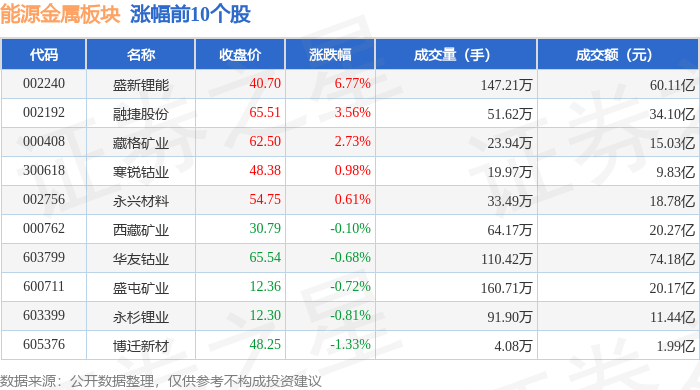
Core Insights - The energy metals sector experienced a slight increase of 0.09% on November 20, with Shengxin Lithium Energy leading the gains [1] - The Shanghai Composite Index closed at 3931.05, down 0.4%, while the Shenzhen Component Index closed at 12980.82, down 0.76% [1] Stock Performance - Shengxin Lithium Energy (002240) closed at 40.70, up 6.77% with a trading volume of 1.47 million shares and a transaction value of 6.01 billion [1] - Rongjie Co., Ltd. (002192) closed at 65.51, up 3.56% with a trading volume of 516,200 shares and a transaction value of 3.41 billion [1] - Cangge Mining (000408) closed at 62.50, up 2.73% with a trading volume of 239,400 shares and a transaction value of 1.50 billion [1] - Other notable stocks include Xiyang Mining (000762) down 0.10% and Huayou Cobalt (603799) down 0.68% [1] Capital Flow - The energy metals sector saw a net outflow of 268 million from institutional investors, while retail investors experienced a net outflow of 92.67 million [2] - Speculative funds recorded a net inflow of 360 million [2] Individual Stock Capital Flow - Shengxin Lithium Energy had a net inflow of 249 million from institutional investors, but a net outflow of 137 million from speculative funds [3] - Yongxing Materials (002756) saw a net inflow of 21.27 million from institutional investors and a net outflow of 32.85 million from retail investors [3] - Huayou Cobalt experienced a net outflow of 45.14 million from institutional investors, while speculative funds had a net inflow of 52.76 million [3]