古茗

Search documents
融资要有规划,别总想一口吃个胖子
Sou Hu Cai Jing· 2025-09-11 13:21
Core Insights - The article emphasizes the harsh realities of entrepreneurship, highlighting that many aspiring business owners focus too much on financing without understanding the foundational aspects of running a successful business [4][5][6]. Group 1: Entrepreneurial Challenges - Many entrepreneurs are influenced by successful figures like Jack Ma and Pony Ma, often overlooking the numerous failures that precede success [3][4]. - The concept of "survivorship bias" is discussed, indicating that only successful entrepreneurs are visible, while many others fail without recognition [4]. Group 2: Business Strategy - A case study of a Nantong entrepreneur seeking to open a new tea shop illustrates the importance of having a solid business model before pursuing financing [6][7]. - The entrepreneur's current operations include three stores with a monthly revenue of 200,000, but the focus should be on stabilizing and expanding to ten stores before seeking investment [6][7]. - Successful brands like Gu Ming and Nai Xue's Tea had significant store counts before their first financing rounds, emphasizing the need for a proven business model [7]. Group 3: Financial Management - The article suggests that entrepreneurs should consolidate their financials into a single entity to present a clear and compliant financial picture to banks, which can lead to easier access to loans [9]. - Building a comprehensive financial record, including procurement and customer data, is crucial for securing funding and supporting future expansion [9].


古茗(01364.HK)半年报点评:25H1收入及业绩端高增 单店GMV增长超20%
Ge Long Hui· 2025-09-10 22:12
Investment Highlights - The company reported a revenue of 5.66 billion yuan for H1 2025, representing a year-on-year increase of 41.2% [1] - Gross profit reached 1.79 billion yuan, also up by 41.0% [1] - Adjusted profit was 1.09 billion yuan, marking a 42.4% increase, with a significant adjustment item of 560 million yuan from financial liabilities fair value changes [1] - Adjusted core profit stood at 1.14 billion yuan, reflecting a 49.0% growth [1] Revenue Breakdown - Revenue from product equipment sales, franchise management services, and direct store sales were 450 million, 120 million, and 8 million yuan respectively, with year-on-year growth of 42%, 39%, and 14% [1] - Total GMV for H1 2025 reached 14.1 billion yuan, up 34.4% [1] - Average monthly GMV per store was 228,000 yuan, an increase of 20.6% [1] - Average daily cup sales per store were 439 cups, up 17.4% [1] Profitability Metrics - Gross margin remained stable at 31.5%, with an adjusted profit margin of 19.2%, up by 0.2 percentage points [1] - Sales, management, R&D, and financial expense ratios changed by -0.02, -0.4, -0.65, and +0.3 percentage points respectively [1] Store Expansion and Market Strategy - The total number of stores at the end of H1 2025 was 11,179, a 17.5% increase, with 1,570 new stores opened, up 105.2% [2] - 305 stores were closed, with the acceleration in store openings attributed to the recovery of the tea beverage market and strategic adjustments in store expansion [2] - The proportion of stores in second-tier cities and below was 81%, up 2 percentage points, while stores in townships accounted for 43%, up 4 percentage points [2] - The number of franchisees reached 5,875, a 22% increase, with an average of 1.9 stores per franchisee [2] Product Development and Membership Growth - A total of 52 new products were launched in H1 2025, including 16 new coffee products [2] - Over 8,000 stores are now equipped with coffee machines, and the company announced Wu Yanzu as the "Coffee Quality Partner" in June [2] - The number of registered members on the mini-program reached approximately 178 million, with about 50 million active members in Q2 [2] Logistics and Supply Chain - The company has established a leading self-owned cold chain storage and logistics system, with 22 warehouses and a cold storage capacity exceeding 61,000 cubic meters [2] - The fleet consists of 362 self-owned transport vehicles, with approximately 75% of stores located within a 150 km radius of warehouses [2] - About 98% of stores can receive cold chain delivery within two days, with delivery costs accounting for less than 1% of GMV [2] Future Outlook - The company expects rapid growth in same-store sales and forecasts net profits of 2.6 billion, 2.5 billion, and 3 billion yuan for 2025-2027, corresponding to PE ratios of 18, 19, and 16 times [2] - Adjusted net profits are projected to be 2.1 billion, 2.6 billion, and 3.1 billion yuan, with year-on-year growth rates of 38%, 22%, and 18% respectively [2]
古茗(01364):财报点评:25H1收入及业绩端高增,单店GMV增长超20%
East Money Securities· 2025-09-10 11:42
Investment Rating - The report assigns an "Add" rating for the company, marking its first coverage [5]. Core Insights - The company reported a significant revenue increase of 41.2% year-on-year for the first half of 2025, reaching 5.66 billion RMB, with adjusted profit rising by 42.4% to 1.09 billion RMB [4][5]. - The total GMV for the first half of 2025 was 14.1 billion RMB, reflecting a growth of 34.4%, with average monthly GMV per store increasing by 20.6% to 228,000 RMB [4]. - The company opened 1,570 new stores in the first half of 2025, a 105.2% increase, bringing the total number of stores to 11,179, indicating a strong expansion strategy [4]. Financial Performance - The gross profit for the first half of 2025 was 1.79 billion RMB, maintaining a gross margin of 31.5% [4]. - The adjusted core profit for the same period was 1.14 billion RMB, showing a 49.0% increase year-on-year [4]. - The company expects net profit for 2025 to reach 2.615 billion RMB, with a projected PE ratio of 18 times [5]. Growth Projections - Revenue is projected to grow from 8.79 billion RMB in 2024 to 17.33 billion RMB by 2027, with a compound annual growth rate (CAGR) of 16.90% [6][11]. - The net profit is expected to increase from 1.48 billion RMB in 2024 to 2.98 billion RMB in 2027, with a notable growth rate of 76.89% in 2025 [6][11]. Market Position - The company has established a leading self-owned cold chain storage and logistics system, with 22 warehouses and a cold storage capacity exceeding 61,000 cubic meters [4]. - Approximately 75% of the stores are within a 150 km radius of the warehouses, allowing for efficient cold chain delivery services [4].
外卖补贴“散场”,七大品牌550亿元营收背后,茶饮咖啡高增长如何“续杯”?
Mei Ri Jing Ji Xin Wen· 2025-09-10 11:41
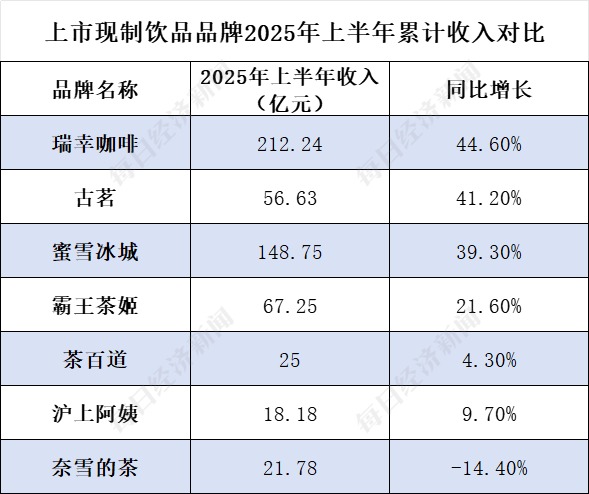
Core Insights - The recent subsidy war among food delivery platforms has significantly impacted the ready-to-drink beverage market, leading to a temporary surge in sales but raising questions about the sustainability of this growth [1][6][9] Industry Overview - The ready-to-drink tea and coffee sector has seen a dramatic price drop, with many brands offering products below 10 yuan due to aggressive subsidies [2][7] - Major brands like Luckin Coffee, Gu Ming, and Mi Xue Bing Cheng reported substantial revenue increases in the first half of 2025, with total revenue reaching 550 billion yuan, a year-on-year increase of 135 billion yuan [1][3][4] Financial Performance - Luckin Coffee reported a net income of 212.24 billion yuan, a 44.6% increase year-on-year, while Gu Ming achieved 56.63 billion yuan in revenue, up 41.2% [3][4] - Other brands also showed growth, with Mi Xue Bing Cheng at 148.75 billion yuan (39.3% increase) and Ba Wang Cha Ji at 67.25 billion yuan (21.6% increase) [4] Market Dynamics - The rapid expansion of store numbers has been a key driver of revenue growth, with Mi Xue Bing Cheng adding over 5,700 stores in the first half of the year [5][8] - The reliance on subsidies has raised concerns about the long-term viability of sales growth, as many brands may struggle to maintain performance without these incentives [5][7] Regulatory Environment - The State Administration for Market Regulation has indicated a focus on monitoring the competitive landscape of the food delivery industry, emphasizing the need for quality service and fair pricing [1][6] - The regulatory body has urged platforms to control subsidies to avoid disrupting the normal pricing structure, which could lead to a decline in consumer demand once subsidies are removed [6][7] Strategic Shifts - Brands are beginning to shift focus towards in-store sales and improving operational efficiency to mitigate the impact of fluctuating delivery orders [8] - There is a growing consensus among leading brands to enhance digital operations and supply chain management to better meet consumer demands and improve profitability [8][9]

消费行业联合行业深度:十五五系列报告解读(51页附下载)
Sou Hu Cai Jing· 2025-09-10 11:41
Core Insights - The importance of the "14th Five-Year Plan": The upcoming "14th Five-Year Plan" is expected to significantly impact China's economic and social development over the next five years, shifting focus from production to a balance between production and consumption due to the current issue of insufficient effective demand [1] - Strengthening consumption policies: Starting in 2024, consumption policies will be significantly enhanced, including the allocation of special government bond funds to support consumption upgrades. Continued funding is expected in 2025 and 2026 [1] - Potential of service consumption: China's service consumption still lags behind developed economies, indicating a substantial opportunity for growth in this sector to stimulate consumer interest and optimize the consumption environment [1] - Rise of technology consumption: With a rapid technological development and an engineering talent surplus, products like robotic vacuum cleaners and drones are gaining market attention, likely creating new consumer demand [1] - Optimization of the overall consumption mechanism: Measures such as consumption tax reform will encourage local governments to transition from production-oriented to service-oriented, promoting the internationalization of quality consumption companies and enhancing residents' consumption capacity [1] Investment Recommendations - Food and Beverage: Recommended companies include Dongpeng Beverage and Lihigh Food, with a focus on Youran Dairy and Bairun Co [2] - Service Sector: Recommended companies include Guming, Mixue Group, and Bubugao, with a focus on Zhongsheng Holdings [2] - Light Industry: Companies to watch include Hengfeng Paper and Xilinmen [3] - Trendy Toys: Recommended companies include Pop Mart and Blokus [4] - Home Appliances: Recommended companies include Midea Group, Haier Smart Home, TCL Electronics H, Roborock, and Ecovacs, with a focus on Yingshi Innovation [5] - Agriculture: Recommended companies include Zhongchong Co, Petty Co, Muyuan Foods, and Haida Group [11] - Textile and Apparel: Recommended companies include Anta Sports, Xtep International, 361 Degrees, and Hailan Home, with a focus on Li Ning and Sanfu Outdoor [11] Report Content Analysis - Expanding consumption share: The report emphasizes that expanding consumption share is essential for achieving Chinese-style modernization, as China's consumption rate is significantly lower than that of developed countries [9] - Shift in fiscal spending: During the "14th Five-Year Plan" period, fiscal spending will shift from material investments to human capital investments, increasing support for education, healthcare, and housing [9] - Promotion of common prosperity: The report highlights the need for income distribution reform and the promotion of the Zhejiang common prosperity model to achieve balanced development [9] - Consumption tax reform: The report suggests that consumption tax reform will help local governments transition from production-oriented to service-oriented, enhancing the consumption environment [9] - Transition from traditional to new consumption: The report analyzes the maturation of traditional consumption markets and the rise of new consumption, which is characterized by a focus on quality and personal satisfaction [9] - Stimulating interest in service consumption: The report indicates that the shift from physical to service consumption is crucial for expanding domestic demand, with growing demand for events and performances benefiting local consumption [9]






产业观察丨外卖补贴“散场”,七大品牌550亿元营收背后,茶饮咖啡高增长如何“续杯”?
Mei Ri Jing Ji Xin Wen· 2025-09-10 11:14
Core Viewpoint - The recent subsidy war among food delivery platforms has significantly impacted the ready-to-drink beverage market, leading to a surge in sales for various brands, but the sustainability of this growth is in question as regulatory scrutiny increases [1][5][9]. Industry Overview - The competition in the ready-to-drink beverage sector intensified during the summer, with major platforms like Meituan, Alibaba, and JD.com engaging in aggressive subsidy strategies, resulting in a chaotic pricing environment where many drinks were sold for as low as a few yuan or even for free [1][5]. - The market regulator has expressed concerns over the impact of these subsidies on the normal pricing system and has called for improved service quality and food safety [1][9]. Financial Performance - In the first half of 2025, seven listed beverage brands reported a combined revenue of 55 billion yuan, an increase of 13.5 billion yuan year-on-year [1]. - Luckin Coffee reported a net income of 21.22 billion yuan, a 44.6% increase year-on-year, while other brands like Gu Ming and Mi Xue Ice City also saw significant revenue growth [6][7]. Growth Drivers - The revenue growth for these brands is attributed not only to subsidies but also to factors such as store expansion and improved single-store efficiency [8]. - Mi Xue Ice City added over 5,700 new stores in the first half of the year, with a significant portion located in lower-tier cities [8][12]. Challenges Ahead - Analysts express skepticism about the sustainability of the sales growth driven by subsidies, suggesting that a return to normal pricing could lead to a sharp decline in order volumes [10][12]. - The heavy reliance on delivery subsidies has raised concerns about the long-term health of franchise operations, as many orders have shifted from dine-in to delivery, impacting profitability [10][12]. Strategic Shifts - In response to the changing landscape, brands are focusing on enhancing in-store dining experiences and optimizing operational efficiency to mitigate the impact of fluctuating delivery volumes [12]. - Companies are also exploring international markets and enhancing digital operations to better understand consumer needs and improve supply chain efficiency [12][13].
茶饮“五剑客”,半年狂揽316亿
创业邦· 2025-09-10 10:31
Core Viewpoint - The article discusses the significant revenue growth of five major tea beverage brands in China, collectively referred to as the "Five Swordsmen," driven by the ongoing competition in the food delivery market, resulting in increased sales and profits for these companies in the first half of 2025 [5][8]. Revenue Growth - The five tea beverage companies, including Nai Xue's Tea, Mi Xue Ice City, Gu Ming, Ba Wang Tea Ji, and Cha Bai Dao, achieved a total revenue of approximately 316 billion yuan, an increase of 73 billion yuan compared to the previous year, representing a year-on-year growth of 30.12% [5][8]. - Mi Xue Ice City remains the largest player with a revenue of 148.75 billion yuan, growing by 39.3% year-on-year, while Gu Ming experienced the fastest growth at 41.2%, reaching 56.63 billion yuan [8][10]. Profitability - The five brands collectively recorded a net profit of 55.6 billion yuan, an increase of 13.76 billion yuan from the previous year, marking a year-on-year growth of 32.89% [15][18]. - Mi Xue Ice City reported the highest profit of 26.93 billion yuan, with a year-on-year increase of 42.9%, while Gu Ming's profit surged by 121.5% to 16.25 billion yuan [15][18]. Market Dynamics - The article highlights that the tea beverage sector is particularly well-suited for the food delivery model due to stable output and competitive pricing, which encourages impulsive purchases [10][11]. - The growth in revenue is attributed to both increased sales of materials and the opening of new stores, with Mi Xue Ice City and Gu Ming exemplifying this dual approach [11][18]. Future Strategies - As the food delivery competition is expected to normalize, companies are focusing on improving operational efficiency at individual stores and exploring opportunities in both overseas and lower-tier markets [22][26]. - Ba Wang Tea Ji is looking to expand internationally, having recently entered the Philippine market, while Mi Xue Ice City is increasing its presence in lower-tier cities, with 57.6% of its stores located in these areas [23][26].
外卖大战下,打不垮的“夫妻店”|一线
吴晓波频道· 2025-09-08 00:30
Core Viewpoint - The article discusses the impact of the recent food delivery war on small and micro businesses, highlighting the decline in profit margins and the challenges faced by local eateries amidst aggressive competition from major platforms [2][3][7]. Group 1: Market Dynamics - The food delivery market has significantly expanded, with daily orders from major platforms reaching 250 million, up from 80 million before the competition intensified [4]. - Major platforms like Meituan, JD, and Alibaba reported a combined profit drop of over 20 billion yuan in the second quarter, with net profits down 89%, 50.8%, and 18% respectively [3][5]. - The competition has led to a substantial increase in user engagement, with Taobao's flash purchase orders peaking at 12 million daily and Meituan maintaining a dominant market share with over 15 million daily orders [5]. Group 2: Impact on Small Businesses - Small and micro businesses, particularly those with low average transaction values, have seen profit margins decline by 7.2% overall, with those under 20 yuan experiencing a 12.61% drop [7][10]. - Community-based eateries, often family-run, are struggling as consumer preferences shift towards cheaper delivery options, leading to a decrease in foot traffic and profitability [12][13]. - Many small business owners report that participation in delivery services often results in losses, as they are forced to subsidize delivery costs while receiving only half the profit compared to dine-in orders [15][16]. Group 3: Survival Strategies - Some small businesses have adapted by focusing on enhancing the dine-in experience, using delivery as a supplementary channel rather than a primary revenue source [21][26]. - Successful examples include eateries that maintain a strong local presence and customer loyalty by offering unique dining experiences and quality service, which helps convert delivery customers into dine-in patrons [26][31]. - The article suggests that the future of small eateries may involve either enhancing dine-in experiences or embracing retail trends, similar to successful models seen in Japan and Singapore [34][39][43].




2025年第35周:食品饮料行业周度市场观察
艾瑞咨询· 2025-09-08 00:06
Group 1 - The article discusses the trend of tea brands entering the coffee market, highlighting the rapid growth of the coffee sector in China, which is expected to reach a trillion yuan by 2025. Brands like Cha Yan Yue Se and Mi Xue Bing Cheng are launching coffee products to capture this market [3] - The resurgence of iced tea is noted, with brands like Nongfu Spring and Yuanqi Forest introducing new products that emphasize health and low sugar content. The iced tea market, traditionally dominated by brands like Master Kong, is seeing new entrants aiming to disrupt the status quo [4] - The rise of street vendors is impacting traditional restaurants, as low-cost and convenient options attract consumers. This shift is supported by policy changes and market dynamics, leading to a more diverse food service ecosystem [5] Group 2 - The decline of sugary beverages is evident, with health-conscious products gaining popularity among younger consumers. Yuanqi Forest's new health-focused product line has seen significant growth, indicating a shift towards traditional health concepts in beverage innovation [6] - Instant drink brands like Xiangpiaopiao are facing challenges as consumer preferences shift towards fresh and convenient options. Despite attempts to diversify, these brands struggle to maintain relevance in a rapidly evolving market [7] - The emergence of hard discount retailing in China is reshaping the market, with retailers focusing on high-quality, low-cost products. This model emphasizes supply chain optimization and has gained traction among consumers seeking value [9] Group 3 - Nongfu Spring has achieved a significant milestone by ranking third in the global soft drink brand value list, driven by its dual-engine strategy of water and beverages, and a strong health positioning [10][11] - Master Kong is redefining instant noodles by focusing on consumer satisfaction and product innovation, achieving revenue growth through a diversified product matrix [12] - New product launches in the health beverage sector, such as Panpan's jasmine tea and Yiwei's new yogurt drinks, reflect a growing consumer interest in health-oriented products [13][14] Group 4 - Mengniu's collaboration with popular IPs like Nezha has proven successful, with significant sales figures indicating effective engagement with younger consumers through innovative marketing strategies [15] - The rapid expansion of brands like Mr. Ice Cream, which focuses on high-quality, handmade ice cream, highlights the competitive landscape in the dessert market [16] - Wahaha's investment in a new beverage production facility in Xi'an aims to enhance its production capabilities and market presence, leveraging the region's established food and beverage ecosystem [17] Group 5 - The beverage market is witnessing a shift towards health and unique flavor experiences, with brands like Reesun Yogurt innovating to meet consumer demands for fresh and diverse products [18] - McDonald's has reported strong performance in China, with plans for aggressive expansion and a focus on local sourcing to enhance its supply chain efficiency [19] - The success of community-focused dining concepts, such as Xiong Daye's handmade dumplings, illustrates the growing trend of personalized and culturally rich food experiences [20] Group 6 - The traditional tea brand Wu Yutai is diversifying into the bakery and coffee market, showcasing a trend of established brands exploring new culinary territories [21] - Yanjing Beer is focusing on premiumization and expanding its product offerings, while also experimenting with low-cost beverage options to create new revenue streams [23] - Huangshanghuang's acquisition of a controlling stake in Lixing Food aims to enhance its product portfolio in the freeze-dried food sector, indicating a strategic move towards emerging market opportunities [24] Group 7 - Chongqing Beer is adapting its strategy by increasing its online presence and expanding into non-alcoholic beverages, reflecting a broader trend in the beverage industry towards diversification and innovation [25] - Huangshi Group is focusing on the water buffalo milk sector, leveraging technological advancements and strategic investments to strengthen its market position [27]





外卖补贴热度退去,茶饮增长何以为继?
Sou Hu Cai Jing· 2025-09-07 16:22
Core Insights - The tea beverage industry must seek new growth avenues as reliance on delivery subsidies diminishes [2][4] - Despite the external challenges, several tea brands reported significant growth in their financial results, contrasting with the declining profits of major delivery platforms [5][6][10] Group 1: Impact of Delivery Subsidies - The delivery subsidy war has significantly boosted user demand for tea brands, with Luckin Coffee reporting a 31.6% year-on-year increase in average monthly transaction customers, reaching 91.7 million [5][6] - Luckin Coffee's GMV for Q2 reached 14.2 billion yuan, a 46.2% year-on-year increase, while net income rose to 12.359 billion yuan, marking a 47.1% increase [6] - Other brands like Gu Ming also experienced substantial growth, with a 121.5% year-on-year increase in net profit, reaching 1.625 billion yuan [8] Group 2: Challenges Post-Subsidy - The sustainability of high order volumes for tea beverages is in question as delivery subsidies fade, raising concerns about the operational viability of newly opened stores [4][18] - Brands like Nayuki Tea have faced declines in revenue, with a 14.4% year-on-year drop, despite a significant contribution from delivery orders [10] - The rapid expansion of store numbers has led to increased competition and operational challenges, as seen with Ba Wang Tea Ji, which reported a 1.5% decline in GMV [10][21] Group 3: Market Dynamics and Strategies - The delivery subsidy war has intensified competition among major platforms, with significant investments from JD, Meituan, and Alibaba to attract consumers [13][15] - Tea brands have adopted various strategies to leverage seasonal demand, including launching new products and optimizing supply chains [12][18] - The industry is exploring new growth avenues, such as expanding product lines and international markets, with brands like Luckin and Mi Xue Bing Cheng leading overseas expansion efforts [22][24][25]