
华海清科

Search documents
黄仁勋警告台积电:必须翻倍产能!
是说芯语· 2026-02-02 23:56
Core Viewpoint - The semiconductor industry is facing unprecedented demand for advanced process wafers driven by AI model training, necessitating significant capacity expansion from TSMC to meet the needs of companies like NVIDIA [1][4]. Group 1: NVIDIA's Demand and TSMC's Response - NVIDIA's CEO Jensen Huang emphasized the urgent need for TSMC to double its advanced process wafer production to meet the explosive demand for AI training and inference chips, predicting a potential growth of over 100% in TSMC's capacity over the next decade [1][4]. - Huang estimated that NVIDIA will require approximately 1 million advanced process wafers annually by 2035, while TSMC's current monthly capacity for 12-inch wafers is about 1.5 million, with only 500,000 at advanced nodes [3][4]. Group 2: TSMC's Capital Expenditure Plans - In response to Huang's call for increased production, TSMC has raised its capital expenditure for 2026-2030 to $100 billion, a 30% increase from previous plans, focusing on expanding 3nm capacity at Fab 20, building a 2nm line at Fab 22, and establishing advanced processes at Fab 21 in Arizona [4][5]. - Despite this significant investment, TSMC's plans still fall short of NVIDIA's demand projections, indicating a growing supply-demand gap in the semiconductor market [4]. Group 3: Opportunities for Chinese Semiconductor Companies - TSMC's expansion efforts are creating unprecedented opportunities for domestic semiconductor equipment and materials manufacturers in China, with companies like AMEC and North Huachuang entering TSMC's procurement lists for new equipment [5]. - The expansion is expected to generate a procurement demand in the hundreds of billions, as Chinese firms make technological breakthroughs in specific segments, positioning them as key players in this capacity race [5][6]. Group 4: Global Semiconductor Landscape Transformation - Huang's warnings signal the beginning of a global semiconductor "computing power arms race," necessitating a complete restructuring of the supply chain to meet the surging demand for AI chips [6]. - The competition will span all aspects of the semiconductor industry, from equipment manufacturers to material suppliers, and will determine which companies can capitalize on the AI computing power era's opportunities [6].


华海清科:关于以集中竞价交易方式回购公司股份的进展公告
Zheng Quan Ri Bao· 2026-02-02 13:45
Group 1 - The company, Huahai Qingke, announced a share buyback of 441,120 shares, which represents 0.1247% of its total share capital [2]

AI需求持续引领,先进晶圆代工有望大放异彩
CAITONG SECURITIES· 2026-02-02 10:52
Investment Rating - The report maintains a "Positive" investment rating for the semiconductor industry [1]. Core Insights - The demand for AI-related chips is driving significant growth in the wafer foundry sector, with TSMC's revenue reaching NT$1.05 trillion in Q4 2025, a 20.45% year-on-year increase, marking a historical high for a single quarter [6][8]. - The global advanced process capacity is expected to accelerate, with SEMI predicting that the capacity for 7nm and below advanced logic processes will grow from approximately 850,000 wafers per month in 2024 to 1.4 million wafers per month by 2028 [6][12]. - Domestic companies in China need to accelerate their technological upgrades and capacity expansions to catch up with global leaders like TSMC and Samsung, as their market share in advanced processes remains significantly low [6][11]. - The import of semiconductor manufacturing equipment in China is projected to reach a historical high of CNY 360.28 billion in 2025, indicating a strong signal for accelerated capacity expansion in advanced processes [12][13]. - The report suggests focusing on semiconductor companies such as Northern Huachuang, Zhongwei Company, Jiangfeng Electronics, and others for investment opportunities [6]. Summary by Sections 1. Global Advanced Process Wafer Foundry Development - AI computing chip demand is propelling the wafer foundry industry to new heights, with TSMC's revenue growth and a projected global wafer foundry market size increase from USD 155.6 billion in 2024 to USD 268.3 billion by 2032 [6][8]. - The complexity and larger size of AI GPU chips require more advanced process capacity, leading to a higher demand for wafer foundry services [8][9]. 2. Domestic Market in China - China's wafer foundry industry has seen rapid expansion in mature processes, but advanced process capacity and technology development face significant challenges due to export restrictions from Western countries [9][11]. - In 2021, China's share in the global advanced process wafer foundry market was only 5%, highlighting the need for further development [11]. 3. Semiconductor Equipment Imports - The import of semiconductor equipment in China is expected to reach CNY 360.28 billion in 2025, with significant investments in critical lithography equipment [12][13]. - ASML's revenue from lithography systems is projected to be EUR 24.474 billion in 2025, with 33% of that coming from the Chinese market, indicating strong demand for advanced manufacturing equipment [12][13].

华海清科(688120) - 关于以集中竞价交易方式回购公司股份的进展公告
2026-02-02 09:16
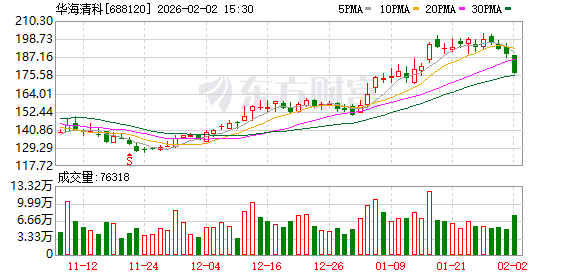
证券代码:688120 证券简称:华海清科 公告编号:2026-005 华海清科股份有限公司 关于以集中竞价交易方式回购公司股份的进展公告 截至 2026 年 1 月 31 日,公司通过上海证券交易所交易系统以集中竞价交易 方式回购公司股份 441,120 股,占公司总股本 353,651,991 股的比例为 0.1247%, 回购成交的最高价为 156.96 元/股,最低价为 127.30 元/股,支付的资金总额为 人民币 60,224,451.49 元(不含交易佣金等费用)。 本次回购符合相关法律法规的规定和公司回购股份方案的要求。 | 回购方案首次披露日 | 2025/8/29 | | --- | --- | | 回购方案实施期限 | 2025 年 9 月 17 日~2026 年 9 月 16 日 | | 预计回购金额 | 5,000万元~10,000万元 | | 回购用途 | □减少注册资本 √用于员工持股计划或股权激励 √用于转换公司可转债 | | 累计已回购股数 | □为维护公司价值及股东权益 441,120股 | | 累计已回购股数占总股本比例 | 0.1247% | | 累计已回购金额 | 6 ...
华海清科(688120.SH):已回购0.1247%公司股份
Ge Long Hui A P P· 2026-02-02 09:15
格隆汇2月2日丨华海清科(688120.SH)公布,截至2026年1月31日,公司通过上海证券交易所交易系统以 集中竞价交易方式回购公司股份441,120股,占公司总股本的比例为0.1247%,回购成交的最高价为 156.96元/股,最低价为127.30元/股,支付的资金总额为人民币60,224,451.49元(不含交易佣金等费 用)。 ...
大盘承压,资金逆势布局半导体设备板块,半导体设备ETF易方达(159558)盘中净申购约2000万份
Mei Ri Jing Ji Xin Wen· 2026-02-02 07:02
2月2日,市场震荡调整,半导体板块跟随大盘回调。截至14:10,中证半导体材料设备主题指数下跌 3.7%。Wind数据显示,多只半导体设备相关ETF盘中获资金加仓,其中半导体设备ETF易方达 (159558)净申购约2000万份。 中证半导体材料设备主题指数聚焦半导体设备与半导体材料领域,根据申万三级行业分类,指数半导体 设备占比超60%,半导体材料占比约20%,权重股覆盖中微公司、北方华创、拓荆科技、长川科技、华 海清科等行业龙头,在国产化趋势中具备较强弹性,投资者可通过半导体设备ETF易方达(159558)等 跟踪该指数的产品一键把握产业发展机遇。 (文章来源:每日经济新闻) 国泰海通证券指出,ASML去年第四季度新增订单额飙升至132亿欧元,达市场预期近两倍;KLA同期 总收入32.97亿美元,同比增长7.2%,均反映AI驱动下设备订单爆发式增长与客户扩产升级的强劲动 能。设备订单高增与业绩指引上修共同确认半导体设备行业已进入强劲上升通道,为上游国产设备厂商 提供明确需求支撑。 ...
电子行业点评:海力士发布FY25Q4财报,周期上行推动业绩创新高
Ping An Securities· 2026-02-02 03:12
Investment Rating - The industry investment rating is "Outperform the Market," indicating that the industry index is expected to perform better than the market by more than 5% over the next six months [9]. Core Insights - SK Hynix reported record performance in FY25Q4, with revenue reaching 32.8 trillion KRW, a year-on-year increase of 66% and a quarter-on-quarter increase of 34%. Net profit for the quarter was 15.25 trillion KRW, up 90% year-on-year and 21% quarter-on-quarter [4][7]. - The storage cycle is on the rise, driven by sustained high demand from AI, leading to rapid growth in the company's operating performance. For FY2025, the company achieved revenue of 97.1 trillion KRW and operating profit of 47.2 trillion KRW, marking its best performance record [7]. - The company is expanding its production capacity, with ongoing projects in Cheongju, South Korea, and Indiana, USA, to create a global integrated manufacturing system that can quickly adapt to changes in downstream customer demand [6]. Summary by Sections Financial Performance - In FY25Q4, SK Hynix's revenue was 32.8 trillion KRW, with a gross margin of 69%, operating margin of 58%, and net margin of 46% [7]. - The DRAM segment saw a low single-digit growth in bit shipments, with an average selling price (ASP) increasing by over 20%. The sales of HBM doubled year-on-year, significantly contributing to revenue growth [7]. - NAND bit shipments grew approximately 10% quarter-on-quarter, with ASP increasing nearly 30%. The company achieved a historical high in annual sales due to strong demand for eSSD [7]. Market Outlook - The ongoing AI infrastructure development is expected to boost enterprise storage demand, leading to a favorable market environment for the storage industry. The current storage cycle's strength and sustainability are anticipated to exceed the previous cycle [8]. - Companies in the related supply chain are expected to see significant improvements in profitability, with a focus on firms such as Northern Huachuang, Zhongwei Company, and others [8].
日媒:中国芯片制造设备加速发展
Huan Qiu Wang· 2026-02-01 22:52
Group 1 - The core viewpoint of the article highlights the significant rise of Chinese semiconductor manufacturing equipment suppliers in the global market, driven by U.S. export control measures, with three Chinese companies expected to enter the top 20 global semiconductor equipment suppliers by 2025 [1] - According to data from Global Net, in 2022, only one Chinese company was listed among the top semiconductor equipment suppliers, while by 2025, North Huachuang, Zhongwei Company, and Shanghai Micro Electronics Equipment Company will rank 5th, 13th, and 20th respectively [1] - The report indicates that if the ranking is extended to the top 30, two more Chinese companies, Shengmei Semiconductor and Huahai Qingke, would be included [1] Group 2 - The production of advanced semiconductor equipment involves over a thousand processes, and Chinese companies are now capable of covering all process stages, including deposition, etching, and cleaning [2] - The domestic production rate of semiconductor equipment in China has increased to 20%-30%, up from approximately 10% three years ago, indicating rapid growth [2] - The semiconductor equipment sales in China are projected to grow by 35% year-on-year in 2024, reaching $49.5 billion, making it the largest market globally [2] - The Chinese semiconductor industry is currently experiencing a golden development period driven by policies, market dynamics, technology, and capital, with emerging sectors like AI computing, new energy vehicles, data centers, and industrial internet further enhancing the industry [2]


1→3!“美国出口限制下,更多中企跻身全球芯片设备制造商20强”
Guan Cha Zhe Wang· 2026-01-31 08:23
Core Viewpoint - By 2025, three Chinese companies are expected to be among the top 20 global semiconductor equipment manufacturers, a significant increase from one company before the U.S. export restrictions in 2022, indicating rapid growth in China's semiconductor industry [1]. Group 1: Company Rankings and Growth - North Huachuang Technology Group has risen from 8th place in 2022 to 5th place in 2025, following major global players like ASML, Applied Materials, and Lam Research [1]. - New entrant, Zhongwei Semiconductor Equipment (Shanghai) Co., Ltd., ranked 13th, with its core etching equipment reportedly used in 5nm chip production, indicating proximity to global advanced levels [1]. - Shanghai Micro Electronics Equipment (Group) Co., Ltd. (SMEE) ranks 20th, primarily producing photolithography equipment, which is crucial for chip performance [3]. Group 2: Industry Trends and Investments - China is increasing its investment in semiconductor self-sufficiency through national funds and local government support, leading to a rapid rise in the number of equipment manufacturers [3]. - Currently, 20% to 30% of semiconductor equipment is manufactured domestically in China, a significant increase from about 10% three years ago [3]. - The advanced semiconductor manufacturing process involves over 1,000 steps, with Chinese companies now capable of covering all process stages, including deposition, etching, and cleaning [3]. Group 3: Market Dynamics and Future Projections - The Chinese semiconductor equipment market is projected to grow by 35% year-on-year in 2024, reaching $49.5 billion, making it the largest market globally [4]. - ASML's revenue from China is expected to decrease from 33% in 2025 to 20% in 2026 due to U.S. export restrictions, indicating a shift in market dynamics [5]. - Chinese companies are striving to overcome challenges in photolithography technology, with efforts focused on developing extreme ultraviolet (EUV) lithography and utilizing deep ultraviolet (DUV) technology to bypass restrictions [5].

从算力到端侧:AI硬件景气上行 端侧AI成2026年主线
Ge Long Hui· 2026-01-29 07:13
Group 1 - The demand for AI computing power is continuously rising, driven by the needs of AI inference and related hardware supply-demand imbalances [1] - In the semiconductor upstream foundry and packaging sectors, foundries are raising prices for certain mature process foundry services due to increased AI-related power demand and production cuts by major manufacturers [2] - The storage industry is projected to reach a value of $551.6 billion by 2026, with a year-on-year growth of 134%, driven by AI [2] Group 2 - Domestic computing power hardware is making significant technological breakthroughs, with companies like Cambrian, Haiguang Information, and Moore Threads emerging in the computing chip sector [3] - In the packaging field, domestic manufacturers are advancing in advanced packaging technologies, with Changdian Technology achieving important progress in optoelectronic packaging [3] - AI is expected to accelerate its integration into various hardware products and industrial scenarios by 2026, creating investment opportunities across the industry chain [4] Group 3 - Investment targets in AI computing-related hardware include foundry manufacturers like SMIC and Hua Hong Semiconductor, and semiconductor equipment companies such as Zhongwei Company and Northern Huachuang [5] - In the end-user storage sector, companies like Zhaoyi Innovation and Baiwei Storage are highlighted, along with terminal manufacturers such as Hikvision, Lenovo Group, and Xiaomi Group [6]