
欧莱雅集团

Search documents
盘后一度跌6%!欧莱雅Q3销售又逊预期,中国高奢需求复苏但北美逊色
美股IPO· 2025-10-22 00:08
三季度欧莱雅同店销售增长4.2%,连续两季低于分析师预期;北亚地区同店销售大逆转,由二季度下降近9%转为增长近5%,在中国大陆实现中等个位 数增长,得益于高端护肤市场复苏;北美同店增速由二季度的超8%放缓至1.4%,远逊分析师预期增速4.4%。财报公布后,盘中曾涨2%的欧莱雅美股转 跌,一度跌超6%。 至此,欧莱雅已连续两个季度的销售额和同店销售增长逊于预期。三季度北美市场表现最为逊色。欧莱雅暗示北美的业绩部分受到去年IT系统调整影 响。虽然欧莱雅未提及美国三季度对进口欧盟化妆品征收15%的关税影响,欧莱雅在美国市场销售的产品中,约有30%来自进口。 欧莱雅在财报中指出,中国大陆和北美的业绩持续复苏推动了今年前三季集团增长。其表示,今年前三个季度,在中国等北亚地区的同店销售增长 0.5%,为两年来首次录得正增长,增速超过市场平均水平。 财报公布后,临近美股午盘时曾涨约2%的欧莱雅美股粉单盘中跳水,迅速转跌,短短5分钟左右,盘中跌幅扩大到5%以上,此后进一步下挫,美股尾 盘刷新日低至86.33美元时,日内跌6.4%,最终收跌逾5.1%。 三季度北亚地区同店销售大逆转 北美增速超预期放缓 分地区看,三季度欧莱雅在 ...

带给跨国企业面向未来的更优选择
Ren Min Ri Bao· 2025-10-21 22:20
Group 1: Global Business Engagement - Entrepreneurs from 17 countries gathered in Shanghai to discuss the theme "Open, Innovation, Inclusion - Towards Shanghai's Development Strategy 2030," reflecting their confidence in China's development prospects and the global value of the Chinese market [1] - The event highlighted China's transformation from a "world factory" to a "global innovation hub," with companies expressing their intent to launch new products and technologies in China [2][3] Group 2: Investment and Market Opportunities - Mizuho Securities (China) Co., Ltd. became the first foreign-funded securities firm approved in China this year, indicating strong growth potential in China's bond market [5] - China is continuously optimizing its business environment and expanding institutional openness, with significant reductions in foreign investment restrictions across various sectors [5][6] Group 3: Consumer Market Trends - The Chinese market is witnessing new consumption trends such as health consumption, silver economy, and cultural tourism, presenting opportunities for multinational companies [7] - Companies like L'Oréal and Novartis are increasing their investments in research, production, and services in China, reflecting confidence in the market's resilience and potential for growth [7][8]


40亿欧元交易引奢侈品美妆变局:开云集团售业务“回血”,欧莱雅揽授权“扩局”
Mei Ri Jing Ji Xin Wen· 2025-10-21 13:01
Core Points - Kering Group announced a significant transaction with L'Oréal Group, involving the sale of its fragrance and beauty division for a total of €4 billion (approximately ¥33.2 billion) [1] - The deal includes the acquisition of the Creed brand and a 50-year exclusive licensing agreement for several luxury brands, including Gucci, Bottega Veneta, and Balenciaga [1][4] - The transaction is expected to be completed in the first half of 2026 and will be paid in cash [1][4] Financial Impact - Kering's beauty division, established in 2023, has shown high growth potential, with Creed being a significant revenue contributor, generating €323 million in 2024 [3] - Kering's overall revenue declined by 16% year-on-year to €7.587 billion in the first half of 2023, with Gucci's revenue down 27% [6] - The sale is seen as a way for Kering to alleviate financial pressure and focus on core brands, although it may hinder future diversification efforts [6][7] Market Reactions - Industry experts express skepticism about the transaction, suggesting that the €4 billion price tag is excessive for a group of brands facing challenges [4][8] - The sale may limit Kering's ability to adapt to future trends in the luxury market, particularly the shift towards lifestyle services [7] - The deal also affects Coty Group, which currently holds the licensing rights for Gucci beauty products until 2028, potentially impacting Coty's strategic direction [9][10] Strategic Considerations - The acquisition by L'Oréal is expected to enhance its high-end product offerings, but it faces risks related to brand performance and market dynamics [8] - The beauty industry is experiencing a shift towards brand diversification, with new competitors emerging, which may challenge L'Oréal's market position [8] - The sale of Kering's beauty division is part of a broader strategy to streamline operations and focus on core business areas [6][7]

开云集团砍掉美妆业务,欧莱雅332亿“接盘”
凤凰网财经· 2025-10-21 12:59
Core Insights - Kering Group has undergone significant business adjustments under the new CEO, Luca de Meo, including a strategic partnership with L'Oréal in the luxury beauty and health sector, involving a transaction valued at €4 billion (approximately ¥33.2 billion) [3][5] - The sale of Kering Beauté, which includes the Creed perfume brand and exclusive rights to Gucci, Bottega Veneta, and Balenciaga's beauty products, marks a shift in Kering's strategy as it focuses on core brands amidst a challenging luxury goods market [3][5][8] Group 1: Business Strategy Changes - Kering Group previously viewed its beauty business as a key growth driver, having acquired the Creed brand for approximately €3.5 billion and established a beauty division in 2021 [5][6] - The recent sale of the beauty business is seen as a cash-out strategy and a self-rescue move, allowing Kering to concentrate on its core brands [8][9] - Luca de Meo emphasized the need for immediate action to adapt to changing market demands, including reducing leverage, cutting costs, and rationalizing business operations [8][9] Group 2: Financial Performance - Kering Group's revenue declined from €20.35 billion in 2022 to €17.19 billion in 2024, with net profit dropping from €3.61 billion to €1.13 billion during the same period [10][11] - In the first half of 2025, Kering's revenue fell by 16% to €7.59 billion, and net profit decreased by 46% to €474 million [11] - The beauty business, while a growth highlight in 2024 with revenue of €323 million, only accounted for 1.9% of total revenue, insufficient to offset declines in core brands [12][13] Group 3: Brand Focus and Future Challenges - Bottega Veneta was one of the few brands to show growth, with a 4% increase in revenue to €1.71 billion in 2024, while Gucci's revenue fell significantly, impacting overall performance [12][13] - The immediate priority for Kering is to revitalize Gucci and other main brands, focusing on product innovation and customer engagement to regain market position [15][16] - The challenge for Kering's new CEO will be balancing short-term financial stability with long-term strategic goals, particularly in enhancing the brand image of Gucci [16]
卢浮宫失窃背后:一个“分裂的法国”与消费市场巨变
3 6 Ke· 2025-10-21 11:31
Group 1: Theft Incident - The Louvre Museum in Paris experienced a shocking theft on October 19, where four suspects used a mechanical lift to access the Apollo Gallery and stole eight valuable items in just four minutes [1][3] - The stolen items included a necklace and earrings from Napoleon to Marie Louise, a brooch belonging to Empress Eugénie, and a sapphire set [5] - The incident has raised concerns about the security of French museums, with the Interior Minister acknowledging the overall vulnerability of these institutions [5] Group 2: Political and Economic Context - The theft has sparked strong political reactions in France, with President Macron calling it an "attack on our history" and other political leaders expressing their outrage [3] - France is currently facing a political crisis, with a "hung parliament" situation leading to difficulties in passing government proposals, which has weakened President Macron's authority [6] - The country's fiscal situation is concerning, with a deficit of 5.8% of GDP and a national debt of 114% of GDP, the third highest in the Eurozone [6][7] Group 3: Impact on Consumer Behavior - The rising cost of living has led nearly half of the French population to change their consumption habits, favoring lower-priced goods [13] - Supermarket sales in France fell by 4.1% in the first half of 2023 compared to the previous year, marking a historic low [13] - The emergence of low-cost platforms like Temu, which has a market penetration rate of 11.9%, reflects the shift in consumer preferences towards affordability [13] Group 4: Social Dynamics and Class Disparities - The growing wealth gap and class divide in France have contributed to a decline in the middle class, with poverty rates reaching their highest level since 2013, affecting approximately 15% of the population [10][12] - The political landscape is increasingly influenced by extreme political parties, reflecting deep societal fractures [9][10] - Young people in France are gravitating towards anti-consumerism and sustainability, impacting their purchasing decisions [12][22] Group 5: Market Opportunities for Brands - French luxury brands dominate the global market, with companies like LVMH, L'Oréal, and Hermès leading in various sectors [12] - The outdoor lifestyle trend in France presents opportunities for businesses in camping and garden furniture, with a projected market growth rate of 6.9% annually [18] - Chinese brands like Huawei and TCL have successfully penetrated the French market by leveraging local partnerships and adapting to consumer preferences [19][20]

营收下滑,阅文发力潮玩救市丨消费参考
2 1 Shi Ji Jing Ji Bao Dao· 2025-10-21 02:36
Group 1 - The core strategy of the company is to integrate "IP + AI + consumption" to create a second growth curve for IP value [2] - The company has launched a "Global Trendy Toy Co-Creation Plan" to incubate original trendy toy IPs and enhance the commercialization of its IP [2] - The company's derivative product GMV reached 480 million yuan in the first half of the year, nearing last year's total [2] Group 2 - The company's revenue declined by 23.9% year-on-year to 3.191 billion yuan in the first half of the year, while net profit increased by 68.5% to 850 million yuan [3] - The decline in revenue is attributed to the natural development cycle and scheduling of film and television projects, leading to a 48.4% drop in IP operation business [3] - The company is entering the comic drama sector, with 30 of its comic drama works surpassing 10 million views, and some exceeding 100 million views [2] Group 3 - The volatility in the film and television market is structural, with long video platforms facing systemic crises due to competition from short videos and a sluggish advertising market [4] - Major competitors like iQIYI and Tencent have reported revenue declines, indicating a challenging environment for video platforms [4] - The film market is also experiencing a downturn, with a significant drop in box office revenue during the National Day holiday [5] Group 4 - The company is cautiously selecting projects for film investments, relying on support from its major shareholder Tencent [5] - The company needs to accelerate its search for a second growth curve in light of the challenges faced in the film and television industry [6]
开云美妆战略大转向,欧莱雅成“接盘侠”
Guan Cha Zhe Wang· 2025-10-21 02:07
Core Viewpoint - L'Oréal Group and Kering Group announced a strategic partnership valued at €4 billion, where L'Oréal will acquire Kering's beauty business, including the Creed perfume brand and exclusive licenses for Gucci, Balenciaga, and Bottega Veneta for 50 years [1][3]. Group 1: Transaction Details - The transaction is expected to be completed in the first half of 2026, pending regulatory approval [2]. - L'Oréal will acquire Kering's beauty business, which includes the Creed brand that Kering purchased for €3.5 billion in 2023 [3]. - L'Oréal will receive exclusive licenses for Gucci, Balenciaga, and Bottega Veneta's beauty and fragrance products for 50 years, with Gucci's current license held by Coty Group set to transfer to L'Oréal in 2028 [3]. Group 2: Financial Context - Kering faces significant financial pressure, with net debt reaching €9.5 billion and long-term lease liabilities of €6 billion as of June 2025 [4]. - Gucci's operating profit fell by 52% year-on-year to €486 million, with revenue down 16% to €7.587 billion in the first half of 2025 [4]. Group 3: Strategic Implications - Kering's CEO, Luca de Meo, emphasized that this strategic alliance is crucial for accelerating the development of major brands in the fragrance and cosmetics sectors, similar to the success of YSL beauty under L'Oréal [4]. - The decision to sell the beauty business marks a significant shift from Kering's previous strategy of expanding its beauty division, which included the acquisition of Creed and the hiring of a former Estée Lauder executive [5]. - The beauty business is seen as a key area for luxury brands to attract a broader consumer base, especially in a slowing luxury goods market [5][6]. Group 4: L'Oréal's Position - This acquisition represents L'Oréal's largest transaction in its history, surpassing the $2.5 billion acquisition of Estée Lauder in 2023 [6]. - L'Oréal has been expanding in the fragrance sector, acquiring several brands, including the high-end Middle Eastern brand Amouage in 2025 [7]. - The partnership with Kering may set a new trend in the industry, focusing on equity cooperation and joint ventures to align interests while maintaining brand prestige [8].
前三季度全国铁路发送旅客35.4亿人次;Gucci母公司拟以40亿欧元出售美容业务 | 消费早参
Mei Ri Jing Ji Xin Wen· 2025-10-20 23:17
Group 1: Kering Group and L'Oréal Acquisition - Kering Group announced an agreement with L'Oréal to sell its beauty business for €4 billion [1] - The deal includes a 50-year license for brands such as Creed, Bottega Veneta, and Balenciaga, with Gucci joining after its licensing period with Coty [1] - This divestiture reflects Kering's strategic focus on its core fashion and leather goods segments, while L'Oréal aims to strengthen its position in the high-end fragrance and beauty market [1] Group 2: Fliggy's Double 11 Sales - Fliggy launched its "Double 11" sales event with a 60% increase in investment compared to last year [2] - The number of travel products participating in the event has doubled, indicating a strong recovery in travel demand [2] - The increase in supply and promotional efforts is expected to enhance platform engagement and conversion rates [2] Group 3: Railway Passenger Volume - In the first three quarters, China's railway system transported 3.54 billion passengers, a 6% year-on-year increase, setting a new historical record [3] - The growth in passenger volume is driven by factors such as holiday travel and family visits, indicating a sustained release of travel demand [3] Group 4: Li Ning's Entry into Meituan Flash Purchase - Li Ning officially joined the Meituan Flash Purchase platform, launching nearly 1,000 stores across almost 100 cities [4] - The brand aims to explore innovative business models like "flash warehouses" and plans to achieve nationwide coverage by the end of the year [4] - This move signifies a shift towards instant retail, enhancing Li Ning's reach to younger consumers and lower-tier markets [4]


伊藤洋华堂“不闭店”改造;天猫双11现货开卖
Sou Hu Cai Jing· 2025-10-20 18:18
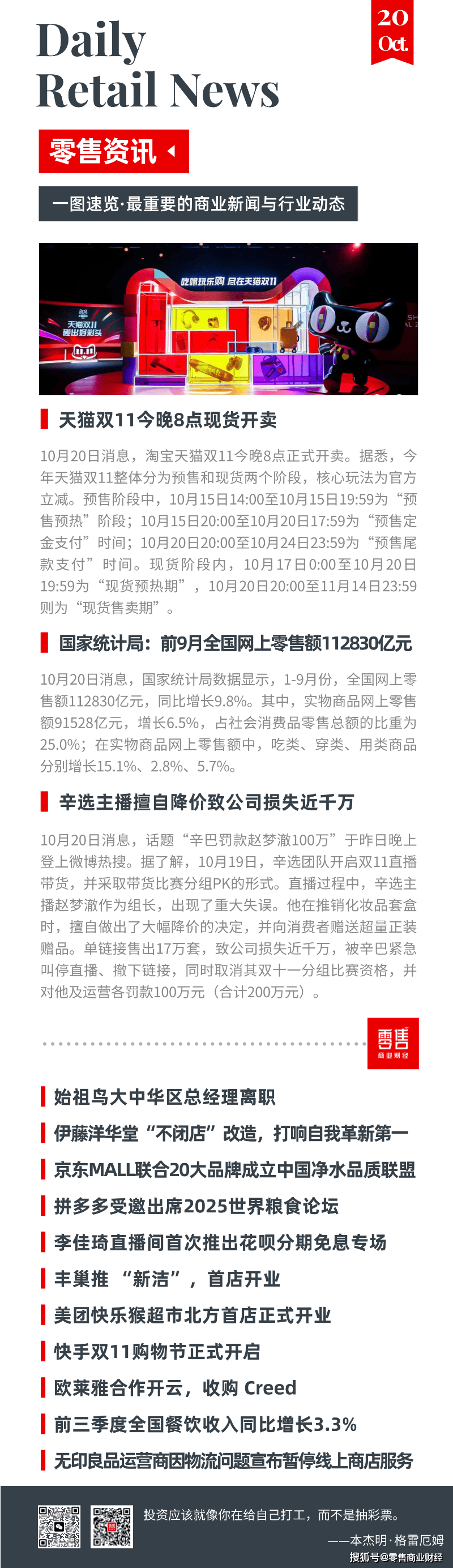
Group 1: E-commerce and Retail Trends - Tmall's Double 11 sales event officially starts tonight at 8 PM, featuring both pre-sale and real-time sales phases, with significant discounts as a core strategy [3][7] - In the first nine months of the year, China's online retail sales reached 1,128.3 billion yuan, a year-on-year increase of 9.8%, with physical goods online retail sales at 915.3 billion yuan, growing by 6.5% [4][10] - The online retail sales of food, clothing, and daily necessities saw respective growth rates of 15.1%, 2.8%, and 5.7% [10] Group 2: Company-Specific Developments - A significant incident occurred during a live-streaming event where a host from XinXuan made unauthorized price cuts, resulting in nearly 10 million yuan in losses for the company, leading to penalties for the host and the team [5][11] - Arcteryx's General Manager for Greater China has left the company, with the position temporarily filled by the regional president, indicating potential shifts in management strategy [12] - Ito Yokado is undergoing a non-closure renovation strategy at its Chengdu store, focusing on enhancing product offerings and customer experience while optimizing resource allocation [13] Group 3: Strategic Partnerships and Initiatives - JD Mall has launched a "China Water Quality Alliance" with 20 major brands to promote water purification standards and consumer awareness [15] - Pinduoduo was invited to the 2025 World Food Forum, showcasing its contributions to digital agriculture innovation [17] - L'Oréal has reached a strategic cooperation agreement with Kering Group, involving the acquisition of the Creed brand and a long-term partnership in the beauty and fragrance sector, valued at 4 billion euros [25]


开云集团拟40亿欧元出售美妆业务 与欧莱雅集团达成合作
Zheng Quan Ri Bao· 2025-10-20 16:43
Group 1 - L'Oréal Group and Kering Group announced a long-term strategic partnership in the luxury beauty sector, with Kering selling its beauty business to L'Oréal for €4 billion (approximately 33.3 billion RMB) [1] - L'Oréal will acquire the Creed brand and gain exclusive rights to develop perfumes and beauty products for Kering's brands such as Gucci, Bottega Veneta, and Balenciaga for a period of 50 years [1][2] - The transaction is expected to be completed in the first half of 2026, and both companies plan to explore further collaboration opportunities in luxury goods, health, and longevity through a 50-50 joint venture [1] Group 2 - Kering's beauty division, established in 2023, reported total sales of €32.3 million in 2024, a significant increase of 421% year-on-year, primarily driven by Creed [2] - Despite the growth in the beauty sector, Kering's overall sales declined by 16% year-on-year, and net profit fell by 46%, indicating financial pressure [2] - Kering's new CEO, Luca de Meo, is focused on improving the company's balance sheet, making the sale of the underperforming beauty business a necessary step [2][3] Group 3 - The partnership is expected to strengthen L'Oréal's leadership position in the luxury beauty market, leveraging the potential of brands like Gucci and Bottega Veneta [2] - Analysts believe that this collaboration will help Kering gain a larger market share in the luxury sector amid overall industry pressures [3]