奈雪的茶

Search documents
国家吹响减肥号角!“减重经济”能否激发万亿级消费新浪潮
GLP1减重宝典· 2025-06-19 12:45
Core Viewpoint - The article highlights the emergence of a "weight management economy" driven by national health policies, consumer upgrades, and technological innovations, with a focus on the "Weight Management Year" initiative launched during the 2023 Two Sessions, aiming to address obesity as a public health issue and create a trillion-level market across various sectors [4][5]. Group 1: Health Crisis to Economic Opportunity - The obesity issue in China is severe, with over 50% of adults classified as overweight or obese, projected to rise to 70.5% by 2030, leading to significant healthcare costs [6]. - The "Weight Management Year" initiative represents a strategic shift from treatment to prevention, aiming to reduce healthcare burdens and improve national health levels [6]. Group 2: Industry Opportunities - National policies are transitioning from "treating diseases" to "preventing diseases," fostering a diverse ecosystem in the weight management economy [7]. - The release of tailored dietary guidelines and the integration of medical and health services are creating new business models in personalized dining and weight management clinics [7]. Group 3: Five Key Consumption Upgrades - **Healthcare**: The pharmaceutical sector is seeing a surge in interest in weight loss medications, with GLP-1 drugs like Semaglutide gaining attention, and over 20 companies are developing similar products [8]. - **Smart Health Devices**: The market for wearable devices is booming, with a 19.3% year-on-year increase in shipments, making China the largest market globally [9]. - **Sports Consumption**: The outdoor sports sector is thriving, with a 51.86% increase in the number of outdoor sports merchants by the end of 2024 [10]. - **Healthy Eating**: The shift towards health-conscious eating is evident, with brands launching low-calorie and functional foods to meet diverse consumer needs [11]. - **Sleep Economy**: Products aimed at improving sleep quality are gaining popularity, reflecting a broader trend in health and wellness [12]. Group 4: Scientific, Personalized, and Experiential Upgrades - The integration of AI and smart devices is transforming weight management into a data-driven, personalized experience, enhancing user engagement through gamification [13]. - The Z generation is reshaping the industry by prioritizing interactive and enjoyable experiences over traditional weight loss methods, leading to a shift in consumer expectations [14]. Group 5: Economic Insights from Weight Management - The health management sector is evolving into a trillion-dollar market, driven by technological advancements and consumer demand for personalized health solutions [15]. - Smart health devices are becoming critical data entry points for health management, with significant sales growth and user engagement [16]. - The fusion of the metaverse and health management is creating new consumer experiences, while social media platforms are driving community engagement in weight management [17]. - The new generation of consumers values aesthetics and cultural relevance in health products, indicating a shift towards lifestyle branding in the weight management sector [18].


餐饮业创新供给添动能
Jing Ji Ri Bao· 2025-06-17 22:20
Core Insights - The restaurant industry in China is experiencing a robust recovery, with May's national dining revenue reaching 457.8 billion yuan, a year-on-year increase of 5.9% [1] - The sector is increasingly focusing on innovative consumption scenarios to enhance customer experiences and drive growth [2][4] - The trend towards quality, personalization, and diversity in dining consumption is contributing positively to economic growth [3] Group 1: Market Performance - In May, the restaurant industry's current performance index was 44.61, up 1.27 from the previous month, while the expected index was 54.22, down 1.81, indicating a slight pressure on operations but overall optimism for the summer dining market [6] - The restaurant industry is projected to reach a revenue of 5.5 trillion yuan in 2024, accounting for over 11% of total retail sales [3] Group 2: Consumer Trends - There is a growing trend of chain restaurants and brand scaling, with the "first store economy" providing fresh experiences for consumers [2] - Seasonal and thematic innovations are being embraced, with restaurants introducing new dishes that align with seasonal ingredients, such as spring-themed offerings [4][5] Group 3: Strategic Initiatives - The Ministry of Commerce is promoting various dining consumption activities, including "Chinese Food Festival" events, to stimulate demand through unique dining experiences [4] - Restaurants are encouraged to explore niche markets such as creative dishes, health-focused meals, and themed dining experiences to enhance service quality [5][7] Group 4: Future Opportunities - The upcoming summer season is expected to boost service consumption significantly, with a focus on beverages, barbecues, and Western-style dining [6] - Companies are advised to prioritize quality and innovation, leveraging digital transformation and optimizing resource allocation to meet diverse consumer needs [7]
茶饮行业的五次浪潮:如何捕获消费新趋势,创造新需求?
Xin Lang Cai Jing· 2025-06-17 13:25
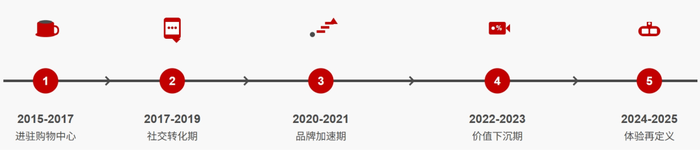
Core Insights - The article highlights the rapid evolution of the tea beverage industry in China, marking 2023 as a significant year for capital market entries by tea brands, with "沪上阿姨" being the fourth to list on the Hong Kong Stock Exchange [1] - The tea beverage sector has transitioned from a niche market to a vital component of shopping centers, reflecting changing consumer behaviors and preferences [1][2] - The industry is currently facing challenges such as declining repeat purchases, brand homogenization, and increased competition, prompting a reevaluation of the value tea brands bring to shopping centers [1][6] Development Phases of the Tea Beverage Industry (2015-2025) - **Phase 1 (2015-2017)**: Transition from street vendors to shopping centers, with brands like CoCo and蜜雪冰城 expanding into lower-tier cities [3] - **Phase 2 (2017-2019)**: Emergence of "new tea" brands like 喜茶 and 奈雪的茶, redefining the tea experience from convenience to social consumption [4] - **Phase 3 (2020-2021)**: Pandemic-driven rapid expansion, with brands competing for prime locations in shopping centers [5] - **Phase 4 (2022-2023)**: Market saturation and rational consumer behavior lead to a decline in repeat purchases and brand differentiation [6] - **Phase 5 (2024-2025)**: Reevaluation of brand value, focusing on brand uniqueness and consumer engagement [7] Consumer Behavior and Brand Evolution - The perception of tea beverages has shifted from mere products to symbols of personal expression and social interaction, driven by younger generations [10] - The rise of social media platforms has transformed tea consumption into a shareable experience, emphasizing aesthetics and brand storytelling [10][13] - Leading brands are diversifying their offerings beyond tea, creating a "brand universe" that includes food and lifestyle products [13][14] Operational Strategies and Market Dynamics - The tea beverage sector is experiencing a decline in average monthly sales per square meter, with a reported drop of approximately 22% from previous years [20] - The traditional strategy of prioritizing prime locations is shifting towards a focus on cost-effectiveness and brand synergy [21] - Shopping centers are encouraged to limit the number of tea brands to enhance differentiation and avoid market saturation [24] Future Outlook - The tea beverage industry is evolving into a more integrated part of the consumer experience, with brands exploring collaborations and immersive experiences [8][25] - The focus is shifting from merely attracting foot traffic to creating meaningful consumer interactions and enhancing overall shopping center appeal [24][25]
港股新消费F4爆红:一场资本、需求与叙事狂欢的共谋
Xin Lang Zheng Quan· 2025-06-17 08:30
Core Insights - The rise of the "New Consumption F4" (Pop Mart, Nayuki, Perfect Diary, Helen's) is driven by a combination of generational shifts, capital narratives, and consumption transformations, rather than just performance metrics [1] Group 1: Generational Consumption Revolution - The essence of the "F4" rise is the takeover of consumption power by Generation Z, focusing on emotional needs rather than just product functionality [2] - Pop Mart has turned blind boxes into "spiritual lottery," appealing to the loneliness economy with annual sales of millions [2] - Nayuki's tea shops have become new social hubs for urban youth, replacing Starbucks in some areas [2] - Over 60% of revenue from these brands comes from users under 30, with private domain repurchase rates exceeding the industry average by 20% [2] Group 2: Traffic Creation Movement - The "F4" brands have shifted from traditional advertising to a self-circulating system of content, traffic, and conversion [3] - Perfect Diary utilized social media strategies to achieve over 100 million GMV in just two years [3] - Nayuki's viral marketing through popular IPs has led to significant foot traffic in stores [3] - The traffic creation efficiency of "F4" is 3-5 times that of traditional brands, with customer lifetime value (LTV) 40% higher than the industry average [3] Group 3: Capital Narrative Reconstruction - The capital market's valuation logic has shifted from profit worship to GMV mythology, with a focus on sales revenue rather than profits [4] - Nayuki was valued at 20 billion despite a 200 million loss at IPO, highlighting the market's focus on expansion potential [4] - Perfect Diary's parent company is valued at 10 billion based on its 130 million member data, indicating future monetization potential [4] - The average oversubscription for "F4" IPOs is over four times, with institutional investors making up 70% of the funding [4] Group 4: Underlying Challenges and Reflections - The "F4" faces significant challenges, including rising marketing costs and supply chain vulnerabilities [5] - Perfect Diary's marketing expenses have exceeded 60% for five consecutive years, leading to a revenue without profit dilemma [5] - Nayuki's profit margins have been pressured by fluctuating raw material costs [5] - The aging of Pop Mart's IPs has resulted in increased inventory turnover days, indicating consumer fatigue [5] Group 5: Transition from "Internet Celebrity" to Sustainable Growth - The success of the "F4" reflects a phase in China's consumption upgrade, emphasizing the importance of understanding the emotional needs of younger consumers [6] - The challenge remains for these brands to evolve from "hit-making machines" to "value-driven brands" [6] - Building a robust product capability, supply chain, and user engagement is essential to avoid becoming a casualty of capital market fluctuations [6]
「四大金刚」,挤满商场一楼
36氪· 2025-06-15 02:02
Core Viewpoint - The article discusses the transformation of shopping malls in China, highlighting the shift from traditional cosmetics brands to new categories such as trendy toys, outdoor sports, and tea beverage brands, referred to as the "Four Kings" of modern retail [6][11][12]. Group 1: Transformation of Retail Landscape - The flagship store of Innisfree, a Korean beauty brand, has been replaced by Pop Mart, a trendy toy company, symbolizing a broader trend in retail [6][8]. - The "Four Kings" now dominating mall spaces include trendy toys, outdoor sports, new energy vehicles, and diverse tea brands, reflecting changing consumer preferences [8][11]. - The vacancy rate in shopping malls has approached 14% in major cities, providing an opportunity for the "Four Kings" to establish a presence [11]. Group 2: Decline of Traditional Brands - The number of cosmetic counters in China has decreased from 15,415 in 2020 to 11,365 in 2022, with low-end cosmetics experiencing the most significant decline [11][12]. - High-end cosmetic brands like Chanel and Lancôme continue to maintain their presence in malls despite overall declines in sales [12][14]. Group 3: New Entrants and Market Dynamics - New energy vehicle brands have become prominent in malls, with Tesla being a pioneer in this space, shifting the focus from traditional car dealerships to experiential retail [18][19]. - The tea beverage market has seen rapid changes, with brands like Nayuki and Heytea adapting to consumer preferences, while others like Tiger Sugar have exited the market [22][24]. Group 4: Future Trends and Opportunities - The article notes that while the "Four Kings" dominate, there are still opportunities for emerging brands like Mao Geping, which has expanded rapidly in the offline market [32][35]. - The future of retail remains uncertain, with the potential for new categories to emerge and replace existing ones, indicating a dynamic and evolving market landscape [36].
新茶饮,5月开店2178家
3 6 Ke· 2025-06-15 01:18
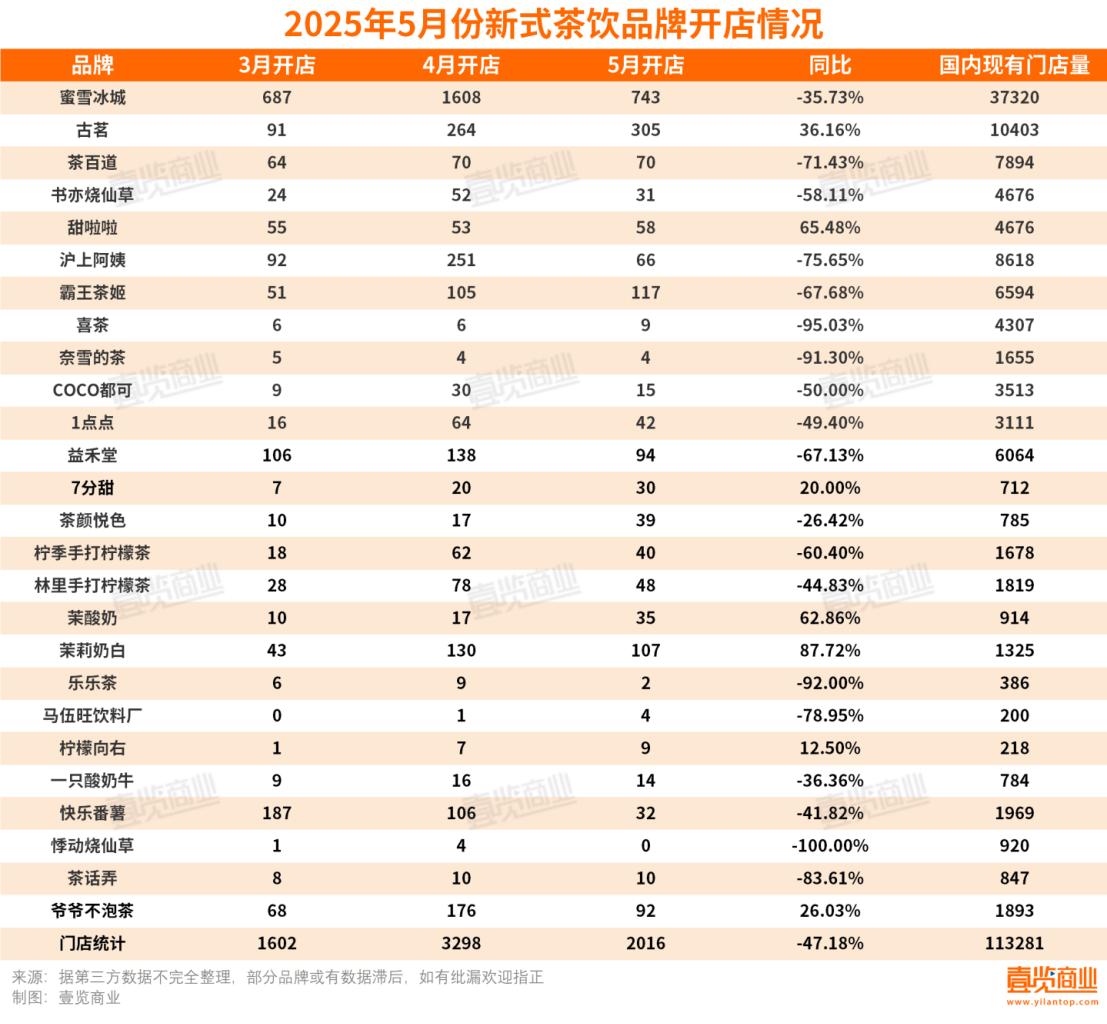
Core Insights - The new tea beverage market is entering a "preparation period" ahead of the Dragon Boat Festival and summer season, with a significant decrease in new store openings in May 2025 compared to previous months and the same period last year [1][4]. Store Opening Trends - In May 2025, 26 new tea beverage brands opened a total of 2016 stores, a decrease of 38.87% month-on-month and 47.18% year-on-year [1][3]. - The total number of stores in the industry reached 113,281, with an increase of 1,029 stores compared to April [1]. - Major brands like Mixue Ice City opened 743 new stores in May, although this was a decrease of approximately 865 stores from April [4]. Brand Performance - Mixue Ice City remains the leader in store openings, followed by Gu Ming with 305 new stores, marking a year-on-year increase of 36.16% [4][7]. - Other brands such as Bawang Chaji and Yihe Tang also showed stable performance with 117 and 94 new stores respectively [4][8]. - Brands like Hey Tea and Nayuki continued to open stores at a slow pace, with only 9 and 4 new stores in May [4][7]. Product Development and Marketing - In May, 26 brands launched approximately 105 new SKUs, an increase of 17 from April, indicating a focus on product innovation [8][11]. - The most popular new product ingredients included peach and bayberry, with several brands introducing related products [11]. - Marketing strategies are shifting from collaboration-driven promotions to influencer marketing, with 7 brands engaging in celebrity or KOL partnerships in May [12]. Industry Dynamics - The industry is experiencing a more differentiated expansion among leading brands, with Gu Ming entering the "10,000 store club" [7]. - Tea Baidao is facing store contraction despite opening 70 new stores, with a net decrease of 104 stores compared to April [7]. - The overall marketing approach is transitioning from heavy reliance on collaborations to a more refined focus on direct sales impact and private domain traffic [12].

「四大金刚」,挤满商场一楼
36氪· 2025-06-14 13:57
Core Viewpoint - The article discusses the transformation of shopping malls in China, highlighting the shift from traditional cosmetics brands to new categories such as trendy toys, outdoor sports, and tea beverage brands, referred to as the "Four Kings" of shopping malls [6][11][22]. Group 1: Transformation of Shopping Malls - The flagship store of Innisfree, a Korean beauty brand, has been replaced by Pop Mart, a trendy toy company, symbolizing a broader trend in retail [6][8]. - The "Four Kings" now dominating mall entrances include trendy toys, outdoor sports brands, new energy vehicles, and various tea beverage brands, reflecting changing consumer preferences [8][11]. - The vacancy rate in shopping malls has approached 14% in major cities, providing an opportunity for the "Four Kings" to establish a presence [11]. Group 2: Decline of Cosmetics Brands - The number of cosmetics counters in China has decreased from 15,415 in 2020 to 11,365 in 2022, with low-end cosmetics seeing the most significant decline [11][12]. - Many cosmetics brands are shifting online due to high rental costs and changing consumer habits, with a growing emphasis on natural beauty and fitness over makeup [11][12]. Group 3: New Entrants and Market Dynamics - New energy vehicle brands have become prominent in shopping malls, with Tesla being a pioneer in this space, leading to a shift in how vehicles are marketed and sold [18][19]. - The tea beverage market is highly dynamic, with brands like Nayuki and Heytea rapidly changing positions in high-demand locations, reflecting the fast-paced nature of consumer preferences [22][24]. Group 4: Future Trends and Opportunities - Despite the challenges, there are still opportunities for brands to thrive in shopping malls, as seen with the rise of domestic beauty brand Mao Geping, which has expanded significantly in physical retail [32][35]. - The article suggests that while the "Four Kings" currently dominate, the future may bring new competitors and shifts in consumer behavior that could alter the retail landscape again [36].


【关注】新茶饮产品高度同质化,上市效益普遍下滑
Sou Hu Cai Jing· 2025-06-13 09:30
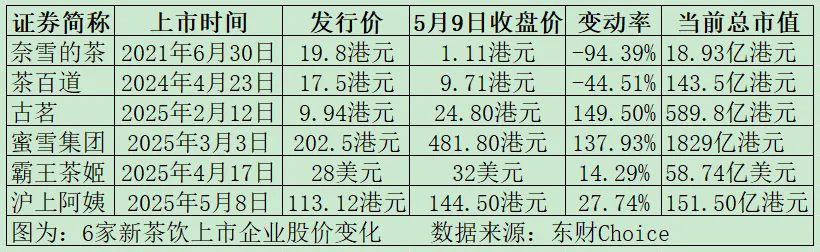
Core Viewpoint - The new tea beverage industry is experiencing a significant differentiation among leading companies following a series of IPOs, indicating a shift into a more competitive phase characterized by homogenization and over-expansion issues [1][10]. Company Performance - Companies like Gu Ming and Mi Xue Group have seen substantial stock price increases post-IPO, with Gu Ming rising by 149.50% and Mi Xue Group by 137.93% as of May 9 [2][3]. - In contrast, companies such as Nai Xue's Tea and Cha Bai Dao have faced significant declines in stock prices, with Nai Xue's Tea down 94.39% and Cha Bai Dao down 44.51% since their respective IPOs [2][7]. - The stock performance of Ba Wang Cha Ji and Hu Shang A Yi has also been weaker compared to their peers, with Ba Wang Cha Ji showing a modest increase of 14.29% and Hu Shang A Yi at 27.74% [3][5]. Market Trends - The new tea beverage market is projected to reach a scale of 354.72 billion yuan in 2024, with a stable growth forecast of 6.4% year-on-year, potentially exceeding 400 billion yuan by 2028 [14]. - The industry is transitioning from a growth phase focused on market share acquisition to a more mature phase emphasizing differentiation and refined strategies [14][16]. Challenges and Issues - The industry faces challenges such as product homogenization, excessive store expansion, and declining operational efficiency, leading to a "impossible triangle" scenario where companies struggle to balance scale expansion, cost control, and brand differentiation [10][12][16]. - Some companies have reported significant drops in net profit, with Cha Bai Dao experiencing a 58.55% decline in 2024, while Nai Xue's Tea reported substantial losses [8][12]. Strategic Directions - Companies are increasingly focusing on differentiation strategies, with Mi Xue Group leveraging its supply chain capabilities to gain competitive advantages [16]. - Expansion into overseas markets is a key strategy for many leading new tea beverage companies, with Ba Wang Cha Ji already testing its first North American store shortly after its IPO [17].
沪上阿姨上市后股价过山车:资本狂欢下的新茶饮生存样本
Xin Lang Zheng Quan· 2025-06-13 09:14
Core Viewpoint - The rapid rise and fall of Hu Shang A Yi's stock price post-IPO reflects a significant shift in the new tea beverage industry from aggressive expansion to a more rational approach, highlighting the challenges faced by the company and the sector as a whole [1][2]. Group 1: IPO and Market Reaction - Hu Shang A Yi's IPO was highly successful, with an oversubscription rate of 3616.83 times and over 940 billion HKD in frozen funds, marking it as the highest new stock subscription in Hong Kong after regulatory changes [2]. - On its first trading day, the stock price surged by 74.68% to 197.6 HKD, but subsequently dropped by 8.78% the following day, leading to a cumulative decline of over 20% within a week [1][2]. - By early June, the stock price had fallen to around 125 HKD, representing a nearly 37% decrease from its peak [1]. Group 2: Financial Performance and Challenges - In 2024, Hu Shang A Yi reported a revenue of 3.285 billion HKD, a year-on-year decline of 1.9%, and a net profit of 329 million HKD, down 15.2% [4]. - The company's business model heavily relies on a franchise system, with 99.7% of stores operated by franchisees, leading to a significant drop in single-store GMV from 1.559 million HKD in 2023 to 1.37 million HKD in 2024, a decrease of 12.12% [4][5]. - The closure rate of franchise stores increased to 12.7% in 2024, with over 1,000 stores shutting down, significantly higher than the industry average of 4% [4]. Group 3: Competitive Landscape and Market Dynamics - The new tea beverage industry is experiencing a slowdown, with a projected growth rate of only 8.2% in 2024 and further decline to 7.5% in 2025, leading to intense price wars among leading brands [6]. - Hu Shang A Yi faces challenges in both low-price and mid-to-high-end markets, struggling against competitors like Mi Xue Bing Cheng and Xi Tea, which have established stronger market positions [6]. - The company's reliance on third-party suppliers and inadequate cold chain coverage hinder its ability to reduce costs, making it difficult to compete on price with rivals [5][6]. Group 4: Future Outlook and Strategic Considerations - The company must focus on optimizing its supply chain and digital commitments, potentially allocating 60% of its IPO proceeds to these areas to regain growth momentum [6]. - Reducing food waste to levels comparable to competitors and leveraging scale procurement could help Hu Shang A Yi improve its cost structure and competitive positioning in the market [6].
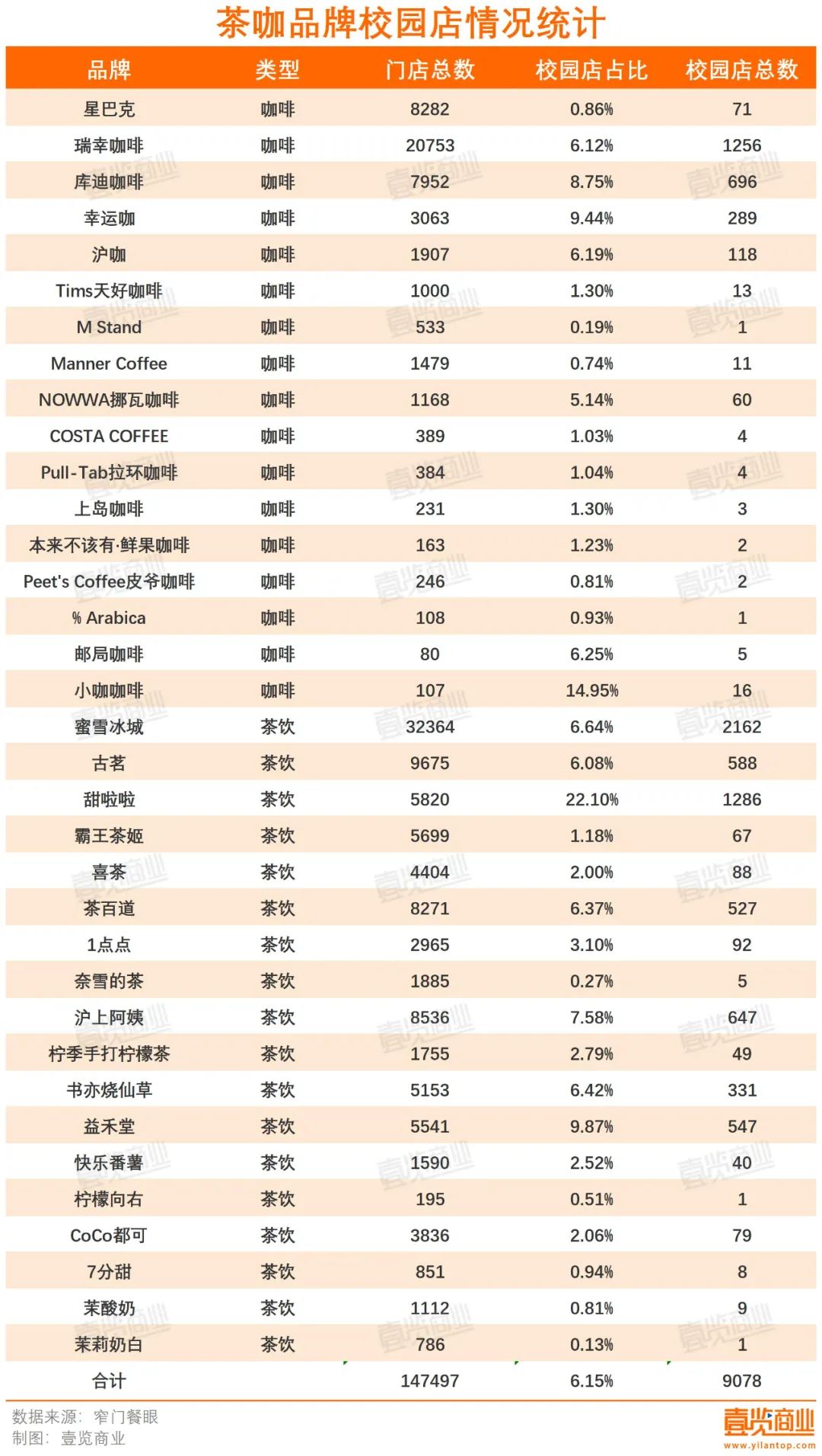
霸王茶姬进军清华,全国校园茶咖店接近一万家
3 6 Ke· 2025-06-13 03:43
Core Insights - Bawang Chaji has opened its first campus store at Tsinghua University, achieving over 2,200 cups sold on the opening day, making it the top GMV store nationwide that day [1] - The brand has expanded to nearly 200 universities across China, with over 2 million student members by June 2025, indicating strong market penetration [1] - The student consumer market is significant, with over 47 million students and an estimated annual consumption of 850 billion yuan in 2024 [1] Industry Overview - The competition in the campus beverage market is intensifying, with multiple brands like Heytea, Gu Ming, and Tims entering the space [1] - As of December 2024, at least 35 tea and coffee brands have opened over 9,000 campus stores, representing 6.15% of total stores [1][3][4] Brand Performance - Among coffee brands, Luckin Coffee leads with 1,256 campus stores, while Bawang Chaji has 67 campus stores, which is a small percentage of its total 5,699 stores [3][4] - The majority of campus stores are operated by tea brands, with Mixue Ice City having 2,162 campus stores, followed by Sweet Lala with 1,286 [4] Consumer Behavior - Students prioritize cost-effectiveness, with many brands adjusting their pricing strategies to remain competitive within campus environments [5] - The demand for a "third space" for studying drives students to frequent beverage shops, especially during exam periods [5] - Students are open to trying new products, as evidenced by Sweet Lala's successful trial of a new product that sold over 1 million cups in three days [5][6] Operational Insights - Campus stores benefit from lower labor costs by employing part-time students, which can save significant expenses compared to hiring full-time staff [6][7] - The operational model for campus stores varies, including independent stalls in cafeterias and partnerships with school administrations, which can complicate entry into the market [8][9] Challenges - High rental costs and management fees in campus locations can significantly increase operational expenses, making profitability challenging [9] - The seasonal nature of campus dining, with limited operational months, poses additional challenges for maintaining consistent revenue [9]