
今世缘

Search documents
食品饮料周观点:中报窗口期,预期回归、分化加剧-20250713
GOLDEN SUN SECURITIES· 2025-07-13 14:28
Investment Rating - The report maintains an "Increase" rating for the food and beverage industry, indicating a positive outlook for selected companies within the sector [4]. Core Insights - The report highlights a significant differentiation within the industry, particularly in the liquor segment, where companies are actively seeking transformation amid market pressures. It emphasizes three main investment themes: leading brands, high-certainty regional brands, and flexible companies benefiting from recovery [1][2]. - In the beer and beverage sector, companies like Yanjing and Zhujiang are expected to show strong profit growth, with Yanjing projected to achieve a net profit of 1.06 to 1.14 billion yuan, reflecting a year-on-year increase of 40% to 50% [3]. Summary by Sections Liquor Industry - The liquor industry is experiencing a challenging half-year, with demand and policy impacts leading to a slowdown in sales. The report anticipates that the performance expectations for the mid-year and the entire year of 2025 have been largely adjusted [2]. - Key players like Kweichow Moutai and Wuliangye are focusing on service enhancement and transformation strategies to navigate the current market conditions. The report suggests that the upcoming month of September will be critical for assessing the impact of policies and consumer demand [2]. Beer and Beverage Sector - Yanjing Beer is expected to achieve a net profit of 1.06 to 1.14 billion yuan for the first half of 2025, marking a year-on-year increase of 40% to 50%. Zhujiang Beer is also projected to see a profit increase of 15% to 25% [3]. - Eastroc Beverage is forecasted to generate revenue of 10.63 to 10.84 billion yuan, with a net profit of 2.31 to 2.45 billion yuan, reflecting a growth of 33% to 42% year-on-year [3]. Consumer Goods - The report notes that companies like Youyou Foods and Miaokelando are expected to report significant profit increases, with Youyou Foods projecting a revenue growth of 40.91% to 50.77% [7]. - The overall consumer goods sector is highlighted as a space to watch for growth, particularly for companies that are innovating and expanding their market reach [7].




行业周报:白酒布局机会渐显,新消费择优长期持有-20250713
KAIYUAN SECURITIES· 2025-07-13 14:07
Investment Rating - The industry investment rating is "Positive" (maintained) [1] Core Viewpoints - The food and beverage index increased by 0.8% from July 7 to July 11, ranking 23rd among 28 sectors, performing in line with the CSI 300 index. The sub-sectors of liquor (+1.4%), health products (+1.4%), and beer (+1.2%) showed relatively strong performance [11][12] - The current liquor market is experiencing downward pressure due to unexpected restrictions on alcohol consumption, leading to a decline in demand. However, it is anticipated that the liquor sector will find a bottom in the second half of the year, presenting potential investment opportunities [11][12] - The report suggests focusing on leading liquor companies such as Kweichow Moutai, Luzhou Laojiao, Shanxi Fenjiu, and others for strategic investments. Additionally, it recommends identifying high-quality new consumption companies that align with industry trends for long-term holding [11][12] Summary by Sections Weekly Insights - Strategic focus on leading liquor companies and maintaining high-quality new consumption stocks. The liquor sector is expected to stabilize and present investment opportunities in the second half of the year [11][12] Market Performance - The food and beverage index's performance is consistent with the broader market, with specific sub-sectors like liquor and health products outperforming [12][13] Upstream Data - Some upstream raw material prices are declining, with whole milk powder prices showing a year-on-year increase of 19.9%, while fresh milk prices have decreased by 6.5% year-on-year [15][20] Liquor Industry News - The market price of Kweichow Moutai has been steadily increasing, indicating a recovery in market confidence. Other companies are also taking measures to stabilize their pricing strategies [39] Recommended Portfolio - Recommended stocks include Kweichow Moutai, Shanxi Fenjiu, Ximai Food, and others, focusing on companies with strong growth potential and favorable market conditions [4][45]


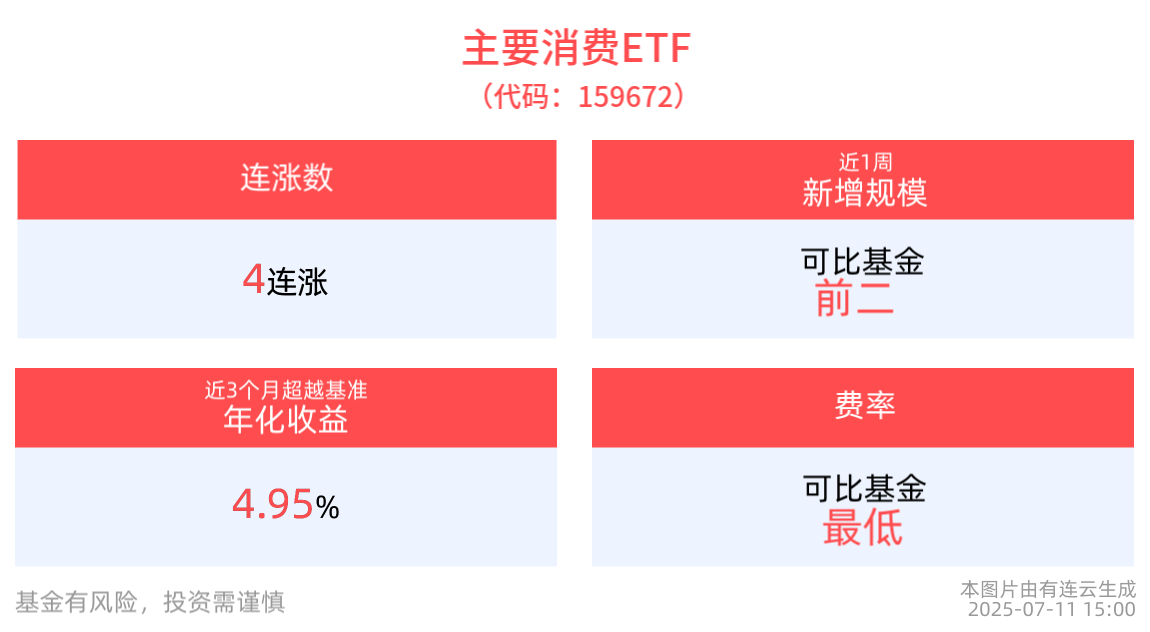
主要消费ETF(159672)实现4连涨,夏季高温叠加政策利好,啤酒饮料消费有望迎来双重驱动
Xin Lang Cai Jing· 2025-07-11 07:46
Group 1 - The main consumption index (000932) increased by 0.44% as of July 11, 2025, with significant gains from stocks like Luzhou Laojiao (000568) up 2.09% and Wuliangye (000858) up 1.40% [3] - The major consumption ETF (159672) achieved a four-day consecutive increase, rising 0.53% and reporting a latest price of 0.77 yuan, with a weekly cumulative increase of 0.79% [3] - The liquidity of the major consumption ETF showed a turnover rate of 4.44% with a transaction volume of 3.36 million yuan, and the average daily transaction volume over the past year was 4.96 million yuan [3] Group 2 - Tianfeng Securities noted that higher summer temperatures across China are expected to boost beer consumption, with long-term growth anticipated from consumer policies and adjustments to alcohol regulations [4] - The major consumption ETF saw a scale increase of 112.25 million yuan over the past week, ranking second among comparable funds [4] - As of July 10, 2025, the major consumption ETF's net value increased by 5.19% over the past year, with a maximum monthly return of 24.35% since inception [4] Group 3 - The management fee for the major consumption ETF is 0.50%, and the custody fee is 0.10%, which are the lowest among comparable funds [5] - The latest price-to-earnings ratio (PE-TTM) for the major consumption index is 18.86, indicating a valuation below 92.49% of the historical data over the past year [5] - As of June 30, 2025, the top ten weighted stocks in the major consumption index accounted for 67.93% of the total, including companies like Yili (600887) and Kweichow Moutai (600519) [5]

高盛:中国白酒_ 政策风险延长周期,拐点尚不明朗;下调四只股票评级
Goldman Sachs· 2025-07-11 01:05
Investment Rating - The report downgrades four stocks: Fen Wine, Luzhou Laojiao, ZJLD to Neutral from Buy, and Anhui Gujing to Sell from Neutral, while maintaining Buy on Kweichow Moutai and Wuliangye [9][36]. Core Insights - The current cycle for the spirits industry is likely prolonged due to the impact of the new austerity policy, with uncertainties on when the cycle will bottom out [1][14]. - The report anticipates policy headwinds to persist from 2Q25 to 2Q26, followed by a modest impact in 2H26 as improper dining restrictions for civil servants normalize [2][14]. - The spirits industry is expected to see a decline in total addressable market (TAM) by 10% to 14% in 2025-27E, with a forecasted decline of over 6% in 2025 and a -2% decline in 2026 [2][14]. Summary by Sections Risk Profiling - A policy impact ranking analysis indicates that upper mid-end and commercial banquet-focused products will face greater pressure, while Moutai is expected to remain resilient due to its gifting demand and limited exposure to government-related banquet consumption [2][12]. Earnings and Valuation Analysis - The report projects +1%/+5% aggregated topline growth for 2025/26E, down from previous estimates of +6%/+9%, with high-end spirits expected to grow by +5%/+5% and upper-mid-high end spirits facing declines of -10%/+2% [2][14]. - A bear case analysis suggests potential earnings downside risks of 6% to 18% for most spirits names compared to the base case [2][14]. Industry Growth Forecast - The spirits industry growth forecast has been revised down to a greater than 6% decline in 2025 and a -2% decline in 2026, compared to prior forecasts of +4%/+3% growth [2][14]. - The report highlights that the spirits industry has been consolidating, with leading players gaining market share, particularly in the super premium segment [2][25]. Company-Specific Insights - Moutai's wholesale price stability is supported by various measures, and the report suggests that a price below RMB 1,800 could hurt distributor profits, leading to market volatility [8][14]. - The report revises down sales and net profit estimates for various companies, including a 1% to 19% reduction for most names, reflecting the impact of the new policy [36][37].



中流击水,革故鼎新——食品行业2025年度中期投资策略
2025-07-11 01:05
Summary of the Conference Call Records Industry Overview - The food and beverage industry is facing a dual impact of oversupply and insufficient demand in 2025, leading to a restructuring of the pricing and competition systems [2] - The white liquor industry is undergoing significant adjustments, with both upgrades and downgrades in demand, and companies are actively adjusting supply to match new market conditions [3][4] Key Insights and Arguments - **White Liquor Industry**: - Currently in a phase of active destocking, with revenue growth slowing down due to weak demand [6] - High-end liquor prices are under pressure, while mid-range products maintain a state of consumption upgrade [6] - Recommended to focus on companies with balanced product structures and healthy inventories, such as Moutai and Wuliangye [4][6] - **Consumer Goods Sector**: - The sector has returned to a "channel is king" era, with new channels like membership supermarkets and live e-commerce disrupting traditional channels [1][5] - New products in niche markets, such as leisure snacks, are experiencing rapid growth [5] - Investment logic should focus on channel enterprises and related manufacturing companies that have capacity and raw material advantages [7] - **Snack Retail Channels**: - Emerging channels like membership supermarkets and discount retail are rapidly expanding, with significant growth in the number of snack retail stores [8] - Companies like Wanchen and Yuyou are benefiting from industry growth, with innovative product offerings driving revenue [9] - **Food Chain Enterprises**: - Companies are increasing efforts in business transformation and exploring new business models, leading to growth despite overall market challenges [10] - **New Product Trends**: - Innovations in product categories such as sugar-free tea and health water are gaining traction, with significant growth potential for domestic whiskey brands [11] - Traditional brands are also innovating to capture new growth spaces [11] Other Important Insights - The dairy and beer industries are experiencing increased concentration post-adjustment, with profitability improving as cost advantages materialize [12] - The supply-demand balance in the dairy sector is expected to reach a turning point, with potential for value enhancement in new milk [13] - The beer sector remains highly concentrated, with top brands maintaining a market share of over 90% [12]
10元票价撬动3亿创收 “草根苏超”成现象级普惠经济样本
2 1 Shi Ji Jing Ji Bao Dao· 2025-07-10 13:03
Core Viewpoint - The "Su Super" league, a grassroots football event in Jiangsu, has gained immense popularity, attracting local support and sponsorships, while promoting community engagement and economic growth in the region [1][9]. Group 1: Event Overview - "Su Super" is the first city football league in Jiangsu, featuring teams from thirteen cities, fostering local pride and community spirit [1]. - The league has a low ticket price range of 5-20 yuan, making it accessible to a wider audience compared to professional leagues [1]. - Out of 516 participants, only 29 have professional backgrounds, with most players being amateurs from various professions [1]. Group 2: Sponsorship and Economic Impact - The league has attracted 27 sponsors, significantly increasing from 6 at the start of the season, with a mix of large enterprises and local businesses [4][5]. - Sponsorship categories include major sponsors, team sponsors, and regional sponsors, providing exposure opportunities for small brands [3]. - The league has positively impacted local economies, with a reported 25% increase in consumption in areas hosting matches, and an estimated overall economic benefit exceeding 300 million yuan [9]. Group 3: Community and Cultural Integration - The league has become a platform for local businesses to gain visibility, with small enterprises like street food vendors benefiting from increased foot traffic during matches [3][5]. - The event has sparked a cultural phenomenon, with local brands and community engagement becoming integral to its success [6][9]. - The league's popularity reflects a broader trend of grassroots sports events driving local tourism and cultural activities, as noted by government officials [10].
食品饮料行业2025年度中期投资策略:中流击水,革故鼎新
Changjiang Securities· 2025-07-10 05:04
Overview - The food and beverage industry is currently facing a dual impact of oversupply and insufficient demand, leading to a restructuring of the overall pricing and competitive landscape [3][6][21] - Despite the pressure on prices and downward revisions of profit growth expectations in some sectors, the intense competition is driving innovation and reform, resulting in new business models and investment opportunities [3][6][21] Baijiu Industry - Since 2025, profound changes have occurred on both the supply and demand sides of the baijiu industry, with a coexistence of consumption upgrades and downgrades [7][22] - Some mid-range baijiu brands are under pressure, while certain local brands continue to grow rapidly, indicating a shift in consumer preferences [22][30] - Baijiu companies have proactively adjusted their supply strategies, leading to a significant slowdown in revenue growth to match demand changes [22][23] - The industry is undergoing a transformation in product and pricing strategies, suggesting a cyclical change, with recommendations to focus on companies with balanced product structures and healthy inventories [22][32] Consumer Goods - The consumer goods sector is entering a new phase where channel efficiency is paramount, driven by the rise of new retail formats such as discount stores and membership supermarkets [8][36] - New business models are disrupting traditional channel barriers and providing better value-for-money options, leading to structural growth opportunities [8][36][37] - The focus for investment should be on channel enterprises and related manufacturing companies, as new retail formats continue to gain traction [8][37] - The market for snacks and beverages is expanding rapidly, with the retail value in the lower-tier markets reaching 2.3 trillion yuan in 2024 [52][56] New Product Trends - There is still room for innovation in certain niche markets, with segments like leisure konjac products experiencing rapid growth [9][70] - The demand for high-quality products remains strong, with a significant portion of consumers willing to pay more for better quality [42][43] Market Structure - The industry is witnessing a consolidation phase, particularly in sectors like dairy, beer, and yeast, where competition intensity is decreasing and leading brands are gaining long-term competitive advantages [10][36] - Traditional sectors like yellow wine are also stabilizing, with improved profitability and potential for revaluation as market dynamics shift [10][36] Retail Channel Dynamics - The rise of membership supermarkets and discount retail channels is reshaping consumer purchasing behavior, with a notable increase in the number of snack retail outlets [48][56] - Companies like Youyou Foods and Lihigh Foods are effectively leveraging these new channels to drive growth and improve profitability [48][70]

扎堆光瓶酒,酒企应对调整期的良策?
Sou Hu Cai Jing· 2025-07-09 21:37
Core Insights - The bottled liquor market is experiencing significant growth, with major brands launching new products and strategies to capitalize on this trend [2][5][7] Market Dynamics - The bottled liquor market has expanded from 35.2 billion RMB in 2013 to 98.8 billion RMB in 2021, with a compound annual growth rate (CAGR) of 13.8%. It is projected to reach 150 billion RMB by 2024, maintaining a 16% annual growth rate from 2022 to 2024 [7] - The under 100 RMB price segment is currently the best-performing in the liquor market, with bottled liquor accounting for over 60% of this segment [7] Consumer Trends - Young consumers, particularly those born in the 1980s and 1990s, are driving the demand for bottled liquor, favoring quality and cost-effectiveness over packaging [9] - The "strictest alcohol ban" has negatively impacted high-end liquor sales, while bottled liquor remains resilient due to its popularity in casual dining settings [9] Competitive Landscape - The market is becoming increasingly crowded, leading to intensified competition among brands [10] - To stand out, brands must focus on building strong identities and value propositions, as well as developing product lines that cater to diverse consumer preferences [11] Strategic Recommendations - Emphasizing branding and systematic marketing strategies is essential for success in the bottled liquor market [12] - Companies should prioritize direct consumer engagement and create sample markets to enhance brand recognition and loyalty [11][12]
白酒行业现人事巨震,高管加速离场,背后指向哪些行业困局?
Nan Fang Du Shi Bao· 2025-07-09 11:48
Core Viewpoint - The recent wave of high-level executive departures in the Chinese liquor industry reflects deep-seated challenges and transformation pains faced by the sector, driven by high inventory levels and price inversions impacting growth [2][11]. Group 1: Executive Changes - Recent resignations include the chairman and board members of Yanghe Co. and the general manager of Jinzhongzi Liquor, indicating a trend of leadership instability across major liquor companies [3][4]. - Guizhou Moutai has also seen personnel changes, with new appointments aimed at addressing internal management dynamics [4]. - The performance pressures, such as Jinzhongzi Liquor's revenue drop of 37.04% to 925 million yuan and a net loss of 258 million yuan, are significant catalysts for these executive changes [4][10]. Group 2: Industry Challenges - The liquor industry is grappling with high inventory levels, with total inventory among 20 listed liquor companies reaching 168.39 billion yuan, an increase of 19.29 billion yuan year-on-year [5][8]. - The prolonged inventory cycle and frequent price inversions are eroding profits and confidence among distributors, leading to increased pressure on sales targets for management [8][9]. - The younger generation's declining interest in traditional liquor, with less than 30% of Gen Z purchasing liquor, poses a significant challenge for the industry [9]. Group 3: Market Dynamics - The liquor market is undergoing a structural adjustment, with a shift from high-growth expectations to a focus on stable dividends, as evidenced by the stock price declines of 19 out of 20 listed liquor companies in 2024 [10][12]. - The industry is witnessing a shift towards consumer-oriented strategies, moving from reliance on government and business consumption to targeting the mass market [13][16]. - New management is increasingly emphasizing innovation and digital marketing to adapt to changing consumer preferences and market conditions [16].


“反内卷”政利好新兴产业,白酒迎“估值-业绩”双底
Mei Ri Jing Ji Xin Wen· 2025-07-09 05:32
Group 1 - The A-share market is experiencing a rebound, with the Shanghai Composite Index returning to 3500 points for the first time in eight months, driven by strong performances in banking stocks and innovative drug concepts [1] - Financial institutions are recommending a focus on three main themes: leading companies, domestic production, and globalization, as the market enters a new phase of core asset rally [1] - The "anti-involution" policy is seen as a necessary macroeconomic choice to alleviate price pressure and improve resource allocation efficiency, leading to structural differentiation in market performance [1] Group 2 - The liquor industry is expected to reach a "valuation-earnings" double bottom by 2025, indicating a mid-cycle buying opportunity, with high dividend yield compared to ten-year government bond yields [2] - Key recommended stocks in the liquor sector include Shanxi Fenjiu, Jinshiyuan, Gujing Gongjiu, Kweichow Moutai, Luzhou Laojiao, and Wuliangye, which are expected to show stable profitability and relative returns post-adjustment [2] - The Food and Beverage ETF provides a convenient investment tool for small capital investors to access core assets in the food and beverage sector, focusing on high-barrier and resilient segments [2]