吉利汽车

Search documents
在海外过年的中国车商:不做“一锤子买卖”,在最前沿扎根|新春走基层
Di Yi Cai Jing· 2026-02-23 04:43
Group 1 - The core viewpoint of the article highlights the growing trend of Chinese automotive companies expanding overseas, driven by both market opportunities and competitive pressures [1][2] - The Chinese automotive industry has transitioned from a focus on low-cost vehicles to enhancing product quality and brand recognition in international markets, particularly in the electric vehicle sector [2] - Major Chinese automotive brands such as BYD, Chery, Geely, and Great Wall have seen increased market share and improved reputation abroad, as consumer perceptions shift away from the low-quality stereotype [2] Group 2 - The competition in overseas automotive markets has intensified, moving from a phase where customers sought suppliers to a scenario where traders compete fiercely for clients [3] - Many traders who lack a deep understanding of the market and rely on low-price strategies are exiting the industry, while savvy overseas customers are increasingly informed and selective [3] - The company emphasizes the importance of establishing long-term relationships with clients and adapting to local market conditions, moving away from short-term profit strategies [3][4] Group 3 - The company is actively engaging with overseas clients, particularly during domestic auto shows, to foster long-term partnerships and ensure successful collaboration [4] - A significant new partnership involves the establishment of a KD factory in the Middle East, which is set to begin operations, necessitating thorough preparation for after-sales services [4][5] - The path for Chinese automotive exports is becoming more crowded and challenging, but the company is committed to long-term strategies for success [5]
港股午评:恒指涨2.29%,恒生科指涨3.32%,美团涨近7%,腾讯控股、阿里巴巴涨超3%
Jin Rong Jie· 2026-02-23 04:32
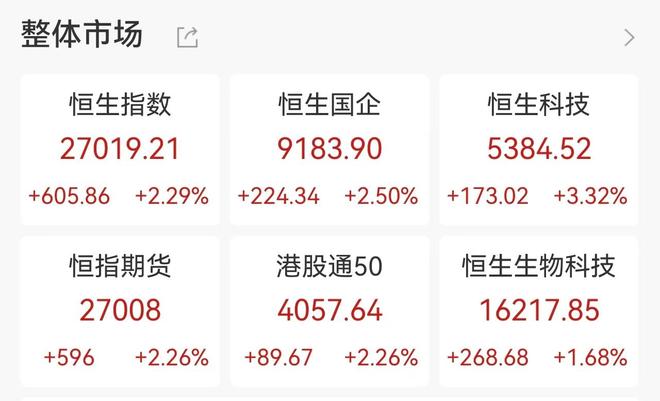
Market Overview - The Hong Kong stock market indices collectively rose on February 23, with the Hang Seng Index increasing by 2.29% to 27,019.21 points, the Hang Seng Tech Index rising by 3.32% to 5,384.52 points, and the Hang Seng China Enterprises Index up by 2.5% to 9,183.9 points [1][2]. Sector Performance - Major technology stocks experienced significant gains, including Alibaba (up 3.6%), Tencent (up 3.35%), JD.com (up 4.24%), Xiaomi (up 2.77%), NetEase (up 2.51%), Meituan (up 6.93%), Kuaishou (up 3.23%), and Bilibili (up 2.79%) [2][4]. - Gold stocks surged, with Tongguan Gold rising over 11%, driven by increased gold prices amid geopolitical uncertainties [4]. - The automotive sector was active, with NIO rising over 3%, supported by strong export data indicating that mainland China's automobile exports reached 8.32 million units last year [5]. - The optical communication sector strengthened, with Yangtze Optical Fibre and Cable rising over 15%, as production capacity remained high during the holiday period [5]. Investment Insights - Analysts from Galaxy Securities suggest that the technology sector remains a long-term investment focus, with reduced valuation pressure and potential for rebound due to accelerated AI model updates and applications [6]. - Huatai Securities highlights three investment directions: semiconductor hardware, consumer sectors like dining and innovative pharmaceuticals, and electrical equipment benefiting from power system upgrades [6]. - The stock buyback activity among industry leaders has instilled confidence in the Hong Kong market, with significant buybacks reported from Tencent, ZTO Express, and Xiaomi, among others [6].


港股大幅走高!恒指涨近3%,恒生科技指数飙升4%,科技、黄金、有色全线爆发
Jin Rong Jie· 2026-02-23 03:21
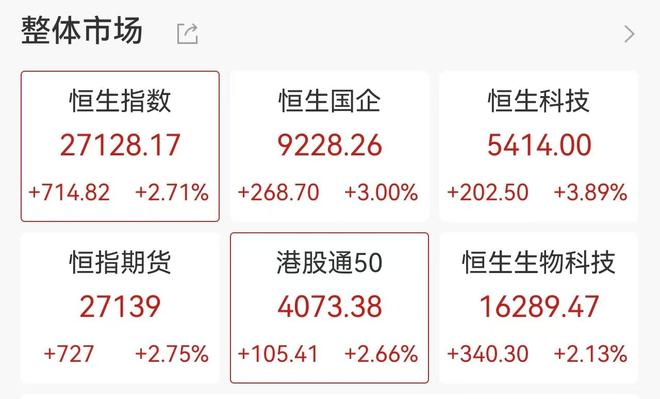
Market Overview - The Hong Kong stock market opened strong and continued to rise, with the Hang Seng Index up nearly 3%, the Hang Seng Tech Index up nearly 4%, and the Hang Seng China Enterprises Index up over 3% [1] - The A50 futures also saw an increase, expanding to over 1.5% [1] Sector Performance - Technology stocks led the market rally, with Meituan rising over 7%, JD Group and BYD up over 5%, and SMIC up nearly 5% [2][3] - Other notable gainers included Huahong Semiconductor, Li Auto, Sunny Optical Technology, and Leap Motor, all rising over 4% [2][3] Individual Stock Highlights - Meituan-W: Current price 86.750, up 7.43% [4] - JD Group-SW: Current price 109.100, up 5.11% [4] - BYD: Current price 100.300, up 5.08% [4] - SMIC: Current price 70.950, up 4.80% [4] - Huahong Semiconductor: Current price 98.350, up 4.46% [4] - Li Auto-W: Current price 73.150, up 4.35% [4] - Alibaba-W: Current price 152.700, up 3.81% [4] Precious Metals and Commodities - The precious metals sector saw significant gains, with spot gold surpassing $5160 per ounce, up over 1%, and spot silver rising over 3% [5] - Chinese gold stocks also surged, with China Gold International up over 7% and Zijin Mining up over 4% [5] Other Sector Movements - The non-ferrous metals sector performed strongly, with China Daye Non-Ferrous Metals up over 9% and Jiangxi Copper up over 6% [5] - The optical communication sector saw collective gains, with Yangtze Optical Fibre up over 18% [5] Investment Insights - Galaxy Securities indicated that the technology sector remains a long-term investment focus, with reduced valuation pressure and potential for rebound due to advancements in AI [6] - Huatai Securities suggested monitoring three key areas: semiconductor hardware, consumer sectors like dining and innovative pharmaceuticals, and electrical equipment benefiting from system upgrades [6] - Significant stock buybacks by industry leaders have instilled confidence in the Hong Kong market, with total buyback amounts exceeding 25.4 billion HKD since 2026 [6]
一汽集团1月销售新车27.5万辆,数据包含零跑汽车销量
Zhong Guo Ji Jin Bao· 2026-02-22 07:08
Core Insights - In January 2026, the total automobile sales of the top fifteen groups reached 2.192 million units, representing a year-on-year decline of 3.8% and accounting for 93.4% of total automobile sales, a decrease of 0.6 percentage points compared to the same period last year [2][4]. Group Performance - The top three companies in terms of sales were SAIC, Geely, and FAW, with a combined market share of 38.5%. SAIC led with sales of 320,000 units, a month-on-month decrease of 17.3% but a year-on-year increase of 24.5%, holding a market share of 13.6%. Geely sold 309,000 units, with a month-on-month increase of 1.9% and a year-on-year increase of 5.2%, capturing 13.2% of the market. FAW sold 275,000 units, experiencing a month-on-month decline of 25.2% and a year-on-year decline of 3.0%, with a market share of 11.7% [2][3][4]. Additional Company Insights - Notably, FAW's January sales data included figures from Leap Motor, which reported a total delivery of 32,059 units in January, reflecting a year-on-year growth of 27% [2]. - BYD and Chery ranked fourth and fifth, respectively. BYD's sales were 210,000 units, down 50.0% month-on-month and 30.1% year-on-year, with a market share of 9.0%. Chery sold 200,000 units, with a month-on-month decline of 18.2% and a year-on-year decline of 10.7%, holding an 8.5% market share [4][5]. Market Concentration - The top five companies accounted for 56% of the market, while the top ten companies held 83.6% of the market share. The sixth to tenth positions included Dongfeng with 189,000 units sold, a month-on-month decline of 29.6% but a year-on-year increase of 31.8%, and a market share of 8.0% [4][5]. - The bottom five of the top fifteen included Tesla with 69,000 units sold, a month-on-month decline of 28.9% but a year-on-year increase of 9.3%, holding a market share of 2.9% [5].


2026开年王炸!爆款新车神仙打架?
电动车公社· 2026-02-21 17:10
Core Viewpoint - The automotive industry is shifting towards high-quality development, reducing internal competition among companies while focusing on technological advancements to attract users [1][2]. Group 1: Key Models to Watch - Xiaomi's YU9 is expected to be a significant player in 2025, likely to continue the sales success of its predecessors SU7 and YU7, and is anticipated to be unveiled mid-year [4][8][10]. - Awenjie M6 is positioned as a new sales leader for the brand, filling a gap in the 250,000 RMB market segment with its competitive features and pricing [11][14][16]. - NIO's ES9 is set to be a high-end offering in the large SUV market, with production already underway and a launch expected in Q2 [19][24][26]. - The updated Li Auto L9 Livis is introducing advanced technology and features, aiming to establish a strong market presence in 2026 [28][32][33]. - XPeng's GX is focusing on L4 autonomous driving technology, with a unique design and high-performance specifications [34][39][41]. - Leap Motor's A10 is entering the market with a focus on affordability and advanced features, targeting the 70,000 to 100,000 RMB segment [42][46]. - Geely's Galaxy M7 is designed to enhance brand visibility and prepare for international expansion, showcasing efficient powertrains and appealing design [49][50][52]. Group 2: Industry Trends and Developments - The automotive sector is witnessing a trend towards larger SUVs, with multiple brands focusing on this segment to capture market share [21][22]. - Companies are increasingly showcasing new models internationally to enhance brand recognition and appeal to global markets [49]. - The competition is intensifying as brands like Tesla face delays in product launches, allowing Chinese manufacturers to gain a competitive edge in performance and technology [66][70][74].



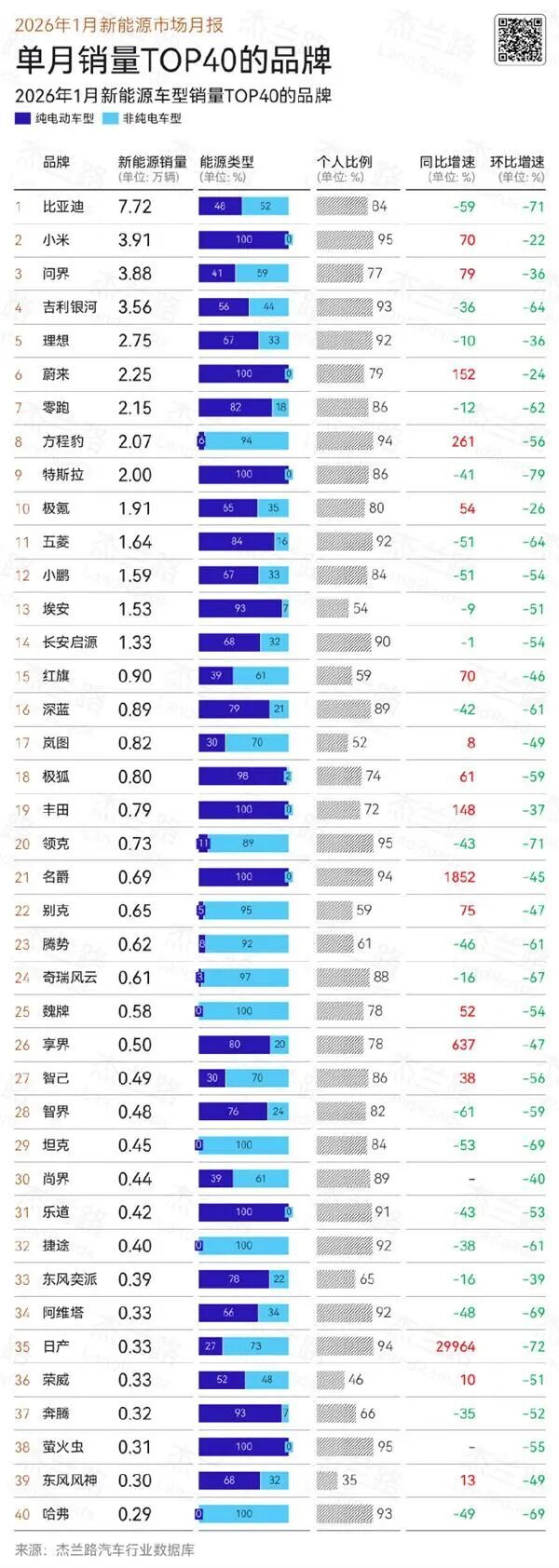
2026年1月新能源车销量:比亚迪第一,小米力压问界跃升至第二
Hang Zhou Ri Bao· 2026-02-21 10:20
Core Insights - The report from LandRoads indicates that Xiaomi has risen to the second position in the domestic new energy passenger vehicle market as of January 2026 [1]. Market Overview - Total sales of new energy passenger vehicles in January 2026 reached 563,000 units, representing a year-on-year decline of 20% and a month-on-month decline of 58% [2]. - The penetration rate of new energy vehicles in the passenger car market was 36.3%, down from 57.4% the previous month and slightly lower than 38.5% in January 2025 [2]. Sales Breakdown by Vehicle Type - Pure electric vehicle sales totaled 344,000 units, down 11% year-on-year and 56% month-on-month [2]. - Plug-in hybrid vehicle sales were 152,000 units, down 35% year-on-year and 63% month-on-month [2]. - Range-extended vehicle sales reached 67,000 units, down 15% year-on-year and 52% month-on-month [2]. Top Selling Models - The top-selling new energy sedan in January was the Geely Galaxy Star Wish, with sales of 14,900 units [2]. - The best-selling new energy SUV was Xiaomi YU7, with sales of 37,900 units, making it the overall sales champion for the month [2][3]. Company Rankings - BYD maintained its leading position with sales of 77,200 units, while Xiaomi sold 39,100 units, surpassing Aion's 38,800 units [3]. - The sales rankings for new energy vehicle manufacturers in January were as follows: 1. BYD: 77,200 units 2. Xiaomi: 39,100 units 3. Aion: 38,800 units [4][3]. Detailed Sales Data - The detailed sales data for January 2026 shows that BYD's sales decreased by 59% year-on-year and 71% month-on-month [4]. - Xiaomi's sales increased by 70% year-on-year but decreased by 22% month-on-month [4]. - Other notable manufacturers included Geely with 35,600 units and Ideal with 27,500 units [4].

打卡浙里 乐享假期
Xin Hua Wang· 2026-02-21 03:54
Group 1: Robot Music Concert - A robot music concert took place in Haining, featuring five robots performing various musical pieces, showcasing their ability to play instruments and interact with the audience [1][2] - The performance included a mix of traditional and contemporary songs, aiming to create a festive atmosphere for both local and international tourists [2] - The robots displayed synchronized movements and musical skills, enhancing the overall entertainment experience for attendees [1][2] Group 2: Industrial Tourism in Qiantang - Qiantang District has embraced industrial tourism, with factories like Zhejiang Printing Group opening their doors to visitors, allowing them to observe the printing process firsthand [4][6] - The district has seen a significant increase in tourist numbers, with 26.72 million visitors during the Spring Festival, marking a 5.6% year-on-year growth [6] - Industrial tourism projects have become popular, with over 1,000 reservations for factory tours, reflecting a growing interest in experiential learning [6] Group 3: Pearl Market in Zhuji - Zhuji's Shanshan Lake Town is home to the largest freshwater pearl trading market in East China, attracting a large number of visitors during the holiday season [7][8] - A unique store, "Xishi Treasure Pavilion," run by a Spanish expatriate, combines Western design elements with traditional pearl jewelry, appealing to a diverse customer base [7] - The town is promoting a "Pearl + Cultural Tourism" strategy, expecting over 100,000 visitors during the Spring Festival and enhancing its global reach through social media and e-commerce [8]
贵州省2025年国民经济和社会发展计划执行情况与2026年国民经济和社会发展计划草案的报告
Xin Lang Cai Jing· 2026-02-20 22:46
Group 1: Traditional Industry Optimization - The strategy focuses on enhancing traditional industries, particularly in mineral resource processing and the development of the liquor industry, with expected growth rates of over 12% in chemical and 10% in non-ferrous industries [1] - The initiative includes the establishment of new coal washing plants and the expansion of coal production to reach 190 million tons, alongside the development of renewable energy projects [1] - The liquor industry aims to strengthen its brand and expand international markets, with plans for a three-year action plan for overseas marketing [1] Group 2: Emerging Industry Cultivation - The digital economy is targeted for growth, with a goal for its core industries to contribute 5.5% to the regional GDP, supported by the establishment of data centers and the implementation of the "East Data West Computing" project [2] - The electric vehicle and new energy materials sectors are expected to see a 10% increase in value, with significant investments in battery production and infrastructure [2] - The advanced equipment manufacturing sector is being developed to support national strategic industries, including aviation and emergency rescue equipment [2] Group 3: Development Zone Enhancement - The management reform of development zones is being implemented, with a focus on increasing the utilization rate of standard factory buildings and establishing a digital management platform [3] - The construction of high-level development zones is underway, with two zones expected to reach a scale of 50 billion and 22 zones at 10 billion [3] Group 4: Service Industry Growth - The logistics sector is being enhanced with the establishment of national logistics hubs and a reduction in logistics costs, aiming for a ratio of logistics costs to GDP to drop to 13.8% [5] - The retail and hospitality sectors are encouraged to innovate, with support for digital supply chains and the introduction of new business models [6] - The tourism industry is being promoted through the development of key scenic areas and the integration of cultural and tourism sectors, with a target of 8% growth in tourist numbers and spending [7] Group 5: Agricultural and Rural Development - The agricultural sector is focused on improving quality and efficiency, with a target of a 2% increase in grain yield and the establishment of emergency supply bases for vegetables [21] - Rural revitalization efforts include enhancing infrastructure and public services, with a goal of covering 53% of the rural population with water supply projects [22] Group 6: Green Transition Initiatives - The implementation of carbon emission control measures aims to reduce CO2 emissions per unit of GDP, with a focus on energy efficiency and low-carbon projects [23] - Pollution prevention and ecological restoration efforts are being intensified, with specific targets for air and water quality improvements [24] Group 7: Risk Management and Stability - Financial risk management is prioritized, with measures to control local government debt and ensure the repayment of existing debts [26] - Safety production measures are being enhanced to prevent major accidents, with a focus on high-risk sectors such as mining and transportation [27] - Social stability is being maintained through comprehensive governance and public safety initiatives [28] Group 8: Social Welfare and Public Services - Employment stabilization measures are being implemented to support key groups, with a focus on enhancing job opportunities and skills training [29] - Public service quality is being improved, particularly in healthcare, with the establishment of regional medical centers and enhanced community health services [30] - Social security measures are being reinforced to ensure basic living standards and support for vulnerable populations [32]
销量翻倍,扭亏为盈!哪些车企2025年表现“夯”爆了?
电动车公社· 2026-02-20 16:06
Core Viewpoint - The article discusses the competitive landscape of the electric vehicle (EV) market in 2025, highlighting several companies that have performed exceptionally well amidst fierce competition. Group 1: Leap Automotive - Leap Automotive achieved a remarkable milestone in 2025 with nearly 600,000 units delivered, doubling its delivery volume from the previous year and becoming the sales champion among new forces [8] - The company reported a revenue of 24.25 billion yuan in the first half of 2025, a year-on-year increase of 174% [14] - Leap's gross margin improved significantly from 8.4% to 14.1%, leading to a net profit turnaround, making it the second new force brand to achieve profitability after Li Auto [15] - The successful product lineup includes models like the Leap B01, which offers high value for money with advanced features [16][19] - Leap's overseas sales exceeded 67,000 units, accounting for over 10% of total sales, aided by support from Stellantis [21] Group 2: NIO Automotive - NIO announced its first quarterly profit in Q4 2025 after 11 years of operation, marking a significant turnaround [28] - The company delivered 326,000 vehicles in 2025, a 46.9% year-on-year increase, with Q4 deliveries reaching 125,000 units, nearly 1.7 times that of the same period in 2024 [31][32] - NIO's success is attributed to its brand and product strategy, including the launch of the sub-brand "Ladao" and the new ES8 model, which has a gross margin of 20% [35][36] - The company achieved a milestone of 100 million battery swaps, demonstrating the viability of its battery swap model [38] Group 3: XPeng Motors - XPeng delivered 429,000 vehicles in 2025, a 126% year-on-year increase, making it the second-largest new force brand after Leap [42] - The company reported a revenue of 54.46 billion yuan in the first three quarters of 2025, with a gross margin of 20.1% [45] - XPeng's flagship model, the MONA M03, accounted for 46% of total sales, showcasing its competitive edge in the market [46] - The company is also investing in AI technology and robotics, indicating a broader vision beyond traditional automotive manufacturing [54][59] Group 4: Geely Automotive - Geely achieved total sales of 3.0246 million vehicles in 2025, a 39% increase, surpassing its target of 3 million [61] - The sales of new energy vehicles reached 1.688 million units, a 90% increase, with a penetration rate of 55.8% [62] - The Geely Galaxy brand was a significant contributor, with sales nearing 1.24 million units, achieving the fastest cumulative sales record for a new energy brand [66] - The company's restructuring efforts have streamlined operations and improved efficiency across its brands and components [75] Group 5: Toyota Motor Corporation - Toyota maintained its position as the global sales leader in 2025 with 11.3 million vehicles sold, a 4.6% increase [79] - The North American market remained its largest, with sales of 2.51 million vehicles [81] - Despite challenges in the Chinese market, Toyota managed to sell 1.78 million vehicles, a slight increase of 0.2% [84] - The success of its hybrid models and the introduction of competitive electric vehicles like the GAC Toyota's Platinum 3X contributed to its strong performance [85][88]


中国十大最具发展潜力城市
泽平宏观· 2026-02-20 16:05
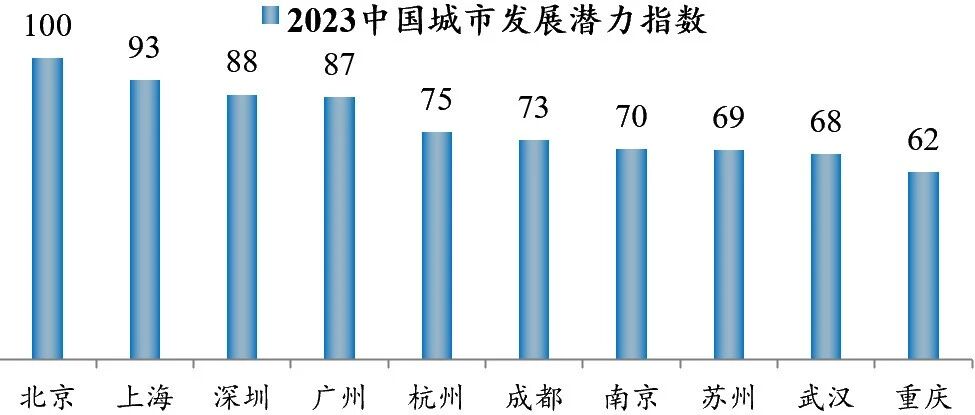
Core Viewpoint - The article discusses the competitive landscape of Chinese cities, highlighting the rapid urbanization and the emergence of new economic centers, while ranking the development potential of 337 cities in China, with Beijing, Shanghai, Shenzhen, and others leading the list [2]. Group 1: Beijing - Beijing is positioned as the political, cultural, international exchange, and technological innovation center of China, with a GDP exceeding 4.1 trillion yuan in 2022, making it the second-largest city after Shanghai [9][10]. - The service sector accounts for 84% of Beijing's economy, with finance, headquarters economy, and technological innovation as key pillars [10]. - Future plans include transforming Beijing into a world-class harmonious city while optimizing population distribution to enhance urban vitality [11][13]. Group 2: Shanghai - Shanghai has established itself as an international economic center, with a GDP of approximately 4.5 trillion yuan in 2022, and aims to rival New York in global economic influence [16][24]. - The city’s industrial structure is supported by the automotive, electronics, and financial sectors, with finance contributing 19.3% to the GDP [17][19]. - Shanghai plans to continue its open policies and develop into a globally competitive city, enhancing the Yangtze River Delta region [24]. Group 3: Shenzhen - Shenzhen's GDP surpassed 3.2 trillion yuan in 2022, marking it as the third-largest city in China, with a significant annual population increase of around 600,000 [25][26]. - The city is recognized as a leading innovation hub, with strategic emerging industries accounting for over 41% of its GDP [26]. - Future initiatives focus on enhancing collaboration within the Guangdong-Hong Kong-Macau Greater Bay Area to solidify its status as a global innovation city [29]. Group 4: Guangzhou - Guangzhou's GDP reached approximately 2.9 trillion yuan in 2022, ranking fifth nationally, with a strong manufacturing base in automotive and electronics [30][31]. - The city faces challenges in innovation capacity and financial sector development, with financial services contributing only 9.2% to the GDP [33]. - Future goals include enhancing its role as a national center city and participating in global economic cooperation [34]. Group 5: Hangzhou - Hangzhou's economy has shown robust growth, with a GDP of around 1.9 trillion yuan in 2022, driven by a vibrant private and digital economy [36][37]. - The city is recognized for its strong digital economy, with core digital industries contributing 27.1% to the GDP [37]. - Plans for the future include improving transportation infrastructure and fostering a more open and innovative business environment [41][42]. Group 6: Chengdu - Chengdu's GDP exceeded 2 trillion yuan in 2022, accounting for 36.7% of Sichuan province's economy, and it is recognized as a key economic hub in Western China [43][44]. - The electronics sector is a major contributor, with a significant portion of the industrial output [44]. - Future strategies involve enhancing its role as a national center city and collaborating with Chongqing to develop the Western economic highland [49]. Group 7: Nanjing - Nanjing's GDP approached 1.7 trillion yuan in 2022, with a per capita GDP of 179,000 yuan, ranking fifth among major cities [50][51]. - The city is focusing on developing its automotive, steel, electronics, and petrochemical industries while nurturing emerging sectors [51]. - Future aspirations include becoming an "innovation city" and enhancing its influence in the Yangtze River Delta region [54]. Group 8: Suzhou - Suzhou's GDP reached nearly 2.4 trillion yuan in 2022, making it the top city among prefecture-level cities in China [56]. - The city is recognized as a global industrial powerhouse, with significant contributions from electronics and manufacturing sectors [56]. - Future plans emphasize its role in the Yangtze River Delta urban cluster and advancing towards a high-tech manufacturing base [59].