嘉能可

Search documents
特朗普关税创造绝佳套利机会,四大贸易商狂捞3亿!
Jin Shi Shu Ju· 2025-07-11 13:29
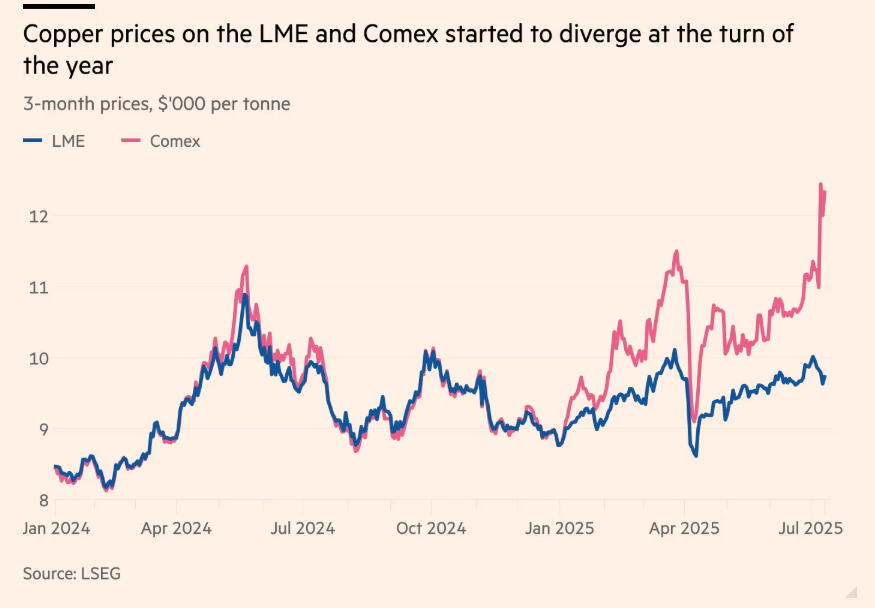
Group 1 - Major commodity traders Trafigura, Mercuria, Glencore, and IXM are expected to earn over $312 million in profits due to record copper shipments to the U.S. before the implementation of tariffs [1][4] - The U.S. copper price surged by 13% following the announcement of a 50% tariff on copper by the Trump administration, creating a significant arbitrage opportunity for traders [1][4] - Since the election in November, these traders have imported approximately 600,000 tons of "surplus" copper into the U.S., exceeding normal demand [4][7] Group 2 - The average price difference between LME and Comex since February indicates a profit of about $520 per ton after accounting for costs, leading to substantial profits for the traders involved [4] - Trafigura has imported around 200,000 tons of copper, while Mercuria is expected to bring in nearly 200,000 tons by the end of the month [4] - The influx of copper into the U.S. has significantly drained supply from global markets, marking a unique period in the copper market [4][7]


惠誉旗下BMI:未来10年全球铜矿山产量料年均增长2.9%
Wen Hua Cai Jing· 2025-07-11 10:26
Group 1 - Global copper mine production is expected to grow at an annual rate of 2.9% over the next decade, increasing from 23.8 million tons in 2025 to 30.9 million tons by 2034, driven by new projects and expansions due to high copper prices and positive demand outlook [1] - In 2023, global copper mine production is projected to increase by 2.5%, supported by recovery in Chilean output and increased production from Mongolia's Oyu Tolgoi mine, with Peru, Russia, and Zambia also contributing significantly [1] - Global copper production increased by 2% year-on-year during the first four months of this year, attributed to output increases from Peru's Las Bambas, Quellaveco, and Toromocho mines, as well as the Kamoa-Kakula mine in the Democratic Republic of Congo [1] Group 2 - The production growth forecast for 2025 has been revised downwards due to a decrease in production guidance from Kamoa-Kakula, which has been affected by seismic activity, although many companies, including Codelco, remain optimistic about the outlook [2] - Chile is expected to maintain its dominance in the copper supply chain, with production projected to grow by 3% to 5.7 million tons in 2025, accounting for a quarter of global mine production [2] - The increase in Chilean production is largely driven by the ongoing ramp-up at Teck's Quebrada Blanca mine, which is expected to offset challenges faced by state-owned Codelco [3] Group 3 - The Democratic Republic of Congo's production is also expected to grow by 3%, but there are downside risks due to the downward revision of Kamoa-Kakula's production guidance [4] - Peru's production is projected to increase by 3.2%, rebounding after a 1% decline in 2024 [4]

对等关税博弈VS国内政策刺激预期,有色止跌回升
Zhong Xin Qi Huo· 2025-07-11 00:24
1. Report Industry Investment Rating - The report does not explicitly provide an overall industry investment rating. However, individual metal outlooks are as follows: - Copper: Expected to be in a "震荡" (sideways) pattern [6] - Alumina: Expected to be in a "震荡" (sideways) pattern [7] - Aluminum: Expected to be "震荡偏强" (sideways with a slight upward bias) in the short - term and cautious about long - term consumption [10] - Aluminum alloy: Expected to be in a "震荡" (sideways) pattern in the short - term and have upward potential in the medium - term [11] - Zinc: Expected to be "震荡偏弱" (sideways with a slight downward bias) [15] - Lead: Expected to be in a "震荡" (sideways) pattern [16] - Nickel: Expected to be "震荡偏弱" (sideways with a slight downward bias) in the medium - to - long - term, and strengthen in the short - term [21] - Stainless steel: Expected to be in a "震荡" (sideways) pattern in the short - term [24] - Tin: Expected to be in a "震荡" (sideways) pattern [25] 2. Core Viewpoints of the Report - The macro - environment shows a game between US reciprocal tariff measures and domestic policy stimulus expectations, leading to repeated macro - expectations and continued volatility in the non - ferrous metals market. - From a supply - demand perspective, the supply - demand of base metals is seasonally loosening, with domestic inventory destocking slowing down and some varieties starting to accumulate inventory slightly. - In the short - to - medium - term, tariff uncertainties and weakening demand expectations suppress prices, while policy stimulus expectations and supply disruptions support prices. Attention should be paid to structural opportunities, and low - buying short - term long opportunities for aluminum and tin can be cautiously considered. - In the long - term, the demand prospects of base metals are still uncertain, and opportunities to sell short at high prices for some varieties with supply surpluses or expected surpluses can be considered [1]. 3. Summary by Directory 3.1行情观点 3.1.1 Copper - **Viewpoint**: US tariffs on copper may be implemented, pressuring the price of Shanghai copper. - **Analysis**: Trump announced a 50% tariff on imported copper, and the US Commerce Secretary said the new tariff might be implemented at the end of July or on August 1st. The TC/RC negotiation result between Antofagasta and Chinese smelters in mid - 2025 was 0.0 dollars/dry ton and 0.0 cents/pound. In June, SMM China's electrolytic copper production decreased slightly month - on - month and increased year - on - year. As of July 10th, copper inventory increased. - **Logic**: Macro factors put pressure on LME and Shanghai copper prices. On the supply - demand side, copper ore processing fees are falling, raw material supply is tight, and overseas smelters are reducing production. Demand is weakening in the off - season, and inventory is accumulating. It is expected that copper prices will fluctuate [6]. 3.1.2 Alumina - **Viewpoint**: Arbitrage space has opened, but sentiment is stronger, and alumina prices continue to rise. - **Analysis**: Alumina spot prices in various regions have increased. Guinea has introduced reform measures for the mining industry, including creating the Guinea Bauxite Index and exercising sales and transportation rights. Alumina warehouse receipts remained unchanged on July 8th, and Xinjiang's alumina shipments will be affected in the short term. - **Logic**: In the short - to - medium - term, there is no shortage of ore, and production capacity and inventory are increasing, but warehouse receipts are still low. The anti - cut - throat competition sentiment drives prices up. In the long - term, Guinea's policies may affect ore prices [7]. 3.1.3 Aluminum - **Viewpoint**: The inventory accumulation rhythm is fluctuating, and aluminum prices are oscillating with a slight upward bias. - **Analysis**: On July 10th, the average price of SMM AOO aluminum increased, and inventory in the main consumption areas decreased. Aluminum rod inventory increased. The Shanghai Futures Exchange's electrolytic aluminum warehouse receipts increased. The "Big and Beautiful" bill was approved, and Trump announced tariffs on imports from 14 countries. - **Logic**: The tariff negotiation deadline is postponed, and domestic anti - cut - throat competition expectations drive up sentiment. Aluminum ingot inventory accumulation is uncertain, and downstream demand may be under pressure in the second half of the year [10]. 3.1.4 Aluminum Alloy - **Viewpoint**: Demand has entered the off - season, and aluminum alloy prices are oscillating. - **Analysis**: On July 10th, the price of Baotai ADC12 increased, and the price difference between Baotai ADC12 and AOO aluminum widened. Thailand plans to levy a carbon tax. In June, the retail sales of passenger cars and new energy passenger cars increased year - on - year. - **Logic**: In the short - term, the supply of scrap aluminum is tight, supporting costs. Demand is in the off - season, and inventory is accumulating. In the medium - term, demand may recover seasonally [11]. 3.1.5 Zinc - **Viewpoint**: The rebound of ferrous metal prices boosts galvanizing demand, and zinc prices are strong in the short - term. - **Analysis**: On July 10th, the spot premiums of zinc in different regions varied. As of July 10th, SMM's seven - region zinc ingot inventory increased. The Xinjiang Huoshaoyun lead - zinc smelting project was put into production. - **Logic**: Macro factors boost galvanizing demand. The short - term supply of zinc ore is loosening, and smelters' profitability is good. However, demand is in the off - season, and inventory is accumulating. In the long - term, supply may exceed demand, and prices may fall [14]. 3.1.6 Lead - **Viewpoint**: Cost support is stable, and lead prices are oscillating. - **Analysis**: On July 10th, the price of waste electric vehicle batteries remained unchanged, and the price difference between primary and secondary lead remained stable. Lead ingot inventory increased, and the Shanghai lead futures warehouse receipts increased slightly. - **Logic**: On the spot side, the premium is stable. On the supply side, the cost of recycled lead is stable, and production is increasing slightly. On the demand side, the operating rate of lead - acid battery factories is increasing, and demand is recovering. It is expected that lead prices will fluctuate [16]. 3.1.7 Nickel - **Viewpoint**: The real - estate market has become a hot topic again, and nickel prices are strengthening in the short - term. - **Analysis**: On July 10th, LME nickel inventory increased, and Shanghai nickel warehouse receipts decreased. There have been many investment and production - start events in the nickel industry in Indonesia, Canada, and Brazil. - **Logic**: Market sentiment dominates the market, and the industrial fundamentals are weakening marginally. The supply of raw materials may increase, and inventory is accumulating. It is expected that nickel prices will be weak in the medium - to - long - term and strengthen in the short - term [20]. 3.1.8 Stainless Steel - **Viewpoint**: Sentiment supports the upward movement of the stainless - steel futures market. - **Analysis**: Stainless - steel futures warehouse receipts remained unchanged. Nickel iron and chrome iron prices are weakening. Stainless - steel production decreased in June, and social inventory decreased last week. - **Logic**: Cost support is weakening, and demand may weaken after the peak season. It is necessary to pay attention to the scale of production cuts by steel mills and inventory changes. It is expected that stainless - steel prices will fluctuate in the short - term [24]. 3.1.9 Tin - **Viewpoint**: The supply - demand fundamentals are resilient, and tin prices are oscillating. - **Analysis**: On July 10th, LME and Shanghai tin warehouse receipts decreased, and Shanghai tin positions decreased. The average price of 1 tin ingots remained unchanged. - **Logic**: The shortage of tin ore in China is intensifying, and Indonesia's refined tin exports are restricted, supporting prices. However, the impact may be limited, and terminal demand is weakening in the second half of the year. It is expected that tin prices will fluctuate [25]. 3.2行情监测 The report only lists the names of the monitored varieties (copper, alumina, aluminum, zinc, lead, nickel, stainless steel, tin), but no specific monitoring content is provided.
直线飙升!关税,大消息!
券商中国· 2025-07-10 10:48
Core Viewpoint - The announcement of a 50% tariff on imported copper by the U.S. government is expected to significantly impact copper prices and various sectors of the U.S. economy, leading to increased costs and potential inflationary pressures [1][3][4]. Group 1: Tariff Announcement and Immediate Market Reaction - On July 9, President Trump announced a 50% tariff on imported copper, effective from August 1, 2025, which led to a sharp increase in copper prices, with COMEX copper prices rising over 2% initially and even spiking 17% at one point [1][4]. - The tariff announcement has caused a premium of approximately 25% for New York copper prices over the international benchmark LME prices, indicating heightened market volatility and speculation [2][6]. Group 2: Economic Implications - The copper tariff is likely to escalate costs across multiple sectors in the U.S. economy, particularly in electronics, automotive, construction, and data centers, as nearly half of the copper consumed in the U.S. is imported, primarily from Chile [3][4]. - Economic experts have expressed concerns that while the tariff may not effectively reduce national security risks, it will lead to increased costs and inflation, adversely affecting economic growth [3][4]. Group 3: Market Dynamics and Trading Strategies - Traders are rapidly moving to ship copper to the U.S. before the tariff takes effect, with some adjusting shipping routes to places like Hawaii and Puerto Rico to expedite deliveries [7][8]. - The current speculative environment in the COMEX copper market is strong, with expectations that the price differential between COMEX and LME copper will continue to widen, potentially reaching 50% [5][7]. Group 4: Future Uncertainties and Adjustments - Despite the announced tariff, there are uncertainties regarding its implementation details, such as which types of copper will be affected, leading to speculation that the tariff may serve as a negotiation tool rather than a definitive policy [9]. - Historical precedents suggest that previously implemented tariffs on steel and aluminum allowed for exemptions on goods already in transit, which may provide some flexibility for traders facing the new copper tariff [9].

特朗普50%关税震动铜市!大摩小摩预判:美国铜价进一步与国际脱钩
Zhi Tong Cai Jing· 2025-07-10 09:52
Group 1: Market Impact - The announcement of a 50% tariff on copper imports by the U.S. President has led to a significant increase in COMEX copper futures, reaching historical highs, while LME copper prices have declined [1] - Morgan Stanley and JPMorgan expect the price gap between COMEX and LME copper futures to widen, with COMEX prices potentially rising further and LME prices declining [2][3] Group 2: Supply and Demand Dynamics - JPMorgan predicts that U.S. copper imports will be relatively low for 4 to 5 months post-tariff implementation, leading to a potential shift of refined copper from the U.S. to other global markets, particularly Asia [3] - The anticipated reduction in U.S. copper demand due to high prices may challenge future growth, despite ongoing trends in electrification supporting copper demand [3] Group 3: Company Analysis - JPMorgan identifies several mining companies that may benefit from higher U.S. copper prices, including First Quantum Minerals, Hudbay Minerals, and Taseko Mines, with specific projects and timelines highlighted [4] - Freeport-McMoRan is noted as the largest beneficiary of rising U.S. copper prices, with approximately 75% of its revenue derived from copper, and significant operations in Arizona [4][5] - Southern Copper Corporation is also mentioned as a potential beneficiary, with about 40% of its contracts linked to COMEX, although this may change as clients renegotiate contracts [5]
美国关税政策引爆全球铜库存“大搬家” 纽约—伦敦期铜价差套利交易沸腾
经济观察报· 2025-07-10 09:48
Core Viewpoint - The COMEX copper trading prices have largely detached from the supply-demand fundamentals and are now heavily influenced by speculative capital, leading to uncertainty about future price movements [1][6]. Group 1: Impact of Tariffs - On July 8, President Trump announced a 50% tariff on copper imports, causing the COMEX copper main contract to surge over 17%, marking the largest single-day increase in history [3][4]. - The price difference between COMEX and LME copper contracts exceeded $2,600 per ton, prompting many CTA funds to engage in arbitrage by buying LME copper while shorting COMEX copper [5][6]. Group 2: Market Dynamics - The influx of copper into the U.S. is expected to continue, with estimates suggesting over 500,000 tons have been redirected to the U.S. market, leading to a significant increase in U.S. copper inventories [6][13]. - As of June 30, LME copper inventories dropped to 90,625 tons, a decrease of two-thirds from the beginning of the year, while COMEX inventories rose to 211,209 tons, an increase of over 126% [11][12]. Group 3: Trading Strategies - Many traders are capitalizing on the widening price gap between COMEX and LME copper through arbitrage strategies, with some institutions entering the market to bet on further widening of this gap [14][15]. - The speculative atmosphere in the COMEX market has led to increased trading volumes, with a 30% rise in call options on COMEX copper, indicating a strong bullish sentiment among investors [17]. Group 4: Global Supply Chain Effects - The U.S. tariff policy has created a "siphoning effect," drawing global copper supplies towards the U.S. and tightening inventories in non-U.S. regions, which may lead to increased processing fees for copper smelters [22][23]. - The processing fee for copper concentrate has turned negative, resulting in significant losses for smelting companies, although high sulfuric acid prices are helping to offset these losses [24]. Group 5: Domestic Market Reactions - Domestic copper prices in China have not followed the surge in COMEX prices, as they remain closely aligned with LME prices, which are seen as more reflective of global supply-demand dynamics [25]. - Analysts suggest that the final implementation of the 50% tariff will create significant volatility in overseas copper prices, which could lead to increased uncertainty in domestic copper pricing [26].

X @Bloomberg
Bloomberg· 2025-07-10 08:16
Aster Chemicals and Energy, a joint venture between Indonesia’s Chandra Asri Group and global commodities trader Glencore, is in talks to buy oil major Exxon Mobil’s gas stations in Singapore, sources say https://t.co/oXroZo9bK7 ...
全球矿业研究 | 这家巨头的铜矿将成为特朗普“美国制造”战略的代表?
彭博Bloomberg· 2025-07-10 03:44
Group 1 - The global energy market is experiencing constant turmoil due to rapid industry development, geopolitical tensions, and fluctuating supply and demand dynamics [2] - Bloomberg Intelligence provides timely industry updates and high-quality data analysis to help interpret market changes and foresee future trends [2] Group 2 - Copper production from 17 covered companies, accounting for 45% of global supply, is expected to grow at a compound annual growth rate (CAGR) of 2.9% over the next five years, reaching a significant increase of 6-6.5% by 2026 [5] - Key factors for the anticipated production increase include the restart of First Quantum's Cobre Panama mine, recovery of Ivanhoe's Kamoa-Kakula post-earthquake, and production increases from Rio Tinto's Oyu Tolgoi and Escondida mines [5] Group 3 - Historical data shows that changes in U.S. tariff policies have had minimal impact on aluminum prices in both the London Metal Exchange (LME) and Shanghai Futures Exchange (SHFE), with global supply and demand remaining the primary drivers [7] - For instance, during Trump's first term, a 10% tariff led to an 8-10% price drop, but prices rebounded shortly after [7] Group 4 - Glencore's coal division is undervalued compared to peers, with an estimated valuation of 2.4x EV/Ebitda, which is approximately 38% lower than the industry average [11] - If valued similarly to peers, Glencore's coal business could be worth 17% more than its current market value [11] Group 5 - Platinum prices are expected to continue rising due to supply disruptions similar to those seen in 2008, alongside increased demand from hybrid vehicles and jewelry [12] - The first quarter of this year has already shown favorable demand trends, supporting the price increase [12] Group 6 - The U.S. plans to raise steel import tariffs to 50% under Section 232 to further reduce imports, which currently account for 28% of apparent steel consumption [15] - The government will need to avoid granting exemptions or negotiate alternative agreements to effectively lower import levels [15] Group 7 - China has become a net exporter of alumina, with exports surging 75% in the first four months of the year, driven by rapid capacity expansion and slowing domestic demand [20] - The country’s alumina demand is expected to grow by 1.1% this year, while supply is likely to exceed consumption [20] Group 8 - Hudbay's Copper World project has seen a stock price increase of over 55% since early April, driven by strong first-quarter performance and rising metal prices [22] - The project is valued between $130 million and $140 million, with potential interest from investors in Saudi Arabia, UAE, and Japan [22]
对等关税博弈延续,资金谨慎驱动有色回落
Zhong Xin Qi Huo· 2025-07-10 01:10
1. Report Industry Investment Rating - Copper: Oscillating [7] - Alumina: Short - term wait - and - see, medium - to - long - term cautious short - selling of far - month contracts or consider reverse arbitrage if warehouse receipts increase [8][10] - Aluminum: Oscillating in a range [11] - Aluminum Alloy: Short - term low - level oscillation, medium - term potential for upward movement [12][14][15] - Zinc: Oscillating weakly, focus on high - short opportunities [15][16] - Lead: Oscillating [16][17][19] - Nickel: Oscillating weakly in the short term [19][20][22] - Stainless Steel: Oscillating in the short term [24] - Tin: Oscillating [25] 2. Core Viewpoints of the Report - The ongoing US reciprocal tariff game and Trump's threat to impose a 50% tariff on copper imports have led to a cautious market sentiment, causing a decline in the non - ferrous metals market. In the short - to - medium term, tariff uncertainties and weakening demand expectations will suppress prices, with a focus on structural opportunities. In the long term, the demand prospects for non - ferrous metals remain uncertain [1]. 3. Summary by Relevant Catalogs Copper - **Information Analysis**: Trump announced a 50% tariff on imported copper. The TC/RC negotiation result between Antofagasta and Chinese smelters in mid - 2025 was 0.0 dollars/dry ton and 0.0 cents/pound. In June, China's electrolytic copper production decreased by 0.34 tons month - on - month, a 0.3% decline, but increased by 12.93% year - on - year. As of July 7, copper inventory increased by 1.11 tons to 14.29 tons [7]. - **Main Logic**: Trump's tariff announcement has put pressure on LME and Shanghai copper prices. The supply of copper raw materials is tight, and the demand has weakened in the off - season. Inventories have started to accumulate, and the upward momentum of copper prices has cooled. It is expected that copper prices will oscillate [7]. Alumina - **Information Analysis**: On July 9, the northern spot comprehensive price of alumina increased. The government of Guinea proposed GBX and exercised transportation rights. On July 8, alumina warehouse receipts remained unchanged. The Xinjiang railway issued a suspension order from July 7 - 11 [8][10]. - **Main Logic**: In the short - to - medium term, there is no shortage of ore, but the market sentiment has a significant impact. In the long term, the focus is on ore prices. The measures proposed by Guinea may increase costs. In the short term, wait and see; in the medium - to - long term, consider short - selling far - month contracts [8][10]. Aluminum - **Information Analysis**: On July 9, the average price of SMM AOO was 20,660 yuan/ton. As of July 7, the inventory of electrolytic aluminum and aluminum rods increased, and the warehouse receipts of electrolytic aluminum on the SHFE increased [11]. - **Main Logic**: The tariff negotiation deadline has been postponed, but there is still uncertainty. The fundamentals show inventory accumulation, and downstream willingness to buy at high prices has weakened. In the short term, prices will oscillate in a range; in the long term, consumption has potential risks [11]. Aluminum Alloy - **Information Analysis**: On July 9, the price of Baotai ADC12 remained unchanged. Thailand plans to impose a carbon tax in 2025. In June, the retail sales of passenger cars and new - energy passenger cars increased year - on - year [12]. - **Main Logic**: The supply of scrap aluminum is tight, and the cost is supportive. Demand is in the off - season, and the inventory is accumulating. In the short term, ADC12 and ADC12 - A00 will oscillate at a low level; in the medium term, there is potential for upward movement [12][14][15]. Zinc - **Information Analysis**: As of July 9, the spot premium of zinc decreased, and the inventory increased. The Xinjiang Huoshaoyun lead - zinc smelting project was put into production [15]. - **Main Logic**: The market risk preference has decreased. The supply of zinc ore has loosened, and the demand is in the off - season. The inventory is accumulating, and prices are expected to decline in the long term [15][16]. Lead - **Information Analysis**: On July 9, the price of waste batteries remained stable, and the price of lead ingots increased. The social inventory of lead ingots and SHFE warehouse receipts increased [16][17]. - **Main Logic**: The spot discount has slightly widened, and the supply has increased. The demand for lead - acid batteries has improved slightly. In the short term, prices will oscillate [16][17][19]. Nickel - **Information Analysis**: As of July 9, LME nickel inventory increased, and SHFE nickel warehouse receipts decreased. Multiple nickel - related projects have advanced [19][20][21]. - **Main Logic**: The market sentiment dominates the market. The industrial fundamentals are weakening marginally. The inventory has accumulated significantly, and prices are expected to oscillate weakly in the short term [19][20][22]. Stainless Steel - **Information Analysis**: The inventory of stainless steel warehouse receipts decreased. The price of nickel iron and chrome iron has declined, and the 300 - series is still in an inverted state [24]. - **Main Logic**: The cost support has weakened, and the demand is out of the peak season. The inventory has decreased, and it is expected that stainless steel prices will oscillate in the short term [24]. Tin - **Information Analysis**: On July 9, LME tin warehouse receipts increased, and SHFE tin warehouse receipts decreased. The price of tin ingots increased [25]. - **Main Logic**: The shortage of tin ore in China is intensifying, and the supply from Indonesia is affected. The supply - demand fundamentals are tightening, but the demand will weaken in the second half of the year. It is expected that tin prices will oscillate [25].
美国关税政策引爆全球铜库存“大搬家” 纽约—伦敦期铜价差套利交易沸腾
Jing Ji Guan Cha Wang· 2025-07-10 00:14
Core Viewpoint - The announcement of a 50% tariff on copper imports by the U.S. President has led to significant volatility in copper markets, with COMEX copper prices soaring while LME prices fell, creating a substantial price differential that traders are exploiting through arbitrage strategies [2][3][4]. Market Reactions - Following the tariff announcement, COMEX copper futures saw a one-day increase of over 17%, marking the largest single-day gain in history, while LME copper contracts experienced a decline, resulting in a price differential exceeding $2,600 per ton [2][3]. - Traders, including CTA fund managers, have engaged in cross-market arbitrage by buying LME copper while shorting COMEX copper to lock in profits from the price differential [2][6]. Supply Chain Dynamics - The U.S. tariff is expected to shift copper inventories from London to New York, as traders seek to capitalize on the price differential, with estimates suggesting over 500,000 tons of copper have already moved to the U.S. [3][5]. - LME copper inventories have decreased significantly, dropping to 90,625 tons by June 30, down from 271,350 tons at the beginning of the year, while COMEX inventories increased to 211,209 tons, reflecting a shift in supply dynamics [5]. Trade and Export Trends - The anticipated tariffs have led to a surge in copper exports from China, with exports reaching 15,770 tons in June, surpassing previous records, as domestic producers seek to alleviate inventory pressures [9]. - The ongoing shift in global copper supply dynamics has resulted in tightening inventories in non-U.S. regions, prompting copper smelters to lower processing fees due to increased operational costs [9][10]. Future Outlook - The current speculative environment in the COMEX copper market is heavily influenced by the tariff announcement, with concerns that rising U.S. copper inventories could lead to a price correction in the near future [7][10]. - Analysts suggest that the final implementation of the 50% tariff will have significant implications for global copper prices, potentially increasing volatility in domestic markets as well [10].