
潞安环能

Search documents
山西证券:进口煤量收缩趋势放缓 未来进口增量有待观察
智通财经网· 2025-08-27 03:15
Group 1 - The trend of shrinking imported coal volume is slowing down, with a marginal improvement in year-on-year negative growth and a month-on-month positive growth in July [1][2] - In July, the total imported coal price was $67 per ton, continuing a year-on-year decline, with a month-on-month decrease of $6.23 per ton [1] - Domestic coal production has contracted both year-on-year and month-on-month, leading to an increase in imported coal demand due to domestic supply gaps [2] Group 2 - The increase in import volume has not led to a rise in import prices, indicating that the overseas supply-demand structure has not significantly improved [3] - The expectation of coal demand remains uncertain due to recent domestic "anti-involution" initiatives and the stable growth outlook for various downstream industries [3] - Companies to watch for potential performance recovery in the coal sector include Huayang Co., Jinkong Coal, Shanmei International, and Luan Environmental Energy, among others [1][3]

25年7月进口煤量收缩趋势放缓,未来增量有待观察 | 投研报告
Zhong Guo Neng Yuan Wang· 2025-08-27 02:52
Core Viewpoint - Shanxi Securities recently released coal import data indicating a contraction in import volumes, with a cumulative decline of 13% from January to July. Although July saw a year-on-year decrease of 22.94%, there was a month-on-month increase of 7.78%, suggesting a marginal easing of the negative growth trend [1][2]. Data Breakdown - The cumulative import volume from January to July has decreased by 13%, continuing a contraction trend. July marked the fifth consecutive month of year-on-year negative growth, but the rate of decline is slowing, with a 22.94% drop year-on-year and a 7.78% increase month-on-month [1][2]. - All coal types are experiencing year-on-year negative growth, but only anthracite coal shows a month-on-month decline. The increase in coking coal imports is primarily from Mongolia and Russia, while thermal coal imports are mainly from Australia, and lignite imports are from Indonesia [2]. - The average import price for all coal types is $67 per ton, continuing a downward trend year-on-year. In July, the price decreased by $6.23 month-on-month, with significant year-on-year declines across all coal types [2]. Commentary and Investment Suggestions - Domestic supply shortages are driving import demand, with July's internal trade coal prices stabilizing and rebounding. Domestic raw coal production has contracted both year-on-year and month-on-month, which has somewhat boosted the demand for imported coal [3]. - Future import increases remain uncertain. Despite a rise in import volumes, prices have not increased correspondingly, indicating that the overseas supply-demand structure has not significantly improved. The divergence between domestic and imported coal prices may influence future import trends [3]. - The company suggests monitoring coal stocks as prices continue to rise unexpectedly, with potential performance recovery for companies like Huayang Co., Jinkong Coal Industry, Shanxi Coal International, and others. Leading coal enterprises such as Shaanxi Coal and China Shenhua still hold high investment value [3].
机构:高股息率资产仍具吸引力,国企红利ETF(159515)整固蓄势
Sou Hu Cai Jing· 2025-08-26 05:53
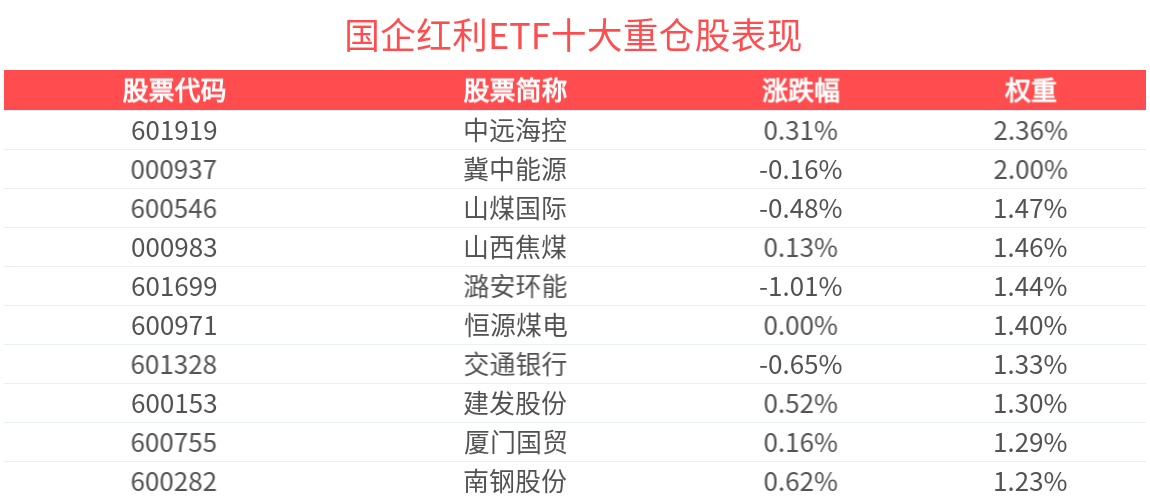
Group 1 - The China Securities State-Owned Enterprises Dividend Index (000824) decreased by 0.09% as of August 26, 2025, with mixed performance among constituent stocks [1] - China National Cereals, Oils and Foodstuffs Corporation (600737) led the gains with an increase of 5.90%, while Shaanxi Natural Gas (002267) experienced the largest decline [1] - The National State-Owned Enterprises Dividend ETF (159515) is consolidating, with the latest price at 1.17 yuan [1] Group 2 - The China Securities State-Owned Enterprises Dividend Index tracks 100 listed companies with high cash dividend yields, reflecting the overall performance of high-dividend securities among state-owned enterprises [2] - As of July 31, 2025, the top ten weighted stocks in the index accounted for 16.77% of the total index weight, including China COSCO Shipping (601919) and Jizhong Energy (000937) [2] Group 3 - Analysts from Minsheng Securities noted that insurance capital prefers undervalued, high-dividend stocks with strong performance certainty, especially in a declining long-term interest rate environment [1] - The report from Caixin Securities suggests that high dividend yield assets remain attractive, with long-term funds like insurance capital likely to continue flowing into these assets [1]



尿素日报:厂家降价吸单,下游采购谨慎-20250826
Hua Tai Qi Huo· 2025-08-26 05:24
Report Industry Investment Rating - Unilateral: Neutral; Inter - period: After the export window period, go for reverse hedging on 01 - 05 when the price is high; Inter - variety: None [3] Core Viewpoints - Recently, the impact of export sentiment has weakened. Manufacturers are reducing prices to attract orders, but downstream buyers are cautious. Spot prices have fallen to previous lows, and there has been an improvement in trading. The downstream agricultural demand is in the off - season, and industrial demand is weak. The urea production is at a high level, and the upstream inventory is still relatively high compared to the same period. Although some companies are expected to undergo maintenance next week and production may decline slightly, with the release of new production capacity, the future supply - demand of urea remains relatively loose. The profit of coal - based urea production is okay, and the cost - side support is average. The export of urea is ongoing, and the port inventory has increased slightly. The Indian NFL's urea import tender may boost the international urea market [2] Summary by Directory 1. Urea Basis Structure - On August 25, 2025, the urea main contract closed at 1745 yuan/ton (+6). The ex - factory price of small - sized urea in Henan was 1710 yuan/ton (unchanged), in Shandong was 1700 yuan/ton (-40), and in Jiangsu was 1710 yuan/ton (-30). The basis in Shandong was - 45 yuan/ton (-46), in Henan was - 35 yuan/ton (-46), and in Jiangsu was - 35 yuan/ton (-36) [1] 2. Urea Production - As of August 25, 2025, the enterprise capacity utilization rate was 83.98% (0.08%). Next week, Yuntianhua, Henan Xinlianxin, and Shanxi Lu'an are expected to undergo maintenance, and production may decline slightly. However, with the release of new production capacity, future urea supply - demand remains relatively loose [1][2] 3. Urea Production Profit and Operating Rate - As of August 25, 2025, the urea production profit was 170 yuan/ton (-40). The coal - based urea profit is okay, and the cost - side support is average [1][2] 4. Urea Off - shore Price and Export Profit - As of August 25, 2025, the export profit was 1270 yuan/ton (+1). August is the export window period, urea export is ongoing, and the port inventory has increased slightly. The Indian NFL has issued a urea import tender, which will boost the international urea market [1][2] 5. Urea Downstream Operating Rate and Orders - As of August 25, 2025, the compound fertilizer capacity utilization rate was 40.84% (-2.64%); the melamine capacity utilization rate was 46.60% (-3.22%); the pre - received order days of urea enterprises were 6.06 days (-0.23). The downstream industrial demand is weak, and there is still resistance to high - priced goods [1][2] 6. Urea Inventory and Warehouse Receipts - As of August 25, 2025, the total inventory of sample enterprises was 102.39 million tons (+6.65), and the port sample inventory was 50.10 million tons (+3.70). The upstream inventory is still relatively high compared to the same period [1]
煤炭进口数据拆解:25年7月进口煤量收缩趋势放缓,未来增量有待观察
Shanxi Securities· 2025-08-26 02:49
Investment Rating - The report maintains an investment rating of "A" for the coal sector, indicating expected performance leading the market [1]. Core Insights - The coal import volume has shown a slowing trend of contraction, with a cumulative decrease of 13% from January to July 2025. Despite a continuous negative growth rate for five months, July saw a year-on-year decrease of 22.94% but a month-on-month increase of 7.78% [1][3]. - The overall import price for coal types averaged $67 per ton, continuing a downward trend year-on-year, with a month-on-month decrease of $6.23 in July [1]. - Domestic coal production has contracted both year-on-year and month-on-month, leading to an increase in import demand due to a domestic supply gap [3]. Summary by Sections Import Data Analysis - The report highlights that all coal types have shown negative year-on-year growth, with only anthracite coal experiencing a month-on-month decline. The increase in coking coal imports is primarily from Mongolia and Russia, while thermal coal imports are mainly from Australia, and lignite imports are from Indonesia [1][3]. Price Trends - The report notes that the import prices for all coal types have significantly decreased compared to the previous year, with July showing a downward trend across all categories [1]. Future Outlook - The report suggests that while there is an increase in import volume, the prices have not risen correspondingly, indicating a potential imbalance in the overseas supply-demand structure. The future demand for coal remains uncertain due to domestic economic conditions and the impact of the "anti-involution" campaign [3]. Investment Recommendations - The report recommends focusing on coal stocks that are expected to recover in performance due to rising coal prices, highlighting companies such as Huayang Co., Jinkong Coal Industry, and Shanxi Coking Coal as key investment targets [2][3].
从财务及固定资产视角看价格支撑 - 煤炭成本专题研究
2025-08-25 14:36
Summary of Coal Industry Conference Call Industry Overview - The conference call focuses on the coal industry, specifically the production costs and financial pressures faced by coal companies [1][2][3]. Key Points and Arguments - **Rising Production Costs**: Coal companies have seen a steady increase in production costs over the years, with labor costs exceeding 20%, materials and power costs around 20%, depreciation and amortization costs between 10%-20%, and safety maintenance costs between 15%-20% [1][2]. - **Indirect Costs Decline**: The overall indirect cost rate in the coal industry has decreased, with management expenses being the largest component at approximately 8%. Employee compensation constitutes over 50% of management expenses [4]. - **Resource Tax Increases**: Resource tax is a significant part of the taxes and additional charges for coal companies, with some provinces raising resource tax rates to increase fiscal revenue. For instance, Shanxi raised its resource tax to 10% and Xinjiang to 9% [5]. - **Cost Increase from 2015 to 2023**: The average cost of thermal coal has increased by approximately 130 CNY/ton, while coking coal has risen by around 307 CNY/ton, with the latter experiencing a higher increase due to labor and safety costs [6][7]. - **Mining Rights and Construction Costs**: The price of mining rights has surged from 2-3 CNY/ton to 10-15 CNY/ton, and construction costs have risen from 500 CNY/ton to an average of 1,169 CNY/ton, with some regions exceeding 1,800 CNY/ton [3][10]. - **Financial Pressures**: New mines are expected to raise production costs by about 40 CNY/ton, with the average production cost of thermal coal now at approximately 130 CNY/ton, indicating limited room for cost reduction [11]. - **Comparison with 2015**: The current coal market differs significantly from 2015, with improved supply-demand dynamics and lower debt levels among coal companies, leading to a more stable financial environment [12][15]. - **Future Price Predictions**: The bottom price for coal is estimated to be around 610 CNY, with limited upward elasticity due to increasing renewable energy installations impacting demand [16]. - **Investment Recommendations**: Investors are advised to focus on leading companies with strong dividend yields above 4.5%, such as China Shenhua, Shaanxi Coal, and others, while also considering coking coal companies for potential gains [17]. Additional Important Information - **Labor Cost Drivers**: The rise in labor costs is attributed to the diminishing low-cost labor advantage, inflation-driven wage increases, and stricter safety regulations [9]. - **Tax and Additional Charges**: Taxes and additional charges account for about 10% of coal revenue, with resource tax being the most significant component [5]. - **Market Dynamics**: The coal market is currently experiencing a phase of temporary supply-demand imbalance, primarily due to seasonal factors like warm winters affecting electricity demand [14].
尿素周报:盘面回归基本面-20250825
Guan Tong Qi Huo· 2025-08-25 11:15
Report Summary 1) Report Industry Investment Rating No investment rating information is provided in the report. 2) Core Viewpoint of the Report The export - related positive sentiment has been mostly digested, while weak domestic demand is dragging down the futures price. Currently, both supply and demand are weak, and the futures price has returned to the fundamentals. It is expected to remain bearish in the short term [2]. 3) Summary by Relevant Catalogs Spot Market Dynamics - In the first half of last week, the futures market rose due to the China - India friendly talks, driving up the spot price. In the second half, the market transaction atmosphere was average, and factories generally lowered prices to attract orders, with limited results. Since the weekend, the urea price has shown a fluctuating downward trend, and demand remains weak [4][5]. Futures Dynamics - Last week, the urea futures price first declined and then rose, showing an overall upward trend but finally falling back. As of August 11, the main January contract of urea closed at 1,722 yuan/ton, a decrease of 33 yuan/ton compared to the settlement price on August 18. Last week's trading volume was 2,806.99 million tons, a week - on - week increase of 1,781.45 million tons; the open interest was 620.05 million tons, a week - on - week increase of 5.91 million tons. The futures decline was weaker than the spot decline, and the basis weakened. As of August 25, the basis of the 01 contract was - 35 yuan/ton, a weekly decrease of 21 yuan/ton; the 1 - 5 spread was - 44 yuan/ton, a weekly decrease of 7 yuan/ton. On August 25, 2025, the number of urea warehouse receipts was 5,123, a week - on - week increase of 1,550 [8][9][10]. Urea Supply - side - Last week, the weekly urea production increased. From August 15 to August 21, the weekly urea production was 1.3611 billion tons, a week - on - week increase of 0.0125 billion tons or 0.93%, with an average daily production of 0.1944 billion tons. Among them, coal - based weekly production was 1.072 billion tons, a week - on - week increase of 1.23%; gas - based weekly production was 0.2891 billion tons, a week - on - week decrease of 0.17%. In the next cycle, it is expected that 4 enterprises will stop production and 1 enterprise will resume production, so the probability of a decrease in production is relatively high. As of August 18, 2025, the national daily urea production was 0.1947 billion tons, and the operating rate was 82.55%. The price of thermal coal increased due to tight supply, while the price of liquefied natural gas decreased. The price center of synthetic ammonia moved down, and the price of methanol increased [15][17][18]. Urea Demand - side - Last week, the compound fertilizer price remained flat week - on - week. As of August 22, the price of 45% sulfur - based compound fertilizer was 2,950 yuan/ton. Recently, the operating rate of compound fertilizer factories has reached a historical high for the same period, and the room for further increase is limited. Affected by environmental protection restrictions for the military parade, the operating rate has slightly decreased and will resume production later, but the overall increase is limited. The inventory of finished products in factories has been at a five - year high for the past two months, and the probability of centralized fertilizer procurement is low. From August 15 to August 22, the operating rate of compound fertilizer was 40.84%, a decrease of 2.64 percentage points from the previous week and 2.24 percentage points lower than the same period last year. The average weekly capacity utilization rate of melamine was 46.6%, a decrease of 3.22 percentage points from the previous period and 18.25 percentage points lower than the same period last year. As of August 22, 2025, the total inventory of Chinese urea enterprises was 1.0239 billion tons, a week - on - week increase of 0.0665 billion tons or 6.65%, and 0.5633 billion tons higher than the same period last year. The port sample inventory was 0.483 billion tons, a decrease of 0.01 billion tons from the previous week [20][22]. International Market - China's third batch of urea exports is expected to complete customs clearance on October 15, about 700,000 - 800,000 tons. With the easing of China - India relations, there will be export quotas to India. India has a continuous demand for urea and will continue to issue tenders. Under China's export expectations, the international urea price will be under pressure. India's NFL issued a new round of urea import tender, targeting to purchase 2 million tons (1 million tons each for the east and west coasts), with a bid - closing date of September 2 and a bid validity period of September 10, and the shipping date is October 31. As of August 22, the FOB prices of small - and large - particle urea in different regions remained flat week - on - week [24].
从福建煤矿事故看煤炭供给脆弱性
Changjiang Securities· 2025-08-25 05:12
Investment Rating - The report maintains a "Positive" investment rating for the coal industry [9]. Core Viewpoints - The recent coal mine accident in Fujian has raised concerns about the vulnerability of coal supply in China. The accident is expected to amplify local safety regulation efforts, potentially impacting coal supply. Despite this, stable demand and rigid supply constraints suggest that coal prices may continue to rise in the short term [2][7]. - The coal index (Yangtze) increased by 0.99% this week, underperforming the CSI 300 index by 3.19 percentage points, ranking last among all industries [6][14]. - The market anticipates that the upcoming "Golden September and Silver October" period will support coal demand, particularly as non-electric demand begins to pick up [6][7]. Summary by Sections Supply and Demand Overview - As of August 21, the daily coal consumption in 25 provinces was 6.427 million tons, up 8.0% week-on-week. The supply of coal was 6.324 million tons, an increase of 3.8% [31]. - The total coal inventory in these provinces was 119.798 million tons, a decrease of 0.4% from the previous week, with an available days supply of 18.6 days, down 1.6 days [31]. Price Trends - As of August 22, the market price for Qinhuangdao 5500 kcal thermal coal was 704 RMB/ton, reflecting a week-on-week increase of 6 RMB/ton (+0.86%) [38]. - The price for coking coal at Jingtang Port remained stable at 1610 RMB/ton [6]. Market Performance - The report highlights that the coal sector's performance has been mixed, with the thermal coal index rising by 1.09% and the coking coal index increasing by 0.76%, both underperforming compared to the CSI 300 index [14][18]. - The report identifies several companies with strong investment potential, including Yanzhou Coal Mining Company, Shanxi Coking Coal Group, and China Shenhua Energy [8]. Company Announcements - China Shenhua announced the approval of its Chongqing Wanzhou Power Plant expansion project, which will add 2×1000 MW capacity [52]. - Yanzhou Coal's Australian subsidiary reported a revenue of 2.675 billion AUD for the first half of 2025 [53]. Future Outlook - The report suggests that while daily consumption may gradually decline, the overall demand for coal remains robust, supported by seasonal factors and ongoing supply constraints [6][15]. - The focus will be on monitoring safety regulations and their impact on supply, as well as the performance of coal prices in the context of broader market conditions [7][8].



潞安环能涨2.06%,成交额3.64亿元,主力资金净流入2051.72万元
Xin Lang Cai Jing· 2025-08-25 03:49
Core Viewpoint - Lu'an Environmental Energy has shown a mixed performance in stock price, with a slight year-to-date decline but a significant increase over the past two months, indicating potential volatility in the coal industry [2]. Group 1: Stock Performance - As of August 25, Lu'an Environmental Energy's stock price increased by 2.06% to 13.88 CNY per share, with a trading volume of 364 million CNY and a turnover rate of 0.89%, resulting in a total market capitalization of 41.52 billion CNY [1]. - Year-to-date, the stock price has decreased by 0.50%, with a 1.31% increase over the last five trading days, a 0.50% decrease over the last 20 days, and a 34.37% increase over the last 60 days [2]. Group 2: Company Overview - Lu'an Environmental Energy, established on July 19, 2001, and listed on September 22, 2006, is based in Xiangyuan County, Shanxi Province, and primarily engages in coal mining, coal washing, and coke smelting [2]. - The company's revenue composition is as follows: coal accounts for 94.10%, coke for 4.62%, and other sources for 1.29% [2]. - The company is classified under the coal mining sector, specifically focusing on coking coal, and is associated with various concept sectors including thermal coal and coal chemical [2]. Group 3: Financial Performance - For the period from January to March 2025, Lu'an Environmental Energy reported a revenue of 6.968 billion CNY, representing a year-on-year decrease of 19.53%, while the net profit attributable to shareholders was 657 million CNY, down 48.95% year-on-year [2]. - The company has distributed a total of 25.851 billion CNY in dividends since its A-share listing, with 14.505 billion CNY distributed over the past three years [3]. Group 4: Shareholder Information - As of March 31, 2025, the number of shareholders for Lu'an Environmental Energy was 82,000, with an average of 36,480 circulating shares per person, showing no change from the previous period [2]. - Among the top ten circulating shareholders, Huatai-PB SSE Dividend ETF holds 42.3752 million shares, an increase of 356,700 shares from the previous period, while Hong Kong Central Clearing Limited holds 37.6163 million shares, an increase of 3.2758 million shares [3].
上半年盈利承压印证底部,煤价中枢有望稳步回升 | 投研报告
Zhong Guo Neng Yuan Wang· 2025-08-25 02:50
Core Viewpoint - The coal industry is currently in the early stages of a new economic cycle, with a combination of fundamental and policy factors supporting the sector. The report suggests that it is an opportune time to accumulate coal sector assets at lower prices [6]. Price Summary - As of August 23, the market price for Qinhuangdao port thermal coal (Q5500) is 702 RMB/ton, an increase of 7 RMB/ton week-on-week. The price for thermal coal from Yulin, Shaanxi remains stable at 630 RMB/ton, while the price from Dongsheng, Inner Mongolia is 535 RMB/ton, also stable. However, the price from Datong has decreased by 9 RMB/ton to 575 RMB/ton [2]. - Internationally, Newcastle NEWC5500 thermal coal FOB price is 71.0 USD/ton, up by 1.0 USD/ton week-on-week, while ARA 6000 kcal thermal coal price is 100.7 USD/ton, up by 6.2 USD/ton [2]. Production Capacity Utilization - As of August 22, the capacity utilization rate for sample thermal coal mines is 91.9%, a decrease of 2.0 percentage points week-on-week. In contrast, the utilization rate for sample coking coal mines is 85.21%, an increase of 1.5 percentage points week-on-week [3][6]. Consumption Trends - Coastal provinces have seen an increase in daily coal consumption, with a rise of 16.30 thousand tons/day (6.86%) week-on-week. Inland provinces also experienced an increase of 31.20 thousand tons/day (8.72%) week-on-week [4][6]. - Chemical coal consumption has increased by 6.83 thousand tons/day (1.00%) week-on-week, while the steel furnace operating rate has decreased to 83.4%, down by 0.23 percentage points [5][6]. Investment Insights - The coal sector is characterized by high performance, cash flow, and dividends, with a favorable long-term outlook. The report emphasizes the importance of investing in high-quality coal companies that demonstrate strong profitability and cash flow [7]. - The report suggests that the coal sector is currently undervalued, with a potential for valuation improvement as coal prices stabilize and rise. The sector is expected to maintain a tight supply-demand balance in the next 3-5 years, reinforcing the attractiveness of coal assets [6][7].