
李宁

Search documents
“双十一”提前拉动大促品类增长 10月餐饮消费小幅回升
2 1 Shi Ji Jing Ji Bao Dao· 2025-11-14 10:24
11月14日,国家统计局发布10月份经济数据。 从消费数据来看,10月份,社会消费品零售总额46291亿元,同比增长2.9%。其中,除汽车以外的消费 品零售额42036亿元,增长4.0%。 从消费结构来看,10月份,商品零售额41092亿元,同比增长2.8%,其中占社零总额比重较高的汽车类 零售额同比下滑6.6%,对商品消费的增速有所拖累。不过,受大促提前影响,部分"双十一"大促品类包 括化妆品、鞋服等同比增速加快。另外,餐饮收入5199亿元,增长3.8%,主要得益于十月的假日经济 拉动。 受访专家认为,假日消费是政策成本较小的一种提振消费方式,建议优化和落实休假制度,延长一些法 定节假日的假期时长。 《中共中央关于制定国民经济和社会发展第十五个五年规划的建议》提出,完善促进消费制度机制,清 理汽车、住房等消费不合理限制性措施,建立健全适应消费新业态新模式新场景的管理办法,落实带薪 错峰休假。 化妆品、鞋服等大促品类增长加快 10月份,服装、鞋帽、针纺织品类在10月份的同比增速达到6.3%,高于1到10月份3.5%的整体增速水 平;化妆品品类的增速为9.6%,高出1到10月份4.6%的整体增速水平。 2024 ...
“双十一”提前拉动大促品类增长,10月餐饮消费小幅回升
2 1 Shi Ji Jing Ji Bao Dao· 2025-11-14 10:16
Group 1: Economic Data Overview - In October, the total retail sales of consumer goods reached 46,291 billion yuan, a year-on-year increase of 2.9% [2] - Retail sales excluding automobiles amounted to 42,036 billion yuan, growing by 4.0% [2] - The retail sales of goods reached 41,092 billion yuan, with a year-on-year growth of 2.8%, while automobile retail sales declined by 6.6%, impacting overall consumption growth [2] Group 2: Consumption Trends - The holiday economy significantly boosted restaurant income, which reached 5,199 billion yuan in October, growing by 3.8% [2][8] - The consumption of cosmetics and apparel saw accelerated growth due to promotional events, with apparel and textile categories growing by 6.3% and cosmetics by 9.6% in October [4] - The "Double Eleven" shopping festival's early start in October contributed to increased sales in key categories, with brands offering unprecedented discounts [4] Group 3: Online Retail and Consumer Behavior - Online retail sales increased by 9.6% year-on-year from January to October, with physical goods retail growing by 6.3% [7] - Instant retail and live-streaming e-commerce maintained double-digit growth, with brands like Anta and Li Ning seeing significant sales increases during the "Double Eleven" period [7] - The average rental period for car rentals increased significantly, indicating a shift in consumer behavior towards service consumption [8] Group 4: Service Consumption Growth - Service consumption is becoming a crucial growth point, with significant increases in tourism, cultural, and recreational services, all maintaining over 10% growth [11] - The demand for digital and entertainment services is expanding, contributing to the overall growth in service consumption [11] - Experts suggest optimizing holiday policies to further stimulate consumption, emphasizing the importance of holiday spending as a low-cost method to boost the economy [3][11]


国货消费何以澎湃成潮
Zhong Guo Zhi Liang Xin Wen Wang· 2025-11-14 06:36
Core Insights - The "Double 11" shopping festival serves as a significant window to observe new consumer trends, showcasing the rise of domestic brands in the e-commerce sector, particularly in beauty and fashion categories [1][2]. Group 1: Rise of Domestic Brands - Domestic brands are increasingly dominating sales on e-commerce platforms, with brands like Proya leading in beauty sales and nine out of the top ten clothing brands being Chinese [1]. - The success of domestic brands is attributed to a cultural and economic shift, reflecting national confidence and a transformation from "made in China" to "created in China" [2]. Group 2: Innovation and Quality Revolution - The rise of domestic consumption is linked to supply-side innovations and a quality revolution, moving away from the stereotype of low-quality products [2]. - Brands like Proya and Bosideng exemplify this shift, with Proya focusing on R&D and quality, while Bosideng combines technical expertise with fashionable design [2]. Group 3: Cultural Confidence and Consumer Identity - The resurgence of domestic brands is driven by a collective awakening of cultural confidence among younger consumers, particularly Generation Z, who are increasingly valuing local culture over Western brands [2][3]. - Brands such as Chi Xia and Sanji Heihua have rapidly grown, reflecting a desire among young consumers to connect with traditional Chinese culture [2]. Group 4: Understanding Consumer Needs - Domestic brands excel in understanding and innovatively expressing consumer needs, capturing subtle changes in local aesthetic preferences [3]. - Successful cases include the popularity of Palace Museum cultural products and the rise of brands like Li Ning and White Elephant Foods, which resonate emotionally with consumers [3]. Group 5: Supply Chain and Digital Marketing - The robust industrial system and efficient supply chain in China enable domestic brands to respond quickly to market changes, facilitating flexible production [3]. - Innovations in digital marketing, such as live-streaming and social media engagement, allow domestic brands to connect directly with consumers, enhancing brand narratives [3]. Group 6: Challenges Ahead - Despite rapid growth, domestic brands face challenges such as avoiding homogenization, transitioning from "hit products" to sustainable success, and building brand resilience [4]. - Continuous investment in R&D, deeper cultural understanding, and improved service systems are essential for domestic brands to maintain their market position [4]. Group 7: New Consumer Paradigm - The rise of domestic consumption reflects a shift in consumer behavior, where quality, design, cultural significance, and emotional value are prioritized over price [4]. - This transformation is reshaping market competition and driving the upgrade of Chinese manufacturing and cultural expression [4].


蔡崇信的球队,正在帮中国出海品牌“上篮”
虎嗅APP· 2025-11-14 03:58
Core Insights - The article highlights the significant growth of the Brooklyn Nets under the leadership of Joseph Tsai, focusing on the team's role as a bridge for Chinese brands entering the international market [6][16]. - The Nets have seen a fivefold increase in partnerships with Chinese brands over the past year, indicating a strong commercial strategy that leverages the team's unique position in the NBA [10][19]. - The club's valuation is projected to rise by 9.1% to $6.22 billion by late 2025, surpassing the average growth rate of other NBA teams, showcasing the Nets' commercial success despite on-court performance [6][19]. Group 1: Business Strategy and Growth - The Brooklyn Nets have become a pivotal platform for Chinese brands, with partnerships spanning various sectors including beverages, food, and hardware [6][10]. - The team has established a dedicated team to cater to Chinese brands, enhancing its appeal and operational efficiency in the Chinese market [16][17]. - The Nets' marketing strategy includes organizing culturally relevant events, such as Chinese New Year celebrations, to engage local Chinese communities and attract brand partnerships [22][24]. Group 2: Team and Leadership - Joseph Tsai emphasizes the importance of building relationships with Chinese brands and has created a supportive environment for his team to operate independently while providing strategic direction [12][13]. - The Nets' management structure includes a specialized team led by Sunshine Rogers, who focuses on developing partnerships with Chinese brands and understanding their unique needs [16][17]. - Tsai's vision includes not only commercial success but also community engagement through initiatives like a basketball charity fund and the establishment of the first all-Chinese NBA cheerleading team, Brooklyn8 [7][15]. Group 3: Market Position and Challenges - The Nets' location in Brooklyn, a culturally diverse area, enhances their attractiveness to brands looking to penetrate the U.S. market, particularly among younger demographics [21][22]. - Despite the team's recent performance struggles, the commercial interest from Chinese brands remains strong, indicating a shift in focus from purely athletic success to broader brand engagement [19][24]. - The Nets face the challenge of increasing their visibility in China and finding a "key player" to further enhance their brand recognition in the Chinese market [24][25].

五月天“卜卜”毛绒玩具出圈,中国明星IP引爆消费新热点
Sou Hu Cai Jing· 2025-11-13 19:02
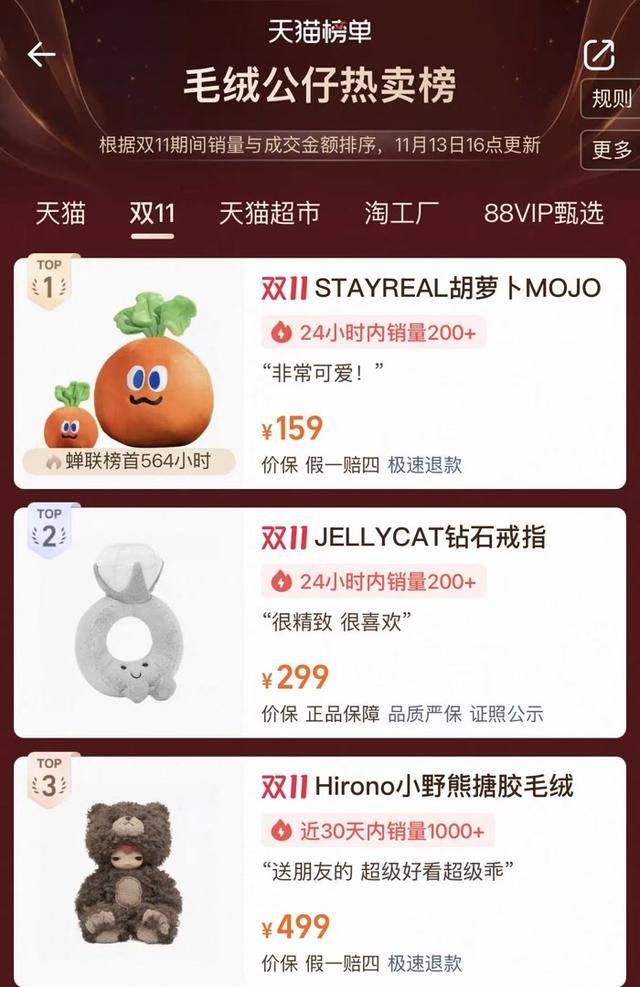
Core Insights - The plush toy market is experiencing a surge driven by emotional consumption, with products like Jellycat's classic bear and the LABUBU series attracting significant fan engagement [1] - Star IP-derived plush toys, such as the "Bubu" from Mayday, are emerging as a new growth point in the market, showcasing strong sales performance during events like "Double 11" [1][4] Market Performance - The "Bubu" plush toy has surpassed sales of 12.7 million yuan, outperforming established brands like Jellycat and Disney during the "Double 11" shopping festival [4][5] - The official flagship store of "Bubu" sold over 80,000 units of a single item priced at 159 yuan, indicating robust consumer interest [4] Consumer Behavior - Fans view plush toys as emotional tokens rather than mere toys, with the "Bubu" toy serving as a cultural symbol among Mayday fans [9] - The emotional connection between fans and their idols drives purchasing decisions, with plush toys becoming a part of daily life and social identity [9] Market Trends - The plush toy market in China is expanding, with projections indicating a global market size nearing 77.7 billion yuan by 2029 [13] - Star IP plush toys are transitioning from niche products to mainstream offerings, indicating a shift towards large-scale operations [7] Challenges and Considerations - Quality control issues have been reported, with some plush toys experiencing defects, raising concerns among consumers [13] - The market faces challenges such as "hunger marketing" strategies and the risk of imitation products due to low manufacturing barriers [14] - Long-term success in the star IP plush toy market requires continuous innovation and the creation of diverse, emotionally resonant products [14]
2025运动品牌全景一览:谁将问鼎年度之王?
3 6 Ke· 2025-11-13 12:17
Core Insights - The Chinese sports consumption market remains active in 2025, with various sports becoming part of daily life, including marathons, trail running, and tennis [1] - Sports brands are both participants in competitions and drivers of industry development, focusing on technology iteration, consumer engagement, and brand influence in daily life [1] Group 1: Ball Sports - Traditional ball sports like basketball, football, and volleyball maintain a stable market with competitive trends, with over 10 brands innovating in basketball technology [2] - Brands are engaging in grassroots events and high-profile sponsorships, with numerous collaborations and athlete endorsements intensifying [2][5] Group 2: Racket Sports - Racket sports, including table tennis, tennis, and badminton, show stability with brands focusing on equipment technology updates and professional collaborations [8] - Tennis is identified as a growth area, with over 10 brands entering the market, launching high-tech products, and sponsoring youth events [8] Group 3: Emerging Ball Sports - The golf market is evolving towards an ecosystem of "technology + events + community," with brands lowering entry barriers and promoting youth engagement [10] - Pickleball is emerging as a trendy sport, with brands promoting it as a lifestyle activity through events and community engagement [14] Group 4: Running - The running market remains competitive, with brands focusing on racing technology and closer engagement with runners through events and training camps [16] - Trail running is seen as a growth area, with new international brands entering the market and established brands expanding their offerings [23][25] Group 5: Outdoor Sports - The outdoor sports sector continues to grow, with a significant increase in related enterprises and international brands entering the Chinese market [33] - Outdoor technology is advancing, with brands focusing on extreme environment adaptability and lightweight features [34] Group 6: Women's Sports - Yoga and Pilates are key segments for women's sports, with competition centered around professional experiences and community engagement [37] - Comprehensive training markets are solidifying, with brands hosting large-scale events to connect with fitness enthusiasts [39] Group 7: Overall Market Trends - Across various sports categories, brands are demonstrating strategic capabilities and market insights, with technology as a core competitive advantage and a focus on local community connections [40] - The "Annual Sports Brand" award serves as an industry benchmark, reflecting innovation and guiding future brand development [43]




外资,开始躺平收租了
Sou Hu Cai Jing· 2025-11-13 11:12
Core Insights - Starbucks has officially announced a partnership with Boyu Capital to establish a joint venture for its retail operations in China, with Boyu holding up to 60% equity and Starbucks retaining 40%, based on a valuation of approximately $4 billion [1][2] Group 1: Market Dynamics - The Chinese market has shifted from a blue ocean to a highly competitive red ocean, making it increasingly difficult for foreign companies to generate profits [5][11] - Starbucks reported an 11% decline in same-store sales in Q2 of fiscal year 2024, with both average transaction value and volume decreasing, leading to significant pressure on the company [5][6] - Other foreign brands, such as Decathlon, are also facing challenges from local competitors and e-commerce, resulting in slowed growth [5][6] Group 2: Strategic Shifts - Many foreign companies are opting to relinquish control and introduce local capital, transforming their operations into a rental model, which allows them to lock in profits while minimizing operational risks [4][10] - The trend of foreign companies transitioning to a "rent-seeking" model reflects a broader strategy of financial conversion, allowing them to maintain brand presence while securing cash flow [10][11] Group 3: Local Market Adaptation - Successful local operations, as seen with Yum China, demonstrate that localized strategies can lead to impressive financial performance, with innovative product offerings tailored to local tastes [6][7] - The complexity of managing operations in China has increased, prompting foreign companies to hand over operational control to local teams who are more adept at navigating the market [8][9] Group 4: Brand Value and Profitability - The core asset for foreign companies in China is their brand, which can generate significant revenue through licensing and brand management agreements, often resulting in high margins [9][10] - For instance, McDonald's receives a franchise fee of 3% to 5% of sales from its Chinese operations, translating to an estimated annual income of $2 to $4 billion based on 2023 sales figures [9][10] Group 5: Future Implications - The shift towards a rental model signifies the end of an era where foreign companies could easily dominate the Chinese market solely based on brand and capital advantages [10][11] - This transition indicates that local capital and operational capabilities are becoming increasingly important in managing global brands within China [11][12]
国信证券:纺织制造25Q4订单有望修复 看好运动户外赛道长期成长性
智通财经网· 2025-11-13 08:44
Core Viewpoint - The report from Guosen Securities indicates that the impact of tariffs is gradually diminishing in Q4, leading to a stabilization of orders. Nike's latest quarterly performance exceeded market expectations, signaling a recovery point, which is expected to improve supplier outlooks [1][5]. Brand Apparel Insights - In September, the retail sales of clothing increased by 4.7% year-on-year, with a month-on-month growth acceleration of 1.6 percentage points [1]. - E-commerce performance in October showed positive trends across all categories, with outdoor products leading growth. Year-on-year growth rates for various categories included: sports apparel at 0%, outdoor apparel at +19%, leisure apparel at 0%, home textiles at +1%, and personal care at +2% [2]. - Leading brands in sports apparel growth included Lululemon (88%), Asics (47%), and Descente (35%). In outdoor brands, Kailas (55%), Berghaus (41%), and Camel (39%) showed strong growth [2]. Textile Manufacturing Insights - On a macro level, October saw a year-on-year decline in textile exports from China (-9.1%) and Vietnam (-1.0%), with apparel and footwear exports from China down by 16.0% and 21.0% respectively. However, PMI indices for Indonesia, India, and Vietnam showed increases, indicating a stable manufacturing environment [3]. - On a micro level, Taiwanese companies are optimistic about future revenue, with orders visibility extending to six months for certain firms. Companies like Yu Hong expect revenue recovery in Q4, while Wei Hong has strong demand driven by the upcoming World Cup [4]. Investment Recommendations - Focus on textile manufacturing rebound and consumer innovation opportunities. The textile manufacturing sector is expected to see order recovery in Q4, with companies like Shenzhou International and Huali Group positioned to benefit from tariff stability and Nike's recovery [5][6]. - In the brand apparel sector, the long-term growth potential of the sports and outdoor segment is highlighted, with recommendations for brands like Anta Sports, Li Ning, and Xtep International, as well as non-sport brands benefiting from a "brand upward" strategy [6].

外资正在批量“撤离”?
Sou Hu Cai Jing· 2025-11-13 01:41
Core Viewpoint - The recent trend of foreign brands selling their businesses in China reflects a significant shift in the market dynamics, where local brands are gaining ground and changing consumer preferences are impacting the competitive landscape [6][9][26] Group 1: Foreign Brands Selling - CPE Yuanfeng has entered a strategic partnership with Burger King, investing $350 million to acquire approximately 83% of the joint venture "Burger King China" [1] - Starbucks has also formed a partnership with Boyu Capital, with an investment of around $4 billion for up to 60% stake in Starbucks China [2] - Yum! Brands is reviewing its strategy for Pizza Hut, considering the sale of its business [4] Group 2: Market Dynamics - The Chinese market has shifted from a foreign brand-dominated "blue ocean" to a competitive "red ocean," with local brands like Luckin Coffee and Li Ning gaining market share [9][14] - Starbucks' market share has dropped from 34% in 1999 to less than 15% currently, indicating a significant decline in its competitive position [9] - The rise of domestic brands has led to a decrease in the perceived value of foreign brands, as consumers now prioritize quality and price over brand origin [11][12] Group 3: Changing Consumer Behavior - Consumers are increasingly aware of the value of domestic products, often finding similar quality at lower prices [11] - The rapid evolution of consumer preferences and marketing strategies has made it difficult for foreign brands to keep up [17][19] - The success of local brands in penetrating lower-tier cities highlights the challenges faced by foreign brands in adapting to the new market environment [21] Group 4: Strategic Shift of Foreign Brands - Foreign brands are transitioning from a "heavy asset direct operation" model to a "light asset cooperation" model, focusing on brand licensing and partnerships rather than direct management [24] - This shift allows foreign brands to minimize risks while still benefiting from the growing Chinese market through royalties and dividends [24][26] - The changing landscape indicates that local players are now leading the market, with foreign brands taking a backseat [26]


国信证券晨会纪要-20251113
Guoxin Securities· 2025-11-13 01:25
Group 1: Market Overview - The Shanghai Composite Index closed at 4000.13 points, with a slight decline of 0.06% [2] - The Shenzhen Component Index and the CSI 300 Index also experienced declines of 0.36% and 0.13% respectively [2] - The total trading volume across the markets was approximately 8404.67 billion CNY [2] Group 2: Mechanical Industry Insights - The mechanical industry report highlights significant events such as Elon Musk's $1 trillion compensation plan being approved, which received over 75% support [6] - Xiaopeng Motors launched its new humanoid robot, IRON, featuring advanced capabilities including 82 degrees of freedom and a height of no more than 170 cm [6][7] - The report emphasizes the potential for long-term investment opportunities in humanoid robots, particularly focusing on companies with strong supply chains and technological capabilities [7][8] Group 3: AI Infrastructure and Energy Supply - The report identifies AI computing power as a key growth area, with increasing demand for energy supply to support AI data centers [8] - Gas turbines are highlighted as a critical energy source for overseas data centers, benefiting from the surge in AI infrastructure needs [8] - Companies such as Yingliu Co., Haomai Technology, and Liande Co. are recommended for their strategic positioning in the energy supply for AI data centers [8] Group 4: Textile and Apparel Sector - The textile and apparel sector saw a 4.7% year-on-year growth in retail sales for September, with October showing pressure on textile exports [15][16] - The report notes that brand apparel outperformed textile manufacturing in November, with notable stock performances from Jiangnan Buyi and Semir Apparel [15] - The report suggests a positive outlook for textile manufacturing orders in Q4, driven by easing tariff impacts and recovery in major brands like Nike [17][18] Group 5: Investment Recommendations - For humanoid robots, the report recommends focusing on companies with strong supply chains and technological advancements, such as Hengli Hydraulic and Weiman Sealing [10] - In AI infrastructure, key investment targets include Yingliu Co. and Haomai Technology, which are positioned to benefit from the growing energy demands of AI data centers [10] - The textile sector is advised to focus on companies like Shenzhou International and Huayi Group, which are expected to benefit from recovering orders and improving market conditions [17][18]