洋河股份

Search documents
美团闪购“双11”数据:人均消费增长近三成 400个品类、超800个品牌翻倍增长
Zheng Quan Shi Bao Wang· 2025-11-12 11:52
Core Insights - Meituan Flash Sale reported record highs in transaction volume, number of users, and per capita spending during the "Double 11" shopping festival from October 31 to November 11, with nearly 400 product categories seeing over 100% year-on-year growth [1] - High-priced products are driving a nearly 30% increase in per capita spending, with over 800 brands also experiencing more than 100% sales growth [1] - The introduction of the "Brand Official Flagship Lightning Warehouse" has led to a nearly 400% increase in overall sales for hundreds of brand flagship stores compared to pre-"Double 11" levels [1] Product Category Trends - The shopping behavior during "Double 11" reflects a clear trend towards "all categories, new categories, and high-priced items," with traditional and fresh product categories seeing explosive sales [1] - Specific high-demand items include mobile air conditioners, sports cameras, jade, gold, sports apparel, coffee machines, gaming consoles, platinum, and optical glasses, all experiencing over tenfold year-on-year sales growth [1] Flash Warehouse Performance - The Meituan Flash Warehouse has seen significant growth across all retail categories, with 3C home appliances sales increasing nearly 500%, and liquor and baby toys sales growing by 300% [2] - Notable sales increases in the liquor category include a nearly 400% rise in overall sales, with Moutai sales growing over 600% and other brands like Luzhou Laojiao and Jian Nan Chun seeing over 500% growth [2] - In the baby formula segment, sales for brands like Friso and Aptamil have increased by over 100% and nearly 300%, respectively [2] Retailer Performance - Multiple chain retailers have reported explosive sales during "Double 11," with Midea's store sales increasing over 30 times, and other retailers like Mingming Hen Mang and Zhongbai Electric seeing sales growth of over 20 times [2]

17只白酒股下跌 贵州茅台1465.15元/股收盘
Bei Jing Shang Bao· 2025-11-12 09:25
Core Viewpoint - The overall market experienced a decline, with the Shanghai Composite Index dropping to 4000.14 points, down 0.07%, and the liquor sector also saw a slight decrease, indicating ongoing challenges in the industry [1]. Industry Summary - The liquor sector closed at 2358.04 points, with a minor decline of 0.04%, and 17 liquor stocks reported losses [1]. - In Q3, the industry is expected to see a year-on-year decline in sales volume of 20%-30%, driven by a low base in Q2 2024, as the market seeks to balance volume and price [1]. - Looking ahead, the industry may face double-digit sales volume decline pressure in Q1 2026, with continued pressure on financial reports, but stabilization is anticipated in Q2 2026, and a potential turning point in fundamentals could occur in Q3 2026 [1]. Company Summary - Kweichow Moutai's stock closed at 1465.15 CNY per share, up 0.42%, while Wuliangye's stock closed at 120.38 CNY per share, down 0.33% [1]. - Shanxi Fenjiu's stock closed at 198.52 CNY per share, down 0.52%, and Luzhou Laojiao's stock closed at 141.87 CNY per share, up 0.16% [1]. - Yanghe's stock closed at 70.30 CNY per share, down 0.71% [1].





广发基金百亿经理王明旭,业绩惨不忍睹!
Sou Hu Cai Jing· 2025-11-12 05:31
Core Insights - Wang Mingxu, a fund manager at GF Fund, has delivered the worst performance in the industry this year, with 6 out of 8 funds under his management reporting losses [3][6][12] - The average return for 4,408 actively managed equity funds this year is 30.82%, with 39 funds exceeding 100% returns [3][4] - Despite the overall market rally, Wang's funds have consistently underperformed, leading to investor dissatisfaction [11][12] Fund Performance - Wang Mingxu manages 8 funds, of which 6 have recorded negative returns this year, with the worst performer, GF Balanced Preferred A, showing a return of -9.98% [5][10] - As of November 7, 2023, 11 actively managed equity funds have seen a net value decline of over 10%, with 5 of these funds managed by Wang [4][8] - The total management fee collected from the 6 underperforming funds in the first half of the year was over 55 million yuan [2][17] Market Context - The A-share market has been steadily rising, yet Wang's funds have not benefited, with investors expressing frustration over the lack of recovery [11][12] - The wine sector, heavily weighted in Wang's funds, has underperformed this year, contributing to the overall losses [14] Future Outlook - Despite the poor performance this year, the same 6 funds have shown promising returns in 2024, with returns ranging from 17.88% to 20.39%, outperforming their benchmarks [12][13] - Wang's funds have a high overlap in their top holdings, which may have contributed to their collective underperformance [13][14] Fund Management and Strategy - Wang Mingxu has over 20 years of experience in the securities industry, with more than 7 years in public fund management [15] - The funds managed by Wang have seen a significant decline in scale, dropping below 10 billion yuan for the first time [6][16] - The management scale of Wang's funds decreased by 26.31% to 8.26 billion yuan as of the third quarter of 2023 [16]

前三季洋河股份营收净利润均降合理优化资源配置聚力稳固重点市场
Xin Lang Cai Jing· 2025-11-12 03:10
Core Insights - Yanghe Co., Ltd. reported a significant decline in revenue and net profit for the first three quarters of the year, with revenue at 18.09 billion yuan, down 34.26% year-on-year, and net profit at 3.975 billion yuan, down 53.66% [3]. Financial Performance - The company's operating income for the reporting period was approximately 3.29 billion yuan, reflecting a decrease of 29.01% compared to the same period last year [3]. - The net profit attributable to shareholders decreased by 158.38% to -368.65 million yuan, while the net profit excluding non-recurring gains and losses fell by 204.12% to -474.69 million yuan [3]. - Basic and diluted earnings per share were both -0.2447 yuan, a decline of 158.37% [3]. - The weighted average return on equity was -0.48%, down 1.52% from the previous year [3]. Assets and Liabilities - As of the end of the third quarter, total assets were approximately 59.50 billion yuan, a decrease of 11.64% from the end of the previous year [3]. - The equity attributable to shareholders was about 48.56 billion yuan, down 5.86% from the previous year [3]. - Contract liabilities reached 6.42 billion yuan, an increase of 29% year-on-year [4]. Market Strategy - Yanghe Co., Ltd. focuses on the Jiangsu market and highland markets, optimizing resource allocation to stabilize key markets [4]. - The company aims to manage inventory and promote sales through various strategies, including controlling the quantity and price of its main products, such as "Dream Blue" and "Sea Blue" [4].
国信证券:酒类渠道包袱加速去化 大众品品类表现分化
智通财经网· 2025-11-12 02:48
Group 1 - The core viewpoint of the report indicates that the liquor industry is entering a phase of adjustment, with a consensus on reduced growth rates for 2024 and an expansion of performance declines in Q3 reports [1][2] - The food and beverage sector is expected to show stable overall volume and structural differentiation by 2025, with Q1/Q2/Q3 revenues growing by +2.5%/+2.4%/-4.77% year-on-year, and net profits declining by +0.3%/-2.1%/-14.6% [1] - The report highlights that the macroeconomic policies in Q4 could catalyze stock price increases due to low expectations in the capital market and low institutional holdings [1] Group 2 - The liquor sector is recommended for investment, particularly companies with pricing power and regional influence, such as Luzhou Laojiao, Shanxi Fenjiu, and Kweichow Moutai, which are expected to achieve greater growth [2] - The consumer goods sector is anticipated to stabilize and improve in 2025, driven by inventory reduction and macroeconomic policy support, with leading companies in segments like sugar-free tea and functional beverages showing strong revenue growth [3] - The snack food segment reported a revenue increase of +22.4% and an 8.6% rise in profits in Q3 2025, despite rising costs from certain raw materials [3]

五粮液强调核心竞争力!食品ETF(515710)微涨0.4%!机构:食饮板块或迎底部回暖复苏
Xin Lang Ji Jin· 2025-11-12 02:08
Group 1 - The food ETF (515710) showed stable performance with a price increase of 0.4% and a trading volume of 19.56 million yuan as of 9:42 AM on November 12 [1] - Key stocks in the ETF included Tianwei Food, Yanjing Beer, and Yangyuan Beverage, with respective gains of 3.56%, 1.85%, and 1.06%. Conversely, stocks like Jiu Gui Jiu, Jin Hui Jiu, and New Dairy exhibited weaker performance, with declines of 1.53%, 1.04%, and 0.87% [1] - Wuliangye emphasized its core competitiveness as a leader in China's strong-aroma liquor sector, highlighting unique natural ecological environments, ancient microbial groups, and traditional brewing techniques [1] - Jiangsu Liquor Association set a target for the province's liquor industry to exceed 100 billion yuan in revenue by 2030, clarifying long-term development goals [1] Group 2 - The liquor industry is currently in a deep adjustment phase, with declining demand affecting manufacturers and slowing performance growth. Companies are proactively reducing supply to balance supply and demand [1] - Open Source Securities noted that the food and beverage sector is nearing a bottom, with most negative factors already released and policy impacts slowing down. Expectations for policy improvements may boost demand [1] - The main theme for the industry in 2026 is expected to be recovery from the bottom, with the pace of recovery linked to macroeconomic conditions. Consumer spending is anticipated to remain resilient, while business consumption may increase with economic activity [1] Group 3 - Huaxi Securities highlighted that the core of the liquor industry lies in its social attributes and price recognition, relying on high gross margins (generally over 70%) and brand building [2] - The industry differentiates itself by price, with high-end liquor catering to identity recognition, while mid-range and real estate liquor achieve growth through structural upgrades [2] - The essence of channel management is maintaining a balance between volume and price, ensuring channel profitability and price stability [2] - The top ten weighted stocks in the food ETF index include Kweichow Moutai, Wuliangye, Yili, Luzhou Laojiao, Shanxi Fenjiu, Haitian Flavoring, Dongpeng Beverage, Yanghe, Jinshiyuan, and Gujing Gongjiu [2]
酒价内参11.12价格发布 贵州茅台飞天终端售价微涨
Xin Lang Cai Jing· 2025-11-12 00:30
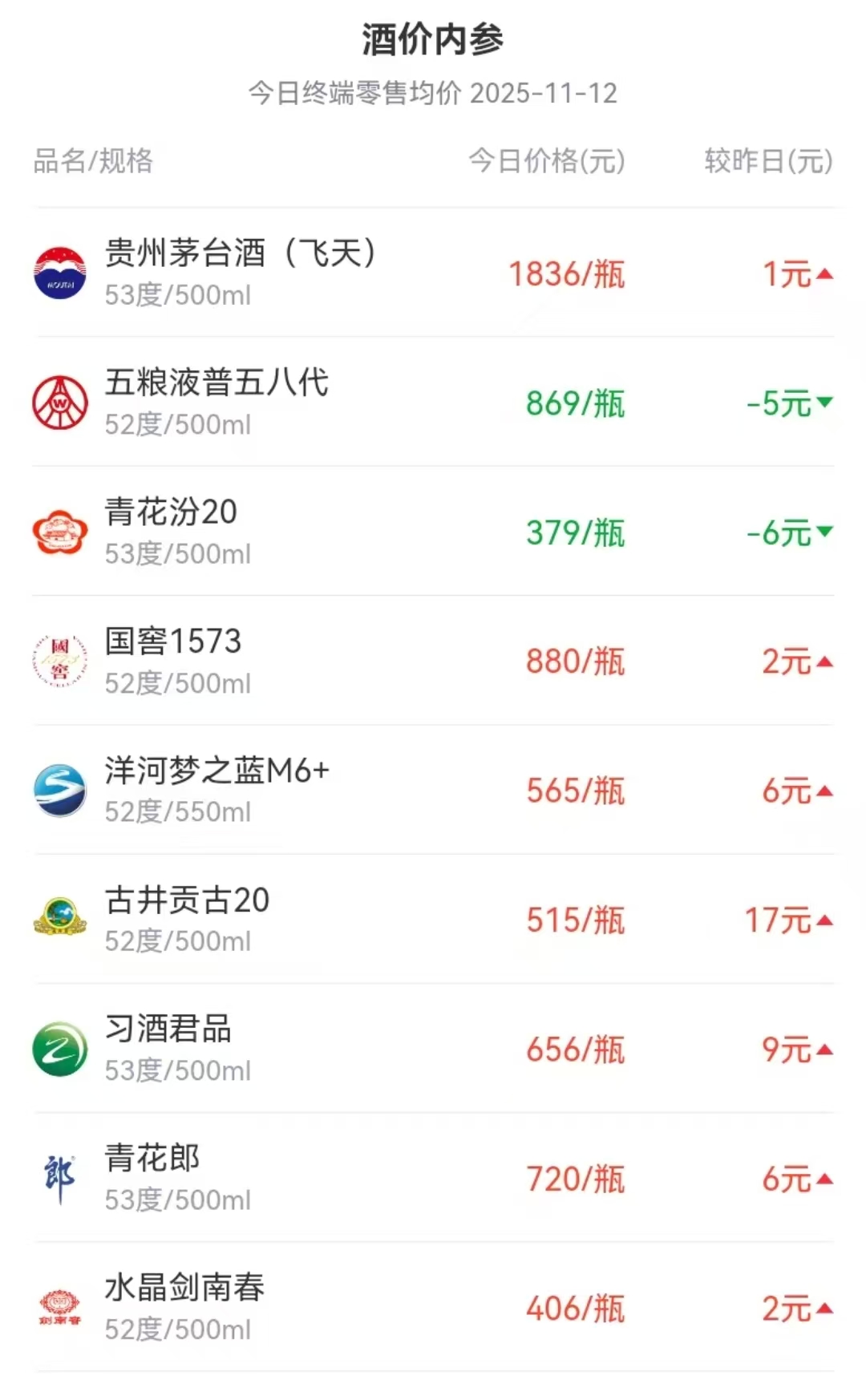
Core Insights - On Double Eleven, the retail prices of major Chinese liquor brands showed an overall increase, indicating a stabilization trend in the market [1][3] Price Changes - Guizhou Moutai (Feitian) saw a slight increase of 1 yuan per bottle, with a current average price of 1836 yuan [3] - The price of Gujing Gongjiu (20 years) rose significantly by 17 yuan per bottle, reaching 515 yuan [3] - Other brands such as Guojiao 1573, Yanghe Dream Blue M6+, Xijiu Junpin, Qinghualang, and Shuijing Jianan Chun experienced minor price increases ranging from a few yuan [1][3] - Conversely, Wuliangye (Pu Wuliang 58th generation) and Qinghualang (20 years) saw a slight decrease in price, dropping by approximately 5 yuan per bottle [1][3]
2025年第45周:酒行业周度市场观察
艾瑞咨询· 2025-11-12 00:06
Group 1: Industry Environment - The white liquor industry is experiencing a slowdown in performance and increasing differentiation, with 19 listed companies reporting a 7% year-on-year decline in total revenue by Q3 2025, while only Moutai and Fenjiu maintained growth [2] - The industry is entering a phase of volume competition, with intensified price wars and channel battles increasing cost pressures, particularly for small and medium-sized enterprises [2] - Future competitiveness will favor companies that actively transform and focus on long-term value, as the industry shifts towards rational development [2] Group 2: Consumer Trends - Young consumers are driving a trend towards mixed drinks, such as white liquor with cola, leading to a demand for lower alcohol content products [3] - Companies are responding with innovative products, including cross-industry collaborations like the "yellow wine + beer" from Guyue Longshan and Carlsberg's low-sugar sparkling fruit wine [3] - The industry is debating the definition of low-alcohol liquor, with a push towards maximizing flavor rather than adhering to strict alcohol content classifications [3] Group 3: Regional Enterprises - Regional liquor companies face significant challenges, including high inventory pressure and price inversions, as national brands dominate the market [4] - Strategies for regional companies include becoming provincial leaders, focusing on core markets, or considering exit strategies [4] - Key pathways for success involve brand premiumization, product structure optimization, and deepening distribution channels [4] Group 4: Policy and Development - The Ministry of Industry and Information Technology has included liquor production in the "historical classic industries," promoting cultural heritage and high-quality development [5] - Goals include cultivating over 50 billion-level leading enterprises and creating trillion-level industry clusters by 2028 [5] - The focus is on integrating culture, technology, and ecology to facilitate the transformation and upgrading of the liquor industry [5] Group 5: Brand Dynamics - Yanjing Beer reported a net profit of 1.77 billion yuan for Q3 2025, a 37.45% increase year-on-year, driven by a high-end strategy and cross-industry collaborations [15] - Luzhou Laojiao achieved revenue of 23.127 billion yuan and net profit of 10.762 billion yuan in the first three quarters of 2025, demonstrating resilience amid industry challenges [16] - Wuliangye's revenue reached 60.945 billion yuan with a net profit of 21.511 billion yuan, as the company adjusted its strategy to meet changing consumer demands [18] Group 6: Innovation and Sustainability - The first sustainable development report for the core sauce-flavored liquor production area was released, focusing on ecological protection and circular economy [9] - Moutai introduced a "date selection" service for consumers, enhancing personalization and emotional value in product offerings [23] - Niulanshan Chenxiang achieved significant sales milestones, selling 6 billion bottles over ten years, supported by strong brand recognition and market positioning [24]

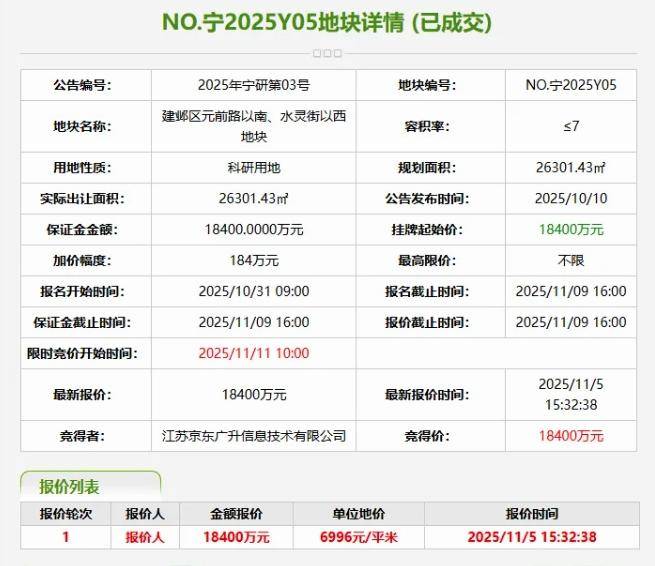
1.84亿元拿下科研地块 京东研发中心正式入驻河西中央科创区
Yang Zi Wan Bao Wang· 2025-11-11 11:37
Core Viewpoint - The acquisition of the NO.宁2025Y05 land plot by JD.com for 184 million yuan marks a significant development in the Nanjing Hexi Central Innovation Zone, indicating the establishment of a headquarters cluster that includes major companies like JD.com, Xiaomi, and Alibaba [1][3]. Group 1: Land Acquisition Details - JD.com won the bidding for the NO.宁2025Y05 land plot, paying 184 million yuan, which translates to approximately 6,996 yuan per square meter [2][3]. - The land plot covers an area of 26,301.43 square meters and is designated for research and development purposes, with a maximum building area of 180,000 square meters [2][3][5]. Group 2: Strategic Importance - The new JD.com research center will serve as a regional hub, focusing on various sectors including retail, technology, finance, health, and home services, with an emphasis on attracting talent in cutting-edge fields such as artificial intelligence and robotics [5]. - The project is expected to employ at least 5,000 research and development personnel from industries like e-commerce, modern logistics, and fintech [5]. Group 3: Headquarters Cluster Development - The Nanjing Hexi area is now home to eight major corporate headquarters, including JD.com, Newland, Alibaba, Xiaomi, and others, which enhances the region's attractiveness for talent and investment [8]. - The influx of these headquarters is driven by Nanjing Hexi's high-quality urban environment and favorable demographic structure, which collectively create a strong magnetic effect for businesses [8].

微醺情绪价值“稀释” 百润股份的威士忌梦能否“救场”
Bei Jing Shang Bao· 2025-11-11 11:01
Core Viewpoint - RIO's market position has weakened significantly, with its products being replaced by competitors in the low-alcohol beverage segment, leading to declining sales and financial performance for its parent company, Bairun Co. [1][5] Group 1: Market Position and Sales Performance - RIO's products, once dominating low-alcohol beverage shelves, now occupy less than one-third of the space, with many products nearing expiration dates [3][4] - Bairun Co. reported a revenue decline of approximately 5% and a net profit decrease of about 4% in the first three quarters of the year [4][5] - The company's inventory turnover days have increased significantly, indicating slower sales, with the latest figure reaching 468.66 days [4] Group 2: Competitive Landscape - The low-alcohol beverage market is becoming increasingly competitive, with brands like Suntory's Holo and 196°C gaining popularity among consumers [7][8] - The market is shifting from a blue ocean to a red ocean, with various brands, including traditional liquor companies, entering the low-alcohol segment, further squeezing RIO's market share [8][9] Group 3: Future Growth Strategies - Bairun Co. is exploring whiskey as a second growth curve, having initiated its whiskey business in 2016 and launching brands like "Laizhou" and "Bailide" [9][10] - The domestic whiskey market is expanding, with a projected capacity of 5 to 8 billion yuan and an annual growth rate of at least 15% [10][11] - However, Bairun Co. faces challenges in brand recognition and sales performance in the whiskey segment, as its products are less known compared to established brands [10][11]