
卡游

Search documents
未知机构:浙商轻工史凡可周观点3月浆价继续强势提涨出口关税迎阶段利好-20260224
未知机构· 2026-02-24 02:50
Summary of Conference Call Records Industry Overview - **Industry**: Pulp and Paper, Real Estate, Metal Cans, New Consumption, Tobacco, Personal Care, AI Applications, Pet Industry - **Key Trends**: Positive cyclical expectations, price increases in pulp, recovery in real estate transactions, and growth in various consumer sectors Key Points Pulp and Paper Industry - **Price Increases**: March pulp prices continue to rise strongly, with Suzano reporting an increase of $20 per ton in China [1] - **Supply Chain Issues**: Indonesia's revocation of forestry licenses affects the supply of hardwood pulp chips, compounded by APP's announcement of delays in the second phase of OKI production [1] - **Investment Recommendations**: Continued recommendations for companies such as Sun Paper, Nine Dragons, and Xianhe, with a focus on potential growth in the sector [1] Real Estate Sector - **Market Recovery**: Improvement in second-hand housing transactions, with the National Bureau of Statistics reporting a narrowing decline in housing prices across 70 cities [1] - **Top Picks**: Recommended companies include Kuka, Hanhai, with expectations for recovery in brands like Gongniu, Oppein, and others [1] Metal Can Industry - **Aluminum Price Adjustment**: Recent pullback in aluminum prices is beneficial for profit release, with a bottom recommendation for Aorikin and attention on Baosteel and Shengxing [1] New Consumption Sector - **Core Products**: Many core products have entered the layout phase, with various brands launching new items and maintaining high store traffic during the Spring Festival [2] - **Tobacco Market**: British American Tobacco reports rapid market share growth in Poland, with a recommendation for Smoore as a core stock [2] - **Personal Care Growth**: Brands like Leshushi and Baia are experiencing significant growth, with new product launches and marketing strategies enhancing their market positions [2] AI Applications - **Smart Glasses Sales**: Kangnait's smart glasses are projected to exceed 7 million units in sales for the year, with ongoing attention to order progress [2] - **Acquisition Plans**: Yudong plans to acquire 51% of Huayan Technology, extending its reach into precision components and AI glasses [2] Pet Industry - **Market Recovery**: The pet industry saw a recovery in January with an overall growth of 18%, with specific brands like Guibao and Zhongchong showing significant increases [3] Cross-Border Trade - **Tariff Changes**: Recent tariff adjustments are favorable, with a 5% reduction in the overall tax rate benefiting cross-border enterprises, particularly focusing on companies like Zhiou and Henglin [3]
【申万宏源研究春节见闻】从“鸡毛换糖”到“全球数贸中心”,见证义乌人基因里的生意经
Xin Lang Cai Jing· 2026-02-22 05:21
专题:资本市场大咖2026新春献词:骏马踏春来 驭势稳行启新程 炒股就看金麒麟分析师研报,权威,专业,及时,全面,助您挖掘潜力主题机会! 作者:申万宏源研究零售社服团队 张蕴达 数贸中心不仅是一个新市场,更是义乌未来"1+3+N"发展战略的落地场景:据义乌发布和中国一带一路 网,"1"指布局1个高能级数贸港,其中包括数贸展示、数据交易、新品发布三个中心,真正实现用数据 和云服务赋能商品贸易;"3"指Chinagoods、义支付、智捷元港3个数贸平台,为全球贸易商提供一站式 贸易服务,并深度融合世界义乌AI商贸大模型,当前已推出小商AI设计、小商AI视创、AI视频翻译等 13项AI应用;"N"指构建N项数字赋能场景,加速数字科技与市场贸易深度融合,数字化赋能小商品贸 易全链路。 局;资料来源:义乌发布公众号,申万宏源研究 图1:《鸡毛飞上天》 暮色四合时,高铁穿过金衢盆地的薄霭,家乡义乌的灯火在远方次第亮起,像无数颗被点亮的星子散落 在浙中大地。工作后虽因各种原因频繁出差归家,却仍跟不上这片土地上的日新月异。义乌江水静静流 淌,耳畔不再是货郎担的摇铃声,而是国际商贸城永不落幕的喧嚣,是保税仓里机械臂的精准律动, ...



知名经济学家杜帅评论:通过春晚广告商矩阵,解码2026中国经济新流向
Sou Hu Cai Jing· 2026-02-21 14:43
Core Insights - The 2026 Spring Festival Gala serves as a significant indicator of China's economic transformation, showcasing a shift from traditional advertising to a more integrated approach where brands and content coexist harmoniously [3][10] - The sponsorship landscape reflects a trend of "technology taking center stage, traditional industries enhancing quality, and diversified consumption," indicating the current strength and future direction of the Chinese economy [3][5] Group 1: Sponsorship Dynamics - The 2026 Spring Festival Gala achieved a record total reach of 23.063 billion across all media platforms, attracting over 28 brands from various sectors including AI technology, smart transportation, and consumer goods [3][6] - The sponsorship system has become more refined and strategic, with exclusive rights being secured by leading brands, marking a transition from broad naming rights to specialized collaborations [3][5] - Notable participation from robotics companies, such as Yushutech and Magic Atom, transformed the gala into a "hardcore technology show," highlighting the deep integration of technology into mainstream entertainment [3][6] Group 2: Economic Trends - The shift towards "technology taking center stage and consumption upgrading" is a key observation for understanding the economic trends in 2026, with traditional industries optimizing their structures while retaining only top brands [5][6] - The emergence of brands like Miniso and card game companies as official partners signifies a cultural and emotional shift in consumer behavior, moving beyond mere material satisfaction to include cultural identity and emotional connection [6][7] - The automotive sector, represented by Great Wall Motors and the collaboration between JAC and Huawei, underscores the successful transition of the new energy vehicle industry from policy-driven to market-driven dynamics [6][7] Group 3: Capital Flow and Market Sentiment - Eight listed companies participated in the gala, including Wuliangye, Yanghe, and Bilibili, reflecting a shift in investment logic from traditional defensive strategies to technology-driven growth [7][9] - The presence of leading liquor brands demonstrates the resilience of the Chinese economy, while companies in smart transportation and new consumption sectors leverage the gala for brand expansion, indicating a commercial turning point [7][9] - The overall sponsorship landscape encapsulates the confidence in China's economic development, showcasing advancements in AI, high-end manufacturing, and consumer upgrades [9][10]

一张小卡片撑起的百亿生意
吴晓波频道· 2026-02-20 00:29
Core Insights - The article discusses the rapid growth and cultural significance of trading cards in China, highlighting their evolution from a children's hobby to a substantial business opportunity [3][10]. Market Growth - The market size for collectible trading cards in China grew from 700 million RMB in 2017 to 12.2 billion RMB in 2022, with a compound annual growth rate (CAGR) of 78.4%. It is projected to reach 31 billion RMB by 2023 [7]. - The trading card market is increasingly recognized as a potential investment sector, with notable companies like Whatnot valued at 26.5 billion RMB and the founders of "Kayu," a leading trading card company, appearing on the Hurun Rich List with a wealth of 60 billion RMB [9]. Cultural Impact - Trading cards have become a new social currency among children, with parents observing their prevalence in school environments. The cards are now integrated into various aspects of pop culture, responding quickly to trending IPs and stories [5][6]. - The community around trading cards is growing, with live-streaming platforms attracting large audiences and fostering a culture of sharing and trading among enthusiasts [32][33]. Investment Potential - Trading cards are increasingly viewed as alternative investment assets, with rare cards fetching high prices. For instance, the Alpha Black Lotus card sold for $300,000 in 2024, showcasing the potential for significant appreciation [18]. - The establishment of a standardized grading and certification system for trading cards is crucial for maintaining market integrity and value, with organizations like PSA and BGS leading the way [21]. Demographics and Spending - The majority of trading card consumers in China are aged 8-14, accounting for 70% of the market, while only 5% are over 25. This contrasts with more mature markets like Japan and the U.S., where older demographics are more engaged [27][28]. - In 2024, the average spending per consumer on trading cards in China was only 18.7 RMB, significantly lower than in Japan (119.3 RMB) and the U.S. (64 RMB), indicating substantial growth potential [28]. Industry Strategies - Companies are expanding their IP portfolios to attract diverse consumer interests, with "Kayu" increasing its IP count from 44 to over 100 in just one year [29]. - Building community culture around trading cards is essential, with live-streaming and social media playing a significant role in engaging consumers and enhancing the overall experience [31][32]. Future Outlook - The trading card market reflects broader trends in emotional spending, with consumers seeking ways to alleviate stress through collectibles. This emotional economy presents new business opportunities for companies [41].

春晚赞助商换了一拨:机器人5亿,追觅2亿,潮玩卡牌上桌
Xin Lang Cai Jing· 2026-02-18 12:07
Group 1 - The Spring Festival Gala (SFG) has shifted its sponsorship focus from traditional sectors like liquor and new energy vehicles to cutting-edge technologies such as robotics and AI, with a notable reduction in liquor sponsors from seven to four and a diminished presence of new energy vehicles [1][6] - Major robotics companies, including Songyan Power, Yushu Technology, Magic Atom, and Galaxy General, have become the primary sponsors, showcasing their technologies in various performances, leading to criticism that the gala resembled a robotics company conference [1][2] - The integration of sponsors into content creation has reached new heights, with programs being tailored to highlight the sponsors' products, marking a significant evolution in the SFG's commercial strategy [5][12] Group 2 - Yushu Technology has emerged as a standout sponsor, leading a martial arts segment with its advanced robots, and has reportedly invested significantly less than other sponsors while still achieving high visibility [7][9] - The collaboration between sponsors and the SFG has resulted in a notable increase in product demand, with sales spikes reported for robots featured during the gala, indicating a successful marketing strategy [9][10] - The introduction of new players from the trendy toy and IP sectors, such as Miniso and Card Game, signifies a diversification of the SFG's sponsorship landscape, with both companies leveraging the gala for brand exposure [13][14] Group 3 - The gala's average viewership reached 33.14%, demonstrating its continued importance as a marketing platform for brands, despite criticisms regarding its entertainment value [18] - The sponsorship landscape has evolved to include significant investments from companies like Chasing, which has integrated its entire ecosystem into the gala, reflecting a trend towards comprehensive brand representation [11][12] - The SFG's shift towards technology and IP-driven content may redefine its role in Chinese culture, raising concerns about the balance between entertainment and educational value [10][18]


衢州夫妇卖卡牌 赚得600亿身家
2 1 Shi Ji Jing Ji Bao Dao· 2026-02-17 16:04
Core Viewpoint - The company KAYOU, led by founder Li Qibin, is leveraging popular IPs to transform trading card games into a billion-dollar business, aiming to integrate these products into mainstream cultural consumption through strategic partnerships and innovative marketing initiatives [1][3][15]. Group 1: Business Performance and Strategy - KAYOU plans to sell 4.8 billion packs of cards in 2024, generating revenue of 10 billion yuan with a net profit of 4.466 billion yuan, maintaining a gross margin of around 70% for three consecutive years [6]. - The company has a strong reliance on a few major IPs, with over 80% of its revenue coming from non-exclusive licenses of popular brands like Ultraman and My Little Pony, which poses a risk of renewal [6][8]. - KAYOU is expanding its product offerings by collaborating with over 30 domestic IPs, aiming to elevate trading cards from mere entertainment products to new cultural consumption symbols [15][19]. Group 2: Market Expansion and Product Diversification - The company is actively diversifying its product lines, including plush toys and stationery, with a notable focus on the "Zero Series" of pens, which has seen a compound annual growth rate of over 370% from 2022 to 2024 [21]. - KAYOU has established a distribution network with 217 dealers across 31 provinces, although it has limited self-operated stores [19]. - The company is also collaborating with Tencent Games to launch physical card competitions based on popular games like "Honor of Kings" [9]. Group 3: Cultural Integration and IP Development - KAYOU is focusing on integrating national cultural elements into its products, having developed its first proprietary IP, "KAYOU Three Kingdoms," and collaborating with renowned artists for themed card sets [11][15]. - The company aims to reduce negative perceptions associated with trading card blind boxes, which have been criticized for promoting irrational spending among minors [8]. - KAYOU's partnership with the Spring Festival Gala marks a significant step in positioning trading cards within mainstream culture [1][15].
春晚的广告牌 印刻着中国经济的一次次跃迁
Nan Fang Du Shi Bao· 2026-02-17 15:27
Core Insights - The sponsorship history of the CCTV Spring Festival Gala reflects China's economic development and industrial upgrades over the past four decades, showcasing three major transitions: from basic needs to consumer electronics and automobiles, from virtual economy to hard technology, and from demographic dividend to engineer dividend [1][2]. Group 1: Historical Sponsorship Trends - In the 1980s, the main sponsors represented basic household needs, with brands like 康巴丝 leading the way, highlighting the public's desire for precision and the prosperity of light industry [1]. - The 1990s saw a shift towards quality consumption, with liquor brands and home appliance giants like 美的集团 becoming prominent sponsors, marking a transition from survival to quality-focused consumption [1]. Group 2: The Rise of Internet and Technology - The year 2015 marked a turning point with the emergence of internet giants like WeChat and Alipay, initiating a "red envelope war" that transformed user engagement and payment methods [2]. - As the internet traffic peaked, the focus shifted to hard technology, with a notable increase in sponsorship from the electric vehicle sector, indicating a fundamental shift in China's competitive edge from demographic to engineer dividends [2]. Group 3: Future Trends and Cultural Consumption - The upcoming 2026 Spring Festival Gala will feature new partnerships with brands like 名创优品 and 卡游, suggesting a potential shift towards "emotional value" and "cultural consumption" as new wealth drivers in a mature market [3]. - The evolution of sponsors serves as a "value anchor" migration, reflecting China's economic transitions from production capabilities to creative intelligence, providing a lens to observe the pulse of the times [3].
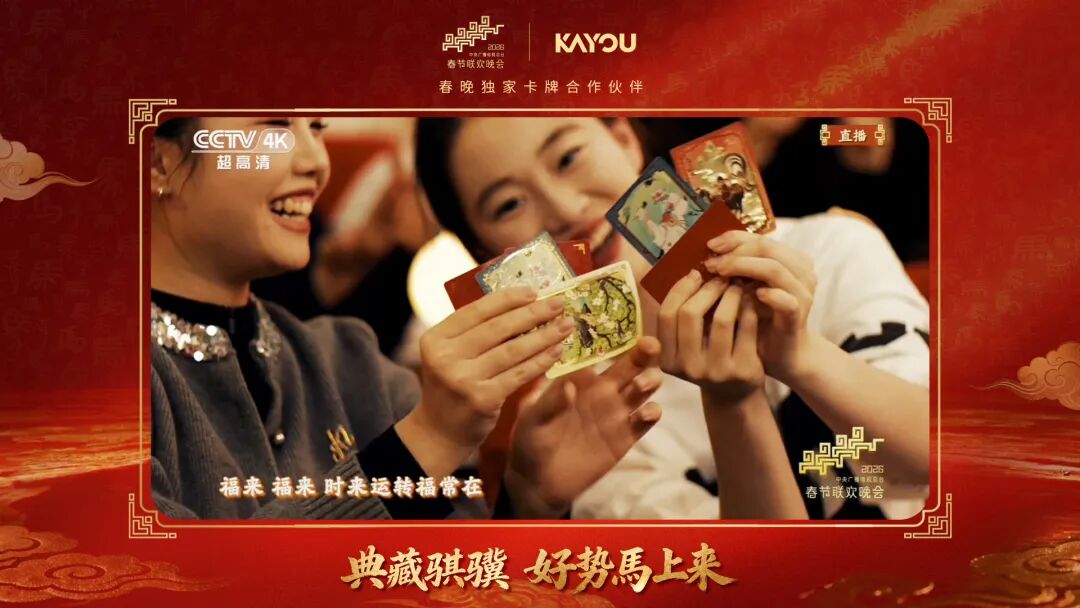
次元壁破了!卡游亮相马年总台春晚
Xin Lang Cai Jing· 2026-02-17 13:15
Core Viewpoint - The collaboration between KAYOU and the Spring Festival Gala marks a significant milestone as it is the first time a cultural consumption brand has partnered with the event, showcasing the evolving landscape of cultural engagement in China [7][9]. Group 1: Event Highlights - KAYOU was introduced as the exclusive card partner for the 2026 Spring Festival Gala, a notable achievement for a domestic company in the cultural sector [7]. - The event featured a unique "card rain" moment during a performance, where various collectible cards were distributed, creating an interactive experience for the audience [4][6]. - The launch of 20,000 sets of the "Qiji Chicheng" collectible cards coincided with the gala, which sold out almost instantly on KAYOU's Tmall flagship store [4]. Group 2: Market Trends - The offline card market is experiencing a surge in demand for products themed around traditional culture, with KAYOU reporting high popularity for its products that incorporate national trends [6]. - KAYOU's success is attributed to its deep understanding of cultural narratives and its ability to resonate with younger audiences, bridging the gap between traditional culture and modern consumer preferences [12][16]. Group 3: Company Background - KAYOU, established in 2011, has become a leader in the collectible card industry, known for its innovative products and commitment to authentic licensing [9]. - The company has developed a diverse IP matrix that includes over 30 national trend IPs, effectively capturing the interest of various consumer demographics [15][16]. Group 4: Cultural Impact - The partnership with the Spring Festival Gala signifies a shift in the perception of collectible cards from a niche market to a mainstream cultural phenomenon [10][13]. - KAYOU's products are not only popular domestically but are also positioned as cultural ambassadors in international markets, promoting Chinese culture globally [15][16].

“宇树IPO更稳了”
投资界· 2026-02-17 07:20
Core Viewpoint - The 2026 Spring Festival Gala showcased a significant presence of technology and innovation, particularly in robotics and AI, marking a shift in China's industrial landscape towards hard technology innovation [4][22]. Group 1: Robotics and AI - The gala featured over 20 partners, with a notable focus on robotics, including companies like Yushutech, Magic Atom, and Galaxy General, highlighting the evolution of embodied intelligence in China [3][4]. - Yushutech's performance demonstrated advanced capabilities, contributing to its valuation exceeding 10 billion RMB and accelerating its IPO process [10]. - Galaxy General, a newly established company, achieved a valuation of 3 billion USD after raising 300 million USD, showcasing the rapid growth in the robotics sector [10]. - The event served as a platform for these companies to compete not just in performance but also in intelligence and practical applications, indicating a maturation of the robotics industry in China [11]. Group 2: New Media and Consumer Engagement - The integration of platforms like Bilibili, Xiaohongshu, and Douyin into the gala reflects a shift in how younger audiences engage with traditional media, emphasizing real-time interaction and content creation [16]. - Douyin's role as the exclusive partner for "Vertical Screen Viewing" and Bilibili's position as the exclusive bullet screen video platform illustrate the diversification of media consumption among younger generations [16]. - The rise of emotional consumption brands like Miniso and KAYOU at the gala indicates a cultural shift towards valuing emotional and cultural connections over traditional material consumption [17][18]. Group 3: Industry Transformation - The gala serves as a microcosm of China's industrial transformation, moving from traditional consumer goods to advanced technology and cultural products, reflecting changing consumer preferences [20][22]. - The reduction in alcohol brand presence at the gala signifies a broader trend away from traditional industries towards tech-driven sectors, highlighting the evolving landscape of consumer engagement [20]. - The emphasis on technology and innovation at the gala marks a pivotal moment in China's industrial evolution, suggesting a future focused on hard tech and sustainable growth [22][23].

当人工智能和机器人扎推出现在春晚
Xin Lang Cai Jing· 2026-02-17 01:43
陈良飞 一台春晚,几多解读。 一台春晚,承载几多希冀与梦想。 除了人工智能、机器人技术的集中展示,谋求新消费的"破圈"也成为春晚与中国经济社会发展阶段同频 共振的新发力点。 "去年春晚转手绢,今年已能秀武术,进化太快了。"这是一家主流媒体给出的评价。在社交平台上,也 有文章认为,今年春晚上成群结队出现的多品牌人形机器人是中国机器人公司在春晚上向全世界的一次 集中展示,"已经从软硬件、算法、应用、生态和产业链上达到了各自顶峰"。 春晚还进行正酣时,来自央视新闻的官方解读已经刊发。宇树科技创始人王兴兴告诉央视新闻,今年机 器人在快速奔跑中完成了穿插变阵和武术动作,这种高动态、高协同的集群控制技术是全球首次亮 相,"这个动作非常实用,为后续机器人在其他场景集群或单台机器人调度做好了铺垫"。 当晚,社交平台上的文章给出了展望:"量产通用型机器人的能力广度被拓宽,一定是规模化落地商用 的第一步。如此硬核的科技能力展示,也许意味着,一个科技大年就在前方。" "科技大年"的期许已成为当前我国经济工作的既定战略——实施新一轮重点产业链高质量发展行动,推 动传统产业改造升级,打造集成电路、航空航天、生物医药等新兴支柱产业,培育 ...