
大宗商品周期

Search documents
活动预告 | 2026年大宗商品如何穿越周期?
对冲研投· 2026-03-30 12:05
Core Viewpoint - The article discusses the impact of macroeconomic factors, geopolitical risks, and commodity price volatility on asset allocation strategies for businesses in 2026, emphasizing the need for companies to adapt and utilize derivative tools to enhance competitiveness in uncertain environments [6][8][9]. Macroeconomic Perspective - The macroeconomic forum will feature discussions on the 2026 economic outlook and investment strategies for major asset classes, highlighting the importance of understanding global economic trends [14][16][17]. Industry Perspective - The article outlines three closed-door sessions focusing on different sectors: non-ferrous metals, black metals, and new energy, each addressing specific industry challenges and potential solutions [7][9][10]. - In the non-ferrous metals session, the core issue revolves around the transformation of demand and the potential for a bull market in 2026, with a focus on how companies can leverage derivative tools [8][18]. - The black metals session will explore the impact of geopolitical risks and the dual carbon goals on supply-demand dynamics, aiming to identify opportunities and risks in the steel market [9][19]. - The new energy session will discuss the supply-demand shifts in lithium and silicon, emphasizing the volatility in prices and the strategic use of derivatives to maintain competitive advantages [10][22]. Practical Applications - The article emphasizes the need for companies to adopt practical solutions to navigate the increasing uncertainty in global markets, particularly through the use of futures and options [6][8][9]. - Each industry session will provide actionable insights and strategies for businesses to enhance their market positioning amidst changing economic conditions [7][9][10].


年内涨超16%!这两只巴西ETF为啥这么猛?
市值风云· 2026-03-27 10:16
Core Viewpoint - Brazil is regaining investor attention as a prominent destination for cross-border asset allocation, with significant performance in the Ibovespa index and related ETFs in 2026 [3][14]. Group 1: ETF Performance - As of March 25, 2026, the Brazil ETFs, E Fund (520870.SH) and Huaxia (159100.SZ), have both surpassed a 16% increase year-to-date [3][4]. - The E Fund ETF has a fund size of 5.1555 billion yuan, while the Huaxia ETF has a size of 4.2276 billion yuan [4]. Group 2: Ibovespa Index Characteristics - The Ibovespa index is characterized by high concentration in resource and financial sectors, reflecting Brazil's comparative advantages in global supply chains [10][11]. - Major companies in the index include Vale, a leading iron ore producer, and Petrobras, a state-owned oil giant, highlighting the index's focus on resource-driven sectors [10][11]. Group 3: Market Dynamics and Opportunities - The Brazilian stock market is expected to experience a second wave of growth, driven by macroeconomic improvements and structural reforms [14][18]. - The index reached a historical high of over 191,000 points in February 2026, indicating restored market confidence [15]. - Predictions suggest a potential influx of $25 billion in foreign capital as global fund allocations to emerging markets normalize [18]. Group 4: Resource Advantages - Brazil's resource endowment positions it as a direct beneficiary of rising global commodity prices, particularly in the context of geopolitical tensions affecting supply chains [20][23]. - The country ranks highly in the production and reserves of strategic resources, including iron and niobium, and is a significant player in the global agricultural market [21][22].

这波能化品种涨停潮能持续多久?
对冲研投· 2026-03-07 09:03
Group 1 - The core driver of the recent caustic soda price surge is a supply disruption from overseas, with major PVC producers reducing their output, leading to an estimated supply gap of approximately 270,000 tons of caustic soda [2][3] - Domestic market conditions are also supportive, with traditional spring maintenance leading to an estimated loss of 620,000 tons of caustic soda in March, an increase from 556,000 tons in February [4] - The industry is experiencing a decline in capacity utilization, with caustic soda margins dropping to -242 yuan/ton in February, resulting in reduced operational willingness among enterprises [5] Group 2 - Despite the price surge, high inventory levels pose a significant risk, with national inventories of caustic soda increasing by 15.5% year-on-year to 555,700 tons as of March 5 [6][7] - The nature of the current price rally is primarily driven by short-term supply-demand mismatches and market sentiment rather than fundamental improvements [8] Group 3 - In the pure benzene market, the price increase is driven by rising crude oil costs, with prices reaching 8,810 USD/ton, significantly higher than pre-conflict levels [13][14] - Supply constraints are evident, with major production facilities undergoing maintenance, leading to a tightening of supply [14][16] - However, high inventory levels in the domestic market are a concern, as they may limit price increases despite short-term demand recovery [15] Group 4 - The styrene market is experiencing upward pressure due to rising costs from raw materials and a significant reduction in new production capacity, leading to a structural shift towards a tighter balance [18][19] - Export expectations have exceeded previous forecasts, alleviating some inventory pressures, with March exports projected at 70,000-80,000 tons [19] Group 5 - The methanol market is facing a paradox where geopolitical tensions have driven prices up, yet high inventory levels remain a significant constraint, with port inventories at a five-year high of 1,446,700 tons [28][29] - The demand from key sectors like MTO is low, which could hinder price increases if methanol prices rise too quickly [30][31] Group 6 - The LPG market has seen volatility due to geopolitical tensions, with prices spiking following supply disruptions, but recent declines indicate a return to reality as demand remains weak and inventories rise [89][92] - The market is currently grappling with high inventory levels, which are expected to suppress prices despite ongoing geopolitical risks [93]

节后首日,有色大幅高开劲涨3.6%!
Mei Ri Jing Ji Xin Wen· 2026-02-24 02:26
Core Viewpoint - The A-share market opened strongly on the first trading day after the Spring Festival, with the non-ferrous metal sector showing particularly strong performance, indicating positive investor sentiment towards the sector [1]. Group 1: Market Performance - On February 24, the A-share indices all opened significantly higher, with the non-ferrous metal sector leading the gains [1]. - The non-ferrous ETF Huabao (159876) saw its price surge over 3.6%, with a net subscription of 7.2 million units, reflecting strong capital inflow and positive outlook for the sector [1]. Group 2: Industry Insights - China Galaxy Securities suggests capitalizing on the "AI leap + century change" resonance, indicating a super cycle for non-ferrous metals driven by the "AI technology revolution" and "global order reshaping" [1]. - Historical data shows that each commodity cycle lasts long (25-30 years), with upward trends lasting 8-10 years and downward trends lasting 15-20 years, suggesting that the current non-ferrous metal cycle may continue for an extended period [1]. - The consensus among institutions is that the non-ferrous metal sector is likely to maintain a bullish trend, with CICC noting that the resource stock market has not ended and is expected to regain upward momentum after short-term adjustments [1]. Group 3: ETF Coverage - The non-ferrous ETF Huabao (159876) and its linked fund (017140) comprehensively cover industries such as copper, aluminum, gold, rare earths, and lithium, providing exposure to precious metals (hedging), strategic metals (growth), and industrial metals (recovery) across different economic cycles [2].
洪灝最新对话:短期更看好A股,大宗商品绝对没有涨完,人民币更大升值还在后头
Xin Lang Cai Jing· 2026-02-12 11:43
Group 1: Precious Metals - The long-term allocation value of precious metals like gold and silver remains strong, driven by geopolitical events and the changing global political landscape [2][12][21] - Despite a recent historic drop, the removal of inappropriate leverage enhances the safe-haven attributes of gold and silver, making them attractive for long-term investment [3][19][20] - The recent volatility in gold and silver prices, with significant daily fluctuations, highlights the importance of momentum trading strategies [14][15][19] Group 2: Digital Currency - Digital currencies, particularly Bitcoin, follow a four-year cycle characterized by one year of decline followed by three years of growth, with the current year being the final downtrend phase expected to last until September or October 2025 [22][24][26][30] - While there may be technical rebounds during this downtrend, the overall long-term outlook for digital currencies remains bullish [30][89] Group 3: Industrial Metals - A significant shortage of copper is anticipated in the coming years, driven by increased demand in the new energy and AI sectors [5][34][36] - Copper prices have reached $14,000, aligning with previous target prices, and are expected to rise further after a consolidation phase [6][62][97] - The overall commodity sector is not finished rising, as supply shortages and previous price suppression will lead to increased demand [43][102] Group 4: Stock Market Outlook - A-shares are favored in the short term due to clearer policy factors and supportive measures from the Chinese government, while H-shares are more affected by uncertainties in U.S. Federal Reserve policies [8][46][107] - The upcoming Two Sessions and anticipated economic growth targets are expected to bolster A-shares [48][107] Group 5: Economic Indicators - The Producer Price Index (PPI) is believed to have bottomed out, with expectations for upstream profit margins to expand in the coming months due to strong commodity price momentum [9][50][111] - The Chinese yuan is expected to appreciate further, supported by high trade surpluses and improved manufacturing competitiveness, which will aid in the revaluation of Chinese assets [10][52][116]

近5天4涨,有色迅速收复4成失地!
Mei Ri Jing Ji Xin Wen· 2026-02-12 02:33
Group 1 - The non-ferrous sector is experiencing a strong rebound, with the China Nonferrous Metals Index rising over 1.5% on February 12, and the related ETF, Huabao Nonferrous ETF (159876), increasing by more than 1.7% [1] - Since the correction began on January 29, the China Nonferrous Metals Index has dropped over 15% in just seven trading days, but has rebounded over 6% in the last five trading days, recovering approximately 40% of its losses [1] - China Galaxy Securities suggests capitalizing on the "AI leap + century change" resonance, indicating that the current super cycle in non-ferrous metals is supported by significant macro narratives, including the "AI technology revolution" and "global order reshaping" [1] Group 2 - Historical data indicates that each commodity cycle lasts long, typically 25-30 years, with upward trends lasting 8-10 years and downward trends lasting 15-20 years, suggesting that once a direction is established, the cycle will persist for a considerable time [1] - The consensus among institutions is that the non-ferrous metals sector is likely to continue its bullish trend, with CICC noting that after a short-term adjustment, the mid-term outlook for related resource stocks remains positive [1] - The Huabao Nonferrous ETF (159876) and its linked fund (017140) cover a wide range of industries including copper, aluminum, gold, rare earths, and lithium, providing comprehensive exposure to different economic cycles [2]
大跌两日后,有色火速反弹涨逾3%!
Mei Ri Jing Ji Xin Wen· 2026-02-03 01:49
Core Viewpoint - The non-ferrous metal sector is experiencing a rebound, with significant inflows into the Huabao Non-Ferrous ETF, indicating a potential super cycle driven by the "AI leap" and "century change" narratives [1][2] Group 1: Market Performance - On February 3, the non-ferrous sector saw a rebound, with the Huabao Non-Ferrous ETF (159876) rising by 3% [1] - Over the past 20 trading days, the net inflow into the Huabao Non-Ferrous ETF has reached nearly 1.7 billion yuan, increasing its fund size to 2.59 billion yuan [1] Group 2: Industry Outlook - China Galaxy Securities suggests capitalizing on the super cycle of non-ferrous metals, which is supported by the "AI technology revolution" and "global order reshaping" [1] - Historical data indicates that commodity cycles last long, typically 25-30 years, with upward trends lasting 8-10 years and downward trends lasting 15-20 years [1] - Institutions generally agree that the non-ferrous metal sector is likely to continue its bullish trend, with expectations of a bull market driven by monetary, demand, and supply factors by 2026 [1] Group 3: ETF Coverage - The Huabao Non-Ferrous ETF (159876) and its linked fund (017140) cover a wide range of indices, including copper, aluminum, gold, rare earths, and lithium, allowing for better exposure to various market cycles [2]
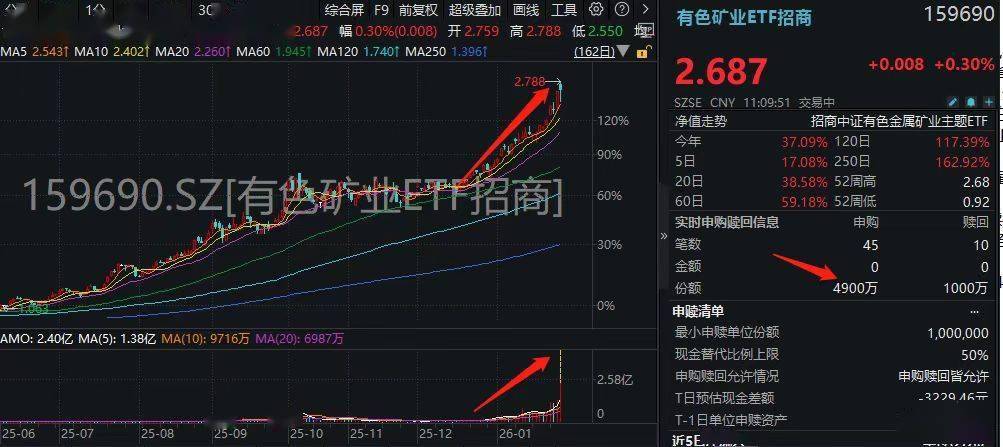
彻底按不住了!有色矿业ETF招商(159690)爆量翻红,成交环比放量超63%再创新高!
Sou Hu Cai Jing· 2026-01-29 03:33
Group 1 - The core viewpoint is that the non-ferrous metal sector is experiencing a rebound, with significant trading volume and price increases observed in related ETFs [1][3] - The non-ferrous metal sector is expected to enter a super cycle driven by the convergence of the "AI leap" and "century change," with historical patterns indicating that commodity cycles can last 25-30 years, with upward trends lasting 8-10 years [3] - Major non-ferrous metal ETFs, such as the one from China Merchants (159690), have a high concentration in key commodities like copper (31%), gold (14%), and aluminum (12%), which together account for nearly 60% of the portfolio [3] Group 2 - Analysts predict that by 2026, the non-ferrous metal industry may experience a bull market driven by a combination of monetary, demand, and supply factors [3] - The non-ferrous metal sector is characterized by a "leverage effect," where rising metal prices lead to significant profit increases for mining companies, resulting in a "Davis double play" scenario where net asset value increases multiple times compared to the commodity price itself [3]
粮食ETF(159698)涨超3.8%,净申购达1950万份,能源化工低位回升下农产品机会也许在新的种植年度开启
Xin Lang Cai Jing· 2026-01-28 08:58
Group 1 - The core viewpoint of the articles highlights the active performance of the agricultural sector, particularly with the surge in agricultural stocks like Nongfa Seed Industry, which hit the daily limit, driven by a record grain production of 14,298 billion jin, an increase of 1.68 billion jin, marking a historical high and maintaining stability above 14 trillion jin for two consecutive years [1] - The agricultural and rural affairs department indicates that the new cycle of bulk commodities has begun, supported by a weakening dollar and a rebound in the BDI index, suggesting a foundation for price increases in commodities [1] - The demand for agricultural products is expected to grow due to increased industrial demand, although the supply has been relatively ample due to favorable weather conditions over the past two years, which could lead to competition for agricultural products if weather conditions change [1] Group 2 - As of January 28, 2026, the National Grain Industry Index (399365) rose by 3.01%, with significant increases in constituent stocks such as Kangsheng Biological (up 10.16%) and Nongfa Seed Industry (up 10.06%) [2] - The Grain ETF (159698) increased by 3.84%, with the latest price reported at 1.14 yuan, closely tracking the National Grain Industry Index, which reflects the price changes of listed companies in the grain industry [2] - The top ten weighted stocks in the National Grain Industry Index as of December 31, 2025, include major companies like Dabeinong and Longping High-Tech, collectively accounting for 51.88% of the index [2]

有色板块飙升,有色金属ETF(512400)量价齐升涨超4%,白银有色、湖南黄金均涨停
Xin Lang Cai Jing· 2026-01-28 03:11
Group 1 - The core viewpoint of the news highlights the significant rise in precious metals, particularly gold and silver, driven by a weakening US dollar and geopolitical uncertainties, leading to increased investment in these assets [1][2]. - The Precious Metals ETF (512400) experienced a notable increase of over 4%, currently up by 3.47%, with a trading volume of 1.569 billion yuan, indicating strong market interest [1]. - The silver price surged by over 7%, reaching a peak of 111.16 USD per ounce, while gold prices also hit a historical high of 5200 USD [1]. Group 2 - Zijin Mining announced a major overseas acquisition, planning to acquire Allied Gold for 5.5 billion CAD (approximately 28 billion RMB), marking the largest single overseas gold mine acquisition in recent years [2]. - The company aims to achieve a gold production target of 85 tons by 2025, with expectations to exceed this target, potentially reaching 100 to 110 tons by 2028 due to the new acquisition [2]. - Analysts suggest that gold may become a key asset valuation anchor in the new credit system, with expectations for a stable Chinese capital market in 2026 and a commodity cycle favoring precious metals [2]. Group 3 - The Precious Metals ETF (512400) closely tracks the Zhongzheng Shenwan Precious Metals Index, which includes 50 listed companies in the precious metals and non-metal materials sectors, reflecting the overall performance of the industry [3]. - The top ten weighted stocks in the index include Zijin Mining, Luoyang Molybdenum, Northern Rare Earth, and others, indicating a diverse representation of the sector [3].

