
存款定期化

Search documents
多省份公布金融数据:浙江人均存款超17万元
Di Yi Cai Jing Zi Xun· 2026-01-19 12:41
Core Viewpoint - The financial data from various provinces in China reveals a stark contrast in household savings and loan behaviors, indicating a growing tendency for residents to save more while showing reluctance to borrow, reflecting a cautious consumer sentiment that still needs to be restored [1][7]. Group 1: Household Savings - Household deposits in five provinces have shown a significant increase, with growth rates reaching 8% to 9%, indicating a strong saving enthusiasm among residents [2][5]. - As of the end of 2025, Guangdong's household deposit balance reached 15.12 trillion yuan, an increase of 1.29 trillion yuan from the beginning of the year, with a growth rate of 9.34% [2]. - Zhejiang's household deposits also increased significantly, reaching 11.85 trillion yuan, with a growth rate of nearly 10% [2][3]. - The national household deposit balance was reported at 167 trillion yuan, with a year-on-year growth of 9.71%, translating to an average per capita deposit of 118,900 yuan [5]. Group 2: Deposit Composition - The trend towards fixed-term deposits remains strong, with fixed-term deposits accounting for 73.3% of total household deposits nationally, as residents prefer to lock in long-term returns amid declining interest rates [5][6]. - In Guangdong, the proportion of demand deposits decreased to 42.91%, while fixed-term deposits increased to 57.09% [6]. Group 3: Household Loans - Both Guangdong and Zhejiang have experienced a contraction in household loans, particularly in short-term loans, indicating a cautious approach to borrowing among residents [7][9]. - In Guangdong, household loans decreased by 47.18 billion yuan year-on-year, with short-term loans down by 1.14 trillion yuan [7]. - Similarly, in Zhejiang, household loans saw a slight decline of 60.49 billion yuan, with short-term loans decreasing by 1.49 trillion yuan [7]. Group 4: Corporate Loans - In contrast to household loans, corporate loans have shown robust growth, with Guangdong's corporate loan balance increasing by 1.34 trillion yuan, a year-on-year increase of 5.36% [9]. - Zhejiang's corporate loans also grew significantly, with an increase of 1.91 trillion yuan, reflecting a year-on-year growth of 12.44% [9]. - The increase in corporate loans is attributed to improved demand for inventory and production expansion, supported by favorable policies and financial tools [9].


招行年报里的十大真相
Xin Lang Cai Jing· 2026-01-18 14:42
Core Viewpoint - The annual report of China Merchants Bank (CMB) for 2023 shows negative revenue growth but positive net profit growth, leading to a significant increase in stock price, indicating market satisfaction with the report. However, the overall economic environment presents more challenges than opportunities, and the actual operational difficulties outweigh the achievements [1][67]. Group 1: Revenue and Profit Analysis - CMB's total revenue for 2023 was 339.1 billion, a decrease of 1.64% compared to 2022, reflecting weakened earning capacity [19][80]. - Both net interest income and non-interest income experienced a decline of 1.6%, indicating a contraction in profit margins and a lack of growth in core business areas [20][82]. - The increase in net profit, despite falling revenue, was primarily due to a significant reduction in credit impairment losses, which decreased by approximately 150 billion, allowing for a positive net profit outcome [24][85]. Group 2: Cost Management and Efficiency - CMB has successfully reduced employee costs, with the average cost per employee decreasing from 625,000 to 604,000, despite an increase in the number of employees [15][16]. - The effectiveness of cost-cutting measures is questioned, as the overall reduction in employee costs is relatively low compared to other industries [16][18]. Group 3: Deposit Trends - There is a concerning trend of increasing "deposit regularization," with corporate fixed deposits rising from 22% to 24.7% and personal fixed deposits increasing from 14.87% to 20.4% [32][92]. - The high cost of deposits is a significant risk, as the bank's deposit rates remain elevated despite multiple reductions in deposit costs throughout the year [30][90]. Group 4: Insurance Income Challenges - CMB's non-interest income from insurance sales, which is a crucial revenue source, is expected to face significant challenges in 2024 due to declining pricing and regulatory changes [36][98]. - The overall income from insurance sales increased by 9.33% to 136 billion, but this growth is overshadowed by declines in other areas such as fund and trust sales [37][98]. Group 5: Market Position and Future Outlook - CMB has played a role in driving the bond bull market, with bond interest income increasing by over 20%, which has helped offset some revenue losses [43][104]. - The bank is focusing on overseas markets, with a 14.78% increase in foreign exchange net income, indicating a strategic shift to capture new revenue streams [47][48].


资金回流 下半年住户存款新增首超2万亿
Zhong Guo Jing Ying Bao· 2025-10-17 07:30
Core Insights - The People's Bank of China reported a significant increase in RMB deposits, with a total increase of 22.71 trillion yuan in the first three quarters of 2023, and a notable rise of 2.96 trillion yuan in September alone, marking the first month this year where household deposits exceeded 2 trillion yuan [1][2] Group 1: Deposit Trends - The surge in household deposits in September is attributed to traditional bank practices at the end of the quarter, as banks typically enhance deposit marketing efforts to meet regulatory requirements [2] - Despite fluctuations in financial products' yields and stock market conditions, the overall risk appetite of residents has not significantly changed, indicating a complex relationship between deposits and investment choices [2][4] Group 2: Financial Market Dynamics - The decline in bank wealth management products, which saw a reduction of 128.47 billion yuan in September compared to August, reflects a seasonal adjustment in the financial market [2] - The phenomenon of "funds moving" between deposits and non-bank financial institutions is ongoing, with expectations that this trend will continue as the capital market remains active [4][5] Group 3: Future Outlook - The dynamic balance of funds among deposits, wealth management, and the stock market is expected to become a norm, with the potential for a slow bull market in equities [5] - Financial institutions are encouraged to innovate and enhance their service offerings to retain deposits and attract investments, particularly through financial technology [3]
13家银行个人存款同比增11.9万亿
Di Yi Cai Jing Zi Xun· 2025-09-01 00:57
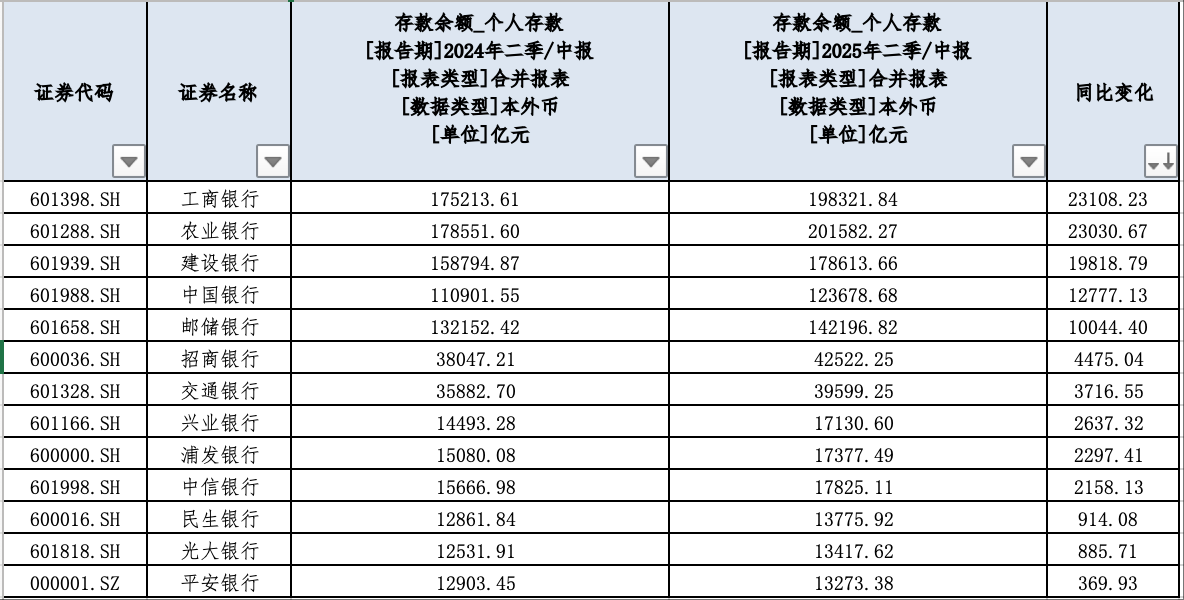
Core Viewpoint - The trend of deposit "migration" is emerging, with residents shifting their bank deposits towards funds and wealth management products, as indicated by multiple brokerage reports. Despite an increase in total deposits, there are signs of funds flowing into the wealth management market, leading to significant growth in wealth management income for several banks [2][3][4]. Group 1: Deposit Trends - In the first half of the year, the total deposit balance of 13 major commercial banks reached 187.4 trillion yuan, an increase of 13.78 trillion yuan year-on-year, with personal deposits totaling 112.07 trillion yuan, up 11.9 trillion yuan year-on-year [3]. - The trend of deposit regularization continues, with the proportion of time deposits among these banks at approximately 59.7%, an increase from 58.48% in the previous year [8][9]. - However, in July, new deposits from households decreased by 1.1 trillion yuan, indicating a potential shift in deposit behavior [4]. Group 2: Wealth Management Growth - The wealth management business of banks is expanding, with significant growth in income from wealth management services. For example, Agricultural Bank's agency business income grew by 62.3% in the first half of the year [4][5]. - The total scale of bank wealth management products reached 30.67 trillion yuan by the end of June, with an estimated increase to 32.67 trillion yuan by the end of July [4][10]. Group 3: Cost of Deposits - The average cost of deposits for the 13 banks was 1.61% in the first half of 2025, a decrease of 34 basis points compared to the same period in 2024 [10]. - The decline in deposit rates is expected to improve the cost of liabilities for banks, with projections indicating a reduction in costs for various types of banks in the coming years [10][11]. Group 4: Net Interest Margin - The net interest margin for commercial banks continued to narrow, reaching 1.42% in the second quarter of 2025, reflecting ongoing pressure on banks' profitability [12][13]. - Most banks reported a decline in net interest margins, with the average margin for the 13 banks at 1.5%, down 12 basis points year-on-year [13][15].






13家银行个人存款同比仍增11.9万亿,定期化趋势未显著缓解
Di Yi Cai Jing· 2025-08-31 12:40
Core Viewpoint - The continuous decline in deposit rates, coupled with the concentration of fixed deposits maturing, is expected to significantly improve the cost of liabilities for banks [1][8]. Group 1: Deposit Trends - Recent reports indicate a trend of residents moving deposits from banks to other financial products such as funds and wealth management products [2][3]. - As of mid-2025, the total personal deposit balance of 13 major commercial banks reached 112.07 trillion yuan, an increase of 11.9 trillion yuan year-on-year [4][5]. - The average cost of deposits for these banks in the first half of 2025 was 1.61%, a decrease of 34 basis points compared to the same period in 2024 [12]. Group 2: Wealth Management Business Growth - The shift of deposits to wealth management products has led to significant growth in banks' wealth management income, with Agricultural Bank's wealth management income increasing by 62.3% [6]. - The total scale of bank wealth management products reached 30.67 trillion yuan by the end of June, with an estimated increase of about 2 trillion yuan by the end of July [6]. Group 3: Interest Margin and Cost of Liabilities - Despite the reduction in deposit costs, banks are still facing pressure on net interest margins, which have decreased to 1.42% as of the second quarter of 2025 [15][16]. - The average net interest margin for the 13 banks was 1.5%, down from 1.62% year-on-year [15]. - The decline in net interest margins is attributed to factors such as the reduction in the Loan Prime Rate (LPR) and adjustments in existing mortgage rates [17][18]. Group 4: Future Outlook - Analysts predict that the concentration of maturing fixed deposits will lead to a significant reduction in the cost of liabilities for banks in the coming years, with expected decreases of 17 to 24 basis points across different types of banks [11]. - The trend of increasing fixed deposits is expected to continue, with the proportion of fixed deposits among total deposits rising to approximately 59.7% in the first half of 2025 [9][10].



7月政府债支撑社会融资,需求仍待提振
3 6 Ke· 2025-08-14 03:38
Group 1 - The core viewpoint of the article highlights that government bonds continue to support the growth of social financing, but the strength of this support may gradually weaken due to remaining quota considerations, making the ability of credit to take over crucial for social financing performance [1][4][6] Group 2 - In the first seven months of 2025, the social financing scale increased by 23.99 trillion yuan, which is 5.12 trillion yuan more than the same period last year, reaching a total balance of 431.26 trillion yuan by the end of July, marking a year-on-year growth of 9%, the highest in nearly 17 months [2][4] - Government bonds net financing in the first seven months amounted to 8.9 trillion yuan, which is 4.88 trillion yuan more than the previous year [3][4] - In July, social financing increased by 1.16 trillion yuan, which is 383.9 billion yuan more than the same month last year, marking the eighth consecutive month of year-on-year growth [4][6] Group 3 - The increase in government bond financing in July was significant, with net financing of approximately 1.24 trillion yuan, which is about 560 billion yuan more than the previous year, continuing to be the main driver of social financing [4][6] - In the first seven months of 2025, RMB loans increased by 12.87 trillion yuan, with the loan balance reaching 268.51 trillion yuan by the end of July, reflecting a year-on-year growth of 6.9% [4][5] Group 4 - The "deposit regularization" issue improved in July, with the broad money (M2) balance reaching 329.94 trillion yuan, a year-on-year growth of 8.8%, while the narrow money (M1) balance was 111.06 trillion yuan, growing by 5.6% [6][7] - The narrowing of the M2-M1 "scissors difference" indicates that enterprises are holding more "liquid money," which is a positive sign for financial liquidity [6][7] Group 5 - Experts suggest that the impact of debt replacement on loan data remains significant, with an estimated 2.6 trillion yuan of refinancing special bonds replacing loans, affecting loan growth by about 1 percentage point [4][5] - Future policy measures, including new rounds of stimulus and personal consumption loan interest subsidies, are expected to boost credit performance [5][6]
独家|某股份行改动零售业务关键考核指标!要求多抓活期存款和“高质量AUM”
券商中国· 2025-07-27 08:00
Core Viewpoint - The retail banking sector is facing challenges with slowing credit growth and increasing reliance on time deposits, prompting banks to adjust their internal assessment metrics to enhance the quality of retail deposits and assets [1][3][5]. Group 1: Retail Banking Challenges - Several banks are experiencing a slowdown in retail credit growth, with some reporting negative growth in personal loans [1]. - The trend of increasing time deposits is leading to a decline in the proportion of revenue generated from retail banking [1][3]. - The shift towards time deposits is putting pressure on the growth of demand deposits, which are typically lower-cost liabilities for banks [5][7]. Group 2: Adjustments in Assessment Metrics - A major bank has recently revised key retail business assessment indicators to focus on increasing demand deposit growth and reducing interest rates on retail deposits [2][4]. - The bank plans to enhance rewards for low-cost deposit acquisition and differentiate assessments based on deposit types and terms [4]. - The emphasis on low-cost demand deposits is reflected in the rising proportion of these metrics in internal assessments [4]. Group 3: Deposit Structure and Trends - As of the end of 2024, major banks like China Merchants Bank (CMB) have a retail deposit scale of approximately 4.03 trillion, with demand deposits accounting for 21.54% of total customer deposits [5]. - Other banks, such as Ping An Bank and Minsheng Bank, show lower proportions of demand deposits, at 9.97% and 9.16% respectively [5][6]. - Overall, the trend of deposit "regularization" is strengthening, with demand deposits under pressure across the industry [10][11]. Group 4: Interest Rate Management - Banks are increasingly focusing on managing deposit interest rates to optimize costs, with CMB reporting a steady improvement in deposit costs [13][14]. - Ping An Bank's average interest rate on deposits decreased by 41 basis points year-on-year, indicating a trend towards lower-cost funding [13]. - The overall industry is witnessing a rise in the proportion of time deposits, with household time deposits reaching a historical high in May [11][12]. Group 5: Focus on High-Quality AUM - Banks are shifting their focus towards acquiring "high-quality AUM" (Assets Under Management) by enhancing rewards for net growth in AUM and incorporating insurance trust contributions [15]. - CMB leads in retail AUM, managing approximately 15.57 trillion, while other banks like Ping An and CITIC Bank are in the 4 trillion to 6 trillion range [16][17]. - The emphasis on AUM quality reflects a broader strategy to improve customer service capabilities and operational efficiency in retail banking [15].

银行业周度追踪2025年第28周:存款定期化压力预计改善-20250720
Changjiang Securities· 2025-07-20 10:45
Investment Rating - The industry investment rating is "Positive" and is maintained [12] Core Viewpoints - The Jiangsu Bank Index has decreased by 0.5% this week, underperforming the CSI 300 by 1.5% and the ChiNext Index by 3.6%. Despite a decline in trading sentiment for bank stocks, the core investment logic remains solid [2][6] - The trend of deposit regularization has stabilized in the first half of the year, with the proportion of RMB time deposits at 73.1% as of the end of June, a decrease of 1.1 percentage points from the previous month, indicating a marginal improvement in deposit regularization pressure for listed banks [2][9][50] - The average dividend yield of the six major state-owned banks' A-shares has fallen to 3.91%, with a spread of 225 basis points over the 10-year government bond yield, while the average yield for H-shares is 4.89%, showing a more pronounced advantage [6][20][24] Summary by Sections Market Performance - The overall market risk appetite has increased significantly this week, leading to a decline in trading sentiment for bank stocks, although the core investment logic remains intact [2][6] - Individual stocks such as Minsheng Bank H and Xiamen Bank have led gains due to improved governance expectations, while Nanjing Bank has seen an increase following the successful delisting of its convertible bonds [6][7] Loan and Deposit Trends - In the first half of the year, the total RMB credit has decreased year-on-year by 350 billion, with weak demand for household credit. The core drag has been short-term and medium-to-long-term operating loans, which have decreased by 705 billion [8][39] - Large banks have increased their new credit year-on-year, capturing 64% of the market share, while smaller banks continue to see a decline in credit demand [8][43][47] Convertible Bonds and Valuation Opportunities - Nanjing Bank's convertible bonds have been successfully delisted, eliminating conversion pressure and suggesting potential for valuation recovery. Other banks like Qilu Bank are also expected to see similar opportunities [7][26] Trading Activity - The turnover rate for joint-stock banks and city commercial banks has increased compared to last week, while the turnover rate for state-owned banks remained stable. The core investment logic for bank stocks remains robust, with low valuation recovery and significant risk bottom lines established [30][35]

住户定期存款余额和占比均创新高!银行多渠道管控负债成本
券商中国· 2025-06-23 01:11
Core Viewpoint - The trend of household deposits becoming more time-bound is strengthening, with a significant increase in the proportion of time deposits and a decrease in demand deposits [1][5][4]. Deposit Structure Analysis - As of the end of May, the total household deposit scale reached 160.64 trillion yuan, an increase of 8.39 trillion yuan since the beginning of the year, with time deposits hitting a new high while demand deposits continued to decline [2][3]. - Time deposits (including other deposits) reached 119.34 trillion yuan, growing by 8.9 trillion yuan since the start of the year, while demand deposits decreased by approximately 513.7 billion yuan due to near-zero interest rates [3][7]. - By the end of May, the proportion of time deposits reached 74.29%, marking a historical high, indicating a deepening trend of deposit time-bounding [4][5]. Monthly Trends - The balance of time deposits has shown a month-on-month increase throughout the first five months of the year, with specific figures of 113.9 trillion, 116.42 trillion, 118.45 trillion, 118.78 trillion, and 119.34 trillion yuan [6]. - The proportion of time deposits has also increased month-on-month, except for a slight decrease in March, reaching 74.29% by the end of May [6]. - However, the growth rate of time deposits is slowing, with a net increase of only 325.8 billion yuan in April and 559.5 billion yuan in May, indicating a significant decline compared to earlier months [6]. Demand Deposit Trends - Demand deposits have shown negative growth in February, April, and May, with reductions of approximately 1.89 trillion yuan, 1.69 trillion yuan, and 922 billion yuan respectively, totaling 41.3 trillion yuan by the end of May, a decrease of 513.7 billion yuan since the end of last year [7]. Long-term Trends - Analyzing over a four-year period from the end of 2020 to the end of 2024, the growth rates of household deposits, time deposits, and demand deposits have shown a "high peak and then a decline" trend, with a significant turning point occurring at the end of 2022 [8]. - In 2022, the net increase in household deposits reached 17.9 trillion yuan, with a year-on-year growth rate of 17.33%, marking a recent high [9]. Banking Sector Implications - The narrowing of net interest margins for commercial banks has become evident, with the net interest margin dropping to 1.43% by the end of the first quarter, indicating pressure on banks to optimize their deposit structures [10][12]. - The increase in the proportion of time deposits is expected to exert continuous pressure on banks' deposit costs, interest margins, and revenues [11]. - To alleviate net interest margin pressure, banks are focusing on optimizing their deposit structures and managing high-cost deposits effectively [12][14].

利率 - 当低存款利率遇上定存到期高峰
2025-06-11 15:49
Summary of Conference Call Records Industry Overview - The records focus on the banking industry in China, particularly the trends in deposit rates and the behavior of depositors in response to macroeconomic conditions [1][2][3]. Key Points and Arguments 1. **Economic Activity and Deposit Behavior** - The decline in economic activity has led to reduced consumer spending and corporate investment willingness. Despite falling deposit rates, the macroeconomic situation has not significantly improved, resulting in a low-risk appetite among residents who prefer fixed-term deposits [1][2]. 2. **Impact of Deposit Rates on Fixed-Term Deposits** - Current fixed-term deposit rates in China are around 1%. Historical data from Japan indicates that fixed-term deposits only significantly decline when rates fall below 0.5%. Therefore, the trend towards fixed-term deposits is expected to continue despite lower rates [1][3]. 3. **Future Trends in Fixed-Term Deposits** - A large volume of three-year fixed-term deposits is set to mature in 2025, with an estimated total of 89 trillion yuan. It is anticipated that most of these funds will be reinvested into new fixed-term products due to limited improvement in fundamentals and the attractiveness of other investment channels [5][12]. 4. **Factors Influencing Deposit Base Growth** - The growth of the deposit base is influenced by several factors: the effectiveness of monetary easing, declining risk appetite among residents, poor performance of other asset classes, and profits remitted by the central bank to enterprises and residents [7][8]. 5. **Long-Term Deposit Preferences** - Residents, particularly those with lower risk tolerance, such as older individuals, are more inclined to choose longer-term fixed deposits. This preference is reflected in the current inversion of interest rates between three to five-year terms and one-year terms [5][6]. 6. **Asymmetric Rate Adjustments** - There is an asymmetric adjustment in interest rates across different terms, with larger adjustments seen in three and five-year terms. This is a response to the current market environment and changing risk preferences [6]. 7. **Historical Context of Deposit Trends** - The increase in fixed-term deposit ratios since 2018 is attributed to declining economic activity, with both residents and enterprises opting for fixed deposits as a safer investment. This trend has persisted despite fluctuations in the broader economic environment [9][10]. 8. **Lessons from Japan's Low-Rate Environment** - Japan's experience shows that even in a prolonged low-rate environment, the overall savings scale does not significantly decrease. This suggests that in a weak economy with limited investment options, individuals will continue to save rather than invest elsewhere [11]. 9. **Banking Sector Implications** - The maturity of fixed-term deposits will have some impact on banks' asset allocation strategies, but the overall effect is expected to be limited. A portion of maturing deposits may be converted to demand deposits, but this does not necessarily translate into a shift towards other business areas [12]. Other Important Insights - The records highlight the importance of understanding depositor behavior in the context of macroeconomic conditions and interest rate trends. The insights drawn from Japan's experience may provide valuable guidance for navigating similar challenges in the Chinese market [11].