
流动性问题

Search documents
高人预测:2026房价若继续下跌,可能会引发这3个问题,提前了解
Sou Hu Cai Jing· 2026-02-08 16:51
Core Viewpoint - The housing market is expected to experience a shift from the previous "universal growth era" to a new normal characterized by "differentiation, adjustment, and slow recovery" by 2026 [3][59] Group 1: Housing Market Trends - There is uncertainty regarding whether housing prices will rise or fall by 2026, but a clear trend indicates that the previous era of universal price increases has ended [3][59] - If housing prices remain weak or decline in many areas, three interconnected issues may arise for homeowners and potential buyers [5] Group 2: Household Financial Health - The concept of "shrinking household balance sheets" refers to situations where property values decrease while mortgage debts remain unchanged, leading to financial strain for high-leverage homeowners [7][11] - Many cities have seen new and second-hand home prices drop by double digits compared to their peaks, creating a situation where homeowners may owe more than their properties are worth [11][14] - Recommendations for managing financial health include controlling leverage, avoiding short-term loans for down payments, maintaining emergency cash reserves, and diversifying investments beyond real estate [16][20][23] Group 3: Local Government Finances - The "land finance" model, where local governments rely on land sales for revenue, is under pressure due to declining real estate activity, leading to reduced land sale revenues for four consecutive years [25][29] - Local governments may face tighter financial conditions, slowing infrastructure projects and public service spending, particularly in cities heavily reliant on land sales [31][34] - Recommendations for buyers include focusing on cities with strong fundamentals, avoiding areas overly dependent on land finance, and prioritizing cash flow and stability in asset allocation [36][41] Group 4: Market Liquidity and Differentiation - The housing market is experiencing significant differentiation, with some areas seeing high inventory and long selling times, while prime locations in first-tier cities show signs of price stabilization [43][45] - Buyers are advised to consider the long-term rental and resale potential of properties, focusing on fundamental factors such as city-level economic stability and population trends [47][50] - Recommendations for potential buyers include prioritizing self-use properties, avoiding investments in low-demand areas, and approaching market entry with a long-term perspective rather than attempting to time the market [52][57]


出通10个月流动性问题显现,研发利好能否推动科笛-B(02487)止跌?
智通财经网· 2026-01-20 07:05
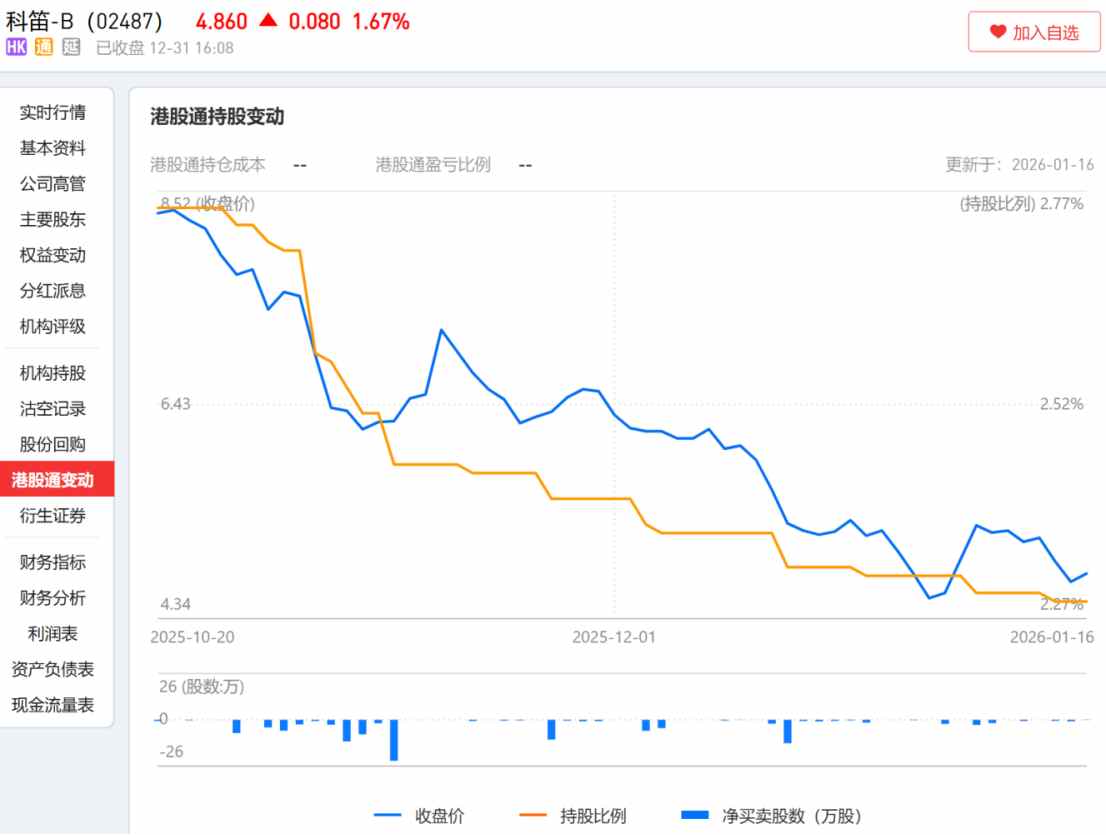
Core Viewpoint - The stock price of Kedi-B (02487) has declined by 35.88% in 2025 and has not yet found a way to rebound in 2026, despite a year-to-date increase of over 7% as of January 19, 2026, primarily due to a low base from a significant drop at the end of 2025 [1] Group 1: Stock Performance and Market Reactions - Kedi's stock price experienced a significant drop of 5.02% on the last trading day of 2025, closing at 4.54 HKD, which contributed to the favorable year-to-date performance in 2026 [1] - The announcement of positive Phase III clinical trial results for CU-20101 (injectable type A botulinum toxin) on January 19, 2026, led to a temporary increase in stock price, indicating potential stabilization [1] - Following its removal from the Hong Kong Stock Connect list in March 2025, Kedi's stock price fell to a low of 3.64 HKD, but rebounded significantly after the release of its annual report in April 2025, showcasing strong fundamentals [2] Group 2: Shareholding and Liquidity Issues - After being removed from the Stock Connect, Kedi's shareholding by Stock Connect funds decreased from 10.09% to 2.29% by January 16, 2026, indicating a significant outflow of funds [2][3] - The accelerated outflow of Stock Connect funds has reduced selling pressure but has also led to a noticeable decline in liquidity for Kedi [5] - Kedi's trading volume has significantly decreased, with only four trading days exceeding 1 million shares in the past four and a half months, contrasting sharply with the previous year's performance [5] Group 3: Financial Performance and Future Prospects - Kedi's revenue for the first half of 2025 decreased by 30.6% to approximately 66.3 million HKD, with a net loss of about 239 million HKD, reflecting challenges due to strategic changes and the termination of a partnership with a U.S. skincare brand [8] - The company plans to issue 28.9 million shares at a price of 8.40 HKD each to raise approximately 240 million HKD, with 45% of the proceeds allocated for the commercialization of new products CU-40102 and CU-10201 [8] - Market forecasts suggest that CU-40102 could generate over 100 million HKD in its first full year, with peak sales potential estimated between 1 billion to 2 billion HKD, while CU-10201 is expected to reach 50 million HKD with peak sales of 500 million to 1 billion HKD [9] Group 4: Clinical Trial Results and Competitive Landscape - The clinical trial results for CU-20101 showed efficacy comparable to BOTOX®, meeting non-inferiority standards, and demonstrated good safety profiles without serious adverse events [12] - The competitive landscape for botulinum toxin products in China includes established players like Allergan's BOTOX® and Lanzhou Biological's Hengli, which dominate the market, making Kedi's entry into this space uncertain [13]
维持低仓位等待市场企稳信号
鲁明量化全视角· 2025-11-23 05:33
Group 1 - The core viewpoint emphasizes maintaining low positions and waiting for market stabilization signals due to recent significant market declines, with the Shanghai Composite Index dropping by 3.90% and the CSI 500 Index by 5.78% [3][4] - The current market sentiment is under pressure from both domestic and international factors, including weak economic indicators in China and a negative impact from the U.S. tech sector's performance [4][5] - The recommendation is to remain cautious and maintain low positions, particularly in the main board, as there are no signs of increased institutional investment or a bottom-buying signal yet [5] Group 2 - The analysis indicates that the short-term economic indicators in China are weakening, with the LPR rates remaining unchanged, which does not meet some investors' expectations [4] - The U.S. Federal Reserve's policies are seen as a significant factor in the current market adjustments, with the latest unemployment rate in the U.S. rising to 4.4%, indicating a weakening job market [4] - The technical analysis suggests that the market has not yet triggered a bottom-buying signal, and the trend has shifted to a broad decline rather than sector rotation [5]

波动放大,“逼宫行情“持续压制科技赛道
Hu Xiu· 2025-11-16 12:17
Group 1 - The current market volatility is increasing, posing a threat to the sensitive technology sector, both domestically and internationally [4] - The U.S. stock market experienced significant fluctuations, with the technology sector facing a sharp decline, raising concerns about liquidity issues across various asset classes [4] - The market's reaction appears to be a "pressure tactic" ahead of the Federal Reserve's upcoming interest rate decision on December 10, indicating a potential for further adjustments if the Fed maintains its stance on interest rates [5] Group 2 - Despite the pressures on economic data, consumer spending remains resilient, suggesting underlying strength in the economy [4]
美国,突传重磅!刚刚,集体爆发!
Zheng Quan Shi Bao Wang· 2025-11-10 01:59
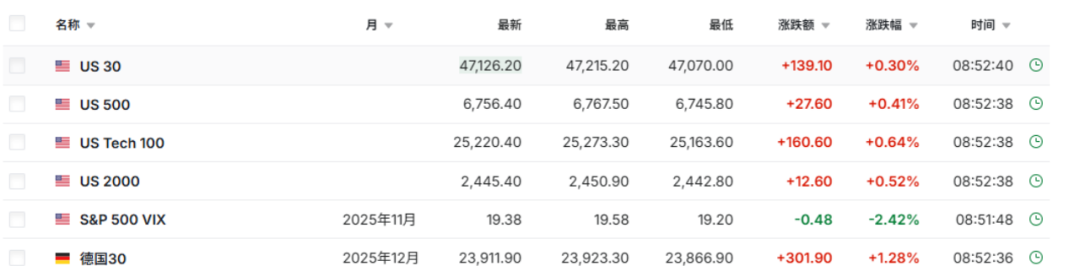
Core Points - The U.S. Senate has reached an agreement to end the federal government shutdown, which has been a significant factor in recent liquidity issues in the market [1][2][4] - The agreement will provide funding for the government until January 30, 2024, and includes provisions to prevent future shutdowns [2][3] - The market reacted positively to the news, with major stock indices and cryptocurrencies experiencing significant gains [1][4][6] Market Reaction - Major U.S. stock indices, including the Dow Jones and S&P 500, saw increases of approximately 0.3% and 0.41% respectively [5] - European stock index futures also rose, with the DAX futures up by 1.3% [1][4] - In the cryptocurrency market, Bitcoin surged past $106,000 and Ethereum exceeded $3,600 [1][6] Economic Context - The government shutdown has lasted for 40 days, surpassing the previous record of 35 days, leading to a tightening of market liquidity [6][7] - The shutdown has delayed salary payments to federal employees, impacting consumer spending, which constitutes 80% of overall expenditure [7] - The Treasury General Account (TGA) balance has risen to $1 trillion due to ongoing financing without expenditure during the shutdown [7]
华尔街慌了!量化数据告诉你真相
Sou Hu Cai Jing· 2025-11-05 12:13
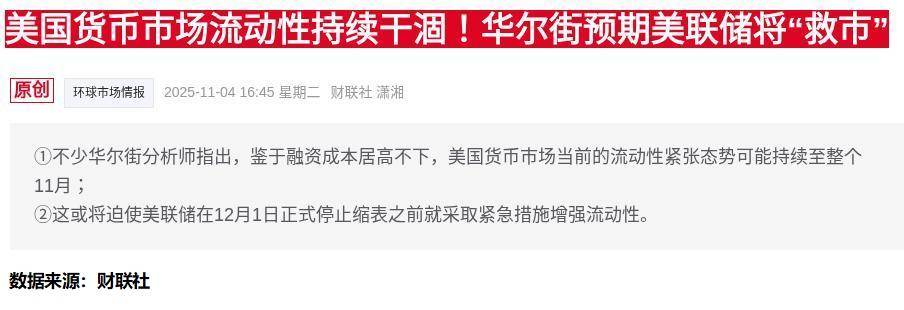
Core Insights - The current liquidity issues faced by the Federal Reserve are causing significant market volatility, with SOFR rates fluctuating dramatically and bank reserves at their lowest since 2020 [1][3] Group 1: Market Behavior and Investor Psychology - Many retail investors tend to make two critical mistakes during bull markets, referred to as the "two regrets of bull markets": hesitating to participate during corrections and impulsively buying at market tops [3][4] - The behavior of retail investors often leads to a mix of fear and impulsiveness, resulting in missed opportunities and poor investment decisions [3][4] Group 2: Institutional Behavior and Market Signals - Despite market fluctuations, institutional activity remains high, indicating that institutions are buying during downturns, which serves as a potential buy signal for investors [10][13] - Historical data shows that significant policy uncertainty often leads to noticeable shifts in institutional funding behavior, which can provide early signals for market movements [14][15] Group 3: Recommendations for Investors - Investors are advised to establish their own decision-making criteria, focusing on institutional funding activity during market adjustments [15] - It is crucial for investors not to be misled by short-term market fluctuations, as the effects of macroeconomic events often take time to manifest [15] - Utilizing modern data analysis tools is recommended to enhance investment strategies and decision-making processes [15]
万科美元债下跌!深圳地铁收紧贷款条件,要求提供抵押物
Hua Er Jie Jian Wen· 2025-11-03 05:05
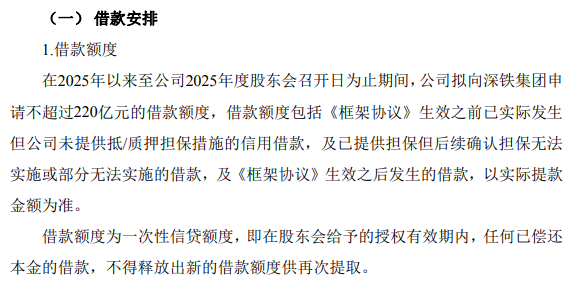
Core Viewpoint - Vanke's dollar bonds have significantly declined due to Shenzhen Metro's requirement for collateral on previously unsecured loans, indicating a tightening of financial support conditions from Shenzhen Metro [1][3][4]. Group 1: Loan Conditions and Changes - Shenzhen Metro has requested Vanke to provide collateral for unsecured loans amounting to 20.373 billion RMB, ensuring the borrower's debt is secured [3][6]. - Vanke plans to apply for a loan limit of up to 22 billion RMB from Shenzhen Metro, which will be a one-time credit limit, meaning any repaid principal cannot be reused for new borrowing [1][6]. - As of October 30, Shenzhen Metro has provided a total of 29.13 billion RMB in loans to Vanke, with approximately 70% of these loans being unsecured [4][6]. Group 2: Impact on Vanke's Financial Position - Following the news, Vanke's dollar bonds maturing in November 2029 with a coupon rate of 3.5% fell by 8.5 cents to 51.3 cents, marking the largest single-day drop since issuance in November 2019 [4]. - The dollar bonds maturing in November 2027 with a coupon rate of 3.975% dropped by 11 cents to 59.5 cents [4]. - The tightening of financial support from Shenzhen Metro has raised concerns among investors regarding Vanke's liquidity issues, especially as the company expands its capital in the third quarter [4][6]. Group 3: Future Outlook and Analyst Opinions - Analysts believe that Shenzhen Metro will continue to support Vanke but will impose stricter controls on the scale of each loan, requiring collateral or pledges for future loans [7]. - The shift in Shenzhen Metro's financial support strategy is evident, as previous loans provided since April did not require asset pledges, which has now changed [6][7].

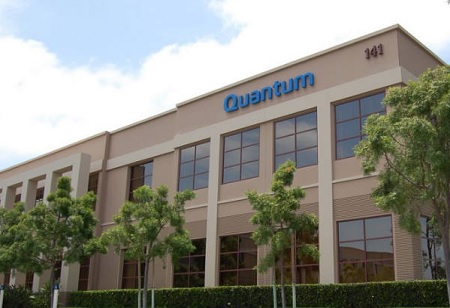
Quantum Corporation's Financial and Legal Challenges
Financial Modeling Prep· 2025-09-10 16:00
Core Viewpoint - Quantum Corporation is facing significant financial difficulties and legal challenges, raising concerns among investors and market analysts regarding its stability and future prospects [1][4]. Financial Performance - Quantum reported an earnings per share (EPS) of -$1.85, which is significantly below the expected EPS of -$0.15, indicating substantial losses [5]. - The company's revenue was $59.7 million, falling short of the estimated $70.1 million, further highlighting its financial struggles [5]. - Quantum has a negative price-to-earnings (P/E) ratio of -0.34, indicating ongoing losses and investor skepticism [2][5]. - The price-to-sales ratio stands at 0.19, suggesting the stock is valued at 19 cents for every dollar of sales [2]. - The enterprise value to sales ratio is 0.62, reflecting a low total valuation relative to its sales [2]. Financial Ratios - Quantum's negative earnings yield of -2.98% indicates that the company is not generating positive returns for its shareholders [3]. - The debt-to-equity ratio of -0.81 suggests that Quantum has more liabilities than equity, raising concerns about its financial stability [3][5]. - The current ratio of 0.40 points to potential liquidity challenges in meeting short-term obligations [3]. Legal Issues - Quantum is facing a class action lawsuit initiated by The Rosen Law Firm, alleging securities fraud against investors who purchased QMCO securities between March 10, 2021, and April 15, 2025 [4][5]. - The Law Offices of Frank R. Cruz are also urging QMCO investors to explore potential securities fraud claims, indicating possible misconduct or misleading information affecting the stock [4].

环球大通集团(08063) - 有关復牌状况之季度更新资料
2025-08-22 09:55
香港交易及結算所有限公司及香港聯合交易所有限公司對本公告的內容概不負責,對 其準確性或完整性亦不發表任何聲明,並明確表示概不就因本公告全部或任何部分內 容而產生或因倚賴該等內容而引致之任何損失承擔任何責任。 茲提述本公司日期為二零二四年十月七日、二零二四年十月八日、二零二四年十月十七 日、二零二五年二月七日、二零二五年二月十日、二零二五年二月十八日、二零二五年 二月十九日、二零二五年二月二十八日、二零二五年四月一日、二零二五年五月十六日 及二零二五年八月十二日之公告(統稱為「該等公告」),內容有關(其中包括)(i)本公司股 份(「股份」)自二零二五年二月十九日起暫停買賣;(ii)恢復股份買賣之復牌指引及額外 復牌指引(統稱為「復牌指引」);及(iii)有關復牌狀況之季度更新資料。除另有指明外,本 公告所用詞彙與該等公告所界定者具相同涵義。 * 僅供識別 1 有關本集團業務營運之更新資料 本公司為投資控股公司,而本集團之主要業務為提供及經營旅遊業務、財資管理業務、 放債業務、提供證券、資產管理業務及財務諮詢業務。 自二零二五年年初以來,本集團持續面臨充滿挑戰及波動之經營環境。難以預測之經濟 及政治狀況導致香港股 ...
“黄金平替”成为市场“新宠”,现在入手合适吗
Jin Rong Shi Bao· 2025-07-09 04:06
Group 1: Market Trends - The "golden alternative" market is gaining traction, with silver and platinum becoming popular in the precious metals market [1] - Silver prices have surged, reaching over $37 per ounce in June, marking a nearly decade-high [1] - Platinum futures have also risen, hitting $1,447.9 per ounce, the highest since September 2014, with a year-to-date increase of over 50% [1] Group 2: Consumer Behavior - Consumers are shifting from gold to platinum jewelry, with some retailers reducing gold display space in favor of platinum [1] - Sales of silver investment products, such as silver bars and ingots, have seen a year-on-year increase of over 40% [1] Group 3: Investment Insights - Analysts suggest that the recent rise in platinum prices may stabilize, advising investors to focus on long-term asset allocation rather than short-term trading [3] - The demand for silver is driven by industrial needs in sectors like electric vehicles, AI, semiconductors, and 5G, alongside its appeal as a hedge against economic uncertainty [3][2] - A significant increase in new silver investment accounts and trading volume has been observed since May, indicating growing investor interest [3] Group 4: Investment Accessibility - The barriers to investing in silver are relatively low, with various channels available for domestic investors, including bank silver accounts and silver ETFs [4]