
消费补贴

Search documents
TrendForce集邦咨询:2Q25晶圆代工营收超417亿美元 季增14.6%创新高
智通财经网· 2025-09-01 06:36
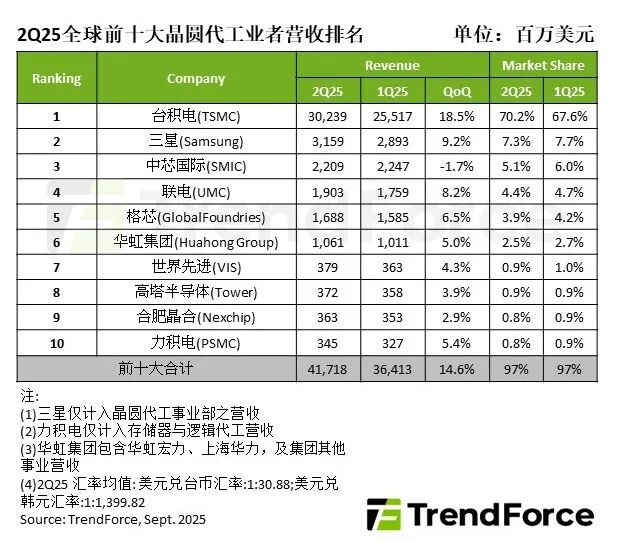
Core Viewpoint - The global top ten foundries are expected to see revenue exceed $41.7 billion in Q2 2025, marking a record high with a quarter-on-quarter increase of 14.6% driven by pre-stockpiling effects from consumer subsidies in China and new product launches in smartphones, laptops/PCs, and servers [1] Industry Summary - The overall wafer foundry capacity utilization and shipment volume are projected to strengthen in Q2 2025, supported by seasonal demand for new products and high-priced wafers [1] - The industry is expected to maintain a continuous quarter-on-quarter revenue increase due to improved capacity utilization [1] Company Performance Summary - **TSMC**: Revenue reached $30.24 billion in Q2 2025, a quarter-on-quarter increase of 18.5%, with a market share of 70.2%, solidifying its position as the market leader [5] - **Samsung**: Revenue was approximately $3.16 billion, up 9.2% quarter-on-quarter, with a market share of 7.3% [6] - **SMIC**: Revenue slightly decreased by 1.7% to around $2.21 billion, with a market share of 5.1% [7] - **UMC**: Revenue grew by 8.2% to $1.90 billion, with a market share of 4.4% [8] - **GlobalFoundries**: Revenue increased by 6.5% to nearly $1.69 billion, holding a market share of 3.9% [9] - **Huahong Group**: Revenue rose by approximately 5% to $1.06 billion, maintaining a market share of 2.5% [10] - **Vanguard**: Revenue was nearly $0.38 billion, up 4.3% quarter-on-quarter, ranking seventh [11] - **Tower**: Revenue increased by 3.9% to $0.37 billion, maintaining an eighth-place market share [12] - **Nexchip**: Revenue reached $0.36 billion, a quarter-on-quarter increase of nearly 3% [13] - **PSMC**: Revenue grew by 5.4% to $0.35 billion, ranking tenth [14]




国金证券:新消费高景气延续 传统轻工内部分化孕育结构性机会
Zhi Tong Cai Jing· 2025-09-01 03:01
Group 1: Home Furnishing Industry - The domestic home furnishing sector is under pressure, with Q2 custom home furnishing experiencing significant challenges and a further divergence in soft furniture performance [2][3] - In H1 2025, domestic home furnishing revenue declined by 0.83% year-on-year, while Q2 saw a 2.89% drop, with net profit attributable to the parent company decreasing by 2.95% and 7.63% respectively [3] - The external home furnishing sector showed growth, with H1 revenue increasing by 11.58% year-on-year and Q2 by 6.56%, although Q2 net profit growth slowed to 0.09% [3] - The resumption of furniture consumption subsidies is crucial for the domestic sector, with expectations for stabilization in the real estate market and recovery in consumer spending [3] Group 2: Paper Industry - The paper industry is facing challenges, with H1 revenue for 13 major paper companies declining by 12.5% year-on-year to 76.13 billion yuan, and net profit dropping to -0.894 billion yuan [4] - The market is currently oversupplied, but there are expectations for a recovery in pulp prices in H2 2025 due to improved downstream demand [4] - Recommendations are made for leading paper companies with integrated cost advantages and strong growth potential to benefit from the anticipated stabilization of pulp prices [4] Group 3: Light Industry Consumption - The light industry sector is experiencing competitive pressure, particularly in personal care products, while the pet and trendy toy segments remain highly prosperous [5] - Personal care product revenue growth has slowed, with notable performance disparities among brands, while some products have seen strong sales due to effective marketing strategies [5] - The pet food industry shows significant growth potential, with domestic brands performing well and external sales growth being particularly strong [5] Group 4: Two-Wheeled Vehicle Industry - The two-wheeled vehicle industry has seen growth driven by new national standards and trade-in policies, with a notable increase in volume, price, and profitability [6] - Leading companies are expanding into mid-to-high-end markets through strategies targeting younger demographics, with overall inventory levels in the supply chain remaining healthy [6] - The industry is expected to further optimize its supply structure, enhancing the competitive advantages of leading firms [6]

宁波发放6000万汽车消费券 购车最高补贴5500元
Mei Ri Jing Ji Xin Wen· 2025-08-31 08:05
Group 1 - Ningbo City has launched a car consumption voucher program with a total amount of 60 million yuan [1] - The subsidy for new car purchases is divided into four tiers, with a maximum of 4,000 yuan available [1] - The second-hand car vouchers are limited to the Haishu District, with a maximum subsidy of 5,500 yuan [1] - The program does not allow for overlapping benefits with other government subsidies [1]
@所有人 这些“真金白银”的补贴、补助要记得领
Yang Shi Xin Wen· 2025-08-30 04:15
Group 1: Consumption Policies - The Central Political Bureau emphasizes the need to implement special actions to boost consumption and expand consumer demand to improve people's livelihoods [1] - The State Council meeting highlights the importance of ensuring that subsidies for "two new" policies are effectively utilized and to combat fraudulent claims [1] - The National Development and Reform Commission has allocated 690 billion yuan in special bonds to support the old-for-new consumption policy, with plans for an additional 690 billion yuan in October [2] Group 2: Childcare and Education Support - A new childcare subsidy scheme will provide 3,600 yuan per child per year for infants under three years old starting January 1, 2025, with tax exemptions for recipients [3] - From the fall semester of 2025, public kindergartens will waive care fees for children in their final year, with similar reductions for private kindergartens [4] Group 3: Consumer Loan Support - A new policy will provide interest subsidies for personal consumption loans from September 2025 to August 2026, covering various consumer categories with a maximum subsidy of 3,000 yuan per borrower [5] - The People's Bank of China and other departments have issued guidelines to enhance financial support for consumption, encouraging financial institutions to provide services for old-for-new consumption [8] Group 4: Elderly and Disabled Support - A new subsidy program for elderly individuals with moderate to severe disabilities will provide financial assistance for home and community care services [7] - The government will support the care services for severely disabled individuals, encouraging localities to enhance their support policies [10] Group 5: Service Industry Support - A loan interest subsidy policy for service industry operators will provide a 1% annual subsidy, with a maximum of 10,000 yuan per entity, covering various service sectors [11] - The funds from these loans must be used to improve consumer infrastructure and service capabilities, with restrictions on overlapping subsidies [12]
有补贴、有补助!记得领
Jing Ji Wang· 2025-08-29 08:19
Group 1: Government Policies and Financial Support - The State Council emphasizes the effective use of "two new" subsidy funds to stimulate domestic demand and combat fraudulent claims [1] - The National Development and Reform Commission has allocated 690 billion yuan in special bonds to support the old-for-new consumption policy, with another 690 billion yuan planned for October [2] - The implementation plan for childcare subsidies will provide 3,600 yuan per child annually starting January 1, 2025, exempting these subsidies from personal income tax [3] Group 2: Elderly and Disabled Support - The Ministry of Civil Affairs and the Ministry of Finance will provide subsidies for elderly individuals with moderate to severe disabilities, covering various care services [4] - The government encourages localities to enhance support for economically disadvantaged individuals with severe disabilities, including integrating them into minimum living security programs [7] Group 3: Financial Support for Consumption - The People's Bank of China and six other departments have issued guidelines to enhance financial support for consumption, including promoting old-for-new financial services and reducing penalties for early loan settlements [5] - A loan interest subsidy policy for service industry operators will provide up to 10,000 yuan in interest support for eligible businesses in sectors such as catering, health, and tourism [9] Group 4: Agricultural Support - The Ministry of Agriculture and Rural Affairs has launched a plan to support the consumption of fresh agricultural products, including measures to assist e-commerce platforms in providing resources for farmers [6]
有补贴、有补助!记得领→
中汽协会数据· 2025-08-29 07:36
Group 1 - The core viewpoint of the article emphasizes the Chinese government's commitment to boosting consumer demand through various financial support measures and subsidies aimed at improving living standards [1][2][3] Group 2 - The State Council's meeting on August 22 highlighted the importance of ensuring that subsidies under the "Two New" policy are effectively utilized to stimulate domestic demand [1][2] - A total of 690 billion yuan in special bonds has been allocated to support the old-for-new consumption policy, with plans for an additional 690 billion yuan in October [3][4] - The implementation of a child-rearing subsidy program will provide 3,600 yuan per child annually starting from January 1, 2025, exempting these subsidies from personal income tax [5][6] Group 3 - The introduction of free preschool education will eliminate fees for public kindergarten's final year starting in the fall of 2025, with similar reductions for private kindergartens [8][9] - A new personal consumption loan interest subsidy policy will be in effect from September 1, 2025, to August 31, 2026, covering various consumer sectors with a maximum subsidy of 3,000 yuan per borrower [10][11] Group 4 - The Ministry of Civil Affairs and the Ministry of Finance will implement a subsidy program for elderly individuals with moderate to severe disabilities, allowing them to use electronic vouchers for purchasing care services [12][13] - Financial support for consumption will be enhanced through measures that promote the replacement of old consumer goods, particularly in the automotive sector [14][15] Group 5 - The agricultural sector will receive special support for fresh agricultural products through a comprehensive plan aimed at enhancing consumption [16][17] - A loan interest subsidy policy for service industry operators will provide up to 10,000 yuan in support for various sectors, including hospitality and healthcare, to improve consumer infrastructure [20][21]

第三批国补淘宝启动补贴申领,智能灯、学习桌椅、学习机等首次纳入补贴
Xin Lang Ke Ji· 2025-08-27 02:46
Core Insights - The third batch of national subsidies for trade-in programs has been launched, with Taobao and Tmall leading the initiative starting August 26 [1] - The subsidy range has expanded this year, particularly targeting back-to-school items such as smart lamps, study desks, and learning machines, with a maximum subsidy of 20% [1] - Consumers can receive additional discounts during the promotional period, with students eligible for up to 4000 yuan in combined educational discounts [1] Group 1 - The subsidy for 3C digital products, including smartphones and tablets priced under 6000 yuan, is set at 15%, with a maximum reduction of 500 yuan [1] - Over 1600 product categories, 3000 brands, and 200,000 items are available under the national subsidy program on Taobao and Tmall, attracting over 150 million daily visits to the subsidy section [1] - The subsidy for energy-efficient home appliances can reach up to 20% for first-level products and 15% for second-level products, with home modification products for elderly care receiving up to 30% [1] Group 2 - Local consumption subsidies are being issued in various provinces, including Zhejiang, Guangdong, Jiangsu, Anhui, and Shanghai, with specific discounts for educational products and home appliances [2] - Taobao and Tmall have upgraded their logistics and installation services to offer half-day precise appointment options, enhancing the consumer experience for national subsidy products [2] - A new "alarm reminder" feature has been introduced to assist consumers in redeeming national subsidies more conveniently [2]

用好工具箱提振消费力 上海7月社零总额增7.8%
Jie Fang Ri Bao· 2025-08-24 02:15
Core Insights - Shanghai's retail sales in July reached 129.138 billion yuan, showing a year-on-year growth of 7.8%, significantly outperforming the national growth rate of 3.7% [1] Retail Performance - The total retail sales of goods in July amounted to 114.085 billion yuan, with a year-on-year increase of 9.7%, contributing to the overall retail growth [2] - The most notable growth was seen in cultural and office supplies, which surged by 78% year-on-year, followed by home appliances and audio-visual equipment, which grew by 49.7% [2] - The increase in these categories is attributed to seasonal factors and the implementation of the "old-for-new" policy, which has been upgraded to include multiple levels of subsidies [2] Jewelry Consumption - Jewelry consumption in Shanghai saw a significant recovery, with a year-on-year increase of 21.5% in July, reversing previous declines [3] - The recovery is linked to major promotional events such as the "Five-Five Shopping Festival" and "Shanghai Summer," which stimulated consumer spending [3] Automotive Market - July marked the first year-on-year growth in automotive consumption in Shanghai, driven by local and national subsidy policies that reduced consumer costs [4] - The introduction of "anti-involution" policies has also contributed to a narrowing of retail discounts in the new energy vehicle market, supporting positive sales growth [4] Consumer Trends - Within essential consumer goods, there is a noticeable divergence: while the retail sales of grain and oil products have shown steady growth, categories like clothing and daily necessities have seen weaker performance or declines [5] - This trend indicates a shift in consumer preferences, where some items remain essential while others are becoming optional [5] Overall Consumption Environment - Shanghai has implemented various strategies to boost consumption, including financial support and creating a vibrant consumption atmosphere, which is reflected in the strong retail data for July [6]
“每日限额发券”改为“集中发券”长沙以旧换新政策有调整
Chang Sha Wan Bao· 2025-08-22 04:41
Group 1 - The Changsha Municipal Bureau of Commerce announced an adjustment to the old-for-new policy for home appliances, 3C digital products, and home renovation from a "daily limited coupon issuance" model to a "centralized coupon issuance" model [1] - The centralized coupon issuance will occur from August 22 to August 26, and on September 1, October 1, November 1, and December 1, with increased subsidy funding to meet consumer demand [1] - Consumers can receive coupons from 11:00 to 24:00 on the issuance days, with a maximum of three times per month for each category after the policy adjustment [1] Group 2 - The policy aims to enhance market demand, improve the efficiency of subsidy fund usage, and stimulate consumption potential to promote the development of related industries [2] - As of August 14, over 6.37 million participants have engaged in the old-for-new program in Changsha, with government subsidies amounting to 4.347 billion yuan and directly driving sales of 36.039 billion yuan [2]
新世纪期货:螺纹钢供应过剩担忧升温
Qi Huo Ri Bao· 2025-08-21 00:34
8月初,国家矿山安全监察局发布新版《煤矿安全规程》"点燃"煤炭供给收缩预期,原料价格大涨带动 螺纹钢价格上涨。上周,煤炭供给收缩预期降温、建材表观需求超预期回落、仓单压力较大等因素压制 螺纹钢期货价格,主力合约从近期高位大幅回调近8%,周三午盘收报3132元/吨。 宏观方面,美国7月非农就业数据低于市场预期及CPI数据"爆表"导致美联储9月降息概率增加。中期来 看,美国货币政策和财政政策预计将协同发力,海外宏观预期转强,需要持续关注美国通胀和降息预期 的变化。国内方面,中共中央政治局7月30日召开会议,决定今年10月在北京召开中国共产党第二十届 中央委员会第四次全体会议,主要议程包括研究关于制定国民经济和社会发展第十五个五年规划的建 议。新质生产力、绿色低碳、设备更新、消费补贴等政策加码预期增强。 供应方面,自7月初以来,长流程和短流程钢厂利润均呈现持续改善状态,近期利润增长速度放缓。截 至8月15日,华东地区螺纹钢高炉利润为131元/吨,华东地区电炉谷电利润为32元/吨,钢厂生产意愿较 强。根据钢联数据,当前短流程钢厂的产能利用率逐步回升至57.39%,较7月初增长6.34个百分点。短 流程钢厂持续复产使近 ...