
美联储降息

Search documents
铂钯数据日报-20260309
Guo Mao Qi Huo· 2026-03-09 04:59
1. Report Industry Investment Rating - Not provided in the given content 2. Core Viewpoint of the Report - On March 6, the prices of platinum and palladium continued their weak and volatile trends. The PT2606 contract closed down 1.2% to 560.5 yuan/gram, and the PD2606 contract closed down 1.79% to 421.5 yuan/gram. Geopolitical tensions between the US and Iran have pushed up energy prices, increasing concerns about inflation and economic recession, which has put pressure on platinum and palladium prices. However, the potential for further escalation of the conflict may limit the downside of prices. The unexpectedly poor US February non - farm data has boosted expectations of a Fed rate cut, and the risk of a private credit crisis in the US has weakened the US dollar index, providing support for platinum and palladium prices. Fundamentally, the WPIC expects the global platinum market to experience a supply shortage for the fourth consecutive year, which may support platinum prices, but the narrowing of the 26 - year spread and new US tariff policies may limit its upside. Palladium has a weaker fundamental situation and is expected to perform weaker than platinum. In the short term, platinum and palladium are expected to maintain a wide - range oscillation, and investors can consider buying on dips after the market sentiment stabilizes [6] 3. Summary According to Relevant Catalogs 3.1 Domestic Prices - Platinum futures main contract closing price: 560.5 yuan/gram, down 0.61% from the previous value of 563.95 yuan/gram [4] - Spot platinum (99.95%): 547.5 yuan/gram, down 2.23% from the previous value of 560 yuan/gram [4] - Platinum basis (spot - futures): - 13 yuan/gram, up 229.11% from the previous value of - 3.95 yuan/gram [4] - Palladium futures main contract closing price: 421.5 yuan/gram, down 1.52% from the previous value of 428 yuan/gram [4] - Spot palladium (99.95%): 422.5 yuan/gram, down 1.17% from the previous value of 427.5 yuan/gram [4] - Palladium basis (spot - futures): 1 yuan/gram, down 300.00% from the previous value of - 0.5 yuan/gram [4] 3.2 International Prices - London spot platinum: 2155.4 dollars/ounce, down 0.65% from the previous value of 2169.6 dollars/ounce [4] - London spot gold: 1662.08 dollars/ounce, down 0.49% from the previous value of 1670.34 dollars/ounce [4] - NYMEX platinum: 2154.9 dollars/ounce, down 0.81% from the previous value of 2172.6 dollars/ounce [4] - NYMEX gold: 1676 dollars/ounce, down 0.80% from the previous value of 1689.5 dollars/ounce [4] 3.3 Internal - External 15 - Point Spread - US dollar/Chinese yuan central parity rate: 6.9025, up 0.03% from the previous value of 6.9007 [4] - Spread between Guangzhou platinum and London platinum: 19.99 yuan/gram, down 0.15% from the previous value of 20.02 yuan/gram [4] - Spread between Guangzhou platinum and NYMEX platinum: 20.12 yuan/gram, up 4.39% from the previous value of 19.27 yuan/gram [4] - Spread between Guangzhou palladium and London palladium: 4.70 yuan/gram, down 49.12% from the previous value of 9.24 yuan/gram [5] - Spread between Guangzhou palladium and NYMEX palladium: 1.21 yuan/gram, down 72.73% from the previous value of 4.43 yuan/gram [5] 3.4 Price Ratios - Guangzhou Futures Exchange platinum/gold price ratio: 1.3298, up 0.0121 from the previous value of 1.3176 [5] - London spot platinum/gold price ratio: 1.2968, down 0.0021 from the previous value of 1.2989 [5] 3.5 Inventory - NYMEX platinum inventory: 205098 (troy ounces), unchanged from the previous value [5] - NYMEX gold inventory: 582441 (troy ounces), down 0.17% from the previous value of 583452 [5] 3.6 Position - NYMEX total position of platinum: 72351, down 3.04% from the previous value of 70154 [5] - NYMEX non - commercial net long position of platinum: 13832, up 4.47% from the previous value of 13240 [5] - NYMEX total position of gold: 16423, down 2.01% from the previous value of 16093 [5] - NYMEX non - commercial net long position of gold: 664, down 75.75% from the previous value of 161 [5]
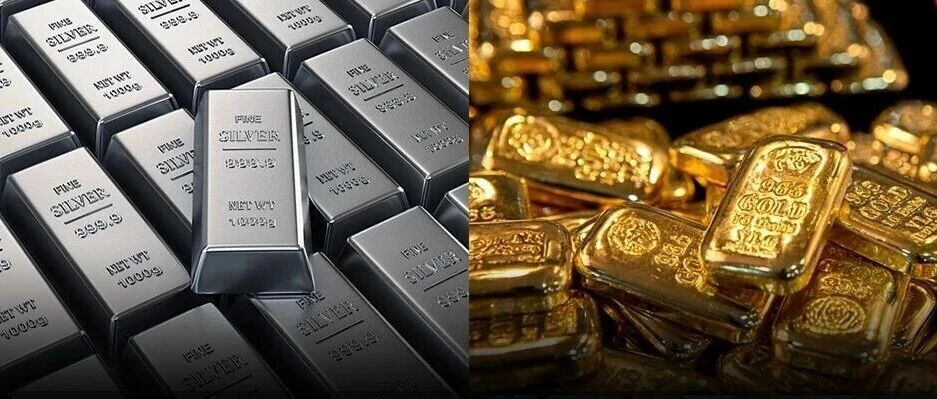
金价下跌,银价追跌!
中国能源报· 2026-03-09 03:58
Group 1 - The surge in energy prices has led investors to worry that the Federal Reserve may delay interest rate cuts due to inflation rebound pressures, resulting in a cooling of previously crowded gold long positions and a significant profit-taking by investors, causing international gold and silver prices to decline last week [2][9] - The U.S. stock indices experienced a broad decline last week, with the Dow Jones falling by 3.01%, the S&P 500 down by 2.02%, marking the largest weekly drop since October of the previous year, and the Nasdaq decreasing by 1.24% [5] - The military conflict in the Middle East has significantly pushed up international oil prices, with New York oil prices rising by 35.63% and London Brent oil prices increasing by 27.88% last week [7][9] Group 2 - As of Monday (9th), international oil prices continued their strong upward trend, with New York oil prices opening above $100 per barrel for the first time since the outbreak of the Russia-Ukraine military conflict in 2022, briefly touching $110 per barrel during trading [11] - The surge in oil prices has put pressure on U.S. stocks, with investors concerned that rising energy prices will impact consumer spending and corporate investment, potentially leading the Federal Reserve to delay interest rate cuts [14] - Key monthly inflation data, including the February Consumer Price Index (CPI) and January Core Personal Consumption Expenditures (PCE) Price Index, is set to be released this week, with expectations that the February CPI will not rebound sharply due to tightening consumer spending and lower used car prices [16]

美国2026年2月非农数据点评:受临时因素扰动较大,3月非农就业有望回归正增长
Dong Fang Jin Cheng· 2026-03-09 03:20
Group 1: Employment Data Overview - In February 2026, the U.S. non-farm employment saw a net decrease of 92,000, significantly below the market expectation of an increase of 55,000, marking the largest monthly decline since 2020[5] - The unemployment rate rose from 4.3% in January to 4.4% in February, exceeding the expected 4.3%[5] - The historical data for non-farm employment was revised downwards, with December's figures adjusted from 48,000 to -17,000 and January's from 130,000 to 126,000, totaling a downward revision of 69,000[5] Group 2: Factors Influencing Employment Trends - The decline in employment was primarily driven by temporary factors such as strikes, extreme weather, and statistical model adjustments, rather than a fundamental collapse of the job market[4] - Major sectors experienced job losses, including healthcare services (-34,000), leisure and hospitality (-27,000), construction (-11,000), and manufacturing (-11,000)[7] - The Kaiser Permanente strike involving approximately 31,000 workers significantly impacted the healthcare sector, leading to a drop in employment in that area[7] Group 3: Future Employment Outlook - As temporary factors dissipate, March non-farm employment is expected to return to positive growth, with a projected recovery in the healthcare sector following the end of the strike[10] - The overall employment market is anticipated to continue a moderate cooling trend, with average monthly job growth expected to stabilize around 30,000 to 50,000 in the second and third quarters of 2026[12] - The labor participation rate, adjusted for population estimates, is stable at approximately 62.4%, indicating no significant decline in labor supply willingness[10] Group 4: Federal Reserve Policy Implications - The current combination of "weak employment and rising oil prices" does not constitute a substantial stagflation scenario, allowing for potential interest rate cuts if inflation expectations remain stable[13] - The Federal Reserve is expected to initiate its first rate cut in September 2026, with an anticipated total reduction of 50 basis points throughout the year[15] - Despite rising market expectations for rate cuts, the likelihood of a rate cut in March remains low at 96.3%, as the Fed monitors wage growth and geopolitical risks[15]
贵金属日报2026-03-09-20260309
Wu Kuang Qi Huo· 2026-03-09 02:13
1. Report Industry Investment Rating - The report has a cautious bearish view on precious metals [3] 2. Core View of the Report - After the short - term boost of geopolitical factors on gold and silver prices, the continuous rise in crude oil prices due to the US - Iran war and the tense situation in the Middle East may be transmitted to inflation indicators such as PPI. Although the US non - farm payroll data in February was disappointing, due to the rising raw material prices, the market expects the Fed to postpone interest rate cuts until September, which will suppress the upward space of precious metal prices in the short term. The recommended operating range for the main contract of Shanghai Gold is 1100 - 1200 yuan/gram, and for the main contract of Shanghai Silver is 20500 - 22000 yuan/kilogram [2][3] 3. Summary by Relevant Catalogs 3.1 Market Quotes - Shanghai Gold rose 0.89% to 1151.16 yuan/gram, and Shanghai Silver rose 1.88% to 21692.00 yuan/kilogram. COMEX Gold rose 2.02% to 5181.30 US dollars/ounce, and COMEX Silver rose 3.06% to 84.70 US dollars/ounce. The US 10 - year Treasury yield was 4.15%, and the US dollar index was 99.45 [2] - The US seasonally - adjusted non - farm payrolls in February decreased by 92,000, a negative figure again after October 2025, while the market expected an increase of 59,000. The US unemployment rate in February was 4.4%, the highest since December 2025, slightly higher than the market expectation of 4.3% [2] 3.2 Key Data of Gold and Silver - **COMEX Gold**: The closing price of the active contract was 5181.30 US dollars/ounce, up 1.73%; the trading volume was 148,500 lots, up 1.87%; the open interest was 409,800 lots, down 2.47%; the inventory was 1029 tons, down 0.06% [6] - **LBMA Gold**: The closing price was 5127.55 US dollars/ounce, up 0.46%; the closing price of the active contract was 1140.80 yuan/gram, down 0.97%; the trading volume was 385,900 lots, up 17.88% [6] - **SHFE Gold**: The open interest was 284,700 lots, down 1.95%; the inventory was 105.03 tons, unchanged; the settled funds were 5.1973 billion yuan, down 2.90% [6] - **AuT + D**: The trading volume was 45.71 tons, down 9.96%; the open interest was 236.92 tons, down 2.05% [6] - **COMEX Silver**: The closing price of the active contract was 84.70 US dollars/ounce, up 2.64%; the open interest was 113,300 lots, down 9.67%; the inventory was 10,860 tons, down 0.63% [6] - **LBMA Silver**: The closing price was 82.34 US dollars/ounce, down 2.23%; the closing price of the active contract was 21,740.00 yuan/kilogram, up 0.47%; the trading volume was 942,500 lots, down 20.84% [6] - **SHFE Silver**: The open interest was 497,500 lots, down 1.32%; the inventory was 255.95 tons, down 6.15%; the settled funds were 2.9203 billion yuan, down 0.86% [6] - **AgT + D**: The trading volume was 311.10 tons, down 27.97%; the open interest was 2941.7 tons, down 0.83% [6] 3.3 ETF Holdings - **Gold ETFs**: The closing price of SPDR US was 473.52 US dollars, up 1.59%; the holding was 1073.32 tons, down 0.24%; the settled funds were 17.6878 billion US dollars, up 0.22%. The holding of iShare US was 494.22 tons, down 0.85%. The holdings of GBS UK, PHAU UK, GOLD UK, and SGBS Switzerland remained unchanged [62] - **Silver ETFs**: The closing price of SLV US was 75.94 US dollars, up 2.25%; the holding was 15,761.62 tons, down 0.30%; the settled funds were 4.1722 billion US dollars, down 2.52%; the trading volume was 4038.93 million shares, down 18.32%. The holding of ETPMAG Australia was 487.41 tons, up 0.26%. The holdings of PSLV Canada and CEF Canada remained unchanged [62]
跟随板块调整,铂钯大幅回落
Hua Lian Qi Huo· 2026-03-09 02:01
Report Industry Investment Rating - Not provided in the given report Core Viewpoints - Last week, the expectation of the Fed's interest rate cut cooled down, the US dollar index was strong, precious metals adjusted weakly, and platinum and palladium suffered a significant pullback. The soaring energy prices and the rise of crude oil prices above $90 per barrel had a siphon effect on speculative funds, significantly amplifying the price fluctuations of platinum and palladium. However, there are still uncontrollable geopolitical risks, and positive factors remain. [8][9] - Fundamentally, the global platinum market has been in short supply for two consecutive years. The shrinking supply, rising industrial demand, and relatively low prices have stabilized the demand for jewelry and investment, highlighting the supply - demand contradiction. It is expected that the supply - demand gap of platinum will still exist in the next few years, so the long - term fundamentals of platinum are optimistic. [9] - For palladium, automobile demand dominates. Due to the sharp increase in the penetration rate of new energy vehicles in China, the incremental demand for palladium is suppressed, and it is difficult to see improvement in the short term. Therefore, the fundamental support for palladium is limited, and its trend is affected by the linkage with platinum and the macro - environment. Overall, without significant changes in fundamentals, it may move in sync with the trend of precious metals. [9] - In terms of strategies, it is recommended to buy on dips in the medium term, and short - term fluctuations are large. For options, a double - buying strategy is suggested for reference. [9] Summary by Directory 1. Weekly Views and Strategies - **Platinum and Palladium Trends**: Last Friday, the main platinum and palladium contracts fell under pressure. The main platinum contract closed down 1.2% at 560.5, and the main palladium contract closed down 1.79% at 421.5. The expectation of the Fed's interest rate cut cooled down last week, the US dollar index was strong, precious metals adjusted weakly, and platinum and palladium fell under pressure. The spot platinum in the outer market closed at 2164.1 early on Saturday, and the spot palladium closed at 1622.6. The weekly declines of domestic platinum and palladium were 10.14% and 9.33% respectively. [8] - **Macroeconomic Situation**: The US manufacturing PMI in February was 52.4, higher than the expected 51.8 and the previous value of 52.6, with the manufacturing PMI remaining in an expansionary range for the second consecutive month. In terms of employment, the US non - farm payrolls in February decreased by 92,000, significantly lower than expected, and the unemployment rate rose to 4.4%, higher than the expected 4.3%. The weak US employment data still keeps the market's hope for the Fed's interest rate cut. However, the rise in crude oil prices further intensifies inflation concerns, and the market continues to postpone the expected time of the Fed's interest rate cut. The Fed will hold a meeting on March 18, and the market generally expects the interest rate to remain unchanged. According to the CME FedWatch tool, the first interest rate cut is expected to be in July. [8] - **News**: On February 28, the US and Israel launched a large - scale air strike on Iran, killing Iran's supreme leader and many senior military and political officials. Iran then counterattacked the US military bases in the Gulf and Israel, and some Middle Eastern countries were affected. The traffic volume in the Strait of Hormuz plummeted, and the Iranian Self - Defense Forces reiterated the closure of the strait and claimed "full control." Energy prices soared, and the crude oil price rose above $90 per barrel, having a siphon effect on speculative funds and significantly amplifying the price fluctuations of platinum and palladium. [8] - **Fundamentals**: In 2026, the supply and demand of platinum and palladium are expected to show obvious differentiation. Platinum supply is continuously restricted, with South Africa accounting for over 70% of global production. Its demand structure is diversified, with automobile exhaust catalysts accounting for only about 40%, and the rest coming from investment, jewelry, and industrial fields. Against the background of rising platinum prices, investment demand has increased significantly, and emerging fields such as the hydrogen energy industry and commercial aerospace have opened up long - term growth space. It is expected that the supply - demand gap of platinum will continue in 2026 and may further widen. Palladium's terminal demand is highly dependent on automobile exhaust catalysts, accounting for over 80%. Suppressed by the accelerated penetration of new energy vehicles and the substitution trend of platinum, the growth of palladium demand lacks imagination. Although there is still a supply gap in the short term, it is expected that the gap will narrow significantly in 2026, and the fundamental support is relatively limited. [8] 2. Futures and Spot Markets - Multiple charts are provided, including the futures and spot price trends of platinum and palladium in NYMEX, London, Guangzhou Futures Exchange, and Shanghai Gold Exchange, showing the price trends of platinum and palladium in different markets. [13][17][21][25] 3. US Economy - Multiple charts are provided, including the trends of US GDP, PMI, non - farm payrolls, and unemployment rate, reflecting the overall economic situation of the United States. [31][32] 4. Inflation - Charts of US CPI/PCE and core CPI/PCE are provided, showing the inflation situation in the United States. [38] 5. Interest Rates - Charts of US Treasury bond yields (short - term and medium - long - term) and real interest rates are provided, reflecting the interest rate situation in the United States. [47][48] 6. Fundamentals - **Platinum**: The global platinum supply - demand balance sheet from 2013 to 2026f is provided, showing the supply and demand situation of platinum in different regions and application fields, and it is expected that the supply - demand gap will continue in 2026. [53] - **Palladium**: The global palladium supply - demand balance sheet from 2009 to 2025 is provided, showing the supply and demand situation of palladium in different regions and application fields, and it is expected that the supply - demand gap will narrow significantly in 2026. [54] 7. Futures Positioning - Charts of the futures position of platinum and palladium in the outer market are provided, including non - commercial net long positions and total positions, reflecting the market's trading sentiment towards platinum and palladium. [55] 8. Passenger Car Sales - Charts of China's passenger car market retail and wholesale data are provided, showing the sales situation of the passenger car market. [62] 9. US Dollar Index and Exchange Rates - Charts of the US dollar index, US dollar - RMB exchange rate, euro - US dollar exchange rate, US dollar - Japanese yen exchange rate, British pound - US dollar exchange rate, and US dollar - Canadian dollar exchange rate are provided, reflecting the exchange rate situation. [68][71][74][76] 10. Platinum and Palladium Price Differences between Domestic and Foreign Markets - Charts of the spot price trends and price differences of platinum between domestic and foreign markets are provided, showing the price differences of platinum in different markets. [85] 11. Platinum - Palladium Ratio - A chart of the platinum - palladium ratio is provided, showing the price ratio relationship between platinum and palladium. [94]
美国经济:就业数据发出疲软信号,但噪音较多
Zhao Yin Guo Ji· 2026-03-09 00:49
Employment Data Summary - In February, the U.S. non-farm payrolls decreased by 92,000, significantly below the market expectation of 55,000[4] - The average monthly job growth over the past three months is 6,000, down from 126,000 in January[4] - Private sector employment fell from 95,000 in January to -61,000 in February[4] Sector-Specific Impacts - The construction industry saw job losses of 11,000, while the leisure and hospitality sector lost 27,000 jobs in February[4] - Healthcare and education services employment dropped from 129,000 in January to -34,000 in February due to a strike involving 31,000 workers in California[4] - Manufacturing jobs decreased by 12,000, contributing to a total goods-producing job loss of 25,000[4] Wage and Unemployment Trends - Despite job losses, wages maintained a month-on-month growth rate of 0.4%, with a year-on-year increase from 3.7% in January to 3.8% in February[4] - The unemployment rate rose from 4.28% to 4.44%, exceeding the market expectation of 4.3%[4] - Labor force participation rate decreased by 0.4 percentage points to 62%[4] Federal Reserve Outlook - Due to the noisy employment data, it is anticipated that the Federal Reserve will not initiate rate cuts in the near term[4] - The Fed is expected to cut rates once by 25 basis points in June as a political gesture under the new chair[4] - The tightening of dollar liquidity is likely to increase as inflation expectations rise due to higher oil prices[4]
海外观察:美国2026年2月非农数据:罢工影响或干扰美国就业数据真实性
Donghai Securities· 2026-03-08 11:16
Employment Data Summary - In February 2026, the U.S. non-farm employment decreased by 92,000, significantly below the expected increase of 59,000[2] - The unemployment rate rose slightly to 4.4%, compared to the expected 4.3% and the previous value of 4.3%[2] - Private sector employment fell by 86,000, with the goods-producing sector losing 25,000 jobs and the service sector losing 61,000 jobs[2] Sector Analysis - The education and healthcare sector, traditionally a stronghold for U.S. employment, saw a reduction of 34,000 jobs, largely due to strikes affecting 31,000 workers in California[2] - The construction and manufacturing sectors were major contributors to the decline, losing 11,000 and 12,000 jobs respectively[2] - The hospitality sector experienced a net loss of 35,000 jobs, marking the fourth consecutive month of decline[2] Wage and Inflation Concerns - Private sector hourly wage growth remained robust at 0.4%, with production and service sector wages increasing by 0.5% and 0.4% respectively[2] - Concerns about inflation persist, as high wage growth combined with geopolitical tensions may lead to renewed inflationary pressures[2] Market Reactions and Predictions - Despite the poor employment data, market expectations for interest rate cuts remain unchanged, with a 96.3% probability of no rate cut in March[2] - The report suggests that the significant drop in employment may not prompt the Federal Reserve to lower interest rates, due to the potential distortions caused by strikes and ongoing inflation risks[3]
中信证券明明:权益资产偏高的估值指向股市波动可能放大,这客观上加大了市场赚钱的难度
Xin Lang Cai Jing· 2026-03-08 09:40
Group 1: Economic Policies and Market Expectations - The necessity for a second round of domestic growth stabilization policies is highlighted, indicating that current fiscal policy may not be sufficient to stimulate demand effectively [2][10] - The expectation of the U.S. Federal Reserve's delayed interest rate cuts is influenced by persistent inflation and labor market conditions, creating a complex scenario for monetary policy [3][11] - The anticipated performance of the A-share market in 2025 suggests a favorable earning effect, although high valuations may increase market volatility and complicate profit generation [4][11] Group 2: Bond Market Outlook - Historical trends indicate that bond bear markets are typically triggered by economic rebounds, increased risk appetite, or central bank liquidity tightening; however, the current environment suggests no imminent bear market for bonds [5][12] - The central bank's commitment to a moderately loose monetary policy is expected to support a slight decline in bond yields throughout the year, with a significant interest rate cut window anticipated in the first half of the year [5][12] Group 3: Commodity Market Dynamics - Gold has been leading the commodity market in 2023, driven by a loose liquidity environment and its strong financial attributes; however, the end of rapid global liquidity expansion may hinder gold's continued leadership in the commodity space [6][12]

“滞胀”风险≠美联储难降息——2月非农数据点评
一瑜中的· 2026-03-08 08:55
Core Viewpoint - The February non-farm employment data showed a significant decline, with a loss of 92,000 jobs, far below the expected gain of 55,000, indicating potential weaknesses in the labor market and raising concerns about the economic outlook [2][20]. Group 1: Non-Farm Employment Data Summary - Non-farm employment decreased by 92,000, with private non-farm employment down by 86,000, and the previous two months' data revised down by a total of 69,000 [2][20]. - Employment contraction was observed across various sectors, notably in education and healthcare services (-34,000), leisure and hospitality (-27,000), construction (-11,000), manufacturing (-11,000), and transportation (-11,300) [22][20]. - The employment diffusion index fell from 55.6% to 50.6%, indicating a broad decline in job growth across sectors [20]. Group 2: Unemployment Rate and Labor Participation - The unemployment rate slightly increased to 4.4%, above the expected 4.3%, while the labor participation rate dropped from 62.5% to 62.0% [25][20]. - The household survey indicated a decrease in total population by 216,000, with a labor force reduction of 1.399 million and a drop in employment by 1.608 million [25][20]. - The decline in labor participation was primarily due to adjustments in population estimates, with the adjusted participation rate around 62.4% [25][20]. Group 3: Wage Growth and Market Reactions - Hourly wage growth was slightly above expectations at 0.4% month-on-month, with a year-on-year increase of 3.8% [31][20]. - Following the non-farm report, market expectations for interest rate cuts increased, with the probability of a rate cut in July rising from 64% to 87% [33][20]. - The stock market reacted negatively, with major indices declining, while gold prices increased by 2.02% [33][20].

2月非农“倒春寒”,美联储“两头堵”
GOLDEN SUN SECURITIES· 2026-03-08 07:07
Employment Data - February non-farm employment decreased by 92,000, significantly below the expected increase of 55,000[2] - The unemployment rate rose to 4.4%, higher than both the expected and previous rate of 4.3%[2] - The labor force participation rate fell to 62.0%, below the expected and previous rate of 62.5%[3] Wage Growth - Average hourly earnings increased by 0.4% month-on-month, exceeding the expected growth of 0.3%[3] Sector Performance - Government sector employment decreased by 6,000, while the private sector saw declines in education and healthcare (-34,000) and leisure and hospitality (-27,000)[4] - Only a few sectors, such as finance (+10,000) and wholesale trade (+6,000), showed slight employment growth[4] Market Reactions - Following the non-farm report, U.S. stock markets declined, with the S&P 500, Nasdaq, and Dow Jones dropping by 1.33%, 1.59%, and 0.95% respectively[5] - The 10-year U.S. Treasury yield fell by 0.77 basis points to 4.13%, while the dollar index decreased by 0.09% to 98.96[5] Interest Rate Expectations - Market expectations for a rate cut by the Federal Reserve increased, with the implied probability of a June rate cut rising from 37.8% to 56.7%[7] - The expected number of rate cuts for 2026 increased from 1.58 to 1.76[7] Economic Outlook - The labor market remains fragile, influenced by strikes, adverse weather, layoffs, and model adjustments, indicating a continued loosening process[2][8] - The true change in policy space is likely to occur after the May Federal Reserve chair transition, with potential for more significant rate cuts in the second half of the year[10]