
全球化

Search documents
中国银河:给予三一重工买入评级
Zheng Quan Zhi Xing· 2025-08-24 07:01
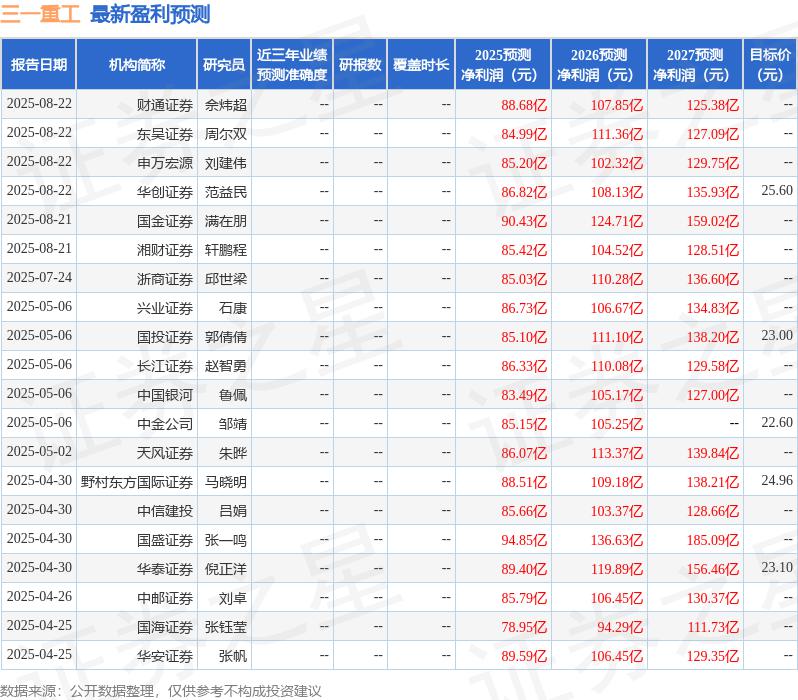
Core Viewpoint - Sany Heavy Industry reported strong revenue and profit growth in the first half of 2025, driven by both domestic and international markets, leading to a "buy" rating from analysts [1][2]. Financial Performance - In H1 2025, the company achieved operating revenue of 44.53 billion yuan, a year-on-year increase of 14.96%, and a net profit attributable to shareholders of 5.22 billion yuan, up 46% year-on-year [2]. - The gross margin for the engineering machinery industry was 27.57%, an increase of 0.81 percentage points year-on-year, benefiting from product price increases and cost reductions [2]. - The net profit margin for H1 2025 was 11.65%, up 2.5 percentage points year-on-year [2]. Domestic and International Revenue - Domestic revenue reached 17.35 billion yuan, a year-on-year increase of 21.4%, while international revenue was 26.30 billion yuan, up 11.7%, with international revenue accounting for approximately 60.3% of total revenue [2]. - The gross margins for domestic and international markets were 22.1% and 31.2%, respectively, with year-on-year increases of 0.90 and 1.04 percentage points [2]. Product Performance - Revenue from excavators was 17.5 billion yuan, a year-on-year increase of 15%, while concrete machinery, cranes, pile machinery, and road machinery reported revenues of 7.44 billion yuan, 7.80 billion yuan, 1.34 billion yuan, and 2.16 billion yuan, respectively [3]. - The company launched over 30 new energy products in H1 2025, achieving full coverage and continuing research and testing of unmanned products [3]. Cost Management and Cash Flow - The company demonstrated effective cost management with sales, management, R&D, and financial expense ratios of 6.54%, 2.81%, 4.83%, and -1.91%, respectively [3]. - Operating cash flow for H1 2025 was 10.134 billion yuan, a year-on-year increase of 20.11%, with a debt-to-asset ratio of 51.4%, down 3.72 percentage points year-on-year [3]. Future Outlook - The company is expected to benefit from a recovery in the domestic industry and strong overseas demand, with projected net profits of 8.745 billion yuan, 11.015 billion yuan, and 13.518 billion yuan for 2025, 2026, and 2027, respectively [4]. - The company maintains a strong market position in excavators and continues to deepen its strategies in globalization, digitalization, and low-carbon initiatives [4].


可口可乐考虑出售旗下英国咖啡连锁品牌Costa Coffee|首席资讯日报
首席商业评论· 2025-08-24 04:27
Group 1 - The article discusses the regulatory framework for internet platforms, emphasizing that the recent document is aimed at standardizing practices rather than halting competition or subsidies [1] - The document requires platforms to disclose rules for promotional activities and prohibits false advertising and exaggeration of subsidy amounts [1] Group 2 - Lucky Coffee, a brand under Mixue Group, opened its first overseas store in Malaysia, selling nearly 2000 cups on the opening day, marking the start of its global expansion [2] - As of July, Lucky Coffee has signed over 7000 stores in the domestic market and plans to refine its overseas store model while deepening its presence in Southeast Asia [2] Group 3 - Coca-Cola is considering selling its UK coffee chain Costa Coffee, which it acquired for $3.9 billion in 2019, and has hired Lazard to evaluate potential options [3] - Initial discussions have taken place with a few potential bidders, including private equity firms, but no deal is guaranteed at this stage [3] Group 4 - In the first seven months of the year, Shaanxi's automobile production reached 1.083 million units, a year-on-year increase of 22.1%, significantly outpacing the national growth rate of 11.6% [4] - The production of new energy vehicles in the province reached 743,000 units, accounting for 68.6% of total automobile production [4] Group 5 - Honglu Steel Structure has begun limited external sales of its self-developed welding industrial robots, which are primarily used internally at present [5] - The company has deployed nearly 2500 welding robots across its ten production bases [5] Group 6 - Oriental Selection reported a 32.7% year-on-year decline in net revenue for its continuing operations, dropping from 6.5 billion yuan to 4.4 billion yuan for the fiscal year ending May 31, 2025 [6] - The company achieved a net profit of 6.2 million yuan for the fiscal year, compared to a profit of 249.1 million yuan in the previous year, but would have seen a 30% increase in profit if the sale of a subsidiary had been excluded [6] Group 7 - The film "Final Destination: Bloodline Curse" has grossed over 30 million yuan in its first two days of release in mainland China [7] Group 8 - Huawei Cloud is undergoing organizational restructuring, focusing on AI and consolidating several departments to improve operational efficiency [8] - The restructuring aims to increase investment in strategic industries while reducing focus on non-strategic areas [8] Group 9 - The U.S. government has become Intel's largest shareholder by investing $8.9 billion for a 9.9% stake in the company, raising concerns about market intervention [9]



美国贸易战的思想根源
Hu Xiu· 2025-08-24 03:02
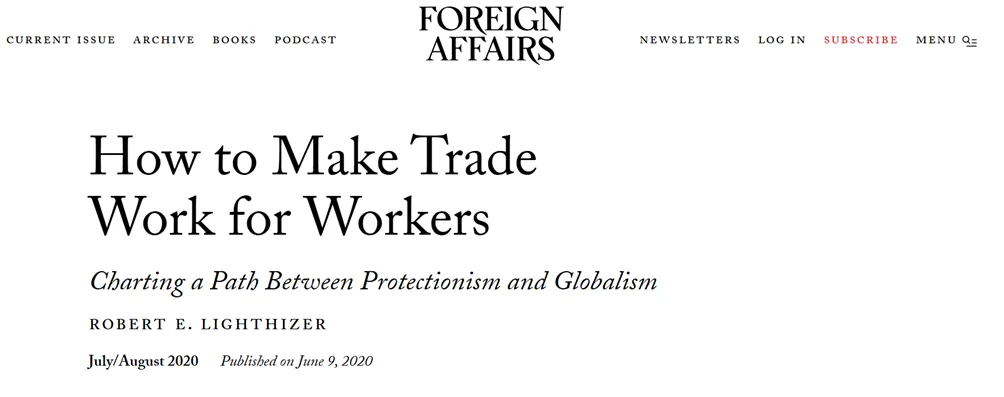
Group 1 - The article discusses the insights of Robert Lighthizer, the former U.S. Trade Representative, on the trade war and its implications for American workers [3][4][10] - Lighthizer criticizes the previous U.S. trade policies that overly emphasized free trade and efficiency, leading to significant job losses in the manufacturing sector [25][29][33] - The article highlights the negative impact of outsourcing manufacturing jobs, which resulted in a loss of 5 million manufacturing jobs in the U.S. from 2000 to 2016 [29][33] Group 2 - Lighthizer argues that the U.S. has been too lenient in trade negotiations with countries like India and China, leading to unfavorable outcomes for American workers [18][19] - The article points out that the U.S. has a long-standing trade deficit, which Lighthizer believes is unsustainable and must be addressed [38][40] - The COVID-19 pandemic exposed the risks of over-reliance on foreign manufacturing, particularly in critical sectors like medical supplies [41][42] Group 3 - The article emphasizes the importance of stable, high-paying jobs for maintaining personal dignity and societal stability [44][46] - Lighthizer advocates for trade policies that prioritize job creation and support for American workers, rather than solely focusing on efficiency [43][45] - The new U.S.-Mexico-Canada Agreement (USMCA) is presented as a model for future trade agreements, aiming to increase domestic job creation in the automotive sector [48][55] Group 4 - The article discusses the historical context of U.S. trade policies and their consequences, including the impact of the North American Free Trade Agreement (NAFTA) on job losses [50][52] - Lighthizer's perspective suggests that trade can be used as both a tool for economic growth and a means of exerting pressure on other nations [68][70] - The article concludes that internal reforms are necessary for the U.S. to address its economic challenges, rather than relying solely on external trade conflicts [86][90]
*ST原尚2025年中报简析:增收不增利
Zheng Quan Zhi Xing· 2025-08-23 22:57
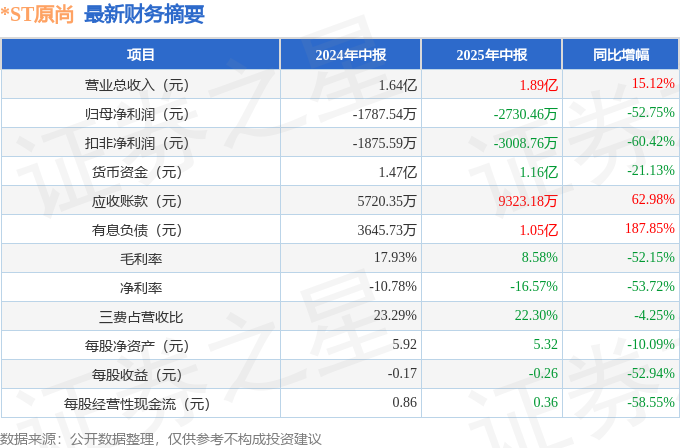
Core Viewpoint - *ST Yuanshang reported a revenue increase but a significant decline in net profit for the first half of 2025, indicating challenges in profitability despite revenue growth [1][3]. Financial Performance - Total revenue for the first half of 2025 reached 189 million yuan, a year-on-year increase of 15.12% compared to 164 million yuan in 2024 [1]. - The net profit attributable to shareholders was -27.30 million yuan, a decrease of 52.75% from -17.88 million yuan in the previous year [1]. - The gross margin fell to 8.58%, down 52.15% from 17.93% in 2024, while the net margin was -16.57%, a decline of 53.72% from -10.78% [1]. - Total expenses (selling, administrative, and financial) amounted to 42.08 million yuan, accounting for 22.3% of revenue, a slight decrease of 4.25% year-on-year [1]. Cash Flow and Assets - Cash flow from operating activities showed a significant decline of 58.55%, with a net cash flow of 0.36 yuan per share compared to 0.86 yuan in the previous year [1][3]. - The company’s monetary funds decreased by 21.13% to 116 million yuan, while accounts receivable increased by 62.98% to 93.23 million yuan [1][3]. - Interest-bearing liabilities surged by 187.85% to 105 million yuan, indicating increased reliance on bank loans [1][3]. Industry Context - The automotive logistics industry is undergoing a transformation driven by technological changes and policy initiatives, with a focus on cost reduction and efficiency improvements [6][7]. - The overall logistics industry in 2024 showed signs of recovery, with a decrease in the ratio of social logistics costs to GDP, reaching a record low since 2006 [6]. - The market for fuel vehicles is experiencing a structural adjustment, with a 14% year-on-year decline in retail sales, reflecting a shift towards new energy vehicles [6]. Future Outlook - The company aims to stabilize its traditional automotive parts logistics while expanding into new business areas to enhance profitability [7]. - The management highlighted the importance of adapting to industry changes and leveraging existing logistics experience to explore new opportunities [7].

伟星股份2025年中报简析:增收不增利,公司应收账款体量较大
Zheng Quan Zhi Xing· 2025-08-23 22:57
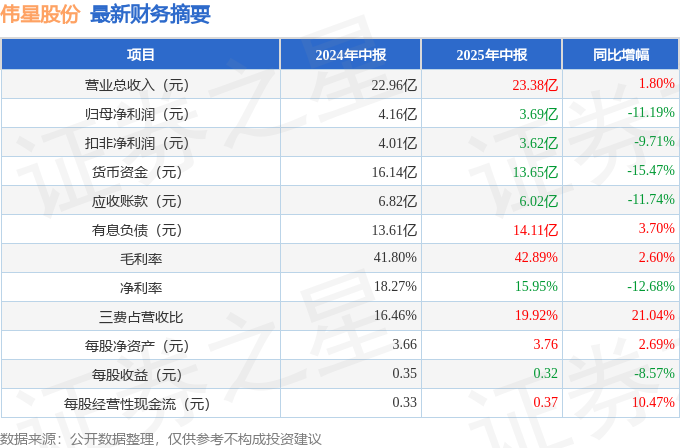
Core Viewpoint - The recent financial report of Weixing Co., Ltd. shows a mixed performance with a slight increase in revenue but a significant decline in net profit, indicating potential challenges in the company's financial health and operational efficiency [1]. Financial Performance - The total revenue for the first half of 2025 reached 2.338 billion yuan, a year-on-year increase of 1.8% [1]. - The net profit attributable to shareholders was 369 million yuan, down 11.19% year-on-year [1]. - In Q2 2025, total revenue was 1.359 billion yuan, a decrease of 9.18% compared to the same period last year [1]. - The gross profit margin improved to 42.89%, up 2.6% year-on-year, while the net profit margin decreased to 15.95%, down 12.68% year-on-year [1]. - The total of selling, administrative, and financial expenses was 466 million yuan, accounting for 19.92% of revenue, an increase of 21.04% year-on-year [1]. Cash Flow and Debt - The cash flow per share was 0.37 yuan, an increase of 10.47% year-on-year [1]. - The company’s receivables accounted for 85.96% of the latest annual net profit, indicating a high level of outstanding payments [4]. - The company’s interest-bearing debt increased by 3.7% to 1.411 billion yuan [1]. Market and Industry Outlook - The company is facing pressure on order intake due to uncertainties from tariff policies and weak end-consumer demand in the apparel sector [6]. - The company aims to focus on its core business of apparel accessories and enhance brand influence and product competitiveness in the long term [7]. - The company’s international business is primarily concentrated in Bangladesh and Vietnam, with limited direct exports to the U.S. and Europe, reducing the immediate impact of tariff changes [12]. Strategic Initiatives - The company plans to enhance its global delivery capabilities and brand influence while maintaining a cautious approach to capital expenditures amid uncertain trade conditions [13]. - The company is committed to sustainable development and aims for a reasonable annual profit distribution plan, maintaining an average dividend payout ratio of around 80% since its listing [15].

泡泡玛特(9992.HK):IP矩阵维持健康 全球化布局再加速
Ge Long Hui· 2025-08-23 11:56
Core Insights - The company reported a revenue of 13.88 billion RMB for 1H25, representing a year-over-year increase of 204.4% with a gross profit of 9.76 billion RMB and a gross margin of 70.3%, up 6.3 percentage points year-over-year [1] - The adjusted net profit for 1H25 reached 4.71 billion RMB, reflecting a year-over-year growth of 362.8% and a net profit margin of 33.9% [1] - The company projects a minimum revenue of 30 billion RMB for the year 2025, with an expected adjusted net profit margin of around 35% [1] Revenue Breakdown - Domestic revenue in China was 8.28 billion RMB, a year-over-year increase of 135.2%, accounting for 59.7% of total revenue [1] - Offline channel revenue was 5.08 billion RMB, up 117.1%, with retail store revenue at 4.41 billion RMB, increasing by 119.9% [2] - Online channel revenue reached 2.94 billion RMB, growing by 212.2%, with significant contributions from various platforms [2] - Revenue from the Asia-Pacific region was 2.85 billion RMB, a year-over-year increase of 257.8% [2] - Offline channel revenue was 1.53 billion RMB, up 203.5%, while online channel revenue surged to 1.07 billion RMB, increasing by 546.7% [2] - Revenue from the Americas was 2.27 billion RMB, showing a remarkable year-over-year growth of 1142.3% [3] - Offline channel revenue was 840 million RMB, up 744.3%, and online channel revenue reached 1.33 billion RMB, increasing by 1977.4% [3] - Revenue from Europe and other regions was 480 million RMB, a year-over-year increase of 729.2% [3] IP and Product Categories - In 1H25, five IPs generated over 1 billion RMB in revenue, including THE MONSTERS, MOLLY, SKULLPANDA, DIMOO, and CRYBABY, with THE MONSTERS accounting for 34.7% of total revenue [3] - Plush toys became the largest product category, increasing from less than 10% in 24H1 to 44% [3] Operational Efficiency - The gross margin improved by 6.3 percentage points to 70.3%, driven by higher pricing of overseas products and a reduction in the proportion of externally sourced goods [4] - The sales and management expense ratios decreased by 6.7 percentage points and 4.0 percentage points, respectively, to 23.0% and 5.6% [4] Investment Outlook - The company is positioned as a leading IP operation platform with a global presence and a robust IP matrix, creating competitive barriers [4] - The adjusted net profit forecasts for 2025-2027 have been raised to 11.1 billion RMB, 17 billion RMB, and 21.2 billion RMB, reflecting increases of 70%, 77%, and 72% respectively [4]

AI+医疗元年 家用医疗器械龙头交出年中答卷
Mei Ri Jing Ji Xin Wen· 2025-08-23 06:29
Core Insights - The company reported a revenue of 4.659 billion yuan for the first half of 2025, representing a year-on-year growth of 8.16%, and a net profit of 1.203 billion yuan, up 7.37% year-on-year [2] - The company is focusing on the integration of AI and healthcare, aiming to create a comprehensive product ecosystem through "hardware + AI + ecosystem" [2][4] - The company is committed to global expansion, digitalization, and the development of wearable technology as part of its strategic direction [3][9] Financial Performance - Revenue for the respiratory treatment solutions reached 1.674 billion yuan, a growth of 1.93%, with home respiratory machines seeing over 40% growth [5] - Blood glucose management and POCT solutions generated 674 million yuan, marking a 20% increase, with the latest dynamic glucose monitoring product achieving record sales [5] - The company achieved overseas revenue of 607 million yuan, reflecting a growth of 26.63% [10] Strategic Focus - The company is enhancing its global market presence by building local teams and optimizing supply chains, as demonstrated by its success in Thailand [9] - The company is actively participating in international exhibitions and academic exchanges to showcase its innovations and expand its global influence [10] - The company is investing in R&D, with 295 million yuan allocated in the first half of the year, a 9.44% increase [7] Product Development - The company launched over 30 innovative products, including the fifth-generation dynamic glucose monitoring device and new oxygen concentrators [7] - The company is focusing on the development of wearable medical devices, aiming to integrate AI technology into its product offerings [7][8] - The company has received multiple certifications and accolades, reinforcing its brand value and commitment to high-quality manufacturing [6]

数据解放生产力——琰究汽车数据系列(2025年7月)【民生汽车 崔琰团队】
汽车琰究· 2025-08-23 01:37
Core Viewpoint - The article provides a comprehensive update on the automotive industry for July 2025, highlighting sales trends, inventory levels, and market dynamics, with a focus on both passenger and commercial vehicles [3][4][12]. Group 1: Overall Automotive Industry - In July 2025, total automotive sales reached 2.593 million units, a year-on-year increase of 14.7% but a month-on-month decrease of 10.7%. Cumulatively, from January to July, sales totaled 18.269 million units, up 12.0% year-on-year [3][19]. - Passenger vehicle sales in July were 2.287 million units, reflecting a 14.7% increase year-on-year and a 9.8% decrease month-on-month. For the first seven months, sales reached 15.841 million units, up 13.4% year-on-year [3][19]. - Commercial vehicle sales in July were 306,000 units, a year-on-year increase of 14.1% but a month-on-month decrease of 17.1%. Cumulatively, from January to July, sales totaled 2.428 million units, up 3.9% year-on-year [3][19]. - The inventory coefficient for automotive dealers decreased to 1.35 in July from 1.42 in June, indicating a reduction in inventory levels [3][19]. Group 2: Passenger Vehicle Sales Structure - In July 2025, the market share of domestic brands was 69.8%, while European, Japanese, American, and Korean brands held 12.9%, 9.6%, 6.2%, and 1.5% respectively, showing a year-on-year change of +3.9, -3.4, -0.8, +0.1, and +0.1 percentage points [4][21]. - By vehicle classification, the market shares for A00, A0, A, B, C, and D segments were 3.2%, 13.2%, 38.6%, 28.7%, 13.9%, and 1.3% respectively, with year-on-year changes of -0.2, +0.8, +1.2, -1.6, -0.3, and 0.0 percentage points [5][21]. - In terms of pricing, the market shares for vehicles priced below 100,000, 100,000-150,000, 150,000-200,000, 200,000-250,000, 250,000-300,000, and above 300,000 yuan were 21.2%, 30.1%, 15.6%, 12.6%, 7.8%, and 12.7% respectively, with year-on-year changes of +6.3, -1.0, -1.5, -1.2, +0.6, and -3.2 percentage points [5][21]. Group 3: Key Automotive Companies - In July, the year-on-year sales growth rates for key companies were as follows: BYD +0.1%, Chery +18.5%, Geely +57.7%, Changan +41.4%, FAW-Volkswagen +0.9%, SAIC Volkswagen -1.8%, Great Wall +14.4%, Tesla -8.4%, and SAIC-GM-Wuling +76.8%. Month-on-month changes were -9.7%, -0.3%, +0.7%, -1.7%, -33.9%, -14.2%, -7.0%, -5.2%, and -5.4% respectively [6][12]. - The overall discount rate in July 2025 was 16.0%, a decrease of 0.70 percentage points from June, and further decreased to 15.8% by the end of July [8][9]. - For fuel and new energy vehicles, the discount rates were 19.9% and 11% respectively at the beginning of July, decreasing to 19.6% and 10.6% by the end of the month [9][11]. Group 4: Commercial Vehicle Sales - In July 2025, truck sales were 264,000 units, a year-on-year increase of 13.8% but a month-on-month decrease of 16.3%. Cumulatively, from January to July, truck sales reached 2.121 million units, up 3.1% year-on-year [12][19]. - Bus sales in July were 42,000 units, reflecting a year-on-year increase of 16.3% but a month-on-month decrease of 21.2%. Cumulatively, from January to July, bus sales totaled 307,000 units, up 9.7% year-on-year [12][19].






盈峰环境2025年半年报亮眼:海外业务营收强势增长 全球化战略成新引擎
Zheng Quan Shi Bao Wang· 2025-08-22 14:03
Core Viewpoint - The company, Yingfeng Environment, reported strong financial performance for the first half of 2025, with significant growth in sales, net profit, and revenue, indicating robust development in the environmental protection industry. Financial Performance - In the first half of 2025, the company achieved a sales revenue of 6.31 billion yuan, a year-on-year increase of 19.63% [1] - The net profit attributable to shareholders was 382 million yuan, up 0.43% year-on-year [1] - Total operating revenue reached 6.46 billion yuan, reflecting a growth of 3.69% [1] Business Segments - The smart city service business generated 5.82 billion yuan in revenue, marking a 7.65% increase year-on-year [1] - The overseas market revenue surged by 59.55%, showcasing strong international growth [3] - The intelligent high-tech equipment segment saw a remarkable growth of 132.3% [1] Market Leadership - Yingfeng Environment has maintained its position as the leading company in the environmental equipment sector for 24 consecutive years, with sales of environmental equipment reaching 2.585 billion yuan, a 15.27% increase [2] - The market share for environmental equipment stands at 18.8%, while the market share for new energy environmental vehicles is at 32.6%, indicating a significant competitive advantage [2] Innovation and Technology - The company has invested 250 million yuan in the development of the Zhiyun platform, which integrates intelligent algorithms and AI models to enhance operational efficiency [6] - As of June 30, 2025, the company holds 1,399 valid patents, including 630 invention patents, leading the industry in innovation [6] Strategic Initiatives - The company is expanding its overseas presence by establishing production bases in Italy and Thailand, targeting the European and Southeast Asian markets [3] - Yingfeng Environment's urban service contracts total 54.646 billion yuan, with a strong focus on digitalization and intelligent management systems [4] Corporate Social Responsibility - The company actively participates in charitable activities and disaster relief efforts, demonstrating its commitment to sustainable development and community support [8]

燃油车稳当下,新能源搏未来:MG品牌两年内将推13款电动车
2 1 Shi Ji Jing Ji Bao Dao· 2025-08-22 12:58
Group 1 - The core strategy of MG brand is to invest 10 billion yuan in the new energy market, launching 13 new energy vehicles within two years, including pure electric, hybrid, and range-extended models [1] - MG's current fuel vehicles still dominate sales, but the brand is committed to transitioning to new energy, emphasizing the importance of foresight in the automotive market [1][3] - The collaboration with OPPO for a smart car interconnection system aims to create an open ecosystem, allowing seamless integration of various smartphone brands, enhancing user experience [2] Group 2 - MG's sales in Europe reached 153,100 units in the first half of 2025, marking an 18.6% increase, and the brand has exported over 3 million vehicles globally, becoming the leading Chinese automotive brand overseas [3] - The design of MG vehicles must balance global aesthetics with local preferences, as international customers favor a more robust design while domestic customers prefer softer, refined styles [3] - MG's strategy includes maintaining a diverse product line from affordable models to luxury sports cars, aiming to appeal to a broad demographic while focusing on individuality and technology [3]