
国产替代

Search documents
资本动作密集!鼎龙股份拟购皓飞新材控股权,进军锂电材料行业
Bei Jing Shang Bao· 2026-01-27 13:03
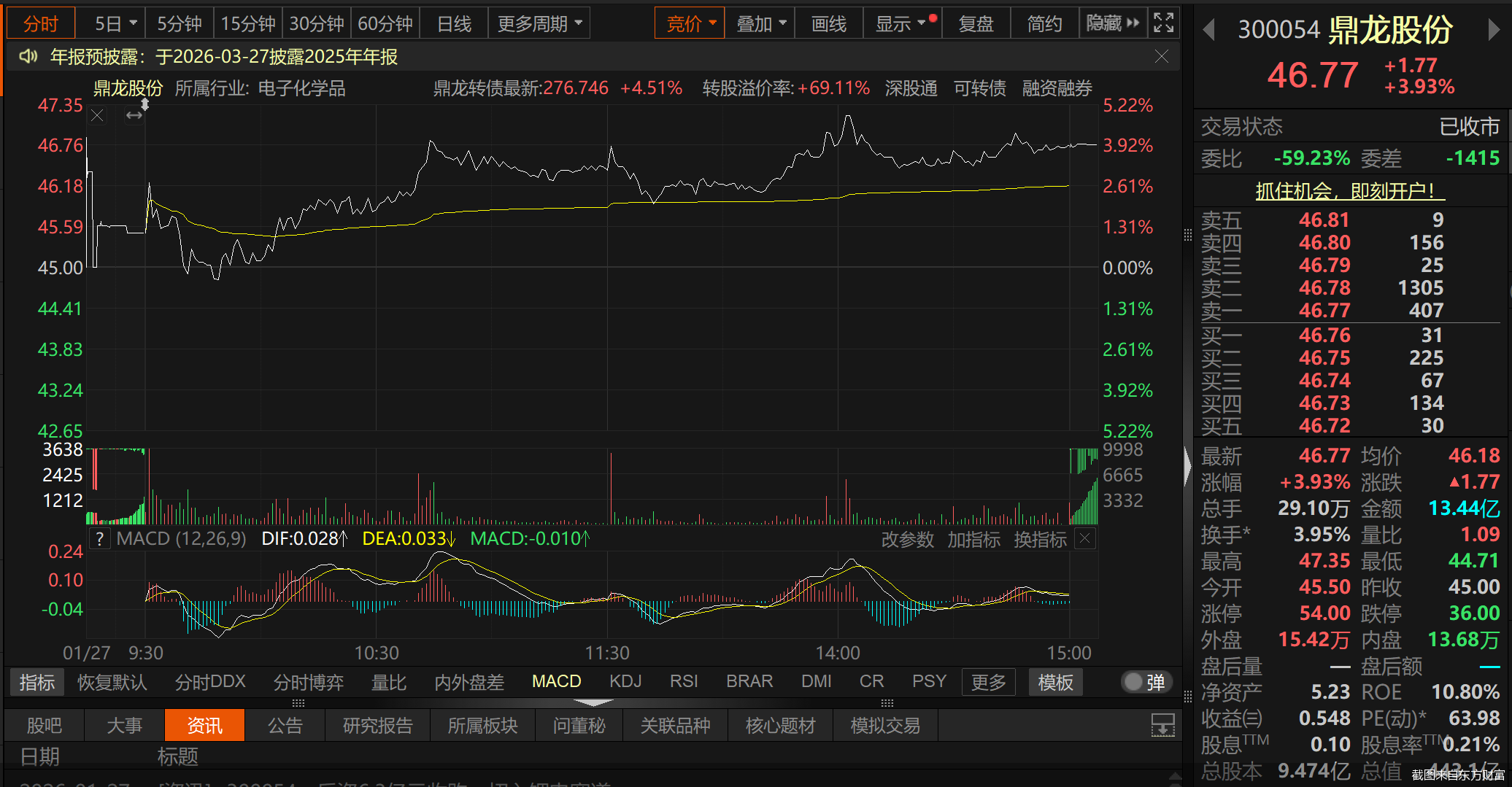
Core Viewpoint - Dinglong Co., Ltd. is actively pursuing capital expansion, including a planned acquisition of 70% of Shenzhen Haofei New Materials Co., Ltd. for 630 million yuan, marking its entry into the lithium battery materials sector [1][3][4]. Group 1: Acquisition Details - The acquisition of Haofei New Materials will be conducted through self-owned or self-raised funds, valuing the entire company at 900 million yuan [3]. - Haofei New Materials specializes in the research, production, and sales of lithium battery process materials, including dispersants and binders [3][4]. - This acquisition will allow Haofei New Materials to become a 70% owned subsidiary of Dinglong, included in the consolidated financial statements [3]. Group 2: Strategic Implications - The acquisition signifies Dinglong's formal entry into the lithium materials industry, driven by the dual demand from new energy vehicles and energy storage [4][5]. - The company aims to leverage its platform advantages and integrate technological resources to expand its business boundaries and create a new growth engine [4]. - Dinglong plans to accelerate its layout in high-end lithium battery auxiliary materials, benefiting from Haofei's established customer channels [4]. Group 3: Financial Performance - As of November 30, 2025, Haofei New Materials reported total assets of approximately 391 million yuan and total liabilities of about 133 million yuan, with owner’s equity around 258 million yuan [4]. - The company achieved revenues of approximately 290 million yuan, 345 million yuan, and 481 million yuan for the years 2023, 2024, and January-November 2025, respectively [4]. Group 4: Market Reaction and Future Plans - On January 27, Dinglong's stock opened at 45.5 yuan per share, closing at 46.77 yuan, reflecting a 3.93% increase and a total market capitalization of 44.31 billion yuan [6]. - Earlier in January, Dinglong announced plans for a Hong Kong listing to enhance its global strategic layout and overseas business expansion [7]. Group 5: Ownership Structure - The actual controllers of Dinglong are Zhu Shuangquan and Zhu Shunquan, who are brothers, indicating a family-controlled structure [8]. - The family has also been active in the capital market, having acquired control of the A-share listed company Zhongyuan Co., Ltd. in October 2025 [8][9].


新股消息 | 新泉股份递表港交所 为中国第二大汽车饰件系统解决方案提供商
Zhi Tong Cai Jing· 2026-01-27 12:50
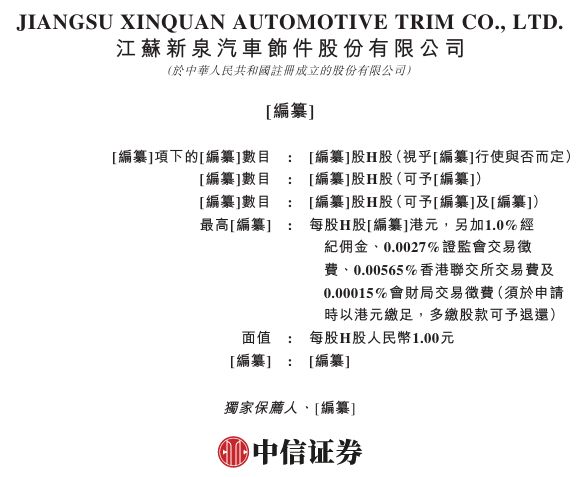
智通财经APP获悉,据港交所1月27日披露,江苏新泉汽车饰件股份有限公司(简称:新泉股份, 603179.SH)向港交所主板递交上市申请书,中信证券为其独家保荐人。根据弗若斯特沙利文的资料,按 2024年中高端整车内饰件系统解决方案收入计算及按2024年全品类整车内饰件系统解决方案收入计算, 公司以8.3%及7.8%的市场份额位居中国第二大汽车饰件系统解决方案提供商。 公司简介 招股书显示,新泉股份自2001年成立以来,始终专注于满足客户对汽车饰件系统解决方案的需求,主要 面向整车厂,从事汽车内外饰总成的研发、生产制造及销售。 成立二十余年以来,新泉股份构建了以持续技术创新为核心的一体化研发制造平台,这一平台是公司快 速响应客户新产品需求及准时交付的坚实基础。公司战略性地将生产及研发中心布局在客户周边,能够 为客户提供从产品设计到量产的全生命周期支持。凭借一体化研发制造平台,新泉股份吸引了庞大且忠 诚的客户群体,其中包括众多国内外知名新能源汽车及传统整车厂品牌。随着核心客户海外业务拓展, 公司亦已做好充分准备,把握北美、欧洲及其他海外市场的增长机遇。公司基于平台化的核心能力,能 够在复杂的国内外市场中快速复制 ...

安路科技拟定向发行A股股票 深耕先进工艺构建竞争壁垒
Zheng Quan Ri Bao Zhi Sheng· 2026-01-27 12:44
Core Viewpoint - Shanghai Anlu Information Technology Co., Ltd. plans to raise up to 1.262 billion yuan through a private placement of A-shares to invest in advanced FPGA chip R&D and upgrade projects, aiming to strengthen its competitive advantage in the FPGA and FPSoC markets [1][2]. Group 1: Investment and Growth Strategy - The FPGA industry is recovering, with Anlu achieving steady growth in the first three quarters of 2025, entering strategic emerging fields such as intelligent computing centers and automotive electronics [2]. - The financing aims to focus on chip technologies that support applications in emerging fields, creating long-term value for investors [2]. Group 2: Project Focus and Market Demand - The "Flat Process Platform FPGA & FPSoC Chip Upgrade and Industrialization Project" targets market demand and aims to balance chip performance, power consumption, and cost, making FPGA chips a preferred choice for new applications [3]. - The projects will introduce new product models to upgrade specifications in logic scale, performance, and security features, catering to the needs of intelligent computing servers, smart vehicles, and edge computing [3]. Group 3: Company Strengths and Market Position - Anlu is a leading domestic FPGA chip supplier with a strong foundation, having the largest cumulative shipment of domestic FPGA chips and a wide application range [4]. - The company has received 322 intellectual property authorizations, including 124 invention patents, and has a core technical team with over 80% of its workforce in R&D [4]. - Anlu has established a customer network of over 2,000 companies across various industries, particularly in high-growth sectors like power energy and intelligent computing servers, providing a reliable foundation for the new projects [4].

71岁董明珠突然退隐!格力造芯8年砸500亿,接棒人竟是他?
Sou Hu Cai Jing· 2026-01-27 12:32
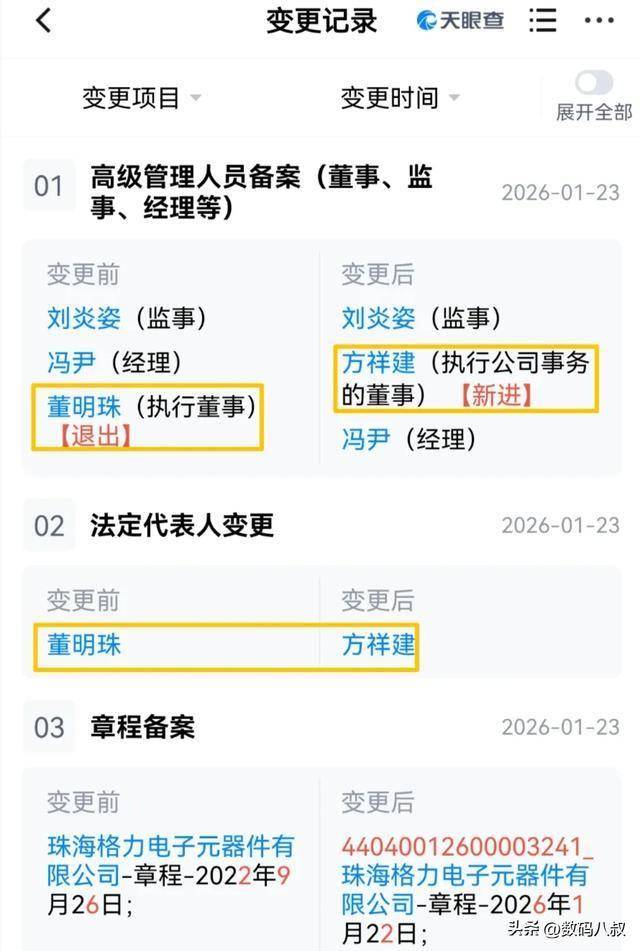
2026开年家电圈炸响惊雷:天眼查信息显示,董明珠正式卸任珠海格力电子元器件有限公司法定代表 人、执行董事,由格力老将方祥建接棒。这是继2025年6月退出零边界集成电路后,她在半导体板块的 又一重大调整,71岁的"铁娘子"为何在造芯攻坚期突然放权?这场看似"退隐"的人事变动,实则藏着格 力穿越周期的大棋。 | < | 心天眼查 . ! 变更记录 | | --- | --- | | 变更项目 - | 变更时间 ~ 展开全部 | | 高级管理人员备案(董事、监 01 事、经理等) | 2026-01-23 | | 变更前 | 变更后 | | 刘炎姿(监事) | 刘炎姿(监事) | | 冯尹(经理) | 方祥建 (执行公司事务 | | 董明珠 (执行董事) | 的重事) 【新进】 | | 【退出】 | 冯尹(经理) | 时间回到2018年,中兴事件刺痛中国制造业神经,董明珠掷下"即便投资500亿,也要把芯片研究成 功"的豪言。彼时格力每年花40亿元进口芯片,核心技术被"卡脖子"的困境,让这位企业家下定决心跨 界突围。8年间,她力排众议,在格力业绩巅峰时暂停11年未断的分红,将资金砸向芯片研发,硬生生 在家电巨头的基 ...

逾950家A股披露2025业绩预告,高增长赛道浮现!机构建议:2026年投资锁定这些方向→
Xin Lang Cai Jing· 2026-01-27 12:24
Market Overview - The A-share market exhibited a fluctuating and differentiated pattern last week, with major indices showing mixed performance and active rotation among hot sectors [1][7] - Institutions generally hold an optimistic outlook, believing the market is likely to trend upward [1][7] - As of January 25, over 950 companies have disclosed their 2025 earnings forecasts, with around 40% of these companies showing positive performance [1][7] Semiconductor Industry - The semiconductor industry, particularly companies related to artificial intelligence, data center construction, and domestic substitution, is expected to see strong earnings growth in 2025 [1][8] - Notable companies include: - Zhongwei Semiconductor expects revenue of approximately 1.122 billion yuan, a year-on-year increase of about 23%, and a net profit of 284 million yuan, up approximately 107% [8] - Juchip Technology anticipates revenue of 922 million yuan, a 41.44% increase, and a net profit of 204 million yuan, up 91.40% [2] - Baiwei Storage forecasts revenue between 10 billion to 12 billion yuan, a growth of 49.36% to 79.23%, and a net profit of 850 million to 1 billion yuan, a staggering increase of 427.19% to 520.22% [3][9] Pharmaceutical Industry - The pharmaceutical sector is experiencing a "polarized" performance, with over 60 companies disclosing earnings forecasts, about half of which are positive [1][9] - Key performers include: - Zhaoyan New Drug expects a net profit of approximately 233 million to 349 million yuan, a year-on-year increase of 214% to 371% [10] - Shanghai Yizhong anticipates a net profit of 6 million to 7 million yuan, a growth of 760.18% to 903.54% [10] - However, companies like Zhifei Biological are projected to incur significant losses, with an expected net loss of 10.7 billion to 13.7 billion yuan [10][5] Banking Sector - As of January 25, eight listed banks have released earnings reports, with all showing year-on-year growth in net profit [5][11] - Key statistics include: - China Merchants Bank's total assets surpassing 13 trillion yuan, and Industrial Bank exceeding 11 trillion yuan [11] - The highest net profit growth among these banks is from Hangzhou Bank at 12.05%, followed by Shanghai Pudong Development Bank at 10.52% [11] - The growth drivers for banks include improved cost of liabilities and rapid growth in intermediary business income, with Ningbo Bank's net income from fees and commissions increasing by 30.72% [12]



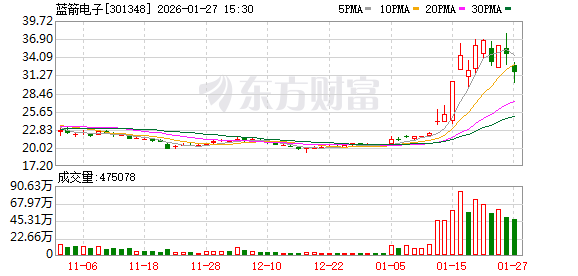
蓝箭电子:公司依托4-12英寸晶圆全流程封测能力,迭代SIP、倒装焊、超薄封装等先进工艺
Zheng Quan Ri Bao· 2026-01-27 12:13
Core Viewpoint - The company is enhancing its advanced packaging capabilities to meet the demand for high-end domestic chips, particularly in the third-generation semiconductor packaging sector [2] Group 1: Company Developments - The company is leveraging its full-process packaging capabilities for 4-12 inch wafers to accelerate the validation of advanced technologies such as SIP, flip chip, and ultra-thin packaging [2] - The company is focusing on deepening its involvement in the third-generation semiconductor packaging to align with the needs of domestic high-end chips [2] Group 2: Market Expansion - With the release of capacity from the company's fundraising projects, it aims to enhance the supply of advanced packaging [2] - The company is striving to expand into core areas of domestic substitution, including automotive electronics and industrial control [2]
皇马科技:公司表面活性剂作为中间产品下游运用领域广泛
Zheng Quan Ri Bao Wang· 2026-01-27 12:12
Core Viewpoint - The company, Huangma Technology, is actively involved in the production of surfactants as intermediate products, which are widely used in various downstream applications, particularly in the semiconductor and electronic components industries [1] Group 1: Product Applications - The surfactants produced by the company are utilized in several manufacturing processes, including electroplating, electrophoresis, cutting, cleaning, photolithography, energy curing, developing, etching, coating, and packaging [1] - The company’s surfactants serve as "industrial MSG," providing essential functions such as dispersion, wetting, leveling, penetration, solubilization, curing, filtration assistance, retention, and antistatic properties in downstream products [1] Group 2: Market Position and Strategy - In recent years, the company has been focusing on the semiconductor electronic chemicals sector, striving to offer products with better performance and cost-effectiveness to its downstream clients [1] - The company is committed to promoting self-sufficiency and domestic substitution processes within the industry [1]

AI基建+国产替代,“芯”机遇势不可挡!华虹公司历史新高,“全芯”科创芯片ETF华宝(589190)首秀涨超3%
Xin Lang Ji Jin· 2026-01-27 11:26
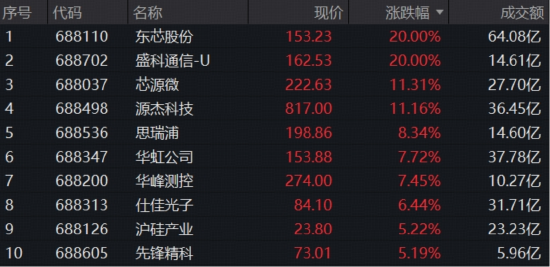
Group 1 - The core viewpoint of the news highlights a significant rebound in the semiconductor industry, particularly in storage chip stocks, with notable gains from companies like Dongxin Co., which saw a 20% increase, and others like Chipone Technology and Shengke Communication-U also performing strongly [1][3] - The newly listed ETF tracking the semiconductor sector, Huabao (589190), experienced a price increase of 2.72% with a trading volume of 1.19 billion yuan, indicating active market participation [1][3] - The semiconductor industry is being driven by two main catalysts: the AI wave and domestic substitution, with significant price increases in NAND flash memory expected to continue due to rising demand from AI infrastructure [3][6] Group 2 - Data from TrendForce indicates that the prices of DRAM and NAND Flash are expected to rise until 2027, supported by long-term demand from AI servers and enterprise storage [3][6] - The domestic semiconductor equipment substitution rate is projected to increase from 25% in 2025 to 35% by 2026, with core equipment like etching machines and thin-film deposition equipment exceeding a 40% substitution rate [3][6] - The Shanghai Stock Exchange's semiconductor index has shown an annualized return of 17.93%, outperforming other similar indices, with a lower maximum drawdown, indicating a favorable risk-reward profile [5][6]


猜想谁是26年“易中天”系列——臻镭科技
格隆汇APP· 2026-01-27 10:45
Core Viewpoint - The article emphasizes the potential of Zhenlei Technology (688270) as a key player in the commercial aerospace sector, driven by its technological advantages, industry positioning, and strong performance metrics, particularly in the context of the booming satellite internet and defense information sectors [5][6][12]. Industry and Policy Benefits - Zhenlei Technology's growth is supported by the convergence of three major industry trends: satellite internet, defense informationization, and domestic substitution, providing a strong growth trajectory [6]. - The global low-orbit satellite market is entering a high-frequency launch phase, with significant demand for core hardware, estimated to exceed 470 billion yuan, as companies like China Star Network and Qianfan Constellation plan to deploy over 27,000 low-orbit satellites [7][8]. Core Advantages - Zhenlei Technology has established a robust technological barrier through comprehensive R&D capabilities, holding multiple proprietary technologies and focusing on full-chain product development from chips to systems [13]. - The company has a diversified product matrix that covers critical application scenarios, with significant revenue growth in its core product lines, including a 71.80% increase in revenue from RF transceiver and high-precision ADC/DAC chips [14][19]. Business Breakdown - The company’s four main product lines are driving performance, with the power management chip segment being the largest revenue contributor, accounting for over 50% of total revenue and growing by 95.79% [20][39]. - The RF transceiver and ADC/DAC chips are positioned as the core growth engines, with a revenue share exceeding 39% and a year-on-year growth of 71.80% [19][39]. Financial Performance and Valuation - In the first half of 2025, Zhenlei Technology reported a revenue of 205 million yuan, a 73.64% increase year-on-year, and a net profit of 62 million yuan, reflecting a staggering 1006.99% growth [27][39]. - The company maintains a healthy financial structure with a low debt ratio of 5.99% and a controllable expense ratio of 11.65%, indicating strong operational efficiency [30][31]. Investment Highlights - Zhenlei Technology is positioned to benefit from the satellite internet boom, with a market space exceeding 470 billion yuan for satellite payloads, and is a key domestic supplier benefiting from increasing delivery demands [38]. - The company’s technological advancements and strong financial health suggest a favorable investment opportunity, with projected earnings growth significantly outpacing industry averages, indicating a potential for valuation recovery [32][39].


学大教育:投资EDA公司,有望享受国产替代红利及产业协同-20260127
Xinda Securities· 2026-01-27 10:30
Investment Rating - The investment rating for the company is upgraded to "Buy" from "Hold" [3] Core Insights - The company plans to invest up to 35 million yuan in Jiangyin Qixin Linghang through a newly established partnership, acquiring a 6.48% stake [3] - Jiangyin Qixin Linghang is in its cultivation and development stage, with projected revenues of 51.71 million yuan in 2024 and 29.10 million yuan in the first three quarters of 2025, alongside net losses of 36.03 million yuan and 12.91 million yuan respectively [3] - The investment is expected to benefit from the domestic substitution boom in the EDA industry, where U.S. companies dominate with a combined market share of 74% globally and over 80% in the domestic market [3] - The founding team of Qixin Linghang has over 20 years of experience in EDA, which positions the company well for industrialization in this sector [3] - The partnership is anticipated to create synergies in vocational education within the EDA field, leveraging the company's extensive network and resources in vocational training [3] Financial Summary - Total revenue is projected to grow from 2,213 million yuan in 2023 to 4,931 million yuan in 2027, with a compound annual growth rate (CAGR) of 19.2% [4] - Net profit attributable to the parent company is expected to increase significantly from 154 million yuan in 2023 to 345 million yuan in 2027, reflecting a growth rate of 1035.2% in 2024 [4] - The company's EPS is forecasted to rise from 1.26 yuan in 2023 to 2.83 yuan in 2027, with corresponding P/E ratios decreasing from 31.28 to 13.95 [4]
