期现套利

Search documents
有色套利早报-20250916
Yong An Qi Huo· 2025-09-16 01:44
1. Report Industry Investment Rating - No relevant information provided 2. Core View of the Report - The report presents cross - market, cross - period, spot - futures, and cross - variety arbitrage tracking data for non - ferrous metals including copper, zinc, aluminum, nickel, lead, and tin on September 16, 2025 [1][3][4] 3. Summary by Related Catalogs Cross - market Arbitrage Tracking - **Copper**: Spot price in China is 80930, LME is 10020, with a ratio of 8.13; March price in China is 80910, LME is 10082, ratio 8.02. Spot import equilibrium ratio is 8.10, profit - 307.15 [1] - **Zinc**: Spot price in China is 22240, LME is 2983, ratio 7.46; March price in China is 22315, LME is 2956, ratio 5.80. Spot import equilibrium ratio is 8.56, profit - 3280.38 [1] - **Aluminum**: Spot price in China is 20950, LME is 2691, ratio 7.78; March price in China is 21025, LME is 2687, ratio 7.82. Spot import equilibrium ratio is 8.37, profit - 1587.60 [1] - **Nickel**: Spot price in China is 121500, LME is 15209, ratio 7.99. Spot import equilibrium ratio is 8.18, profit - 2378.18 [1] - **Lead**: Spot price in China is 17000, LME is 1966, ratio 8.62; March price in China is 17190, LME is 2014, ratio 11.08. Spot import equilibrium ratio is 8.82, profit - 391.22 [3] Cross - period Arbitrage Tracking - **Copper**: Spreads for次月 - 现货月, 三月 - 现货月, 四月 - 现货月, 五月 - 现货月 are - 420, - 450, - 460, - 460 respectively, theoretical spreads are 509, 916, 1331, 1747 [4] - **Zinc**: Spreads for次月 - 现货月, 三月 - 现货月, 四月 - 现货月, 五月 - 现货月 are 60, 65, 80, 100 respectively, theoretical spreads are 214, 335, 455, 575 [4] - **Aluminum**: Spreads for次月 - 现货月, 三月 - 现货月, 四月 - 现货月, 五月 - 现货月 are - 265, - 260, - 285, - 305 respectively, theoretical spreads are 217, 336, 454, 573 [4] - **Lead**: Spreads for次月 - 现货月, 三月 - 现货月, 四月 - 现货月, 五月 - 现货月 are 160, 190, 195, 190 respectively, theoretical spreads are 210, 316, 422, 528 [4] - **Nickel**: Spreads for次月 - 现货月, 三月 - 现货月, 四月 - 现货月, 五月 - 现货月 are 780, 1020, 1180, 1390 respectively [4] - **Tin**: 5 - 1 spread is 420, theoretical spread is 5673 [4] Spot - Futures Arbitrage Tracking - **Copper**: Spreads for当月合约 - 现货 and 次月合约 - 现货 are 450 and 30 respectively [4] - **Zinc**: Spreads for当月合约 - 现货 and 次月合约 - 现货 are 10 and 70 respectively [4][5] - **Lead**: Spreads for当月合约 - 现货 and 次月合约 - 现货 are 0 and 160 respectively [5] Cross - variety Arbitrage Tracking - Ratios for copper/zinc, copper/aluminum, copper/lead, aluminum/zinc, aluminum/lead, lead/zinc are 3.63, 3.85, 4.71, 0.94, 1.22, 0.77 in Shanghai (three - continuous), and 3.42, 3.77, 5.09, 0.91, 1.35, 0.67 in London (three - continuous) [5]
有色套利早报-20250911
Yong An Qi Huo· 2025-09-11 00:13
Report Industry Investment Rating - Not provided Core View - The report presents cross - market, cross - period, and cross - variety arbitrage tracking data for multiple non - ferrous metals including copper, zinc, aluminum, nickel, lead, and tin on September 11, 2025, including domestic and LME prices, price ratios, equilibrium price ratios, and profit margins [1][3][6] Summary by Related Catalogs Cross - Market Arbitrage Tracking - **Copper**: On September 11, 2025, the domestic spot price was 79,760, the LME spot price was 9,884, and the spot price ratio was 8.07. The equilibrium price ratio for spot import was 8.11, with a profit of - 232.79 [1] - **Zinc**: The domestic spot price was 22,100, the LME spot price was 2,896, and the spot price ratio was 7.63. The equilibrium price ratio for spot import was 8.57, with a profit of - 2,724.25 [1] - **Aluminum**: The domestic spot price was 20,750, the LME spot price was 2,629, and the spot price ratio was 7.89. The equilibrium price ratio for spot import was 8.38, with a profit of - 1,287.79 [1] - **Nickel**: The domestic spot price was 119,450, the LME spot price was 14,992, and the spot price ratio was 7.97. The equilibrium price ratio for spot import was 8.18, with a profit of - 1,447.10 [1] - **Lead**: The domestic spot price was 16,700, the LME spot price was 1,932, and the spot price ratio was 8.64. The equilibrium price ratio for spot import was 8.83, with a profit of - 368.54 [3] Cross - Period Arbitrage Tracking - **Copper**: On September 11, 2025, the spreads between the secondary month, third month, fourth month, and fifth month and the spot month were 110, 80, 60, and 30 respectively, while the theoretical spreads were 500, 899, 1306, and 1714 [3] - **Zinc**: The spreads were 155, 150, 145, and 150 respectively, and the theoretical spreads were 213, 333, 452, and 571 [3] - **Aluminum**: The spreads were 50, 40, 30, and - 5 respectively, and the theoretical spreads were 215, 330, 446, and 562 [3] - **Lead**: The spreads were - 75, - 50, - 35, and 15 respectively, and the theoretical spreads were 209, 315, 420, and 525 [3] - **Nickel**: The spreads between the secondary month, third month, fourth month, and fifth month and the spot month were 330, 470, 640, and 920 [3] - **Tin**: The 5 - 1 spread was 580, and the theoretical spread was 5606 [3] Spot - Futures Arbitrage Tracking - **Copper**: On September 11, 2025, the spreads between the current - month contract, secondary - month contract and the spot were - 25 and 85 respectively, and the theoretical spreads were 129 and 586 [3] - **Zinc**: The spreads were - 40 and 115 respectively, and the theoretical spreads were 103 and 232 [3] - **Lead**: The spreads were 170 and 95 respectively, and the theoretical spreads were 116 and 227 [3] Cross - Variety Arbitrage Tracking - On September 11, 2025, for cross - variety arbitrage, the ratios of copper/zinc, copper/aluminum, copper/lead, aluminum/zinc, aluminum/lead, and lead/zinc in Shanghai (three - continuous) were 3.59, 3.84, 4.74, 0.94, 1.24, and 0.76 respectively; in London (three - continuous) were 3.47, 3.81, 5.04, 0.91, 1.32, and 0.69 respectively [6]
30年国债ETF博时(511130)突破200亿元,博时多只百亿旗舰债券ETF护航!
Sou Hu Cai Jing· 2025-09-03 02:47
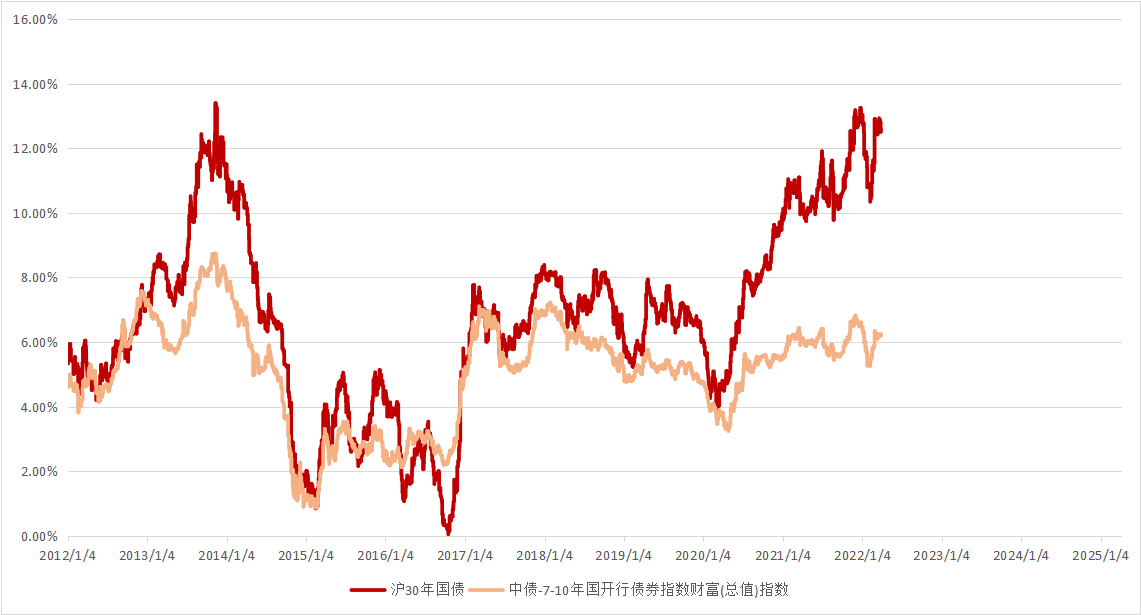
Core Insights - The 30-year government bond ETF from Bosera has surpassed 20 billion yuan in scale, marking it as a significant product alongside other major bond ETFs from the company [1] - The ETF's core value lies in its approximately 20-year duration, which provides leverage benefits and makes it a rare product in the current market [2][4] - The ETF offers three main investment values: allocation value, trading value, and hedging value, particularly in a low-interest-rate environment [2][6] Allocation Value - In a downward interest rate trend, the long duration of the 30-year government bond ETF provides strong allocation value, with an average annualized return of 6.69% for a three-year holding period since 2012, compared to 5.09% for 7-10 year government bonds [2][4] Trading Value - The ETF has a higher trading value due to its longer duration and greater volatility compared to 7-10 year government bonds, with a modified duration of 19.65 years versus 7.50 years for the latter [6] - Historical data shows that during low volatility phases, the trading value of the 30-year government bond ETF becomes more pronounced [6] Hedging Value - The long duration of the ETF allows it to hedge against equity market fluctuations, with a significant occurrence of the "stock-bond seesaw" effect noted in 61.31% of the months analyzed since 2013 [6] - The ETF supports various trading strategies, including arbitrage and grid strategies, enhancing its appeal in a volatile market [6][7] Trading Mechanism - The ETF can be traded conveniently through both primary and secondary markets, with options for physical or cash subscriptions [7] - The trading efficiency is comparable to stocks, allowing for T+0 transactions, which lowers the entry barrier for investors [7] Future Outlook - Bosera aims to continue innovating and expanding its product offerings in the index product space, focusing on providing diverse investment options for investors [9]

有色套利早报-20250901
Yong An Qi Huo· 2025-09-01 04:18
Report Overview - The report provides cross - market, cross - period, and cross - variety arbitrage tracking data for non - ferrous metals on September 1, 2025 [1][4][5] Cross - market Arbitrage Tracking Copper - Spot price in China is 79400, LME spot price is 9803, March price in China is 79400, LME March price is 9884, with a March ratio of 8.01. The equilibrium ratio for spot import is 8.12, and the profit is 93.34. The profit for spot export is 49.03 [1] Zinc - Spot price in China is 22010, LME spot price is 2810, with a spot ratio of 7.83. March price in China is 22135, LME March price is 2804, with a March ratio of 6.00. The equilibrium ratio for spot import is 8.60, and the loss is 2144.80 [1] Aluminum - Spot price in China is 20730, LME spot price is 2620, with a spot ratio of 7.91. March price in China is 20730, LME March price is 2618, with a March ratio of 7.92. The equilibrium ratio for spot import is 8.40, and the loss is 1295.79 [1] Nickel - Spot price in China is 120150, LME spot price is 15156, with a spot ratio of 7.93. The equilibrium ratio for spot import is 8.19, and the loss is 2013.87 [1] Lead - Spot price in China is 16650, LME spot price is 1951, with a spot ratio of 8.57. March price in China is 16900, LME March price is 1993, with a March ratio of 11.08. The equilibrium ratio for spot import is 8.80, and the loss is 442.18 [3] Cross - period Arbitrage Tracking - For copper, zinc, aluminum, lead, and nickel, the spreads and theoretical spreads for the differences between the next month, March, April, May, and the spot month are all not available. For tin, the 5 - 1 spread is 350, and the theoretical spread is 5754 [4] Inter - period Arbitrage Tracking Copper - The difference between the next - month contract and the spot is 110, and the theoretical spread is 742 [4] Zinc - The difference between the next - month contract and the spot is 130, and the theoretical spread is 262 [5] Lead - The difference between the next - month contract and the spot is 230, and the theoretical spread is not available [5] Cross - variety Arbitrage Tracking - The ratios of copper/zinc, copper/aluminum, copper/lead, aluminum/zinc, aluminum/lead, and lead/zinc in Shanghai (triple - continuous) are 3.59, 3.83, 4.70, 0.94, 1.23, and 0.76 respectively, and in London (triple - continuous) are 3.51, 3.79, 4.97, 0.93, 1.31, and 0.71 respectively [5]
螺纹钢周报:承压运行-20250829
Bao Cheng Qi Huo· 2025-08-29 02:40
Report Industry Investment Rating - Not provided Core View of the Report - Since mid - August, the spot and futures prices of rebar have weakened again, and the futures price has dropped significantly. The market is under the influence of multiple negative factors, and under the pattern of weak supply and demand, the rebar price is under pressure, but the cost increase may limit the downside space. It is expected that the steel price will show a trend of bottom - seeking through oscillation, and the performance of peak - season demand should be focused on [2][4] Summary According to Related Content Price Performance - Since mid - August, the futures price of the rebar main contract has dropped from 3,274 yuan/ton to a minimum of 3,097 yuan/ton, with a cumulative decline of nearly 5.4%. The spot price in the East China mainstream area has dropped by 80 - 110 yuan/ton during the same period, and the basis has strengthened [2] Market Negative Factors - Market sentiment has changed, the "anti - involution" trading logic has cooled down, and the previously leading varieties have started high - level adjustments. The black industry chain is restricted by its weak fundamentals, and the overall upward momentum is insufficient. The near - month rebar contracts are suppressed by the delivery logic, and the long - position willingness to take delivery is low [2] Inventory Situation - As of the week of August 22, the total rebar inventory was 6.0704 million tons, a week - on - week increase of 198,500 tons, and it has accumulated for four consecutive weeks. The inventory sales ratio is 3.116, reaching a high in recent years. The inventory in some major consumption areas has accumulated rapidly and is higher than that of the same period last year [3] Production Status - The weekly output of rebar is 214,650 tons, which has declined for two consecutive weeks, with a cumulative decrease of 65,300 tons. The reduction mainly comes from long - process steel mills. Currently, long - process steel mills are in good profit condition, and short - process steel mills have not significantly reduced production. The average capacity utilization rate of 90 independent electric arc furnace steel mills is 75.69%, still at a high level this year [3] Demand Performance - As of the week of August 22, the weekly apparent demand for rebar was 194,800 tons, remaining at a low level in recent years. The cement outbound volume and concrete shipment volume are also at low levels, with year - on - year decreases of 16.5% and 7.8% respectively. The real - estate market is still in weak recovery, and the basis strengthening may lead to profit - taking, which will increase demand - side pressure [4]
有色套利早报-20250828
Yong An Qi Huo· 2025-08-28 01:10
Report Summary 1) Report Industry Investment Rating No investment rating provided in the report. 2) Core View The report presents cross - market, cross - period, and cross - variety arbitrage tracking data for non - ferrous metals including copper, zinc, aluminum, nickel, lead, and tin on August 28, 2025, offering data support for potential arbitrage opportunities [1][4][5]. 3) Summary by Related Catalogs Cross - Market Arbitrage Tracking - **Copper**: On August 28, 2025, the domestic spot price was 79,520, the LME price was 9,728, and the spot import equilibrium ratio was 8.14 with a profit of 90.69; the three - month domestic price was 79,190, the LME price was 9,818, and the ratio was 8.09 [1]. - **Zinc**: The domestic spot price was 22,270, the LME price was 2,795, and the spot import equilibrium ratio was 8.62 with a loss of 1,839.43; the three - month domestic price was 22,310, the LME price was 2,803, and the ratio was 6.03 [1]. - **Aluminum**: The domestic spot price was 20,840, the LME price was 2,641, and the spot import equilibrium ratio was 8.43 with a loss of 1,417.39; the three - month domestic price was 20,790, the LME price was 2,636, and the ratio was 7.91 [1]. - **Nickel**: The domestic spot price was 121,100, the LME price was 15,091, and the spot import equilibrium ratio was 8.22 with a loss of 2,251.12 [1]. - **Lead**: The domestic spot price was 16,725, the LME price was 1,945, and the spot import equilibrium ratio was 8.82 with a loss of 389.50; the three - month domestic price was 16,880, the LME price was 1,987, and the ratio was 11.24 [3]. Cross - Period Arbitrage Tracking - **Copper**: On August 28, 2025, the spreads between the next - month, three - month, four - month, and five - month contracts and the spot - month contract were - 40, - 40, - 90, and - 100 respectively, while the theoretical spreads were 498, 894, 1299, and 1705 respectively [4]. - **Zinc**: The spreads were 25, 25, 25, and 0 respectively, and the theoretical spreads were 214, 335, 455, and 576 respectively [4]. - **Aluminum**: The spreads were 70, 50, 20, and - 10 respectively, and the theoretical spreads were 215, 330, 446, and 562 respectively [4]. - **Lead**: The spreads were - 20, - 30, - 20, and 5 respectively, and the theoretical spreads were 210, 315, 421, and 526 respectively [4]. - **Nickel**: The spreads were 1,580, 1,710, 1,860, and 2,150 respectively [4]. - **Tin**: The 5 - 1 spread was 550, and the theoretical spread was 5,634 [4]. Spot - Futures Arbitrage Tracking - **Copper**: The spreads between the current - month and next - month contracts and the spot were - 245 and - 285 respectively, while the theoretical spreads were 289 and 723 respectively [4]. - **Zinc**: The spreads were 15 and 40 respectively, and the theoretical spreads were 149 and 279 respectively [4]. - **Lead**: The spreads were 185 and 165 respectively, and the theoretical spreads were 166 and 278 respectively [5]. Cross - Variety Arbitrage Tracking On August 28, 2025, for cross - variety arbitrage, the ratios of copper/zinc, copper/aluminum, copper/lead, aluminum/zinc, aluminum/lead, and lead/zinc in Shanghai (three - continuous) were 3.55, 3.81, 4.69, 0.93, 1.23, and 0.76 respectively, and in London (three - continuous) were 3.53, 3.75, 4.92, 0.94, 1.31, and 0.72 respectively [5].
有色套利早报-20250827
Yong An Qi Huo· 2025-08-27 00:19
Report Overview - The report provides cross - market, cross - period, spot - futures, and cross - variety arbitrage tracking data for various non - ferrous metals on August 27, 2025 [1] Cross - Market Arbitrage Tracking Copper - Spot price: domestic 79,550, LME 9,720, ratio 8.21; March price: domestic 79,180, LME 9,805, ratio 8.11; equilibrium ratio for spot import 8.14; spot export profit - 660.06 [1] Zinc - Spot price: domestic 22,280, LME 2,794, ratio 7.97; March price: domestic 22,265, LME 2,799, ratio 6.04; equilibrium ratio for spot import 8.63; spot import profit - 1,820.78 [1] Aluminum - Spot price: domestic 20,780, LME 2,617, ratio 7.94; March price: domestic 20,705, LME 2,614, ratio 7.93; equilibrium ratio for spot import 8.43; spot import profit - 1,287.62 [1] Nickel - Spot price: domestic 119,350, LME 14,885, ratio 8.02; equilibrium ratio for spot import 8.22; spot import profit - 1,806.58 [1] Lead - Spot price: domestic 16,750, LME 1,965, ratio 8.55; March price: domestic 16,920, LME 2,004, ratio 11.15; equilibrium ratio for spot import 8.82; spot import profit - 531.05 [3] Cross - Period Arbitrage Tracking Copper - Spreads for次月 - 现货月, 三月 - 现货月, 四月 - 现货月, 五月 - 现货月 are - 500, - 510, - 530, - 550 respectively; theoretical spreads are 500, 899, 1306, 1714 [4] Zinc - Spreads for次月 - 现货月, 三月 - 现货月, 四月 - 现货月, 五月 - 现货月 are - 105, - 110, - 105, - 110 respectively; theoretical spreads are 215, 336, 457, 578 [4] Aluminum - Spreads for次月 - 现货月, 三月 - 现货月, 四月 - 现货月, 五月 - 现货月 are - 70, - 80, - 115, - 150 respectively; theoretical spreads are 215, 331, 447, 563 [4] Lead - Spreads for次月 - 现货月, 三月 - 现货月, 四月 - 现货月, 五月 - 现货月 are 85, 75, 85, 90 respectively; theoretical spreads are 209, 314, 420, 525 [4] Nickel - Spreads for次月 - 现货月, 三月 - 现货月, 四月 - 现货月, 五月 - 现货月 are 300, 410, 630, 870 respectively [4] Tin - 5 - 1 spread 640; theoretical spread 5591 [4] Spot - Futures Arbitrage Tracking Copper - Spreads for当月合约 - 现货, 次月合约 - 现货 are 140, - 360 respectively; theoretical spreads are 366, 734 [4] Zinc - Spreads for当月合约 - 现货, 次月合约 - 现货 are 95, - 10 respectively; theoretical spreads are 146, 276 [4] Lead - Spreads for当月合约 - 现货, 次月合约 - 现货 are 95, 180 respectively; theoretical spreads are 157, 269 [5] Cross - Variety Arbitrage Tracking - Ratios for copper/zinc, copper/aluminum, copper/lead, aluminum/zinc, aluminum/lead, lead/zinc in Shanghai (three - continuous) are 3.56, 3.82, 4.68, 0.93, 1.22, 0.76 respectively; in London (three - continuous) are 3.50, 3.73, 4.95, 0.94, 1.33, 0.71 respectively [5]
有色套利早报-20250826
Yong An Qi Huo· 2025-08-26 00:24
Group 1: Report Industry Investment Rating - No information provided Group 2: Core View of the Report - The report presents cross - market, cross - period, spot - futures, and cross - variety arbitrage tracking data for various non - ferrous metals (copper, zinc, aluminum, nickel, lead, tin) on August 26, 2025 [1][4][5] Group 3: Summary by Related Catalogs Cross - Market Arbitrage Tracking - **Copper**: Domestic spot price is 79440, three - month price is 79680, LME three - month price is 9809, and the ratio is 8.08 [1] - **Zinc**: Domestic spot price is 22300, three - month price is 22390, LME three - month price is 2806, and the ratio is 6.01 [1] - **Aluminum**: Domestic spot price is 20780, three - month price is 20740, LME three - month price is 2622, and the ratio is 7.91 [1] - **Nickel**: Domestic spot price is 119100, and the profit of spot import is - 1806.58 [1] - **Lead**: Domestic spot price is 16700, three - month price is 16870, LME three - month price is 1992, and the ratio is 11.23 [3] Cross - Period Arbitrage Tracking - **Copper**: The spreads between different months and the spot month are 1000 (next month), 990 (three - month), 970 (four - month), 950 (five - month), with theoretical spreads of 495, 889, 1291, 1694 respectively [4] - **Zinc**: The spreads are 120 (next month), 115 (three - month), 110 (four - month), 105 (five - month), with theoretical spreads of 214, 335, 455, 576 respectively [4] - **Aluminum**: The spreads are 120 (next month), 90 (three - month), 55 (four - month), 30 (five - month), with theoretical spreads of 214, 330, 445, 560 respectively [4] - **Lead**: The spreads are 85 (next month), 90 (three - month), 115 (four - month), 135 (five - month), with theoretical spreads of 209, 314, 419, 524 respectively [4] - **Nickel**: The spreads are 850 (next month), 990 (three - month), 1320 (four - month), 1590 (five - month) [4] - **Tin**: The 5 - 1 spread is 1610, with a theoretical spread of 5594 [4] Spot - Futures Arbitrage Tracking - **Copper**: The spreads of the current - month and next - month contracts minus the spot are - 665 and 335 respectively, with theoretical spreads of 251 and 836 [4] - **Zinc**: The spreads are - 25 and 95 respectively, with theoretical spreads of 166 and 296 [4] - **Zinc (repeated data)**: The spreads are - 25 and 95 respectively, with theoretical spreads of 134 and 277 [5] - **Lead**: The spreads are 80 and 165 respectively, with theoretical spreads of 158 and 270 [5] Cross - Variety Arbitrage Tracking - The ratios of copper/zinc, copper/aluminum, copper/lead, aluminum/zinc, aluminum/lead, lead/zinc in Shanghai (three - continuous) are 3.56, 3.84, 4.72, 0.93, 1.23, 0.75 respectively [5]
有色套利早报-20250825
Yong An Qi Huo· 2025-08-25 01:24
Report Industry Investment Rating - No investment rating information is provided in the report. Core Viewpoint - The report presents cross - market, cross - period, spot - futures, and cross - variety arbitrage tracking data for non - ferrous metals including copper, zinc, aluminum, lead, nickel, and tin on August 25, 2025 [1][3][4]. Summary by Related Catalogs Cross - Market Arbitrage Tracking - **Copper**: Spot price is 78,825 domestically and 9,636 on LME with a ratio of 8.17; March price is 78,630 domestically and 9,715 on LME with a ratio of 8.10. Spot import equilibrium ratio is 8.16 with a profit of 171.81, and spot export profit is - 396.63 [1]. - **Zinc**: Spot price is 22,190 domestically and 2,770 on LME with a ratio of 8.01; March price is 22,260 domestically and 2,773 on LME with a ratio of 6.03. Spot import equilibrium ratio is 8.65 with a profit of - 1,764.99 [1]. - **Aluminum**: Spot price is 20,710 domestically and 2,588 on LME with a ratio of 8.00; March price is 20,595 domestically and 2,586 on LME with a ratio of 7.99. Spot import equilibrium ratio is 8.45 with a profit of - 1,162.37 [1]. - **Nickel**: Spot price is 118,400 domestically and 14,749 on LME with a ratio of 8.03. Spot import equilibrium ratio is 8.24 with a profit of - 1,806.58 [1]. - **Lead**: Spot price is 16,575 domestically and 1,942 on LME with a ratio of 8.57; March price is 16,790 domestically and 1,976 on LME with a ratio of 11.25. Spot import equilibrium ratio is 8.84 with a profit of - 524.17 [3]. Cross - Period Arbitrage Tracking - **Copper**: The spreads of次月 - 现货月, 三月 - 现货月, 四月 - 现货月, 五月 - 现货月 are 110, 90, 70, 50 respectively, while the theoretical spreads are 495, 887, 1289, 1691 [4]. - **Zinc**: The spreads of次月 - 现货月, 三月 - 现货月, 四月 - 现货月, 五月 - 现货月 are 15, 0, - 15, - 30 respectively, and the theoretical spreads are 214, 335, 455, 575 [4]. - **Aluminum**: The spreads of次月 - 现货月, 三月 - 现货月, 四月 - 现货月, 五月 - 现货月 are 10, - 25, - 60, - 80 respectively, and the theoretical spreads are 214, 329, 444, 559 [4]. - **Lead**: The spreads of次月 - 现货月, 三月 - 现货月, 四月 - 现货月, 五月 - 现货月 are 35, 45, 55, 80 respectively, and the theoretical spreads are 209, 313, 418, 523 [4]. - **Nickel**: The spreads of次月 - 现货月, 三月 - 现货月, 四月 - 现货月, 五月 - 现货月 are - 90, 100, 350, 600 respectively [4]. - **Tin**: The 5 - 1 spread is 800, and the theoretical spread is 5526 [4]. Spot - Futures Arbitrage Tracking - **Copper**: The spreads of当月合约 - 现货 and 次月合约 - 现货 are - 240 and - 130 respectively, and the theoretical spreads are 360 and 812 [4]. - **Zinc**: The spreads of当月合约 - 现货 and 次月合约 - 现货 are 70 and 85 respectively, and the theoretical spreads are 177 and 306 [4]. - **Lead**: The spreads of当月合约 - 现货 and 次月合约 - 现货 are 170 and 205 respectively, and the theoretical spreads are 182 and 293 [5]. Cross - Variety Arbitrage Tracking - The ratios of copper/zinc, copper/aluminum, copper/lead, aluminum/zinc, aluminum/lead, lead/zinc for Shanghai (three - continuous) are 3.53, 3.82, 4.68, 0.93, 1.23, 0.75 respectively, and for LME (three - continuous) are 3.48, 3.73, 4.91, 0.93, 1.32, 0.71 respectively [5].
尾盘异动,全线大涨!“双焦价格底部已现”!
Qi Huo Ri Bao· 2025-08-23 23:45
Group 1 - A coal mine accident in Fujian Daitian resulted in 7 fatalities, leading to a rapid increase in coking coal futures prices, with the main contract rising by 6.18% to over 1200 yuan/ton [1] - Coking coal futures contracts experienced significant gains, with various contracts showing increases ranging from 4.32% to 6.18% [2][3] - Analysts suggest that the rebound in coking coal and coke futures is primarily influenced by the mine accident news rather than fundamental market conditions [4] Group 2 - Recent "anti-involution" policies have dampened bullish sentiment in the commodity market, with exchanges adjusting fees to reduce market volatility [4] - Basic supply and demand dynamics indicate a recent recovery in mining output, with coal imports increasing significantly since late July, suggesting a potential rise in future coking coal arrivals [4] - Current inventory levels for coking coal are stable, but there is an increase in upstream coal mine inventories, indicating rising pressure on coking coal supply [5] Group 3 - The market is currently experiencing a transition from a replenishment phase to a destocking phase, with coking coal inventories at steel mills decreasing slightly [5] - The demand for coking coal may weaken further due to seasonal factors and potential production cuts in northern steel mills [5][6] - The trading logic in the market reflects a struggle between the residual effects of "anti-involution" policies and weak fundamental realities, with expectations of further price declines in the short term [6]