量化宽松(QE)

Search documents
美元霸权让美国国债持续扩张
Di Yi Cai Jing· 2025-11-16 12:50
Core Viewpoint - The expansion of U.S. national debt is supported by the dominance of the U.S. dollar, which remains strong as long as dollar credit is intact, leading to a significant increase in national debt levels, surpassing $38 trillion for the first time in history [1][11]. Group 1: U.S. National Debt Expansion - The U.S. national debt has grown at an unprecedented rate, accumulating at approximately $69,713.82 per second over the past year, marking the fastest increase outside of the COVID-19 pandemic period [1]. - As of October, the U.S. national debt reached over $38 trillion, following a previous milestone of $37 trillion in August [1]. - The U.S. government currently holds over 40% of the total global sovereign debt, surpassing the combined economic sizes of China, Japan, Germany, and the UK [5]. Group 2: Historical Context of Dollar Dominance - The Bretton Woods system established the U.S. dollar as the world's dominant currency post-World War II, replacing the British pound and leading to the creation of a global dollar system [2][3]. - The dollar's value was initially tied to gold, but significant military expenditures during the Korean and Vietnam Wars led to its devaluation and the eventual decoupling from gold [2][3]. - The establishment of the "petrodollar" system in the 1970s, where oil transactions were conducted in dollars, further solidified the dollar's global dominance [3]. Group 3: Mechanisms Supporting Debt Expansion - The Federal Reserve's control over dollar issuance and its ability to conduct quantitative easing (QE) have been crucial in supporting the U.S. national debt market, ensuring liquidity and preventing defaults [6][8]. - The Fed's purchasing of government bonds during economic downturns allows it to maintain a stable market for U.S. debt, preventing issues such as auction failures or price drops [6]. - The digitalization of the dollar through stablecoins has opened new channels for dollar issuance, further reinforcing the demand for U.S. debt as these stablecoins are often backed by U.S. Treasury securities [7]. Group 4: Global Demand for U.S. Debt - The U.S. dollar accounts for 56.3% of global foreign exchange reserves, and its dominance in international trade and finance makes U.S. debt a preferred asset for many countries [8][9]. - Countries with trade surpluses, particularly in East Asia and oil-exporting nations, are significant holders of U.S. debt, using it as a tool for balancing their foreign exchange markets [9]. - The U.S. financial market's sophistication allows for effective external financing, with national debt serving as a mechanism to recycle dollars back into the economy [9]. Group 5: Credit and Value of the Dollar - The stability of the dollar's value and its creditworthiness are key factors in its continued acceptance as a global reserve currency, with the Fed's monetary policies ensuring a controlled supply of dollars [11][12]. - The relationship between the credit of the dollar and U.S. debt is positive; as long as the dollar maintains its credit, the expansion of U.S. debt will continue smoothly [11][12]. - The absence of defaults or payment delays on U.S. debt reinforces its credibility, ensuring ongoing demand from both domestic and international investors [11].
诡异的现象:特朗普反复强调降息,美联储新主席候选人却集体讨论“缩表”
美股IPO· 2025-11-15 23:55
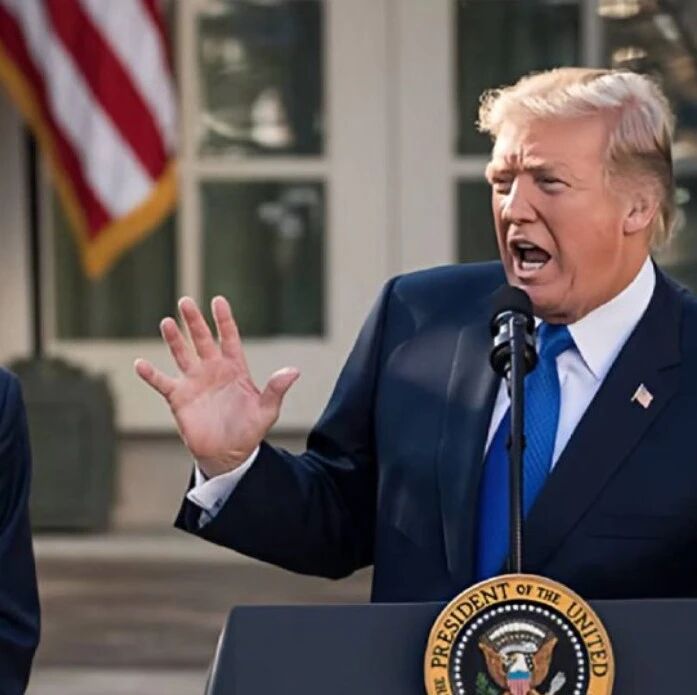
Core Viewpoint - The article discusses the emerging hawkish consensus among candidates for the next Federal Reserve chair, focusing on the need to limit the central bank's balance sheet, contrasting sharply with President Trump's calls for lower interest rates [1][3][4]. Group 1: Candidates' Stance - Candidates for the next Federal Reserve chair, including Kevin Warsh and Michelle Bowman, express concerns over the current balance sheet size exceeding $6 trillion, advocating for a reduction to create space for lowering short-term interest rates without triggering inflation [4][5]. - Warsh has consistently argued for limiting the central bank's size over the past 15 years, suggesting that reducing the balance sheet could allow for lower interest rates without inflationary consequences [4][6]. Group 2: Trump's Contradictory Position - President Trump's public pressure for lower interest rates conflicts with the candidates' focus on balance sheet reduction, highlighting a tension between his desire to stimulate borrowing and the candidates' caution regarding market intervention [5][6]. - Trump's past comments, such as his 2018 tweet urging the Fed to stop reducing its balance sheet, illustrate his concern over liquidity in financing markets, raising questions about his true stance on the Fed's influence [5][6]. Group 3: Policy Logic Behind Balance Sheet Reduction - The candidates' calls for balance sheet reduction stem from Republican concerns about the long-term effects of quantitative easing (QE), which is seen as a tool that disrupts market discipline and exacerbates wealth inequality [6][7][9]. - Critics argue that QE has led to increased government spending and has artificially inflated asset prices, contributing to wealth disparity [8][9]. Group 4: Market Outlook and Future Decisions - The Federal Reserve plans to halt balance sheet reduction by December 1 to prevent liquidity issues in the financial system, a decision supported by key economic advisors [11]. - Future actions by the Fed will depend on the economic landscape, with indications that QE may still be considered if significant risks to employment and price stability arise [12][14].

诡异的现象:特朗普反复强调降息,美联储新主席候选人却集体讨论“缩表”
Hua Er Jie Jian Wen· 2025-11-15 08:12
Core Viewpoint - The debate surrounding the future role of the Federal Reserve is intensifying as potential successors to Chairman Powell express concerns about the central bank's large balance sheet, which may contradict President Trump's desire for lower interest rates [1][2]. Group 1: Candidates' Perspectives - A consensus among candidates is forming around limiting the Federal Reserve's market interventions, with a general belief that the Fed's balance sheet, exceeding $6 trillion, is too large [2]. - Candidates like Kevin Warsh and Michelle Bowman advocate for a smaller balance sheet, contrasting sharply with Trump's push for lower borrowing costs [1][3]. Group 2: Trump's Contradictory Position - Trump's focus on lowering interest rates to alleviate federal debt and stimulate mortgage lending conflicts with candidates' emphasis on reducing the Fed's market influence [3]. - An example of this contradiction occurred in December 2018 when Trump urged the Fed to halt its $50 billion monthly balance sheet reduction, fearing it would drain liquidity from critical financing markets [3]. Group 3: Policy Logic Behind Balance Sheet Reduction - Candidates' calls for reducing the balance sheet stem from long-standing Republican concerns about quantitative easing (QE) [4]. - Kevin Warsh argues that reducing the balance sheet could create room for lowering short-term rates without triggering inflation, a view not universally accepted [4]. - Michelle Bowman believes a smaller balance sheet would provide more flexibility to respond to future economic shocks [4]. - Treasury Secretary Bessent, involved in the selection process, emphasizes the need to reduce the Fed's distorting market influence, although he advocates for cautious future asset purchases rather than immediate contraction [4]. Group 4: Market Outlook and Decision-Making - Regardless of the debate's outcome, the short-term market trajectory appears set, with the Fed planning to halt balance sheet reduction by December 1 to prevent liquidity issues [6]. - Stephen Miran, a current Fed governor, supports this decision and indicates that the Fed may still consider using QE when faced with significant risks to employment and price stability [6]. - The next Fed chair, appointed after Powell's term ends in May, may have to utilize all available policy tools in the event of an economic downturn, adding uncertainty to the market [6].
每日机构分析:11月14日
Xin Hua Cai Jing· 2025-11-14 12:06
Group 1 - Goldman Sachs suggests that the Federal Reserve may soon announce "reserve management purchases," injecting liquidity into the market by buying short-term government bonds, which the market interprets as a signal for a new round of quantitative easing (QE) [1][3] - JPMorgan's CEO emphasizes that the current AI investment wave is not a market bubble but the beginning of a significant transformation in corporate operations, indicating that the market's expectations for AI's value exceed its current realizations, suggesting substantial potential [1] - Citi notes an improvement in credit outlook for peripheral Eurozone countries, with Italy, Spain, Portugal, Greece, and Ireland likely to receive credit rating upgrades by 2026 due to fiscal consolidation and resilient economic growth [1] Group 2 - Guggenheim's Chief Investment Officer indicates that the economic slowdown reflected in the Beige Book, along with pressures on low-income groups and small businesses, suggests a "dual-speed economy," leading the Fed to likely cut rates again in December [2] - Blackhawk Analytics reports that initial jobless claims in the U.S. slightly decreased to 227,500, indicating a stable labor market, which may support the Fed's decision to hold rates steady in December [2] - Morgan Stanley's economists assert that the current level of initial jobless claims is consistent with recent years, showing no signs of an escalating layoff trend, and that the government shutdown may have distorted data reporting [2]


BBMarkets:缩表刚停、利率再飙,美联储离重启QE还有多远?
Sou Hu Cai Jing· 2025-11-14 07:01
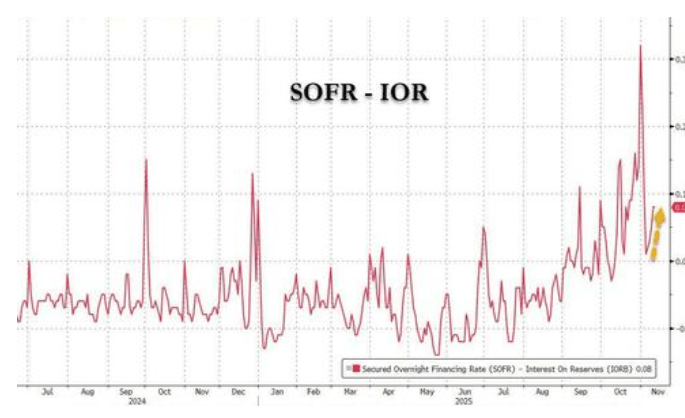
Core Viewpoint - The U.S. money market is signaling liquidity concerns again, with the Secured Overnight Financing Rate (SOFR) rising and the gap between SOFR and the Interest on Reserves (IOR) widening to 8 basis points, indicating a shift from ample to scarce reserves in the banking system [2][3] Group 1: Liquidity Signals - The three-party repo rate has also risen above the IOR by 0.8 basis points, suggesting a tightening liquidity environment [2] - As of early November, the Federal Reserve's reserve balance was approximately $3.1 trillion, significantly lower than the pandemic peak of $4.3 trillion [3] - Historical patterns indicate that when the Effective Federal Funds Rate (EFFR) approaches or exceeds the IOR, the Fed typically slows or halts balance sheet reduction [3] Group 2: Market Reactions - Market participants are already pricing in expectations for balance sheet expansion, with predictions that the Fed may announce Reserve Management Purchases as early as December, injecting $750 billion to $1 trillion monthly into the system [5] - The Treasury's plan to increase the General Account (TGA) balance from $75 billion to $850 billion by year-end will likely withdraw equivalent reserves from the system [5] - Regulatory pressures, particularly the Supplementary Leverage Ratio (SLR) year-end checks, are causing large banks to reduce their balance sheets, further tightening liquidity [5] Group 3: Federal Reserve's Stance - Federal Reserve officials have shown a subtle shift in tone, acknowledging that reserves are nearing the lower end of the ample range, with a growing likelihood of policy adjustments if necessary [6] - Futures data indicates a 70% probability of the Fed initiating technical balance sheet expansion in December, up from 30% a month prior [6] - The transition from surplus to scarcity in reserves is expected to be bumpier than anticipated due to regulatory, fiscal, and year-end demand pressures [6]
Fed policy divide sharpens; Brainard flags labor market risks, supports December easing
Youtube· 2025-11-14 03:03
Economic Outlook - The Federal Reserve faces a dual challenge with inflation remaining above the target of 2% for nearly four years, currently around 3%, raising concerns among hawks about persistent inflationary pressures [2][4][13] - The labor market is showing signs of softening, particularly in the tech sector, where AI and automation are replacing jobs, leading to urgent concerns for the Fed [5][6] Tariff Impact - Tariffs have contributed to a stagflationary environment, pushing prices higher while dampening hiring and economic activity, complicating the Fed's policy decisions [13][14] - Without tariffs, inflation might have stabilized around 2.5%, but current levels are closer to 3%, indicating a significant impact from tariff policies [4] Consumer Behavior - The top 10% of consumers are driving approximately 50% of spending growth, benefiting from rising stock portfolios and home prices, while the lower 75% are facing higher prices and job security concerns [9][10] - Consumer sentiment surveys indicate that the lower income distribution is increasingly worried about job prospects, reflecting a divided economic outlook [10][11] Federal Reserve Strategy - The Fed is emphasizing the need to cushion downside risks to the labor market, indicating a shift in focus towards employment stability [14][15] - There is a division within the Fed, with some members advocating for caution in rate cuts due to inflationary pressures, while others prioritize labor market concerns [15]

美国流动性指标再现“收紧苗头”,市场逼美联储“重启QE”?
Sou Hu Cai Jing· 2025-11-14 01:40
Core Viewpoint - The U.S. short-term financing market is showing signs of liquidity tightening again, raising doubts about the effectiveness of recent Federal Reserve interventions. The rise in key interest rate indicators suggests speculation that the Fed may be forced to expand its balance sheet again, interpreted by some as a new round of quantitative easing (QE) [1][3]. Group 1: Market Dynamics - The secured overnight financing rate (SOFR) has recently surged, widening the spread with the Fed's interest on reserves (IOR) to 8 basis points, indicating a return to a tense financing environment [1][4]. - Following the Fed's decision to end quantitative tightening (QT) at the end of October, the banking system's reserves may be sliding towards "scarcity" levels, increasing pressure for further Fed action [3][9]. - The rebound in SOFR and tri-party repo rates above the IOR suggests that bank reserves have moved from "ample" to "scarce" levels [4][10]. Group 2: Federal Reserve's Position - Fed officials have indicated that reserves are no longer "ample," hinting that "reserve management purchases" may be the next step in normalizing the Fed's balance sheet [6][11]. - The timing for the Fed to expand its balance sheet will depend on the relationship between the effective federal funds rate (EFFR) and the IOR, with expectations that the EFFR-IOR spread may narrow by year-end [8][9]. - The continued use of the standing repo facility (SRF) is seen as a clear signal of scarce reserves, with recent data showing a resurgence in daily usage of the SRF tool [10][11]. Group 3: Current Reserve Levels - U.S. bank reserve levels have dropped to their lowest point in five years, indicating a challenging transition from "ample" to "scarce" reserves, with market signals suggesting potential volatility in this process [11][12].

美联储“印钞机”待命,两位数通胀恐卷土重来?
Jin Shi Shu Ju· 2025-11-11 08:53
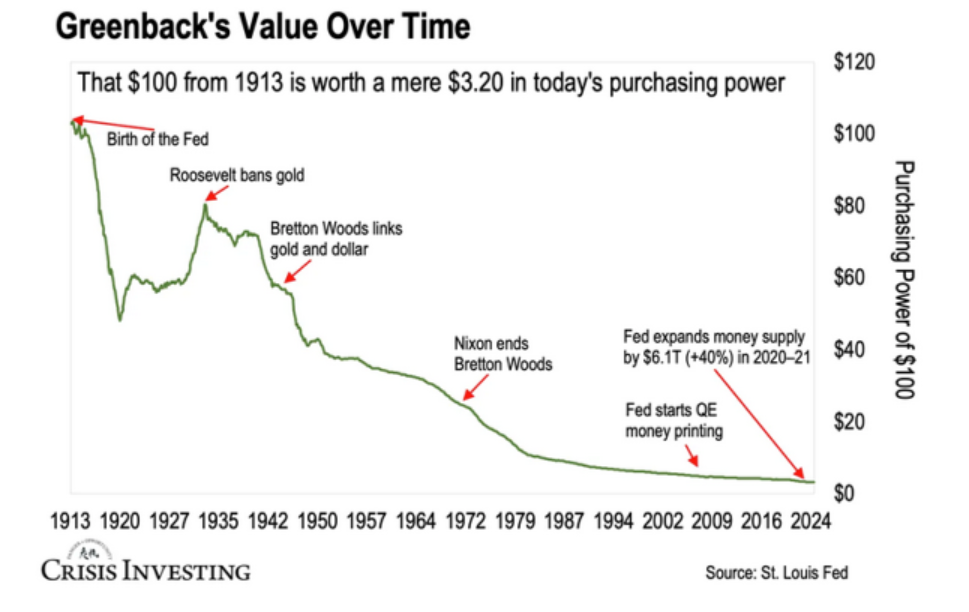
Group 1 - The Federal Reserve Chairman Jerome Powell announced a 25 basis point interest rate cut during the October FOMC meeting, bringing the total rate cut since June of last year to 150 basis points, indicating that more cuts are likely to come [1] - Powell hinted at the end of quantitative tightening (QT) during a meeting in Philadelphia, confirming that the Fed will officially end its balance sheet reduction on December 1 [1] - The historical context shows that since the establishment of the Fed in 1913, the dollar has lost 97% of its purchasing power, with $100 in 1913 now equivalent to $3.20 [1] Group 2 - The primary reason for the dollar's depreciation has been the severing of its link to gold, with the introduction of quantitative easing (QE) in the 21st century, which involves the Fed creating money to purchase government bonds, thus eroding the value of existing dollars [4] - Following the 2008 financial crisis, the Fed expanded its balance sheet from $900 billion to $4.5 trillion through multiple rounds of QE, creating approximately $3.6 trillion, resulting in a 20% decrease in dollar purchasing power by the end of the QE period [4] - During the COVID-19 pandemic, the Fed created $3.3 trillion in 2020 alone, which accounted for about 20% of the total circulating dollars at that time, leading to a significant increase in the balance sheet from $4.2 trillion to $8.9 trillion by April 2022, causing a 25% decline in dollar purchasing power from 2020 to 2025 [4] Group 3 - The Fed is expected to restart QE to lower long-term interest rates, likely starting early next year, with a balance sheet already inflated to approximately $6.6 trillion, which could lead to double-digit inflation [5] - The upcoming monetary policy could result in unprecedented large-scale and rapid currency devaluation in the U.S. economy [5]
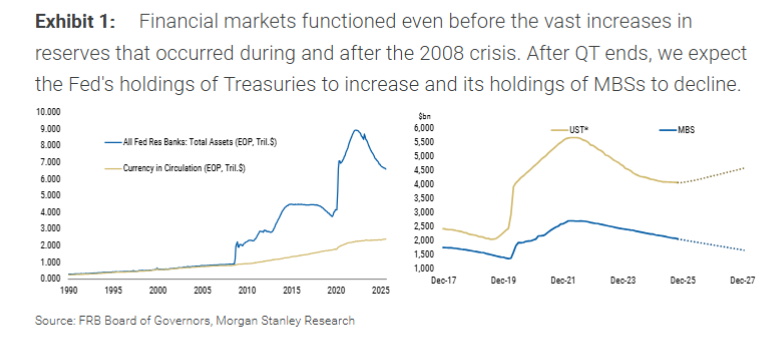
大摩:美联储结束QT ≠ 重启QE,未来扩表也非宽松,财政部的发债策略才是关键!
Sou Hu Cai Jing· 2025-11-11 06:32
Core Insights - The Federal Reserve's decision to end quantitative tightening (QT) has sparked discussions about a potential policy shift, but it should not be equated with the start of a new easing cycle [1][2] - The Fed will stop reducing its Treasury holdings but will continue to let approximately $15 billion of mortgage-backed securities (MBS) mature each month, replacing them with short-term Treasury bills [1][3] - This operation is characterized as an asset swap rather than an increase in reserves, focusing on changing the composition of the balance sheet rather than expanding its size [1][4] Summary by Sections End of QT vs. Restart of QE - The current Fed operation is fundamentally different from quantitative easing (QE), which aims to inject liquidity into the financial system through large asset purchases [2][4] - The Fed's plan involves an internal adjustment of its asset portfolio, with no increase in bank reserves, making it a misunderstanding to interpret this as a restart of QE [2][3] Future Balance Sheet Expansion - Future expansion of the Fed's balance sheet is expected only in extreme situations, such as a severe recession or financial crisis, primarily to hedge against cash demand [3][4] - The Fed may begin purchasing Treasury bonds to maintain stable reserve levels, potentially increasing its buying by $10 billion to $15 billion monthly to match cash growth [3][4] Focus on Treasury Issuance Strategy - The key focus for asset markets should shift from the Fed to the U.S. Treasury, which plays a crucial role in determining how much duration risk the market needs to absorb [5][14] - The Treasury's recent strategy has leaned towards increasing short-term bond issuance, and the Fed's purchase of short-term Treasuries may facilitate this, depending on the Treasury's final decisions [5][14]

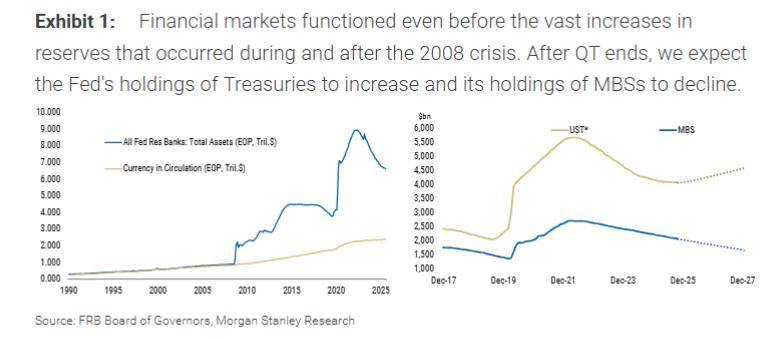
大摩:美联储结束QT ≠ 重启QE,未来扩表也非宽松,财政部的发债策略才是关键 !
Hua Er Jie Jian Wen· 2025-11-11 06:02
Core Viewpoint - The Federal Reserve's decision to end quantitative tightening (QT) has sparked discussions about a potential policy shift, but it should not be interpreted as the beginning of a new easing cycle [1][2]. Group 1: Federal Reserve's Actions - The Federal Reserve announced it will end QT on December 1, which is about six months earlier than previously expected [1]. - The Fed will stop reducing its Treasury holdings but will continue to let approximately $15 billion of mortgage-backed securities (MBS) mature each month, replacing them with an equal amount of short-term Treasury bills (T-bills) [1]. - This operation is characterized as an asset swap rather than an increase in reserves, focusing on changing the composition of the balance sheet rather than expanding its size [1]. Group 2: Distinction from Quantitative Easing (QE) - It is crucial to distinguish this operation from quantitative easing (QE), which involves large-scale asset purchases to inject liquidity into the financial system [2]. - The Fed's current plan is merely an internal adjustment of its asset portfolio, not an increase in bank reserves, thus misinterpreting it as a restart of QE is incorrect [2]. - The cumulative impact of stopping the $5 billion monthly reduction in Treasury holdings is relatively minor, amounting to only $30 billion in the context of the Fed's large portfolio [2]. Group 3: Future Balance Sheet Expansion - Future expansion of the Fed's balance sheet is expected to occur only under extreme conditions, such as a severe recession or financial crisis, primarily for technical reasons to hedge against cash demand [3]. - The Fed may need to purchase additional Treasury securities to maintain stable reserve levels, potentially increasing its monthly purchases by $10 billion to $15 billion to match cash growth [3]. - This buying behavior is aimed at preventing a decline in reserves rather than increasing them, and should not be overinterpreted as a signal of monetary easing [3]. Group 4: Focus on Treasury's Issuance Strategy - The real focus for asset markets should shift from the Federal Reserve to the U.S. Treasury, which plays a key role in determining how much duration risk the market needs to absorb [4]. - The Treasury's recent strategy has leaned towards increasing the issuance of short-term bonds, and the Fed's purchase of short-term Treasuries may facilitate further short-term bond issuance by the Treasury [4]. - Ultimately, the Treasury's decisions will significantly influence market liquidity and interest rate trends, making it a core variable in market direction [12].