
能源转型

Search documents
蜂巢能源出口大涨近400%!
起点锂电· 2025-11-25 10:39
Core Viewpoint - The article highlights the rapid growth and competitive strength of Chinese lithium battery companies, particularly focusing on the significant export increases and market expansion of companies like Honeycomb Energy in the international market [5][6][7]. Group 1: Market Performance - From January to October, China's power and other battery exports reached 228.1 GWh, showing a year-on-year growth of 43.9%. In October alone, the sales of power and other batteries increased by 33.5% year-on-year [5]. - Honeycomb Energy demonstrated exceptional performance with a year-on-year growth of 394% in October, significantly surpassing the average growth rate [5]. - In the global market, Honeycomb Energy's power battery installation volume reached 6.5 GWh from January to September, marking a year-on-year increase of 425% and capturing a market share of 1.9%, ranking it tenth globally [5]. Group 2: International Expansion - In the first half of 2025, Honeycomb Energy's overseas shipments reached 5.13 GWh, with overseas shipments accounting for 30% of total output, and an expected annual growth of 94% [7]. - The company has made significant breakthroughs in international client deliveries, including partnerships with BMW, Stellantis, and VinFast, enhancing its presence in the European market [7][8]. - Honeycomb Energy has supplied 128,000 battery packs to Stellantis and over 110,000 battery packs to BMW MINI, indicating strong demand and successful integration into high-end automotive supply chains [8]. Group 3: Energy Storage Sector - The demand for overseas energy storage orders is surging, particularly in the Middle East, Europe, and Australia, with orders from the Middle East reaching 40.06 GWh and Europe 48.08 GWh in the first three quarters [9]. - Honeycomb Energy's energy storage projects have seen rapid delivery, with a total of 4.18 GWh of signed storage orders by June 2025, including 2.1 GWh of new orders in the first half of 2025 [9]. - The company is collaborating with various partners to provide energy storage solutions, including a 450 MWh large storage project in Eastern Europe and a 700 MWh project with a German developer [9]. Group 4: Technological Advancements - Honeycomb Energy has made significant progress in next-generation battery technology, particularly in semi-solid batteries, achieving a safety breakthrough with 100% non-thermal runaway [10]. - The second-generation semi-solid battery is expected to have an energy density of 360 Wh/kg and has already been integrated into an eVTOL project [10]. - The company has established the world's largest dedicated production line for semi-solid batteries, with plans for mass production by November 2025 [10]. Group 5: Financial Outlook - Honeycomb Energy's CEO has set a target to achieve profitability by 2026, with overseas business expected to be a key driver for this goal [11].


光伏行业报告(2025.11.16-2025.11.22):适应“拍卖”机制:整体Q4需求平淡,明年预计整体进入过渡期
China Post Securities· 2025-11-25 09:12
证券研究报告:电力设备|行业周报 发布时间:2025-11-25 行业投资评级 强于大市 |维持 | 行业基本情况 | | --- | | 收盘点位 | | 9617.17 | | --- | --- | --- | | 52 | 周最高 | 10950.05 | | 52 周最低 | | 6107.84 | 行业相对指数表现 2024-11 2025-02 2025-04 2025-06 2025-09 2025-11 -19% -13% -7% -1% 5% 11% 17% 23% 29% 35% 41% 电力设备 沪深300 资料来源:聚源,中邮证券研究所 l 投资要点 格局优化预期迎来政策支持。供给端的"反内卷"政策持续推动, 叠加中国提交 NDC3.0,国内的相关配套措施会使 2026 年整体呈现过 渡年状态,大基地的消纳有望加速解决,基于此,我们认为 2026 年 整体需求有支撑,整体的预期差加大。 2025 年 1-10 月,累计新增装机规模 252.GW,同比+39.3%,1-9 月消纳率 95%。2025 年 4-5 月受 136 号文 531 截止带来的抢装潮,9 月装机 9.7GW,同比 ...
Veolia Environnement (OTCPK:VEOE.F) Update / Briefing Transcript
2025-11-25 08:02
Summary of Veolia Environnement Update / Briefing Company Overview - **Company**: Veolia Environnement (OTCPK: VEOE.F) - **Industry**: Urban energy, waste management, and environmental services - **Key Focus**: Decarbonization, urban heating networks, and energy efficiency Core Points and Arguments 1. **Acquisition Announcement**: Veolia announced a major acquisition in the US related to hazardous waste, emphasizing its strategy of combining strongholds and boosters in its operations [1] 2. **Pozna's Energy Transformation**: Pozna is transitioning to a 100% coal-free urban heating network by 2030, showcasing a model for energy transformation across Europe [2] 3. **New Energy Equation**: The energy crisis has highlighted the need for local energy production, affordability, stability, efficiency, flexibility, and decarbonization, which Veolia aims to address [3] 4. **Revenue Breakdown**: In 2024, Veolia generated EUR 45 billion in revenues, with energy representing 25% (EUR 11 billion) of its business, primarily from urban heating networks [4][24] 5. **Heating Networks**: 50% of energy consumed in Europe is heat, with 75% still derived from fossil fuels, presenting a significant opportunity for transformation [6] 6. **Leadership in Urban Heating**: Veolia claims leadership in urban heating networks due to its scale, local presence, public procurement expertise, and ability to integrate various energy solutions [7][8] 7. **Efficiency Metrics**: Veolia operates at an average efficiency of 88% across its networks, with some achieving 94%, compared to the European average of 75% [11] 8. **Decarbonization Projects**: Significant projects in Germany and the Czech Republic have achieved emission reductions of 45% to 60% without service interruptions, with investments totaling EUR 700 million since 2018 [14][15] 9. **EcoThermal Grid Launch**: Veolia launched EcoThermal Grid to optimize existing networks and create new ones, targeting a EUR 4 billion addressable market and EUR 350 million in additional turnover by 2030 [19][20] 10. **2030 Ambition**: Veolia aims to become the number one player in urban heating in Europe, achieve a coal exit across all operations, and generate EUR 350 million from EcoThermal Grid [20] Additional Important Insights 1. **Regulatory Support**: EU regulations are accelerating the shift towards decarbonization and energy efficiency, with ambitious targets for connecting additional citizens to heating networks by 2030 [6] 2. **Financial Resilience**: Veolia's strategy includes hedging against energy price volatility and maintaining stable cash flows through long-term contracts and pass-through mechanisms [28][29] 3. **Growth Drivers**: Future growth will come from new connections, additional services, and geographic expansion, supported by favorable regulations and efficiency gains [30][31] 4. **Coal Exit Strategy**: Veolia's commitment to exit coal by 2030 involves a multi-fuel approach, including biomass, waste heat recovery, and geothermal energy, with expected additional EBITDA of EUR 250 million [32][34] 5. **Partnership with Pozna**: The collaboration with the city of Pozna has been crucial for the successful transition to a decarbonized heating system, highlighting the importance of local partnerships [49][60] This summary encapsulates the key points from the Veolia Environnement update, focusing on the company's strategic direction, financial performance, and commitment to sustainability and decarbonization in urban energy systems.
CIGRE首场青年工程师实习交流活动在广州启动 探寻能源转型科技创新的“中国方案”
Xin Hua Cai Jing· 2025-11-25 07:23
11月17日,由中国南方电网与国际大电网委员会(CIGRE)共同策划的国际青年工程师实习交流活动, 在位于广州的南方电网科技交流中心正式启动。这是CIGRE首次举行青年工程师实习交流活动,共吸引 近百名全球青年才俊报名,来自6个国家的10名优秀电力青年工程师成功入选,在大湾区共同见证这一 电力领域国际合作盛事。 在不少学员看来,各国的电力规模和标准有较大差异,国际合作是关键,开展知识共享和人才流动非常 必要,CIGRE与中国南方电网共同为全球青年工程师搭建学习交流平台具有开创性意义。此行,国际青 年工程师将深入广州及大湾区项目一线,亲身体验"南网方案"从理念到现实的跨越。他们将以广州为窗 口,感知中国电力发展的强劲脉搏;以广州为桥梁,联接世界能源合作的广阔未来。 新型电力系统看南网,树立清洁能源高效利用新典范 能源转型看中国,共建绿色低碳跨国新桥梁 当前,全球能源转型浪潮奔涌,绿色低碳已成为国际共识。中国正从过去的追赶者,逐步转变为引领全 球能源技术发展的开拓者。南方电网作为全球电力行业的领军企业,以建设具有全球竞争力的世界一流 企业为目标,在全球率先提出以数字化绿色化协同促进新型能源体系和新型电力系统建设的 ...
强强携手!旭阳集团与宁德时代达成全面战略合作
鑫椤锂电· 2025-11-25 07:08
Core Viewpoint - The strategic cooperation agreement between Xuyang Group and CATL aims to enhance collaboration in renewable energy investment, new energy storage applications, electric transportation transformation, charging infrastructure layout, and zero-carbon park construction, contributing to the development of a new blueprint for the renewable energy industry [2][3]. Group 1: Strategic Cooperation - Xuyang Group and CATL will work together to explore new models and business formats for the deep integration of chemical and renewable energy industries, aiming to create a national and global benchmark for green, low-carbon, and intelligent innovation in energy and chemicals [3]. - The partnership will leverage Xuyang's expertise in modern green coal coking, basic chemicals, and the entire renewable energy industry chain, alongside CATL's leading position in renewable energy technology research and global market layout [3]. Group 2: Market Position and Innovation - CATL is a global leader in renewable energy innovation, with a market share of 37.9% in power batteries and 40% in energy storage batteries as of 2024, maintaining its position as the top supplier for eight consecutive years in power batteries and four years in energy storage [3]. - The collaboration is expected to create new momentum for the development of the renewable energy industry by exploring new pathways for the new energy transformation of the coke and chemical industries [3]. Group 3: Operational Mechanism - Both parties will establish a long-term and stable strategic partnership, focusing on creating an efficient and pragmatic operational mechanism that penetrates specific operational levels, ensuring collaboration in technology development, market expansion, and industrial ecosystem reshaping [5].

有色板块走强!华锡有色盘中涨停创新高,矿业ETF(159690)标的指数单季净利同比增55%
2 1 Shi Ji Jing Ji Bao Dao· 2025-11-25 06:24
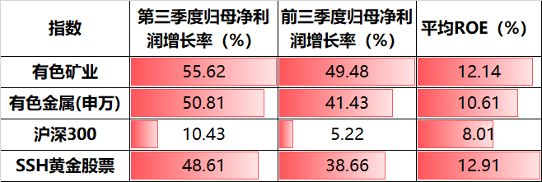
Core Viewpoint - The A-share non-ferrous metal sector is experiencing significant growth, driven by supply-demand dynamics and strong fundamentals in the industry, particularly in copper and precious metals [1][2]. Group 1: Non-Ferrous Metal Sector Performance - On November 25, the non-ferrous metal sector in A-shares strengthened, with Huaxi Nonferrous hitting a new high and several companies like Zhongjin Gold and Zijin Mining seeing gains of over 4% [1]. - The mining ETF (159690) rose by 2.74% as of the report [1]. Group 2: Copper Market Dynamics - According to Zhongyuan Securities, the copper price is expected to rise due to supply constraints from declining global copper ore grades, insufficient capital expenditure, and increased mining disruptions [1]. - Demand for copper is supported by global monetary easing and trends in green transformation, particularly in electricity investment, electric vehicles, and data center construction [1]. Group 3: Precious Metals Outlook - Dongguan Securities noted a significant negative correlation between gold and the US dollar index, with the current challenges to the US dollar credit system prompting a reassessment of gold's monetary attributes [1]. - The uncertainty in monetary policy as the Federal Reserve seeks to balance inflation control and economic stability is expected to increase gold's safe-haven premium [1]. - Despite short-term fluctuations due to reduced risk aversion and profit-taking by speculative funds, the long-term outlook for gold remains positive due to declining dollar credit, sustained safe-haven demand, and regular central bank gold purchases [1]. Group 4: Industry Profitability - The overall profitability of the non-ferrous metal industry has improved, with a 41.43% year-on-year increase in net profit attributable to shareholders in the first three quarters of 2025, and a further increase to 50.81% in the third quarter [2]. - The mining ETF (159690) tracked a net profit growth of 49.48% for the first three quarters and 55.62% for the third quarter [2][3]. Group 5: Index Performance - The non-ferrous mining index showed a net profit growth rate of 55.62% for the third quarter and 49.48% for the first three quarters, with an average ROE of 12.14% [3]. - The non-ferrous metal sector (Shenwan) recorded a net profit growth of 50.81% in the third quarter and 41.43% for the first three quarters, with an average ROE of 10.61% [3].

有色板块强势上攻!华锡有色涨停创新高,矿业ETF(159690)标的指数单季净利增55%
Sou Hu Cai Jing· 2025-11-25 05:46
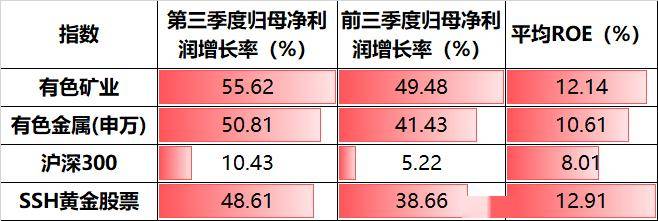
Core Viewpoint - The A-share non-ferrous metal sector is experiencing significant growth, driven by supply-demand dynamics and strong fundamentals in the industry [1][2] Group 1: Market Performance - On November 25, the non-ferrous metal sector in A-shares saw strong performance, with Huaxi Nonferrous hitting the daily limit and reaching a new high [1] - The mining ETF (159690) increased by 2.74% [1] - Key companies such as Zhongjin Gold, Xiyang Co., and Zijin Mining saw stock price increases of over 4% and 2% respectively [1] Group 2: Supply and Demand Dynamics - According to Zhongyuan Securities, the copper price is expected to rise due to supply constraints from declining global copper ore grades and limited new mining projects [1] - Demand for copper is supported by global monetary easing and trends in green transformation, particularly in electric power investment, new energy vehicles, and data center construction [1] Group 3: Profitability and Financial Performance - The non-ferrous metal industry saw a year-on-year net profit growth of 41.43% in the first three quarters of 2025, with the third quarter showing an even larger increase of 50.81% [2] - The mining ETF (159690) tracked the non-ferrous metal mining index, which had net profit growth rates of 49.48% and 55.62% for the first three quarters and single quarter respectively [2][3] Group 4: Industry Metrics - The non-ferrous mining index reported a return on equity (ROE) of 12.14%, while the overall non-ferrous metal sector had an ROE of 10.61% [3] - The SSH gold stocks index showed a net profit growth of 48.61% for the third quarter and 38.66% for the first three quarters [3] Group 5: Long-term Outlook - The non-ferrous metal sector is expected to benefit from long-term resource demand driven by energy transition, AI computing infrastructure, and global monetary policies [3]
双融日报-20251125
Huaxin Securities· 2025-11-25 01:34
Market Sentiment - The current market sentiment score is 55, indicating a "neutral" stance, with historical trends showing that scores below 30 provide support while scores above 70 present resistance [5][9]. Hot Themes Tracking - **Non-ferrous Metals**: Demand expectations are boosted by potential US interest rate cuts and AI data centers driving marginal increases. Copper prices are rising due to financial attributes and supply constraints, while aluminum production peaks domestically and limited overseas increases maintain a tight balance. Key stocks include Zijin Mining (601899) and China Aluminum (601600) [5]. - **Power Equipment**: The intersection of global energy and digital transformation is accelerating AI penetration in the power sector. The International Energy Agency (IEA) predicts that global data center electricity consumption will double by 2030. China's State Grid investment exceeded 420 billion yuan in the first nine months of the year, with a projected annual investment of 650 billion yuan. Relevant stocks are Guodian Nanzi (600268) and China Xidian (601179) [5]. - **Banking Sector**: Bank stocks offer high dividend yields, with the CSI Bank Index yielding 6.02%, significantly higher than the 10-year government bond yield. In a slowing economy with increased market volatility, bank stocks become important for long-term funds like insurance and social security. Notable stocks include Agricultural Bank of China (601288) and Ningbo Bank (002142) [5].
这一地要自产锂5万吨,究竟出于何种考虑?
Zhong Guo Qi Che Bao Wang· 2025-11-25 01:32
Core Insights - The UK has announced a new strategy to produce at least 50,000 tons of lithium by 2035, with 20% of this supply coming from recycling efforts, supported by an investment of approximately £50 million [2][3]. Group 1: Strategic Importance of Lithium - Lithium is recognized as a critical resource for the development of electric vehicles (EVs), with the UK currently relying on imports for over 90% of its key minerals, including lithium, which is predominantly sourced from Australia (40%) and Chile (28%) [3]. - The UK's electric vehicle production faced a 12% decline due to supply chain disruptions, highlighting the importance of stable lithium supply for the automotive industry [3]. Group 2: Domestic Production and Economic Impact - The UK aims to develop a complete domestic lithium supply chain from extraction to battery manufacturing, particularly focusing on the geothermal brine lithium resources in Cornwall, which has a lithium concentration of 260 mg/L [3][8]. - The development of the lithium industry is expected to create 50,000 high-paying jobs across various sectors, contributing significantly to the UK economy [5]. Group 3: Competitive Landscape in Europe - The UK is currently lagging behind Germany and France, which have planned a combined domestic lithium capacity of 240,000 tons, with the UK’s market share for electric vehicles at only 16.5% compared to Germany's 22% and France's 19% [4]. - The UK’s battery production capacity is only 10 GWh, less than one-third of Germany's, which limits its competitiveness in the EV market [4]. Group 4: Environmental Considerations - The UK’s lithium strategy emphasizes sustainable mining practices, with projects like the Cornwall lithium mine utilizing a closed-loop water system that achieves a 95% water utilization rate and reduces carbon emissions by 60% compared to traditional mining methods [9][10]. Group 5: Future Outlook - The UK’s lithium production goal is seen as the beginning of a larger trend in the global competition for lithium resources, with the potential for significant market share in the electric vehicle sector by 2035 [10].

鼎和保险“十四五”收官展硕果 能源保险行业专家护航绿色新时代
Nan Fang Du Shi Bao· 2025-11-24 23:11
2025年,是中国"十四五"规划的收官之年。站在这一重要历史节点回望,鼎和保险作为南方电网旗下产 业金融单位,以一份亮眼的成绩单展现了能源行业保险专家的专业力量。 在"十四五"期间,鼎和保险总资产翻番跃升至250亿元,净利润稳居非上市险企前五,市场价值及综合 竞争力跻身行业前十,连续8年保持中国保险行业协会经营评价A类。 今年9月,随着深圳金融监管局正式批复同意鼎和保险公司增加注册资本金至60亿元,这家能源保险专 家迎来了新一轮发展契机,为做好金融五篇大文章蓄势发力。 专业化领航: 从电力保险专家到能源行业守护者 "十四五"以来,鼎和保险紧盯"两强三优"国内一流、国际知名保险公司的战略目标,成功完成从"电力 行业保险专家"向"能源行业保险专家"的全面转型升级。 在内蒙古"沙戈荒"深处,光伏板铺成一片壮阔的"蓝色海洋";在广东沿海滩涂,海上风电场的风塔正挥 动"巨翅";在云南群山环绕间,一座大型储能电站巍然耸立——这些国家重大能源项目的背后,都有着 鼎和保险的专业守护。 "能源的饭碗必须端在自己手里。"围绕这一战略定位,鼎和保险构建了覆盖"源网荷储碳数"全链条的保 险解决方案,成为国家能源安全链条上不可或缺的" ...