
日本央行加息

Search documents
日本首相高市早苗会见央行行长在即 日本股债汇承压
Zhong Guo Xin Wen Wang· 2025-11-18 06:23
Core Points - Japanese Prime Minister Fumio Kishida is set to meet with Bank of Japan Governor Kazuo Ueda, with expectations that the meeting may provide insights on when the central bank will resume its interest rate hike cycle [1] - The Tokyo stock market experienced a decline, with the Nikkei 225 index dropping by 3.3% amid concerns over a significant drop in tech stocks and deteriorating Japan-China relations [1] - The Japanese yen fell to its lowest level since January, trading at 155.38 yen per dollar, as market speculation suggests that the Bank of Japan may delay interest rate hikes due to the government's unexpectedly large spending plans [1] - Japan's 20-year government bond yield reached its highest level since 1999, with the 30-year bond yield rising by 5.5 basis points, nearing historical highs [1] - Japan's overall inflation rate has exceeded the 2% target for over three years, leading many market participants to anticipate a potential interest rate hike by the central bank in December or January [1] - Despite indications from Ueda that a rate hike could occur as early as December, Kishida expressed dissatisfaction and urged the Bank of Japan to align with government policies aimed at stimulating the economy [1] Group 1 - The meeting between the Prime Minister and the central bank governor is highly anticipated for potential signals regarding interest rate hikes [1] - The Tokyo stock market's decline is attributed to tech stock drops and geopolitical tensions [1] - The depreciation of the yen is linked to expectations of delayed interest rate hikes and increased import costs [2] Group 2 - Rising government bond yields indicate market reactions to inflation and interest rate expectations [1] - The sustained inflation above the target suggests a potential shift in monetary policy [1] - The Prime Minister's push for alignment with economic stimulus measures highlights the tension between fiscal and monetary policy [1][2]
“明年美联储可能降息两次”
第一财经· 2025-11-18 03:39
Core Viewpoint - Goldman Sachs Asset Management's 2026 investment outlook report indicates a divergence in central bank policies across major markets, influenced by varying economic conditions [1] Group 1: U.S. Market - The labor market is showing signs of weakness, leading Goldman Sachs to predict that the Federal Reserve may cut interest rates twice in 2026 [1] Group 2: European Market - The European Central Bank is expected to maintain interest rates at their current levels for the foreseeable future [1] - The Bank of England may resume rate cuts in December, contingent on improvements in inflation, a relatively weak labor market, and potential tax increases [1] Group 3: Japanese Market - High inflation and strong growth in Japan may prompt the Bank of Japan to raise interest rates [1] - Recent political changes and a shift towards expansionary fiscal policy further reinforce the likelihood of this direction [1]

高盛资管:美联储在2026年可能降息两次
Xin Hua Cai Jing· 2025-11-18 03:11
Core Viewpoint - Goldman Sachs Asset Management released its 2026 investment outlook report, indicating a potential divergence in central bank policies across major markets [1] Group 1: U.S. Market - The report anticipates that the Federal Reserve may lower interest rates twice in 2026 due to a weak labor market [1] Group 2: European Market - The European Central Bank is expected to maintain interest rates at current levels for the foreseeable future [1] - The Bank of England may resume rate cuts in December, influenced by improving inflation, a relatively weak labor market, and potential tax increases [1] Group 3: Japanese Market - High inflation and strong growth in Japan may lead to an interest rate hike by the Bank of Japan [1] - Recent political changes and a shift towards expansionary fiscal policy further reinforce this direction [1]

日本经济六季度首次萎缩 日本央行加息前景蒙阴
Jin Tou Wang· 2025-11-17 03:50
Group 1 - The core viewpoint of the articles indicates that Japan's economy is experiencing a temporary setback, with a 1.8% year-on-year decline in GDP for Q3, marking the first contraction in six quarters, primarily due to the impact of U.S. tariffs on exports [1] - Japan's Q3 GDP contracted by 0.4% quarter-on-quarter, which was better than the market expectation of a 0.6% contraction, while the revised growth for Q2 was 2.3% [1] - Exports were the main drag on the economy, with net external demand reducing growth by 0.2 percentage points, significantly affected by a 15% tariff on Japanese goods imposed by the U.S. starting in September [1] - Private consumption increased by only 0.1%, down from 0.4% in the previous quarter, as high prices suppressed spending willingness; however, capital expenditure rose by 1.0%, exceeding the expected 0.3% [1] - The Japanese government is planning a stimulus package of approximately 17 trillion yen to improve household income and support consumption next year [1] Group 2 - From a technical analysis perspective, the USD/JPY exchange rate maintains a bullish structure in the short term, with clear resistance levels above [2] - The USD/JPY rebounded strongly from 153.60 and broke through the resistance zone of 154.45–154.50, indicating potential for further upward movement [2] - If the USD/JPY effectively breaks the psychological level of 155.00, it could open up further upward space towards 155.60 or even 156.00 [2] - The support level at 154.00 remains crucial for maintaining the bullish structure; a drop below 153.60 could lead to a further decline towards 153.00 [2]
刚刚,日本旅游、消费股大幅下挫
Zhong Guo Ji Jin Bao· 2025-11-17 02:16
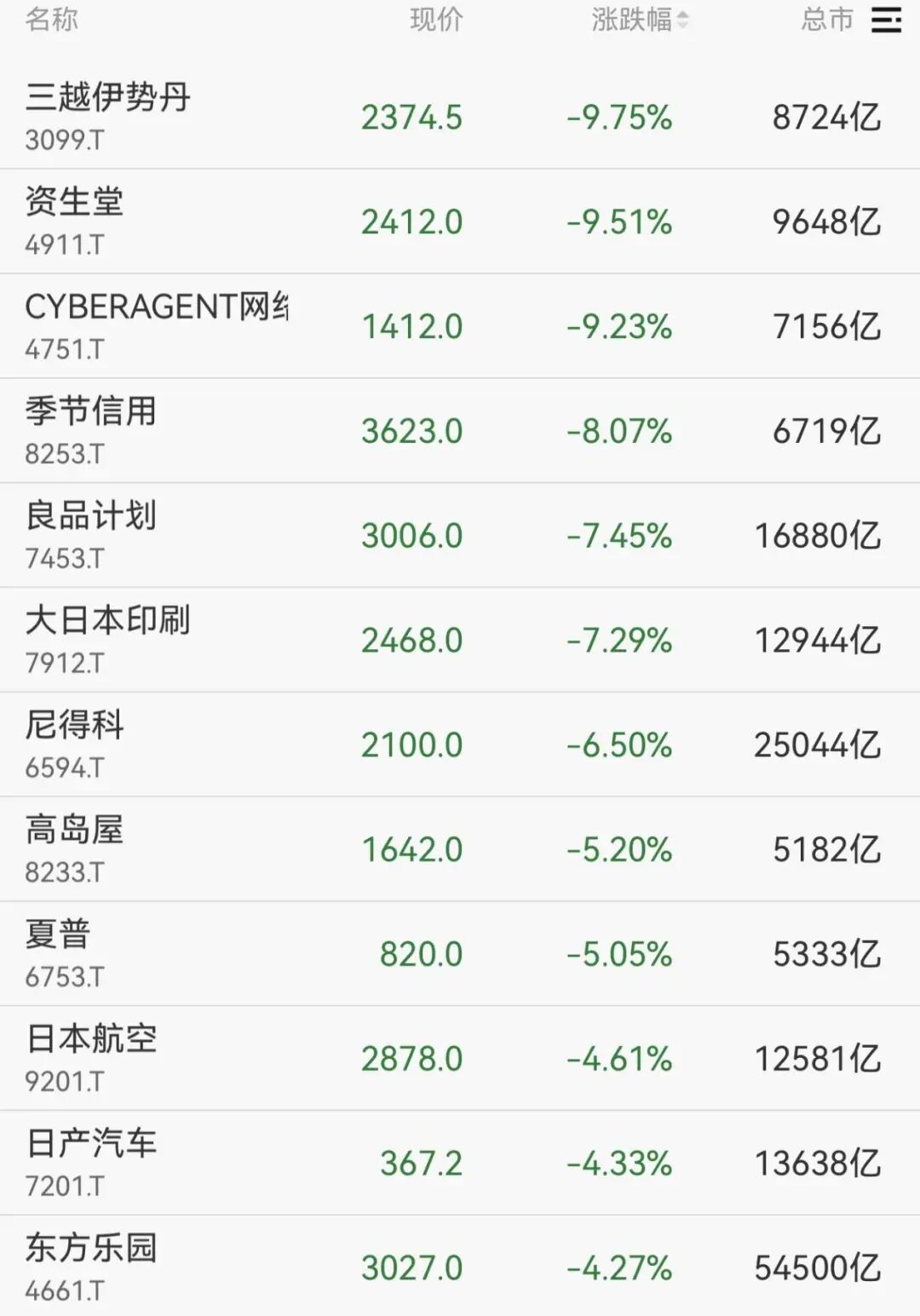
Group 1: Market Overview - On November 17, the Japanese stock market opened with a significant decline, with the Nikkei 225 index dropping over 1% [2] - Tourism-related stocks in Japan experienced substantial losses, with Shiseido's stock price falling by 11% and Japan Airlines dropping by 5% [2] - Other consumer goods and retail stocks also declined, with companies like Sanrio, Asics, and Fast Retailing all seeing drops exceeding 6% [2] Group 2: Stock Performance - Notable stock declines included: - Mitsukoshi Isetan: -9.75% [3] - Shiseido: -9.51% [3] - CyberAgent: -9.23% [3] - Ryohin Keikaku (Muji): -7.45% [3] - Japan Airlines: -4.61% [3] - The overall market sentiment reflects a bearish trend, particularly in the retail and tourism sectors [2][3] Group 3: Economic Context - Japan's GDP reported a year-on-year decline of 1.8% for Q3, marking the first negative growth in six quarters [5] - The GDP decreased by 0.4% compared to the previous quarter, influenced by external demand and a 9.4% drop in housing investment [5] - Analysts suggest that this economic contraction complicates the timeline for potential interest rate hikes by the Bank of Japan, with expectations leaning towards a delay in policy changes until next year [5]
再触155关口!日元贬值魔咒难破 央行与政府政策分歧加剧市场疑虑
智通财经网· 2025-11-13 03:53
Core Viewpoint - The Japanese yen is experiencing significant depreciation, raising concerns about the new government's ability to intervene effectively to support the currency, especially in light of Prime Minister Kishida's signals of a potential slowdown in interest rate hikes [1][2][3] Currency Trends - The yen has depreciated approximately 4.5% against the US dollar this quarter, marking the largest decline among G10 currencies, with the exchange rate reaching around 154.73 [1][2] - The yen's rapid fluctuations have prompted warnings from Japanese officials, indicating a heightened urgency to monitor excessive volatility [1][2] Government and Central Bank Actions - Japan's Finance Ministry previously intervened in the market when the yen fell to around 160.17, with multiple interventions at various levels [2] - Current discussions suggest that if the yen surpasses 155 against the dollar, the likelihood of intervention will significantly increase [2][3] - The Bank of Japan maintained its interest rates in the last meeting, with a decision on the next policy expected on December 19, and a majority of economists anticipate a rate hike by January [2][4] Market Sentiment and Predictions - Analysts suggest that if the yen breaks the 155 mark, verbal intervention may intensify, and the probability of a rate hike by the Bank of Japan could also rise [3] - The market currently estimates a 40% chance of a rate hike by the end of the year, with full expectations for a rate increase not anticipated until April next year [4] Economic Implications - A weaker yen could benefit Japan's export sector by increasing the value of repatriated earnings, but it also raises import costs and inflationary pressures [2] - The potential for intervention may complicate Japan's $550 billion investment plan in the US, which is a key component of the US-Japan trade agreement [3]
KCM Trade分析师Tim汇评| 静待数据洪流,停摆尾声下的降息博弈
Sou Hu Cai Jing· 2025-11-12 10:23
Group 1 - The U.S. government shutdown is expected to end by 2025, leading to clearer economic conditions as key macroeconomic data will resume publication once the government is operational again [1] - The Senate has passed a temporary funding bill to keep the government running until at least the end of January, awaiting House approval and presidential signature [1] Group 2 - Market sentiment suggests that the resumption of labor market and inflation data may not indicate a positive economic outlook, potentially prompting the Federal Reserve to consider further rate cuts next month [3] - Traders are optimistic about the end of the government shutdown and the possibility of the Fed lowering rates again after key economic data is released [3] Group 3 - The U.S. dollar has reacted to the expectations of a December rate cut, with the dollar index (DXY) falling below the psychological level of 100 [3] - The decline of the dollar is not uniform, as the Japanese yen remains weak due to expectations of increased fiscal spending by the new Japanese government [4] Group 4 - Gold and silver prices have risen due to the weakening dollar, with gold trading above $4,100 and potential to reach $4,235 if it breaks resistance levels [4] - Silver prices have also gained attention, returning to the $50 mark amid expectations of a supply shortage in 2026 [4] Group 5 - Oil prices have been boosted by the news of a potential end to the government shutdown, with U.S. crude prices rising above $60 per barrel [6] - However, the upcoming increase in supply from OPEC+ may limit further price increases [6]

日元疲软受薪资数据拖累
Jin Tou Wang· 2025-11-06 10:12
Core Viewpoint - The USD/JPY exchange rate is experiencing fluctuations, currently trading at 153.6200, following a significant rebound after a dip, influenced by various economic indicators and statements from Japanese officials [1]. Group 1: Economic Indicators - The USD/JPY rate saw a decline of 0.5% on Tuesday due to warnings from Japan's Finance Minister, but rebounded on Wednesday, driven by better-than-expected ADP data from the US [1]. - Japan's September wage income level showed a year-on-year decline of 1.4%, raising concerns about the sustainability of demand-driven inflation in Japan [1]. - The market is questioning the Bank of Japan's ability to generate sustainable inflation pressure, given the ongoing weakness in wages despite a rising inflation environment [1]. Group 2: Central Bank Actions - The Bank of Japan is awaiting wage growth momentum before considering interest rate hikes, with the December rate increase not guaranteed [1]. - The upcoming speech by Bank of Japan Governor Kazuo Ueda on December 1 is anticipated to be a critical factor, especially after an unexpected rise in Tokyo's CPI last month [1]. - Market expectations for a rate hike by the Bank of Japan are increasing, as indicated by interest rate futures for January to April next year [1]. Group 3: Technical Analysis - The USD/JPY remains within an upward channel, but the recent decline in the exchange rate amidst a rising dollar index suggests a decrease in market enthusiasm for shorting the yen [2]. - There is a growing risk of adjustment for the USD/JPY as the dollar approaches a potential peak and as the yen's interest rate hike process progresses [2].
日本最大工会之一计划继续推动薪资增长
Xin Hua Cai Jing· 2025-11-06 06:26
Core Viewpoint - Japan's largest labor union, UA Zensen, plans to negotiate for a wage increase in the upcoming year that matches this year's level, targeting a total wage growth of 6% [1] Group 1: Wage Negotiation Plans - UA Zensen aims for a 4% increase in base wages during the wage negotiations ending in March next year, following a successful 4.75% wage increase achieved this year [1] - The union also plans to request an additional 1% wage increase for companies with significant wage disparities compared to their peers [1] Group 2: Economic Context - The Bank of Japan is closely monitoring wage trends as a key factor in determining the timing of future interest rate hikes, indicating heightened market attention on the upcoming wage negotiations [1] - Bank of Japan Governor Kazuo Ueda has stated that he is watching the "initial momentum" of annual salary negotiations, suggesting that the union's announcement may signal early signs of this momentum [1]
每日机构分析:11月4日
Xin Hua Cai Jing· 2025-11-04 11:39
Group 1 - Dongwu Securities indicates that the recovery of prices is crucial for economic growth and capital markets, with favorable conditions in consumption demand, monetary liquidity, and exchange rates [1] - The chief economist of Dongwu Securities, Lu Zhe, highlights that long-term demographic, industrial, and fiscal transformations will boost household income, predicting a more optimistic total consumption due to the simultaneous movement of population and consumption peaks in the next decade [1] - The report suggests that the central bank's initiation of government bond trading and fiscal debt reduction will facilitate the transfer of fiscal deposits to households and enterprises, leading to a significant rebound in M1 growth over the past year, which will in turn drive PPI recovery [1] Group 2 - The dollar has slightly weakened as investors assess the differing views among Federal Reserve officials regarding future interest rate cuts, with some officials expressing caution due to persistent inflation [2] - Wall Street executives warn that investors should prepare for a potential market correction of over 10% within the next 12 to 24 months, emphasizing that such corrections are common in market cycles [2] Group 3 - Analysts from ING state that the daily fluctuations in Eurozone government bond yields are predominantly influenced by U.S. trends, as there are insufficient internal factors to change direction [3] - Mizuho Financial Group's CEO expresses confidence that Japan's growth-promoting policies and potential interest rate hikes by the Bank of Japan will drive bank business expansion [3] Group 4 - Capital Economics suggests that the Reserve Bank of Australia (RBA) has room for future interest rate cuts, maintaining a neutral stance despite mixed economic data [4] - Moody's analysis indicates that the RBA is unlikely to cut rates until mid-2026 at the earliest, contingent on a convincing decline in inflation [4][5]