财政刺激

Search documents
日本股市新高后突然转跌
Zheng Quan Shi Bao· 2025-09-16 03:28
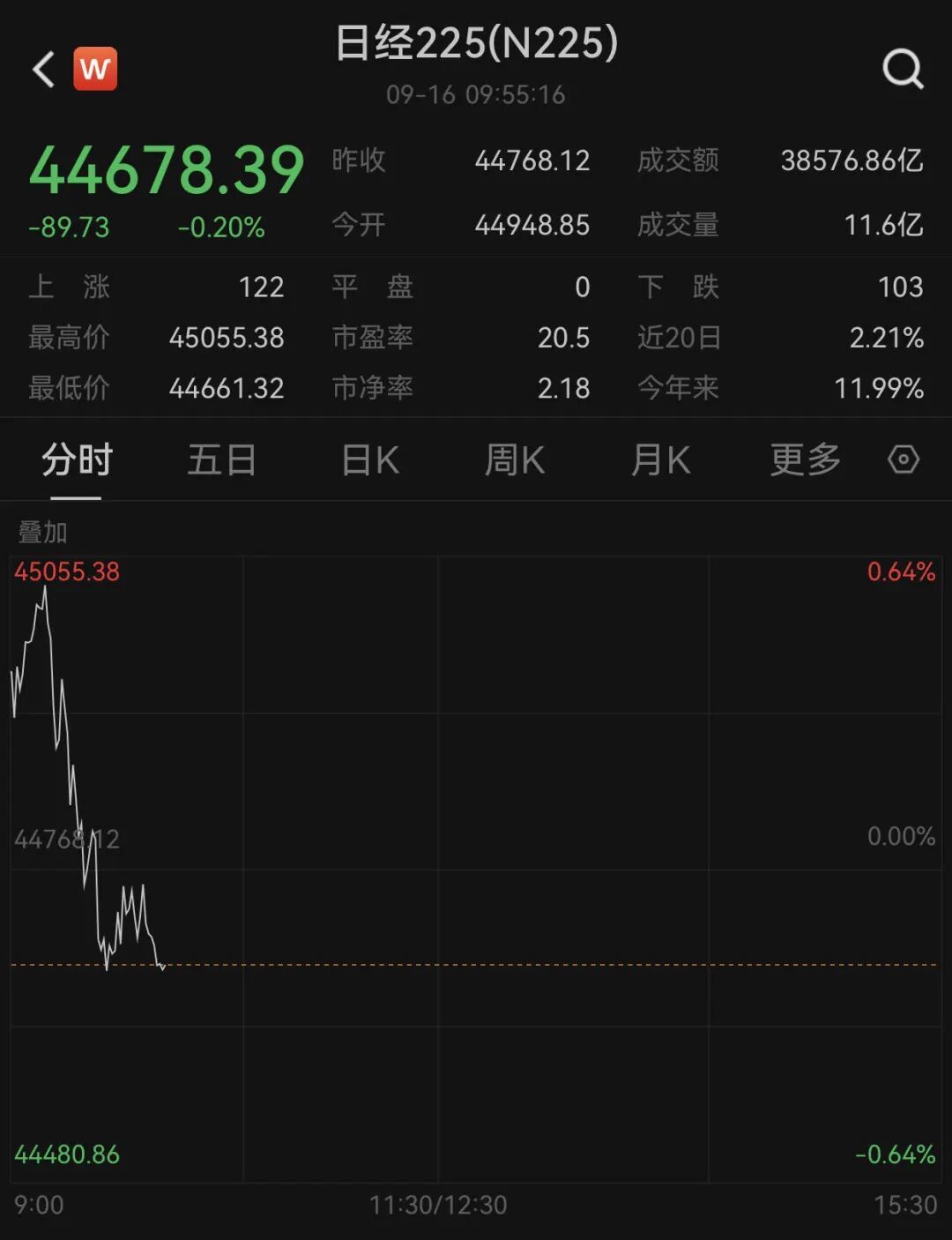
Group 1 - The Nikkei 225 index initially rose to a historical high of over 45,000 points but then turned down, closing at 44,678.39 points, a decrease of 0.20% [2][1] - The U.S. government announced a reduction in tariffs on Japanese cars to 15%, down from the previous 25%, effective from September 16 [4][5] - This tariff reduction aligns with President Trump's executive order to implement a U.S.-Japan trade agreement, which sets a baseline tariff of 15% on most Japanese imports [5] Group 2 - The Bank of Japan is expected to maintain its current interest rate of 0.5% during its upcoming meeting, with predictions suggesting that any rate hike may not occur until January 2026 [6][6] - Economic reports indicate that Japan's exports and production are showing signs of weakness, particularly in the automotive sector, which may influence the Bank of Japan's decision [6] - The market is optimistic about the potential election of a new Prime Minister, with candidates like Sanae Takaichi advocating for increased fiscal stimulus and monetary easing, which could positively impact Japanese stocks [7]

美国最高法院将审议关税合法性,影响几何?瑞银给出参考答案
智通财经网· 2025-09-15 08:05
Core Viewpoint - The U.S. Supreme Court will hold a hearing in November regarding the legality of certain tariffs, increasing the likelihood that some tariffs may be deemed illegal in the first half of next year [1] Group 1: Tariff Legality and Implications - If certain tariffs are ruled illegal, they may be replaced by new tariffs that could have different rates depending on the exporting country [1] - Refunds will be available for tariffs paid from April 2025 until the ruling, with U.S. Treasury Secretary suggesting that half of the tariff revenue could be refunded, equating to 0.5% to 0.7% of GDP, which would add to the fiscal deficit [1] Group 2: Impact on Companies - Refunds of tariff payments represent a form of tax rebate, providing unexpected cash payments to U.S. companies that have paid tariffs, with approximately two-thirds of these payments coming from small U.S. companies [1] - The potential for tariff refunds may act as a fiscal stimulus similar to income tax rebate checks [1] Group 3: Inflation Considerations - The introduction of new tariffs replacing old ones may lead to inflationary distortions; if new tariffs lower rates, prices of U.S. goods that increased due to previous tariffs may not decrease due to price stickiness [1] - Conversely, if the new tariff regime raises certain rates, it could introduce new inflation risks [1]
华尔街顶级机构内部分析:为什么目前美国经济还不错但是后市要大跌?
Sou Hu Cai Jing· 2025-09-13 23:43
Group 1 - The Federal Open Market Committee (FOMC) has indicated that there will be no changes in the short term, and market expectations for preventive rate cuts by the Federal Reserve starting in September are deemed correct [1] - The importance of the Federal Reserve's independence is emphasized, as it is crucial for maintaining credibility in economic policy, which in turn lowers borrowing costs and supports sustainable growth [1] - The theme of currency depreciation remains unchanged, with gold prices surpassing $3,650, reflecting a monthly increase of 6% and a year-to-date increase of 40% [1] Group 2 - The current economic environment suggests a favorable outlook for the stock market, contingent on strong income and profit growth, regulatory relaxation, healthy balance sheets, record capital expenditure, lower policy rates, and upcoming fiscal stimulus measures [1] - The 10-year U.S. Treasury yield is around 4%, which is considered high, and the market has nearly priced in the peak of dovish sentiment relative to current data [1] - A significant sell-off is anticipated if future predictions hold true, indicating potential volatility in the market [1]
美国低利率时代,有哪些投资机遇?
2025-09-09 14:53
Summary of Key Points from the Conference Call Industry or Company Involved - The discussion revolves around the U.S. economy and its response to three major economic crises: the Internet bubble burst, the financial crisis, and the COVID-19 pandemic. Core Insights and Arguments 1. **Monetary Policy Evolution**: The U.S. has implemented various monetary policies across different crises, including interest rate cuts and quantitative easing, to stimulate economic recovery. For instance, during the Internet bubble, the Fed cut rates by 550 basis points over 30 months, while during the financial crisis, rates were brought close to zero and multiple rounds of quantitative easing were initiated [1][11][12]. 2. **Fiscal Policy Measures**: The U.S. government responded to crises with fiscal stimulus measures, including tax cuts and increased public spending, leading to significant increases in government deficit and leverage ratios. For example, the deficit rate reached 14% during the COVID-19 pandemic [1][9][14]. 3. **Asset Price Performance**: Different asset classes reacted variably during the crises. After the Internet bubble burst, stock prices fell significantly, while real estate prices increased. Conversely, during the financial crisis, both stock and real estate markets faced severe declines, with the Dow Jones Industrial Average dropping by 49% [2][4][6][10][16]. 4. **Investment Opportunities**: The low-interest-rate environment has created investment opportunities primarily in gold, real estate, and specific sectors like energy and materials. Technology stocks, however, require a longer recovery period [3][19]. 5. **Impact of COVID-19**: The pandemic led to a sharp decline in GDP by 7.5% in Q2 2020, with significant unemployment and business disruptions. The Fed responded with aggressive rate cuts and expanded its balance sheet significantly [8][9][10]. 6. **Long-term Trends**: The U.S. stock market has maintained a long bull market due to technological advancements and sustained inflows from long-term funds like pensions and mutual funds. This shift in asset allocation from real estate to financial assets reflects changing risk preferences among investors [19][20]. Other Important but Possibly Overlooked Content 1. **Comparison with Japan**: The U.S. bond fund market did not experience the same contraction as Japan's, attributed to the U.S. economy's resilience and quicker recovery from crises [18]. 2. **Inflation and Interest Rates**: The low-interest-rate environment has led to a general increase in asset prices, with housing prices rising over 40% during the pandemic period [9][10]. 3. **Government Debt Levels**: The federal government’s leverage ratio increased significantly during the crises, reaching 141% during the pandemic, indicating a substantial rise in government debt relative to GDP [14][19]. 4. **Sector-Specific Performance**: The technology, consumer, and healthcare sectors have shown particularly strong performance during the recovery phases following the crises [7][10]. This summary encapsulates the key points discussed in the conference call, highlighting the U.S. economic landscape's response to significant crises and the resulting investment implications.
每日投行/机构观点梳理(2025-08-26)
Jin Shi Shu Ju· 2025-08-26 11:47
Group 1: Federal Reserve Outlook - Morgan Stanley expects the Federal Reserve to cut rates twice in 2025 and four times in 2026, bringing the target rate down to 2.75%-3.0% [1] - UBS warns that increased politicization of the Federal Reserve will raise the risk premium in the U.S. bond market, leading to higher borrowing costs and reduced fiscal stimulus space [1] - French Agricultural Credit Bank anticipates two rate cuts this year, with a terminal rate of 4%, citing persistent inflation as a limiting factor for aggressive easing [2] Group 2: Economic Sentiment in Germany - Dutch International Group reports that German businesses are optimistic about upcoming government spending, despite weak economic data [3] - The IFO index indicates rising confidence among German enterprises, driven by expectations of significant fiscal investment in defense and infrastructure [3] Group 3: Real Estate Market Dynamics - CICC notes that new housing policies in Shanghai are expected to provide a temporary boost to local market sentiment [7] - Huatai Securities believes that recent real estate policies in major cities will accelerate the stabilization of the housing market, recommending developers with strong fundamentals [8] - CITIC Securities states that further optimization of real estate policies will help release short-term demand and support market stabilization efforts [9] Group 4: Investment Opportunities - CICC identifies a new paradigm in China's pig farming industry, indicating that traditional cyclical patterns are becoming less relevant [5] - Shenwan Hongyuan suggests that while the market shows signs of overheating, there are still opportunities in advanced manufacturing and technology sectors [6] -招商策略 emphasizes the importance of the new technology cycle and the progress of societal intelligence in investment strategies [6]
来不及了!2026年利率砍到3%,美联储降息也救不了美国经济?
Sou Hu Cai Jing· 2025-08-23 21:38
Economic Outlook - The probability of the US economy entering a recession within the next 12 months is estimated at 49% according to a prediction by Moody's chief economist Mark Zandi, based on a complex machine learning model [1] - Over half of the industries have initiated layoffs, a phenomenon that aligns closely with historical indicators of impending economic recessions [1] Policy Impact - The negative impacts of tariffs and immigration restrictions from the Trump administration are expected to peak between late 2025 and early 2026, contributing to an "economic winter" [3] - The actual tariff rate in the US has reached 23%, the highest in a century, leading to increased operational costs for businesses and potential price hikes for consumers [6] Economic Indicators - The US GDP growth rate is projected to plummet from 3% in Q2 to 1%, while inflation could rise to a peak of 3.5% [5] - Employment growth has significantly declined, with potential job growth dropping from 206,000 in Q1 to just 28,000 by July, far below the 90,000 needed to maintain economic stability [5] Federal Reserve Actions - The Federal Reserve is expected to implement a series of interest rate cuts, with predictions of three consecutive cuts in September, October, and December, followed by two more in 2026 [6] - There is a notable division among Federal Reserve officials regarding interest rate predictions for 2025, complicating the formulation of a unified monetary policy [7] Market Reactions - The US stock market is experiencing a "high valuation trap," with significant sell-offs occurring despite some companies reporting better-than-expected earnings [8] - Concerns about the US dollar's valuation persist, with Goldman Sachs indicating that the actual exchange rate is overvalued by 15% [8] Broader Economic Challenges - The US economy is facing a confluence of high inflation, rising unemployment, and economic slowdown, presenting one of the most severe challenges since the 1970s [10]
荷兰国际:韩国三季度消费可能飙升
Sou Hu Cai Jing· 2025-08-22 04:43
Core Viewpoint - The report indicates that South Korea's consumption is expected to surge in the third quarter due to government cash handouts and fiscal stimulus, although sluggish construction investment may hinder overall growth [1] Economic Growth Projections - The Bank of Korea is likely to revise its GDP growth forecast for 2025 from 0.8% to 1.0% and for 2026 from 1.6% to 1.7% [1] - Despite the improved economic growth outlook, South Korea's growth rate is still expected to remain below its potential [1] Monetary Policy Outlook - The report suggests that the Bank of Korea may ease monetary policy in October [1]
日债又陷抛售潮
Sou Hu Cai Jing· 2025-08-21 13:55
Core Viewpoint - Japan's bond market is experiencing a sell-off due to concerns over fiscal conditions and persistent inflation, leading to a surge in long-term government bond yields to their highest levels in a decade [1][3]. Group 1: Bond Yield Trends - The yield on Japan's 10-year government bonds rose to 1.61%, the highest since October 2008, while the 20-year yield reached 2.655%, the highest since 1999, and the 30-year yield climbed to 3.18%, nearing the historical high of 3.2% set in July [1][2]. - As of 8 PM Beijing time, the 10-year yield was reported at 1.611%, the 20-year yield at 2.645%, and the 30-year yield at 3.191% [1]. Group 2: Factors Influencing Bond Yields - The primary driver for the rise in long-term bond yields is investor expectations of new fiscal stimulus measures following the ruling coalition's loss in the July Senate elections, which will increase Japan's already high debt levels [2][3]. - Persistent inflation in Japan has raised the likelihood of interest rate hikes by the Bank of Japan, further pushing up bond yields [3][6]. Group 3: Foreign Investment Trends - In July, net purchases of Japanese government bonds by foreign investors dropped to 480 billion yen (approximately 3.3 billion USD), only one-third of the amount purchased in June [3][4]. - Despite high yields, foreign investor demand for Japanese bonds has waned since July, reflecting concerns over fiscal imbalances and the Bank of Japan's gradual exit from the bond market [6][8]. Group 4: Market Dynamics and Future Outlook - The bond market is facing a significant demand drop, described as "catastrophic," due to rising inflation and potential fiscal stimulus, which increases the burden on Japan's already high leverage [3][7]. - Experts suggest that if the sell-off continues, the Bank of Japan may intervene to stabilize the market, potentially through liquidity injections or adjustments to its monetary policy [8][9].

中金 • 全球研究 | 印尼经济增长提速:在增长中寻求平衡
中金点睛· 2025-08-20 23:31
Macro Economic Outlook - Indonesia's GDP growth accelerated to 5.12% in Q2 2025, exceeding Bloomberg's consensus estimate of 4.8%, driven by strong household spending and infrastructure investment [2][8] - Household consumption increased slightly to 4.97% year-on-year, while investment growth reached 6.99%, the highest in four years, supported by major infrastructure projects like the Jakarta metro expansion [2][8] - To sustain this growth momentum, policies should focus on cautious monetary easing, fiscal stimulus for household spending, and strategic trade reforms to attract foreign investment and diversify exports [2][8] Tariff and Trade Agreements - Starting August 2025, the U.S. will impose a 19% "reciprocal tariff" on Indonesia, positioning Indonesia favorably among ASEAN countries and alleviating short-term export risks [3][21] - Indonesia has signed several agreements with the U.S., including zero tariffs on key minerals and a $34 billion MoU for energy and agricultural products, while negotiations on palm oil and rubber exports are ongoing [3][21] Fiscal Stimulus and Monetary Easing - In June-July 2025, Indonesia launched a $1.5 billion fiscal stimulus plan, the second round of measures this year, aimed at boosting domestic demand through transportation discounts and social assistance [4][22] - The central bank has adopted a moderately easing monetary policy, reducing the benchmark interest rate from 6.25% in Q2 2024 to 5.5% in Q2 2025, with expectations of further cuts to 5.3% in Q3 2025 [4][24] State-Owned Enterprise Restructuring - Indonesia's sovereign wealth fund, Danantara, is restructuring over 60 state-owned enterprises, focusing on the mining and energy sectors to enhance efficiency and competitiveness [5][25] - The restructuring aims to reinvest dividends into downstream industries and renewable energy, positioning state-owned enterprises as drivers of industrial upgrading and global supply chain integration [5][26] Capital Market Dynamics - Despite attracting over $1 billion in the bond market this quarter, Indonesia's stock market has seen a foreign capital outflow of $3.8 billion year-to-date, reversing the $1.2 billion inflow in 2024 [6][27] - The Indonesian rupiah has depreciated by 1.6% year-to-date, becoming one of the weakest currencies in Southeast Asia, primarily due to global volatility and domestic policy uncertainties [6][27] Industry Allocation - Short-term investment opportunities are seen in defensive assets such as essential consumer goods, while financial services and infrastructure sectors are expected to benefit from Danantara's restructuring and fiscal expansion [7][29] - Long-term prospects favor the energy and mining sectors, which are likely to benefit from industrialization and state-owned enterprise reforms led by Danantara [7][29]

发钱了,背后是什么信号?
大胡子说房· 2025-08-16 05:11
Core Viewpoint - The newly introduced childcare subsidy aims to stimulate birth rates and consumer spending, but its actual impact may be limited due to the relatively small amount of financial support compared to the overall costs of raising a child [5][10]. Group 1: Childcare Subsidy Details - Starting from January 1, 2025, a subsidy of 3,600 yuan per child per year will be provided for children under three years old, amounting to a total of 10,800 yuan over three years [1][2]. - For the period of 2022-2024, approximately 28.12 million births are expected to receive varying levels of subsidies, with a total subsidy scale estimated at 85.4 billion yuan [2]. - The total subsidy scale for 2025 is projected to be around 34.7 billion yuan, based on an estimated 9.6 million newborns [2]. Group 2: Financial Implications - The total subsidy amount for this year is estimated to be around 120 billion yuan [3]. - If the birth rate remains stable over the next decade, the total subsidy scale could reach approximately 347 billion yuan [4]. - The financial burden of the subsidy is relatively small compared to the non-tax revenue increase of state-owned financial institutions, which saw a year-on-year increase of 369.8 billion yuan in just one month [4]. Group 3: Effectiveness of the Subsidy - The subsidy is unlikely to significantly stimulate birth rates, as the financial support does not cover the substantial costs associated with raising a child [5][6]. - Historical data from countries with similar subsidy programs indicate that financial incentives alone have not effectively reversed declining birth rates [7][8]. - The impact on consumer spending may also be limited, as the subsidy primarily covers essential expenses for young children, leaving little for discretionary spending [9][10]. Group 4: Symbolic Significance - The introduction of a nationwide childcare subsidy represents a shift towards universal welfare, as it includes all children rather than just those from families with multiple children [10]. - The long-term nature of the subsidy suggests that it may continue to evolve, potentially increasing in amount over time [11][12]. - The policy could pave the way for broader financial stimulus measures, including direct cash transfers to residents, which may further influence asset prices and economic conditions [13][14].