AI时代

Search documents
当我最后一道职业护城河正在溃堤
3 6 Ke· 2025-12-05 15:52
Core Insights - The integration of blue-collar and white-collar jobs is driven by the proliferation of AI tools and the shift of the Chinese market towards advanced manufacturing [3][11] - The WISE conference featured discussions on the evolving job landscape, emphasizing the importance of skill adaptability and the merging of traditional job roles [2][11] Group 1: Event Overview - The WISE conference showcased a variety of advanced manufacturing companies and included interactive demonstrations, highlighting the changing nature of work [2] - The slogan "Blue-collar and White-collar, Workplace Landscape" reflects the current trend where traditional job boundaries are blurring [2] Group 2: Key Themes from Speakers - The importance of skill migration and adaptability in the current job market was emphasized, with individuals encouraged to think beyond their traditional professional boundaries [7] - The concept of "workplace dividends" was discussed, indicating that personal effort and choices significantly impact career development [9][11] - AI is seen as both an amplifier of individual talent and a potential source of widening skill gaps, necessitating continuous learning and adaptation [13] Group 3: Job Market Dynamics - The salary of certain blue-collar jobs, such as assembly engineers in high-end manufacturing, can surpass that of some white-collar positions, indicating a shift in job value perception [35] - The demand for skilled labor in manufacturing remains high, with some positions offering monthly salaries exceeding ten thousand [26] - The rise of freelance work is noted, with individuals needing to identify their core competencies to thrive in a gig economy [19] Group 4: Future Trends - The job market is experiencing a shift towards digital intelligence, advanced manufacturing, and cross-border opportunities, with cities like Shanghai and Shenzhen becoming increasingly attractive for talent [38] - The integration of AI in various sectors is expected to continue, necessitating a reevaluation of skill sets to remain competitive [24]



黄仁勋和马斯克,谁才是“时代的司机”
虎嗅APP· 2025-12-05 11:32
Core Viewpoint - The article discusses the challenges faced by NVIDIA and its CEO Jensen Huang in the current market environment, highlighting the high expectations from investors and the pressure to deliver consistent performance amidst concerns about sustainability and potential AI bubble risks [4][5][6]. Group 1: NVIDIA's Market Position and Challenges - Huang expressed frustration that the market does not fully recognize NVIDIA's impressive quarterly performance, indicating that the company is in a "no-win" situation where any slight underperformance could lead to significant market repercussions [4][7]. - In November, NVIDIA's stock price fell by 9%, and over the past month, it has dropped more than 13%, despite reporting a 62% year-over-year revenue growth and a 65% increase in net profit, surpassing Wall Street expectations [7][10]. - Huang's comments reflect a broader concern that the company is seen as a pillar supporting the global stock market, with any negative performance potentially being interpreted as evidence of an AI bubble [7][10]. Group 2: Historical Context and Comparisons - The article draws parallels between NVIDIA's current situation and the past experiences of Intel and Microsoft, both of which faced similar market pressures despite strong performance [10][12]. - Historical examples are provided, such as Microsoft's stock drop in 1996 despite strong earnings due to concerns about future growth, illustrating how market sentiment can impact stock prices regardless of actual performance [13][14]. - The narrative also includes Apple's experience during the mobile era, where even strong financial results did not prevent stock price declines due to market skepticism about future demand [18][19]. Group 3: Competitive Landscape in AI - The article highlights the competitive dynamics in the AI sector, with major players like Google, Meta, and Amazon also vying for leadership, indicating a fierce battle for market share and technological supremacy [23][26]. - Google's advancements with its TPU technology are noted as a significant threat to NVIDIA, as TPU offers lower costs and higher efficiency compared to NVIDIA's GPUs, potentially allowing Google to capture NVIDIA's customers [26][27]. - The ongoing "driver's seat" competition in the AI landscape is emphasized, with various companies positioning themselves to challenge NVIDIA's dominance, reflecting a rapidly evolving industry [23][34].

黄仁勋和马斯克,谁才是“时代的司机”
Sou Hu Cai Jing· 2025-12-05 10:04
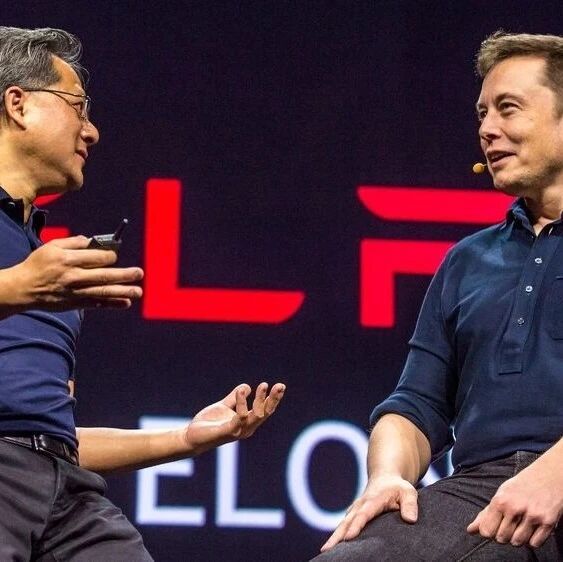
关起门来,黄仁勋也有绷不住的时刻。 财报炸裂,市场反馈却是股价反而跌了,这种情况近两年在英伟达身上频频上演。但这一次,我们听到了黄仁勋的一些心里话。 在被泄露的一次内部全员大会上,黄仁勋诉苦"市场并未充分认识到(英伟达)令人难以置信的季度表现。" 这并不是说英伟达被低估了,而是预期过高。他觉得,现在英伟达无论做什么,都难以取悦市场,陷入"无赢"的境地。 黄仁勋正在品尝当"时代的司机"的痛苦。PC时代的双司机英特尔与微软,移动时代的苹果,都曾有相似的痛苦。 一旦成为手握方向盘的企业,外界对其的判断也会与"乘客"不同——业绩表现之外,外界总是会操心可持续性,也会联想过去人类经验的总和,正如当下 人们回想起当年互联网泡沫破裂的往事。 "时代的司机"不仅活在当下,也同时活在未来和过去。 AI时代刚刚开启,方向盘还在抢夺中。微软、Meta、谷歌、OpenAI……既是这辆车上的VIP乘客,也都虎视眈眈地盯着驾驶室,谷歌的TPU进展就是最新 鲜的例子。 方向盘固然有些烫手,黄仁勋只能紧紧握住。 在内部会议上,黄仁勋提到一个网络梗图,几根绝望的杆子苦苦支撑一栋倾斜严重的大楼,大楼是"全球股市",杆子全是"英伟达"。 "如果我 ...

资讯早班车-2025-12-05-20251205
Bao Cheng Qi Huo· 2025-12-05 01:05
1. Industry Investment Rating - No industry investment rating information is provided in the report. 2. Core Viewpoints - Multiple foreign institutions have raised their GDP growth forecasts for China. Goldman Sachs has adjusted its 2025 forecast from 4.9% to 5.0%, and its 2026 and 2027 forecasts to 4.8% and 4.7% respectively. The OECD has raised its 2025 forecast for China to 5.0%, and Deutsche Bank has raised its Q4 2025 GDP growth forecast to 4.6% and the full - year forecast to 5.0% [2][17]. - The Chinese economy shows signs of recovery. The real estate market in first - tier cities has improved, with the number of second - hand housing transactions in November reaching a 7 - month high. The new housing market is expected to have a pulse - like recovery in December [18]. - The global commodity market is volatile. Copper prices have reached record highs, and the price of gold is expected to rise by 15% - 30% in 2026 [5][6]. 3. Summary by Directory 3.1 Macro Data Quick View - In Q3 2025, China's GDP grew by 4.8% year - on - year, down from 5.2% in the previous quarter but up from 4.6% in the same period last year. - In November 2025, the manufacturing PMI was 49.2%, slightly up from 49.0% in the previous month but down from 50.3% in the same period last year; the non - manufacturing PMI was 49.5%, down from 50.1% in the previous month and 50.0% in the same period last year [1]. 3.2 Commodity Investment Reference 3.2.1 Comprehensive - Experts expect that the CPI in November will rise by 0.9% year - on - year, up 0.7 percentage points from October [2]. - The reduction of some US tariffs is an admission that tariffs push up domestic prices. The business community hopes that China and the US will focus on more cooperation [3]. - Many major projects in China are accelerating, and policy support for "two major" projects is expected to increase [3]. 3.2.2 Metals - The price of lithium iron phosphate is expected to rise, with some leading companies planning to increase the processing fee by 3000 yuan/ton in 2026 [5]. - Copper prices have reached record highs, driven by the Fed's interest - rate cut expectations and regional shortages of global copper inventories [5]. - Gold prices are expected to rise by 15% - 30% in 2026, affected by geopolitical and economic uncertainties [6]. 3.2.3 Coal, Coke, Steel and Minerals - The waterway transportation of key materials such as coal in northern Jiangsu is ensured, with 669,000 tons of coal and key materials handled by November [8]. - JFE Steel plans to acquire a 50% stake in the steel business of Bhushan Power & Steel for 157.5 billion rupees [8]. 3.2.4 Energy and Chemicals - The annual output of the Daqing Gulong continental shale oil demonstration area has exceeded 1 million tons for the first time, and the proven reserves are 158 million tons, with a planned output of 3 million tons by the end of the 15th Five - Year Plan [9]. - Chevron's capital expenditure in 2026 will be between $18 - 19 billion, mainly for US production and investments related to its Guyanese oil shares [9]. - The EU will ban the import of Russian natural gas starting from the fall of 2027 [10]. 3.2.5 Agricultural Products - Australia's beef exports have reached a record high this year, with exports in the first 11 months reaching 14 million tons, a 15% increase year - on - year [13]. - Brazil's exports of corn, soybeans and other agricultural products in December are expected to increase compared with the same period last year [13][14]. 3.3 Financial News Compilation 3.3.1 Open Market - On December 4, the central bank conducted 180.8 billion yuan of 7 - day reverse repurchase operations, with a net withdrawal of 175.6 billion yuan on the same day [15]. - On December 5, the central bank will conduct 1 trillion yuan of 3 - month (91 - day) outright reverse repurchase operations to achieve equal - amount hedging [15]. 3.3.2 Key News - China and the US have carried out in - depth exchanges on trade and cooperation in various fields [16]. - The EU has terminated the WTO lawsuit against China's trade restrictions [17]. - The real estate market in first - tier cities has improved, and new housing sales in December are expected to have a pulse - like recovery [18]. 3.3.3 Bond Market Review - The Chinese bond market is weak, with the yields of interest - rate bonds generally rising, and the yields of 30 - year treasury bonds rising by more than 4bp [22]. - The prices of Vanke bonds have continued to adjust, with some bonds falling by more than 15% [22]. 3.3.4 Foreign Exchange Market Express - The on - shore RMB against the US dollar closed at 7.069 on December 4, down 29 basis points from the previous trading day [27]. - The US dollar index rose 0.20% in late New York trading, and most non - US currencies fell [28]. 3.3.5 Research Report Highlights - If the Bank of Japan raises interest rates in December, Japanese government bond yields may rise, which may affect exchange rates and equity asset pricing [29]. - In December, investors are advised to actively allocate convertible bonds in the price range of 128 - 136 yuan, and pay attention to low - price large - cap bonds and low - premium equity - like bonds [29]. 3.4 Stock Market Key News - The A - share market shows a divergence between large and small indexes. The Shanghai Composite Index fell 0.06%, while the Shenzhen Component Index and the ChiNext Index rose 0.4% and 1.01% respectively [32]. - The Hong Kong Hang Seng Index rose 0.68%, and the Hang Seng Technology Index rose 1.45% [32]. - The Shenzhen - Hong Kong Stock Connect has reached its 9th anniversary, with a cumulative transaction volume of 131 trillion yuan [32].
《西至哈至》亮相读书月,在AI时代寻找神话中的人性之光
Nan Fang Du Shi Bao· 2025-12-04 16:28
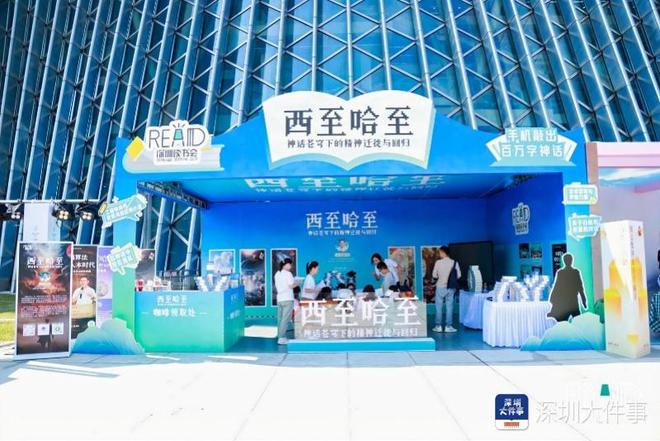
Core Insights - The ninth "Reading in Autumn" public reading event in Shenzhen features an immersive experience zone for the new book "From West to Ha", highlighting the theme "AI Era, Love Reading" [1][4] - The event is part of the 26th Shenzhen Reading Month, which has grown to over 3,000 themed activities, transforming Shenzhen from a "cultural desert" into a city with a unique reading culture [1][4] Event Highlights - The "Smart Navigation" experience area allows children to send "time letters" to the future using AI technology, showcasing how technology can convey emotions and expectations [4] - The themed exhibition for "From West to Ha" features a "mythical city wall" made of books, creating an immersive reading experience that blends coffee aroma with the scent of books [4][10] Book Content and Themes - "From West to Ha" draws from the folk songs of the Yugu ethnic group, narrating the adventures of twin children and exploring themes of waiting, searching, losing, and sacrificing [5][7] - The book presents a grand narrative that combines mythology, science fiction, and modern elements, with significant battles that reveal human struggles and choices in extreme conditions [7] Cultural Context - The theme "AI Era, Love Reading" reflects the importance of storytelling and human experience in an age dominated by AI, emphasizing the irreplaceable essence of humanity [8][10] - The event illustrates the harmonious coexistence of technology and culture in Shenzhen, aligning with the city's identity as a melting pot of cultures and a hub for innovation [10]
铜价创历史新高
Di Yi Cai Jing Zi Xun· 2025-12-04 14:06
Core Insights - Domestic and international copper prices have reached new highs, driven by expectations of Federal Reserve interest rate cuts and regional tightness in global copper inventories [2][4][6] - The anticipated demand for copper in the AI era is expected to require significant copper ore imports, leading to potential regional shortages [2][6] Price Movements - On December 3, LME copper futures peaked at $11,540 per ton, closing at $11,448.5, a 2.72% increase [4] - On December 4, domestic copper futures reached historical highs of 90,980 CNY per ton and 82,080 CNY per ton for international contracts, with increases of 2.26% and 2.96% respectively [4][5] Supply and Demand Dynamics - Analysts suggest that the copper price increase may continue, but any negative factors or unmet demand expectations could lead to significant price corrections [3][11] - The current imbalance in global copper inventory distribution is exacerbated by strong demand for copper in the U.S. and concerns over potential tariffs [5][12] Industry Impact - The impact of rising copper prices varies across the supply chain; overseas mines benefit the most, while smelting companies with high external ore procurement face greater challenges [8][9] - Copper processing companies are experiencing cost pressures due to rising procurement costs and low processing fees, which may lead to reduced operating rates [9][10] Future Outlook - The copper market is expected to remain volatile, with potential for high price fluctuations due to macroeconomic conditions and supply-demand fundamentals [11][12] - Key factors to monitor include the Federal Reserve's interest rate decisions, recovery of copper supply in response to high prices, and the realization of copper consumption growth driven by AI and energy storage [12]
黄仁勋和马斯克,谁才是“时代的司机”?
3 6 Ke· 2025-12-04 10:21
Core Insights - Huang Renxun expressed frustration that the market does not fully recognize Nvidia's impressive quarterly performance, indicating that high expectations make it difficult for the company to please investors [2][6] - Nvidia's stock price has dropped 9% in November and over 13% in the past month, despite reporting a 62% year-over-year revenue growth and a 65% increase in net profit, which exceeded Wall Street expectations [6][21] Group 1: Market Perception and Performance - Huang Renxun mentioned that Nvidia is in a "no-win" situation where any poor quarterly report could be seen as evidence of an AI bubble, while a strong report could be interpreted as fueling that bubble [6][15] - The company is compared to past tech giants like Intel and Microsoft, who also faced market skepticism despite strong performance, highlighting a historical pattern of investor concerns over sustainability and future growth [11][12] Group 2: Competitive Landscape - Nvidia is currently the dominant player in the AI chip market, akin to the "Wintel" alliance during the PC era, but faces increasing competition from companies like Google and Amazon, who are developing their own AI chips [21][26] - Google's recent advancements with its TPU chips and the launch of Gemini 3 have raised concerns for Nvidia, as these developments could attract Nvidia's customers and challenge its market position [23][24] Group 3: Industry Dynamics - The AI era is still in its early stages, having only begun in earnest with the emergence of ChatGPT, and the competition for leadership in this space is intensifying [22][28] - Huang Renxun's acknowledgment of the competitive pressures and the need for Nvidia to maintain its innovation pace reflects the broader challenges faced by industry leaders in adapting to rapid technological changes [28]

吴世春:新的独角兽企业创始人,都是张一鸣、王兴这样的小镇青年
创业家· 2025-12-04 10:15
Core Viewpoint - The article discusses the current state and future prospects of angel investing in China, emphasizing the importance of patience and long-term vision in the investment landscape, particularly in the context of emerging technologies like AI and hard tech. Group 1: Investment Landscape - The investment environment has become challenging, with difficulties in fundraising and high costs of customer acquisition, leading to longer exit cycles for investments [3][4]. - Previously, companies like Li Auto and NIO went public within a few years, but now the average time for an IPO in China has extended to around 12 years [4]. - Despite the challenges, angel investing can still be a profitable venture in China for those with sufficient patience [5]. Group 2: Investment Logic - The first investment logic is to focus on "unicorn tigers," which are companies that can dominate their market rather than just being another player [7][9]. - The second logic emphasizes investing in "small-town youth," who are seen as more dedicated and less likely to chase fleeting trends, thus fostering long-term growth [10][11][13]. - The third logic involves ensuring alignment of people, projects, timing, and valuation, as missing the right timing can lead to lost investment opportunities [14]. Group 3: Portfolio and Future Prospects - The company has invested in over 600 enterprises, with around 70 achieving profitability close to A-share listing standards, and expects about 20 companies to go public by 2026 [14][15]. - The focus on AI and new productive forces is seen as a key area for future investment, with a belief in a 20-year bull market for technology innovation in China [14].

德技优品雷少军受邀参加2025企业家博鳌论坛,共话AI时代品牌创新与产业跃升
Sou Hu Cai Jing· 2025-12-04 06:41
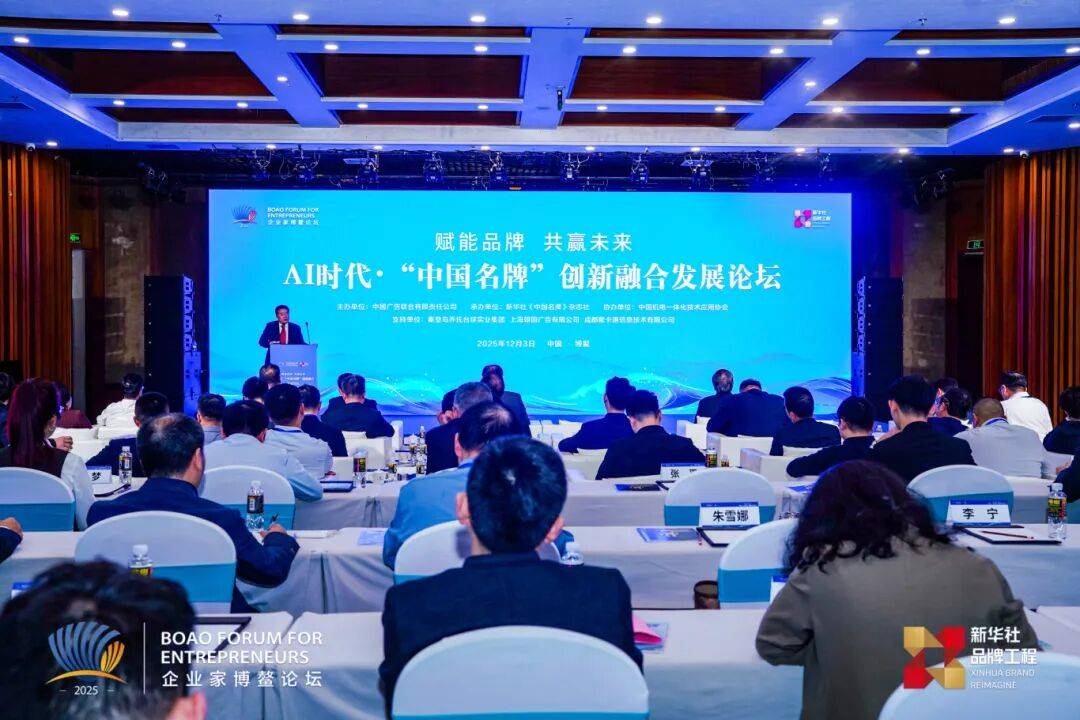
Group 1 - The core theme of the forum is "AI Era," focusing on how artificial intelligence can inject innovation into enterprises, emphasizing that industrial upgrades are not merely about equipment but about achieving efficiency and quality through technology [3][5] - Guangdong Deji Youpin Door and Window Co., Ltd. is committed to product iteration driven by research and development, utilizing intelligent upgrades to strengthen quality control [5][7] - The company has established a large-scale production base of 70,000 square meters and a smart industrial park of 180,000 square meters, showcasing its practical path towards digital transformation [5][7] Group 2 - The "14th Five-Year Plan" emphasizes "regional coordinated development," presenting new opportunities for the door and window industry, with three core opportunities identified: cost reduction and efficiency increase through industrial clustering, policy empowerment for green development, and collaborative technological innovation [8][10] - The company has outlined its response strategy to the new industry landscape, focusing on deepening market penetration in key domestic and international regions, leveraging industrial cluster advantages for supply chain optimization, and continuously iterating energy-efficient smart products [10] - The vision articulated by the chairman reflects the company's commitment to integrating AI and collaboration, aiming to enhance regional industrial clusters and contribute to the narrative of Chinese door and window brands [10]
航运费飙升467%! 地缘冲突与制裁正在颠覆全球大宗海运格局
智通财经网· 2025-12-04 02:46
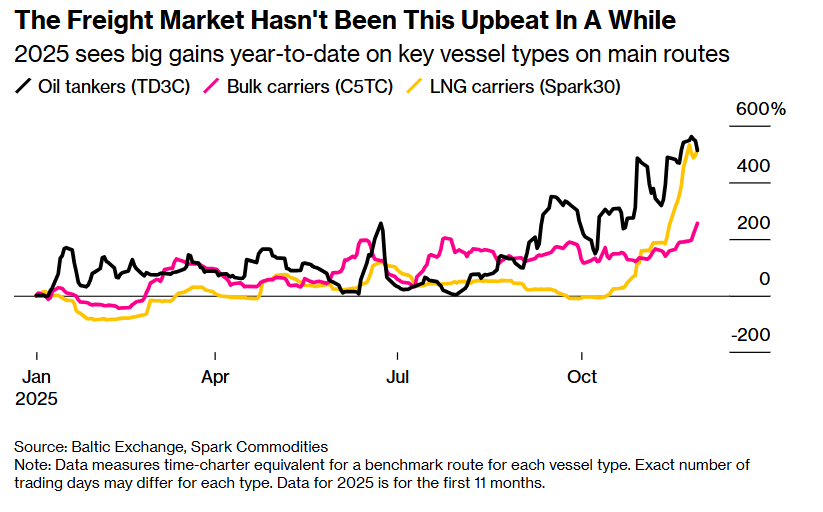
Core Viewpoint - The global shipping freight rates for commodities, including energy and bulk minerals, are experiencing an unprecedented year-end surge due to ongoing geopolitical conflicts, Western sanctions, and rising production levels, which are disrupting global shipping supply lines [1] Group 1: Freight Rate Increases - The daily earnings for transporting crude oil products on key global routes have surged by 467% from the beginning of the year to the end of November [1] - Freight rates for liquefied natural gas and iron ore have increased by over four times and two times, respectively [1][4] - The benchmark for shipping bulk commodities, including grain and minerals, reached a 20-month high by the end of November due to expectations surrounding a major iron ore project in Guinea and weather-related delays near China's coast [4] Group 2: Supply Chain Disruptions - Geopolitical tensions, such as attacks by Houthi forces on Red Sea commercial vessels, have forced some ships to reroute, increasing the "ton-miles" metric, which indicates longer transportation distances [5] - The effective shipping capacity has been artificially reduced due to slower turnaround times, with the same fleet now able to complete fewer trips per year [5] - The shipping industry is facing a static number of vessels, leading to a significant impact on freight rates due to reduced effective capacity [5] Group 3: Market Dynamics and Future Outlook - Despite a slight decline from the peak in late November, high transportation costs continue to have a positive ripple effect across the shipping market [6] - Major U.S. LNG buyers have considered delaying shipments, while some oil tanker operators are opting for longer routes to secure higher profits [6] - Shipping companies remain cautious about fleet renewal and strategic decisions due to high new ship prices and potential price declines following the reopening of the Red Sea [6] - Analysts suggest that the current year-end freight rate surge is driven by a combination of strong demand, reduced effective supply, and longer shipping routes, rather than seasonal trends or market speculation [7]