
货币政策

Search documents
古尔斯比力挺鲍威尔:破坏央行独立性将致通胀“卷土重来”!
美股研究社· 2026-01-16 12:34
Core Viewpoint - Concerns regarding attacks on the Federal Reserve's independence could negatively impact inflation, as stated by Chicago Fed President Goolsbee [2]. Group 1: Federal Reserve Independence - Goolsbee emphasized that any infringement on the independence of the central bank is problematic, warning that it could lead to a resurgence of inflation [2]. - He supported Powell's statement that inquiries into construction projects could be seen as political pressure from President Trump regarding interest rates [3][5]. Group 2: Powell's Tenure and Future - Powell's term as chair will end in May, but he can remain as a governor until 2028 [4]. - Goolsbee praised Powell as a "first-ballot Hall of Fame member" for managing to lower inflation without triggering a recession [6]. Group 3: Monetary Policy Outlook - Goolsbee indicated that the Fed should focus on reducing inflation, given the strong employment market, and suggested that there is room for interest rate cuts later this year if inflation trends back to 2% [6].


美最高法院再推迟裁决关税是否合法 美国经济将面临什么?
Sou Hu Cai Jing· 2026-01-16 12:06
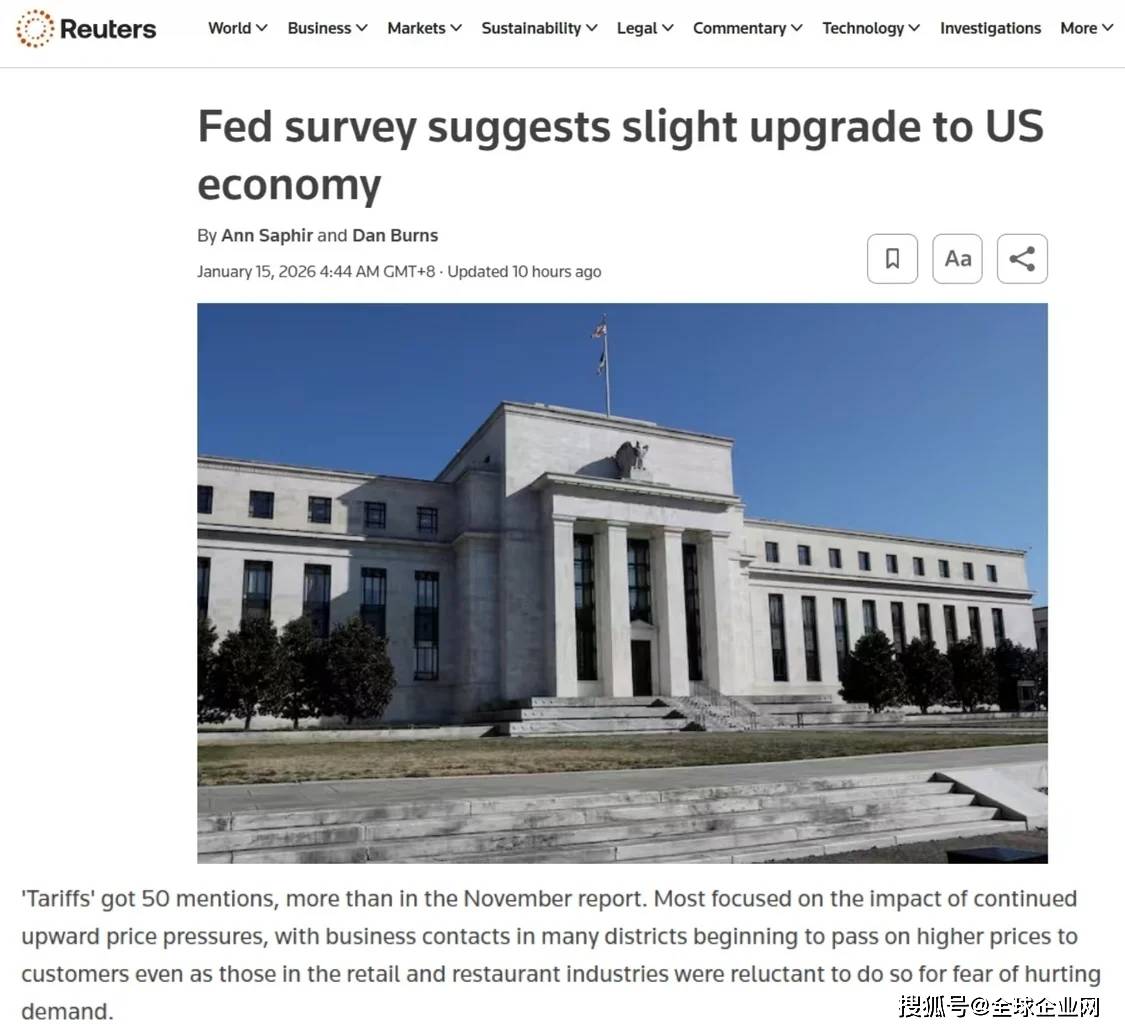
Group 1 - The Federal Reserve's Beige Book indicates that economic activity has improved across most districts, but cost pressures from tariffs persist [1] - Companies are beginning to pass on tariff costs to consumers due to depleted inventories and increased pressure to maintain profit margins [1] - Concerns are rising about inflationary pressures if companies continue to transfer costs to consumers, which could impact overall economic conditions in the U.S. [4] Group 2 - The uncertainty surrounding tariffs is causing companies to be cautious in long-term production planning, potentially disrupting manufacturing investment [4] - The Federal Reserve may face a dilemma in its monetary policy, as rising inflation from tariffs could prevent it from lowering interest rates to stimulate economic growth [4] - The U.S. Supreme Court has not yet ruled on the legality of the Trump administration's tariff policies, which has led to ongoing legal challenges [7] Group 3 - The legal basis for the tariffs is under scrutiny, particularly whether the invocation of the International Emergency Economic Powers Act violates U.S. tariff laws [7] - If the Supreme Court rules against the tariffs, the government could face significant financial repercussions, including potential refunds amounting to hundreds of billions [8] - A balanced or compromise solution may be sought by judges to avoid exacerbating economic and fiscal impacts while addressing potential executive overreach [9] Group 4 - The U.S. government has announced new tariffs on certain imported semiconductors and related products, indicating that tariffs will remain a core tool in domestic and foreign policy [9] - A ruling that supports the government's tariff measures could strengthen its global tariff strategy, potentially undermining the multilateral trading system established post-World War II [10] - Consideration may be given to establishing broader tariff exemptions for essential goods to mitigate domestic inflation and public discontent [10]
日本两个反对党联合组建新党 以在可能的大选中挑战首相高市早苗
Xin Lang Cai Jing· 2026-01-16 11:53
Core Viewpoint - The largest opposition party in Japan has merged with a former ruling coalition partner to form a new party, the "Centrist Reform Alliance," aimed at obstructing Prime Minister Kishi's efforts to consolidate power through early elections [1][2]. Group 1 - The new party was officially registered on Friday morning, with joint leaders Yoshihiko Noda from the Constitutional Democratic Party and Tetsuo Saito from the Komeito Party [1]. - The new party aims to improve the lives of ordinary citizens and plans to seek a reduction in consumption tax while maintaining fiscal discipline and avoiding the issuance of additional deficit bonds [2]. - Noda highlighted the negative impact of a weak yen on the public, stating it exacerbates inflation and emphasized the need for the government to avoid giving the impression that interest rates should not normalize [2].
大摩2026全球展望:美国强经济推迟降息,日央行全年按兵不动,中国出口持续扩大……
Sou Hu Cai Jing· 2026-01-16 11:28
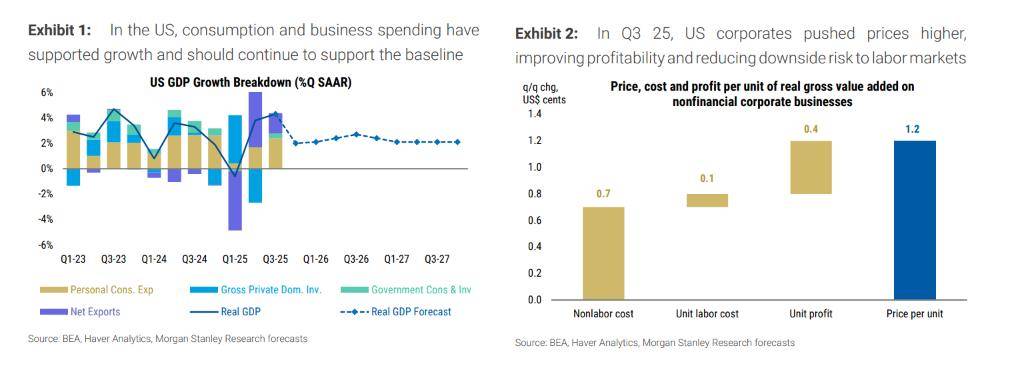
Group 1: Global Economic Outlook - Morgan Stanley indicates that the global economy is at a highly differentiated crossroads, with market expectations for liquidity easing potentially misaligned with reality [1] - The expectation for the Federal Reserve to cut rates early in the year has largely evaporated due to strong U.S. consumer data, pushing the first rate cut expectation to mid-year [1][5] - The first half of 2024 is expected to operate under a "high interest rate, strong dollar" monetary environment, leading to increased asset price volatility [1] Group 2: U.S. Economic Conditions - The U.S. economy shows a confusing yet resilient divergence, with consumer spending growing at a strong annualized rate of 3.5% despite signs of labor market weakness [2][5] - Inflation, particularly driven by tariff costs, is becoming a more pressing threat than recession, with a significant portion of tariff cost pass-through to consumers still pending [5] Group 3: Eurozone and UK Economic Challenges - The Eurozone is experiencing stagnation, with the composite PMI dropping from 52.8 to 51.9, indicating a loss of growth momentum [6] - Core inflation in the Eurozone has decreased to 2.3%, supporting the case for potential rate cuts by the European Central Bank in June and September [8] - The UK economy remains weak, with labor demand softening and inflation expected to return to target levels by April 2026, increasing the likelihood of a rate cut in February [8] Group 4: Japan's Monetary Policy Outlook - Morgan Stanley predicts that the Bank of Japan will maintain its interest rates throughout 2026, contrary to market expectations for rate hikes, due to anticipated declines in core CPI [9][12] - Political uncertainty in Japan, including potential early elections, adds to the challenges for monetary policy tightening [12] Group 5: China's Economic Strategy - China is expected to increase its share of the global export market from 15% to 16.5% by 2030, reflecting a strong export outlook [13] - The recent PMI data indicates the effectiveness of prior fiscal expansion, with continued fiscal support expected in 2026 [14] Group 6: Emerging Markets Dynamics - India is projected to be a growth engine in emerging markets, with a growth forecast of 7.4% for the fiscal year 2026, driven by policy easing and strong demand [17] - Latin America is poised for a policy shift towards more market-friendly approaches, with Brazil expected to cut rates significantly while facing moderate economic slowdown [17]

股指、黄金周度报告-20260116
Xin Ji Yuan Qi Huo· 2026-01-16 11:23
Report Industry Investment Rating - Not provided Core Viewpoints of the Report - In the short term, the policy side releases positive signals again, but corporate earnings have not significantly improved, so the stock index may need adjustment after continuous rise; the gold market is in high - level oscillation due to the game around the Fed's monetary policy independence and the Iran situation, waiting for a direction [31][32] - In the medium to long term, the valuation of the stock index will be dragged down by the decline in corporate earnings growth at the molecular end, and the support at the denominator end mainly comes from the recovery of risk appetite, so the stock index will maintain a wide - range oscillation; the US tax - cut policy will gradually stimulate the economy, the Fed's room for further interest rate cuts will narrow, and gold may face a deep adjustment [32] Summary by Relevant Catalog Macroeconomic Data - In December 2025, China's CPI rose 0.8% year - on - year (previous value 0.7%), PPI fell 1.9% year - on - year with the decline narrowing by 0.3 percentage points. Imports increased 5.7% and exports increased 6.6% year - on - year, with the growth rates accelerating by 3.8 and 0.7 percentage points respectively. Industrial deflation pressure has been relieved [6] - In the US, in December 2025, the number of new non - farm payrolls was 50,000, the unemployment rate dropped from 4.6% to 4.4%, and CPI rose 2.7% year - on - year with the same increase as last month, indicating a slow recovery in the labor market but still high inflation [19] Stock Index Fundamental Data - In late December 2025, China's broad money supply M2 increased 8.5% year - on - year (previous value 8%), M1 increased 3.8% year - on - year (previous value 4.9%) with the growth rate slowing for three consecutive months, and the gap between M1 and M2 widened [14] - The margin trading balance in the Shanghai and Shenzhen stock markets rose to 267.3143 billion yuan, a record high. The central bank conducted 951.5 billion yuan of 7 - day reverse repurchase operations and 900 billion yuan of outright reverse repurchase operations this week, achieving a net injection of 1712.8 billion yuan [16] Gold Fundamental Data - The growth of Shanghai gold futures warehouse receipts and inventory has slowed down, and the COMEX gold inventory in New York has decreased slightly, indicating a relief of delivery pressure [29] Strategy Recommendation - The effects of the "anti - involution" and elimination of backward production capacity policies are gradually emerging. Commodity prices have risen, industrial deflation pressure has been relieved, and the profit of the upstream raw material processing industry is expected to improve [31] - Although corporate earnings have not significantly improved, the central bank's measures may boost risk appetite. After the continuous rise of the stock index, attention should be paid to the callback risk [31] - The US labor market is slowly recovering, but inflation risk remains. The Fed officials think there is no need for further interest rate cuts in the short term. The gold market is in high - level oscillation and may face a directional choice [31] Next Week's Focus - Important data such as China's December fixed - asset investment, industrial added value, and consumer retail [33]
甲醇日报:静待库存拐点-20260116
Guan Tong Qi Huo· 2026-01-16 11:15
Report Summary 1. Industry Investment Rating - Not provided in the report 2. Core Viewpoints - The methanol port inventory decreased significantly this week, and there is a high possibility of an inventory inflection point in the first quarter. It is advisable to pay attention to buying opportunities after the price decline. Currently, methanol is in a low - valuation state, and although the overall rebound space is limited by weak downstream demand, it is prone to a low - level rebound. Also, close attention should be paid to the geopolitical situation in Iran [1][3] 3. Summary by Directory Fundamental Analysis - As of January 14, 2026, the total inventory of Chinese methanol ports was 1.4403 million tons, a decrease of 96,900 tons from the previous period. The inventory in the East China region decreased by 84,400 tons, and that in the South China region decreased by 12,500 tons. The significant reduction in methanol port inventory this week is mainly due to the small total unloading volume. The visible unloading of foreign vessels within the cycle was 96,100 tons, and the non - visible unloading was 125,000 tons. The提货 situation in the mainstream storage areas along the Yangtze River in Jiangsu was okay, while the提货 performance in other social warehouses in Jiangsu and Zhejiang was average. Although there were new terminal shutdowns in Zhejiang, the inventory decreased significantly due to the low unloading volume. The inventory in South China ports continued to decline. In the Guangdong region, there were small - scale imports and domestic arrivals during the week, the提货 volume in the mainstream storage areas was stable, and the inventory decreased. In the Fujian region, the supply was supplemented by imports and domestic trade, and the inventory fluctuated little under the on - demand consumption of downstream enterprises [1] Macroeconomic Analysis - The People's Bank of China will take promoting stable economic growth and reasonable price recovery as important considerations for monetary policy, and flexibly and efficiently use various monetary policy tools including reserve requirement ratio cuts and interest rate cuts to maintain sufficient liquidity. Starting from January 19, 2026, the central bank will lower the rediscount rate and the interest rate of relending by 0.25 percentage points [2] Futures and Spot Market Analysis - The futures price has slightly declined, and attention should be paid to the support of the 60 - day moving average at the daily - line level. January is expected to be a period of slowdown in imports, and there is a high possibility of an inventory inflection point in the first quarter. Buying opportunities after the price decline can be appropriately considered. Currently, methanol is in a low - valuation state. The overall rebound space is restricted by weak downstream demand, but low - level rebound is likely. Recently, special attention should be paid to the geopolitical situation in Iran [3]
芳烃日报:苯乙烯超预期去库、纯苯历史级别高库存-20260116
Guan Tong Qi Huo· 2026-01-16 11:14
【基本面分析】 1、1 月 2 日至 8 日,中国苯乙烯工厂整体产量在 35.57 万吨,环比+0.99%; 工厂产能利用率 70.92%,环比+0.69%。 【冠通期货研究报告】 芳烃日报:苯乙烯超预期去库、纯苯历史级别高库存 发布日期:2026 年 1 月 16 日 2、1 月 2 日至 8 日,苯乙烯下游 EPS、PS、ABS 消耗量环比+0.31%至 25.97 万吨。 3、截至 1 月 8 日,苯乙烯工厂库存在 16.23 万吨,环比上周-5.48%;截至 1 月 12 日,苯乙烯华东港口库存在 10.06 万吨,环比上周-23.96%。 4、截至 1 月 12 日,苯乙烯非一体化利润在 250.79 元/吨,一体化利润在 660.46 元/吨。 苯乙烯根据行业往期规律来看,1-3 月属于需求淡季,季节性累库的可能性 较大。由于今年春节较晚,季节性降负的时间点晚。 【宏观面分析】 人民银行新闻发言人、副行长邹澜表示,根据国内外经济金融形势和金融市 场运行情况,把促进经济稳定增长、物价合理回升作为货币政策的重要考量,灵 活高效运用包括降准降息在内的多种货币政策工具,保持流动性充裕。 中国人民银行决定: ...
2025金融数据收官:总量保持合理增长,货币政策发力传递积极信号
Hua Xia Shi Bao· 2026-01-16 10:39
Core Viewpoint - The People's Bank of China (PBOC) reported significant support from monetary policy for the real economy in 2025, with a focus on stabilizing investment and promoting economic growth [2]. Financial Data Summary - In December 2025, new RMB loans increased by 910 billion yuan, a year-on-year decrease of 80 billion yuan, while the total social financing scale was 22,075 billion yuan, down by 646.2 billion yuan year-on-year [2][3]. - As of the end of December, broad money (M2) grew by 8.5% year-on-year, accelerating by 0.5 percentage points from the previous month, while narrow money (M1) grew by 3.8%, a decrease of 1.1 percentage points from the previous month [2][6]. - For the entire year of 2025, new RMB loans totaled 16.27 trillion yuan, a decrease of 1.82 trillion yuan compared to the previous year [5]. Loan Structure Analysis - The loan structure showed a strong performance from enterprises, with corporate loans increasing by 580 billion yuan in December, while household loans decreased by 441.6 billion yuan [3][4]. - The overall weak credit performance in December was attributed to insufficient demand for loans, particularly from households, while corporate loan demand was supported by policy measures and year-end inventory needs [4]. Monetary Policy Outlook - The PBOC introduced a series of structural monetary policy tools, including a 25 basis point reduction in the interest rates of these tools and an increase in the quota for targeted loans [7][8]. - Analysts expect stable growth in social financing and credit in 2026, with social financing growth projected at around 8% and credit growth at over 6% [2][7]. - The focus of monetary policy will be on promoting economic growth and reasonable price recovery, with expectations of further reserve requirement ratio cuts and interest rate reductions in 2026 [8].

担心政策难以预测 美资管巨头着手卖出美元资产
Sou Hu Cai Jing· 2026-01-16 10:10
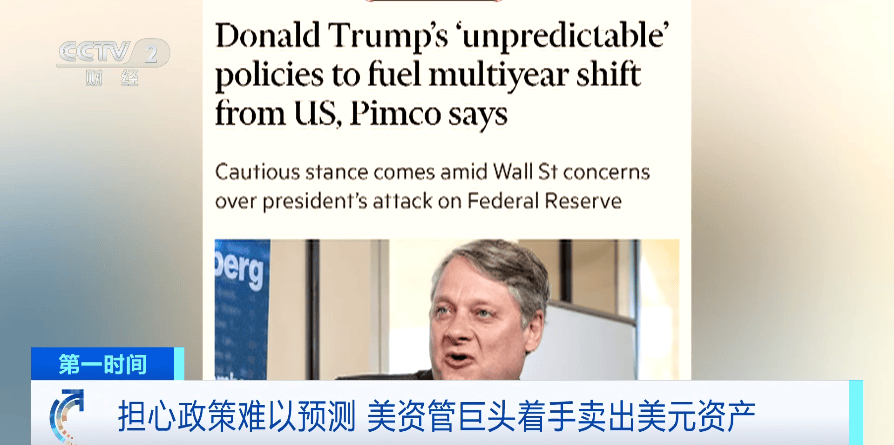
Group 1 - The Federal Reserve Chairman Jerome Powell is under criminal investigation by U.S. federal prosecutors, raising concerns on Wall Street and prompting investment firms to sell dollar assets to mitigate risks [1][9] - Investment management firm PIMCO, which manages $2.2 trillion in assets, is diversifying its investment portfolio by reducing dollar assets in response to unpredictable policies from President Trump, which have increased market volatility [3] - Jamie Dimon, CEO of JPMorgan Chase, echoed similar sentiments, stating that any actions undermining the independence of the Federal Reserve would not be advisable and could lead to higher inflation expectations [5] Group 2 - Powell's term is set to end in May 2026, and President Trump may nominate Powell's successor in the coming days or weeks. Some Wall Street executives view the subpoena issued to Powell as a warning to his potential successor, indicating that Trump may seek certain assurances from the next Federal Reserve Chairman [7] - Powell released a video statement claiming that the federal government's criminal investigation is an attempt to exert greater influence over the Federal Reserve and its monetary policy [9]
宏观动态跟踪报告:货币政策的新举措与新信号
Ping An Securities· 2026-01-16 09:51
Monetary Policy Measures - The central bank has introduced new monetary policy measures, including a 0.25 percentage point reduction in various structural monetary policy tool rates, expected to save banks approximately 13.5 billion yuan annually[5] - The re-lending and rediscounting for agricultural and small enterprises have been merged, increasing the quota by 500 billion yuan, with a dedicated 1 trillion yuan for private enterprises[7] - The minimum down payment ratio for commercial property loans has been lowered to 30% to support the real estate market[8] Exchange Rate Management - The central bank aims to stabilize the foreign exchange market in 2026, with a projected net inflow of 302.1 billion USD for the year, indicating a shift from net outflow[9] - Approximately 60% of import and export trade is minimally affected by exchange rate fluctuations, with 30% of foreign trade conducted in RMB[10] - The central bank emphasizes the importance of balanced import and export development and plans to enhance macro-prudential management to mitigate exchange rate risks[11] Financial Data Trends - As of December 2025, the total social financing stock grew by 8.3% year-on-year, while loan stock increased by 6.4%[15] - The growth rate of M2 rose to 8.5%, reflecting a 0.5 percentage point increase from the previous month[15] - Direct financing reached 16.7 trillion yuan in December 2025, accounting for 46.9% of total social financing, an increase of 7.8 percentage points compared to 2020[16]